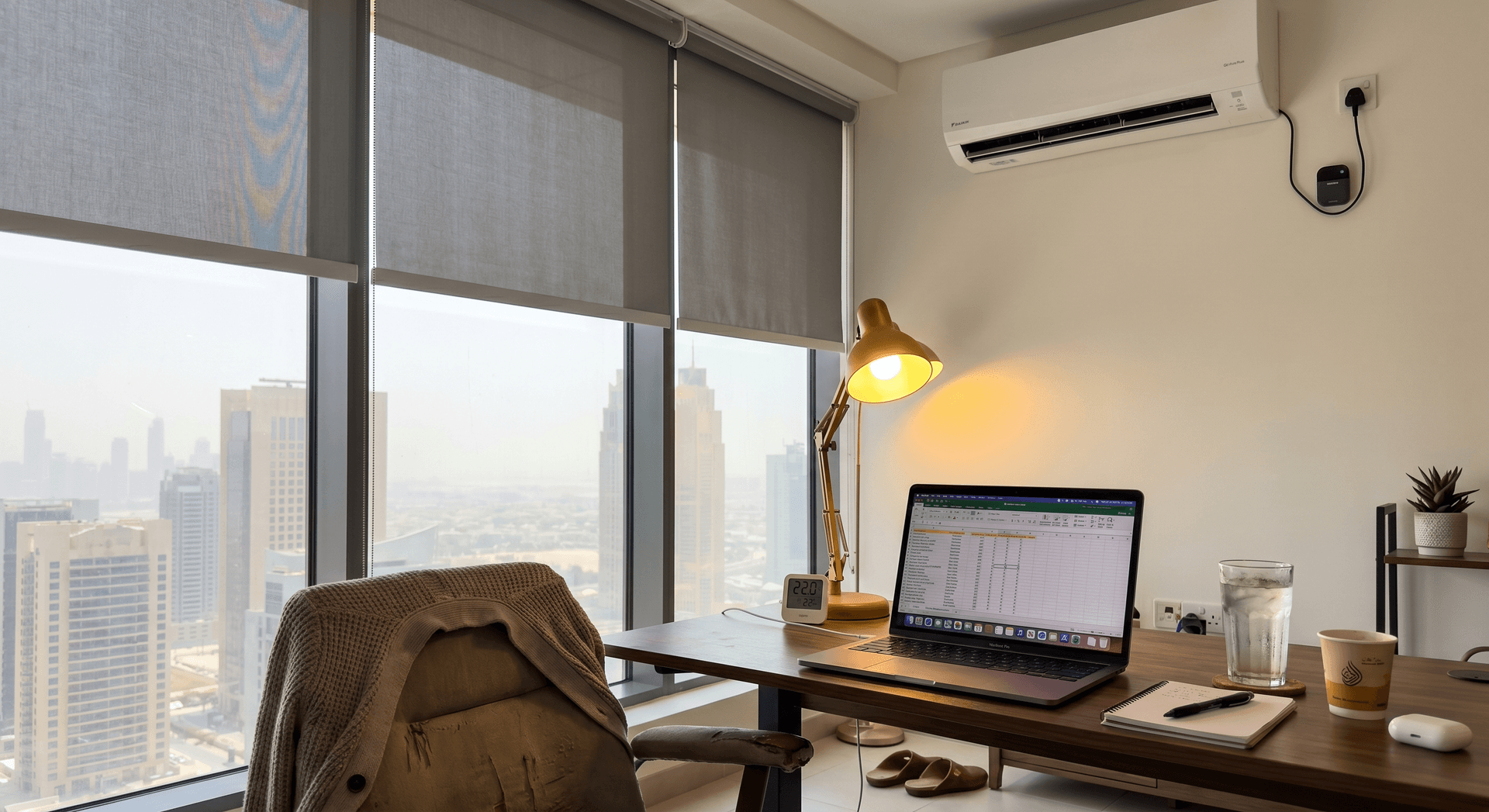
You had a call at 9am, another at 11, and a deadline at 2. The outdoor work ban kicked in at 12:30, so the construction sounds from the road stopped. What didn't stop was your AC, which has been running since 7:30 and still hasn't convinced the west-facing study that 22°C is achievable in a Dubai afternoon in June.
Summer solstice was this week. June 21 marks the longest day of the year, and NCM recorded 49.4°C inland two days ago (Khaleej Times, 2026). If you work from home in a Dubai apartment, the next 90 days are the real test of whether your home was designed for you or against you.
TL;DR: A Dubai WFH setup runs 8 to 10 hours of sustained cooling daily across rooms that need different temperatures at different times. Smart AC control, room-by-room temperature sensors, and motorized blinds reduce cooling waste by 15 to 23% while keeping your desk at the 22°C that research identifies as the cognitive performance ceiling. The kit costs AED 1,800 to 3,500 depending on your apartment. The DEWA bill for a badly managed 2-bedroom in summer runs AED 900 to 1,100 per month. A well-managed one runs AED 600 to 750.
The Summer WFH Problem No One Talks About Honestly
The honest version of WFH in Dubai summer is this: you are cooling a 2-bedroom apartment for 10 hours straight to keep one room at a temperature that lets you think clearly. The bedroom, the living room, the kitchen, and the hallway all run cold because there is no way to tell your split AC unit to ignore the empty rooms.
Air conditioning accounts for 60 to 70% of total electricity consumption in a Dubai home during June through September (Oliva, 2025). In a 2-bedroom apartment, a summer month bill runs AED 900 to 1,100 on the DEWA slab tariff, up from AED 400 to 500 in December (Oliva, 2025). The jump is almost entirely cooling. And most of that cooling is spent on rooms you're not in.
Smart AC control does not solve this by being smarter than you. It solves it by being aware of the rooms, the clock, and the temperature in a way that a wall-mounted AC remote with a cracked screen cannot.
Why Temperature Matters More for WFH Than Office Work
In an office, the building management system holds the floors at 22 to 23°C. You notice it or you don't. At home, you set the thermostat, forget about it, and check your email.
Research from a 2024 ScienceDirect meta-analysis on indoor thermal environments found that cognitive performance begins degrading meaningfully above 25°C, with lower accuracy and increased response time after more than one hour of sustained exposure (ScienceDirect, 2024). Multiple workplace studies identify 21 to 22°C as the range for sustained concentration work.
In a Dubai apartment in July, where a west-facing room can absorb significant solar gain through glass, reaching and holding 22°C in your study takes deliberate effort. The AC unit can do it. The question is whether it is told to do it only in your study, only when you are there, and at the right time rather than after the room has already climbed to 28°C. If you want the full breakdown of how smart AC controllers work versus smart thermostats, we covered that in detail in the honest UAE guide to smart AC control.
The outdoor work ban (June 15 to September 15, 12:30pm to 3:00pm) formalises what WFH professionals already know: the midday stretch is when the apartment takes the worst solar load (Gulf News, 2026). That window is also the peak of your workday.
What a Well-Configured Smart Apartment Does Across a WFH Day
Walk through what a 2-bedroom Business Bay apartment does on a summer WFH day when it has been properly configured, versus what an unconfigured apartment does.
7:00am: Pre-cooling Before You Start
A smart setup pre-cools the study to 22°C between 7:00 and 8:30am, while the bedroom stays at 24°C (sleeping temperature). The living room remains off. By the time you sit down with coffee at 8:30, the room is already at working temperature and the AC unit is not fighting a room that has been baking since 6am.
An unconfigured apartment either runs the AC all night (expensive) or asks you to remember to turn it on at 7am (you won't, reliably).
9:00am to 12:30pm: Room-Level Awareness
With a temperature sensor in the study (Aqara's TVOC and temperature sensor costs AED 99 to 120 from Amazon.ae), the system knows when the study has drifted from 22°C and adjusts before you notice. The bedroom AC stays off because nothing is in the bedroom.
Without sensors, the AC runs on the ambient reading from the unit's built-in sensor, which is typically near the ceiling and reads 1 to 2°C colder than where you are sitting.
In our experience setting up these configurations for WFH clients in Business Bay and JVC apartments, the difference between a smart AC reading from a desk-level sensor versus a ceiling-mounted unit sensor is often 1.5°C of systematic under-cooling at the desk. You compensate by lowering the setpoint, which uses more energy.
12:30pm to 3:00pm: The Peak Load Window
This is the most expensive two and a half hours of a Dubai summer day. The sun is directly overhead, the west-facing glass is taking maximum load, and the construction sites have gone quiet (midday ban in force) while your home carries the full cooling burden.
A motorized blind set to 70% closure on a west-facing window at 1:00pm cuts incoming solar radiation by 60 to 70% (Stråla, 2024). That is the difference between your AC fighting 1,000W per 2 square metres of west glass at full load versus fighting 300W. On a 10 square metre west-facing elevation, that is 7,000W removed from the equation by closing a blind.
Without the blind: the AC runs continuously and still loses the temperature argument between 1pm and 3pm.
With the blind: the room holds temperature and the AC cycles instead of running flat.
3:00pm to 5:30pm: Afternoon Transition
This is when the study shifts from work mode to wrap-up mode. A smart setup eases the setpoint from 22°C to 23°C at 4pm (you're on lighter tasks by then), starts warming the bedroom slightly (you'll want it ready by evening), and dims the desk lamp to match the lower sun angle coming through the gap the blind allows.
After 6pm: Handing Back to the Evening
When work ends, the study AC comes up to 24°C and the living room takes over at 22°C for the evening. If you're going out, the study turns off automatically via a motion sensor or a geofence. The bedroom starts its pre-cool for sleeping. The lighting side of this handoff, the focus-and-calls light through the day and the one tap that ends it, is its own setup, and we cover it in the work-from-home scene.
This is not luxury automation. It is the difference between a 10-hour cooling cycle that serves one purpose all day and one that tracks what you need, room by room, hour by hour.
The DEWA Math for a WFH Summer in Dubai
A 2-bedroom apartment on DEWA's 2026 slab tariff pays 23 fils per kWh for the first 2,000 kWh, 28 fils per kWh from 2,001 to 4,000 kWh, and 32 fils from 4,001 to 6,000 kWh, plus fuel surcharges and VAT (DEWA, 2026). A WFH apartment in summer that runs AC in multiple rooms simultaneously climbs into the 28 to 32 fils band faster than one with zone control.
The DEWA recommendation is to set your AC no lower than 24°C (Khaleej Times, 2025). Each degree below that adds approximately 5% to your cooling bill. A study configured to 22°C and applied uniformly to all rooms is wasteful - uncomfortable for the rooms you are not in and expensive on the DEWA bill.
Zone control, which means per-room AC management using smart IR controllers, lets you run the study at 22°C and turn everything else off or warm. Smart thermostats and scheduling reduce cooling costs by 10 to 23% compared to manual or constant-on operation (Consumer Reports / Nest data, 2024).
For a WFH 2-bedroom apartment spending AED 1,000 per month in peak summer, a 15% reduction is AED 150 per month. Over June through September, that is AED 600 in savings, enough to pay for the smart AC controller kit in a single summer.
We want to be specific about where savings come from: it is not magic. It is the hours between 7pm and 7am when a configured system runs warmer than you'd manually set it, the two empty bedrooms that stay off during the workday, and the 1-degree setpoint discipline that accumulates over 90 days.
What the Kit Looks Like for a WFH 2-Bedroom
There is no single solution for every apartment. Here is what we specify for a 2-bedroom WFH setup in Dubai, by tier.
Renter Setup (AED 1,800 to 2,400)
For renters who cannot touch the wiring or mount hardware permanently:
- 2x smart IR AC controllers (Sensibo Sky or Sensibo Air at AED 299 to 499 each from Amazon.ae or Microless): one for the study unit, one for the bedroom unit
- 2x Aqara temperature and humidity sensors (AED 99 to 120 each): placed at desk level and bedside
- 1x smart plug for the desk lamp (AED 55 to 80): lets the lighting schedule slot into the same app
- Setup time: 45 minutes to 2 hours. Everything is wireless and battery-powered. Takes it when you move.
Total estimate: AED 800 to 1,220 for hardware. Setup is a weekend morning.
Standard Apartment (AED 2,400 to 3,500)
For owned apartments or landlord-approved setups:
- 2x smart AC controllers as above
- 1x motorized roller blind for the west or south-facing study window (Aqara or SwitchBot motor, AED 350 to 650 for the motor, plus your existing blind track or a new bracket kit)
- 3x temperature sensors (one per AC zone + one common area)
- Automation hub to coordinate blinds, sensors, and AC into a single daily schedule (Apple HomeKit, Google Home, or Home Assistant via a Raspberry Pi 5 AED 550 if you want local-only, cloud-free control)
Total estimate: AED 1,500 to 2,800 for hardware. A Bayora setup visit for this tier is typically 2 to 3 hours.
Full Zone Control (AED 3,500 to 5,500)
For 3-bedroom or villa setups, or apartments where the WFH room is on a different floor from the bedroom:
- 3 to 4 smart AC controllers covering all rooms
- Motorized blinds on the primary WFH room and the main living-area west-facing windows
- Full sensor array (temperature, humidity, motion in each room)
- Automation hub with scheduling, geofencing, and scene triggers
At this tier, the Bayora installation includes configuration, testing, and a walkthrough for every person who uses the apartment. The hub is open-platform (you are not locked into any manufacturer's cloud if it shuts down or changes subscription pricing).
What Bayora Will Talk You Out Of
Some things get sold hard for WFH setups that do not deliver what they promise.
A new, larger AC unit. If your current split unit can cool the room to 22°C but takes 40 minutes to get there, the problem is how it is managed, not how powerful it is. Replacing a 1.5-ton unit with a 2-ton unit in a study that never changes its usage pattern will not solve the pre-cooling problem. The controller and the scheduling will.
A whole-home automation system in month one. Crestron and Control4 are the right answer for villas and large properties that are fully owned, long-term, and have a household manager. For a WFH 2-bedroom rented apartment, start with the study AC controller and one sensor. You will learn your specific problem before you spend AED 25,000 guessing at it.
A dedicated home office split AC. Some installers will quote a new indoor unit for the study. If you already have a unit that covers the room, a smart controller on the existing unit is the same outcome for 90% less cost. The exception: if your study is served only by ducted central AC with no per-room control, you may genuinely benefit from a new split. We will tell you which applies to your apartment before we recommend anything.
Smart bulbs instead of smart switches. Smart bulbs are useful in lamps and fixtures with no alternative. For a study where you flip a wall switch multiple times a day, a smart switch or smart dimmer module is the better long-term choice. Smart bulbs fail when someone flips the wall switch off, cutting power to the smart circuit entirely.
Dubai Summer Surprises and the Practical Window to Buy
Dubai Summer Surprises 2026 runs from July 3 to August 30 (BrandStory.ae, 2026). Electronics and homeware are named categories in the promotions, with discounts confirmed across 1,500+ stores and participating online platforms.
This is not the primary reason to buy smart home equipment. It is a practical reason to buy it in early July rather than late August. Most of the smart AC controllers, sensors, and motorized blind motors used in Dubai setups are available via Amazon.ae, Microless, or Noon at standard pricing. The DSS promotions are worth checking, but they do not change whether the equipment solves your problem.
If your summer WFH bill is already AED 900 to 1,100 per month and July is arriving, a July 3 purchase date means three full months of savings before October brings relief. An August purchase means one.
The Apartment That Knows You Work Here
The point of all this is not that your apartment becomes complicated. It is that your apartment stops requiring your attention between 8am and 6pm when you are working.
One of the things we hear most often from WFH clients after a setup is that they stopped thinking about the temperature. The study was 22°C when they sat down and stayed there. The bill in September was lower than August even though the days were equally hot. They did not do anything differently. The apartment did.
That is the gap between a home that runs on remotes and a home that runs on a schedule that someone configured once.
Summer solstice this week means the worst heat of the year is either here or arriving in the next two to three weeks. A properly configured WFH setup takes one afternoon to install and one weekend morning to configure. It runs until October without adjustment.
A free consultation with Bayora covers your specific apartment layout, what you already have, and what we would recommend. No obligation and no surprise costs. We give you a quoted price before any work starts.
Frequently Asked Questions
Does smart AC control work with the district cooling in my apartment?
It depends on the setup. If your district-cooled apartment has fan coil units (FCUs) with standard remote control, smart IR controllers work with them the same way they work with split units. If your cooling is centrally controlled without a local remote on each unit, you need a different solution (typically a smart thermostat wired into the FCU). We confirm this during the survey before recommending anything.
How much does a smart AC controller cost in Dubai?
Smart AC controllers (IR blasters that replace your wall remote) run AED 299 to 499 each from Amazon.ae or Microless. The most-used options in Dubai apartments are the Sensibo Sky, Sensibo Air PRO, and Aqara IR Controller. Each pairs with a free app and works with Alexa, Google, and Apple HomeKit.
Will a smart home setup help me during a power cut?
Smart controllers and hubs require power to operate. During a DEWA outage, the AC units themselves stop working, so smart control has nothing to control. Some hub setups (Home Assistant on a UPS) can maintain automation for small loads (sensors, some lights) during short outages, but cooling is not one of them. The practical value during outages is the push notification that tells you power was restored so you can check the apartment remotely.
Can I set up smart AC in a rented apartment?
Yes. The most common WFH renter setup uses wireless IR controllers that clip or stick to the wall near the existing AC unit, paired with wireless temperature sensors. Nothing is hardwired, nothing requires drilling, and everything comes off cleanly when you leave. Most landlords in Dubai have no grounds to object because the setup is less invasive than a picture nail.
Does the automation still run if my internet drops?
Some platforms require internet for every command (Sensibo's cloud, for example). Others run locally and only use internet for remote access from outside the apartment. Home Assistant running locally means your WFH schedules continue even if your router drops, because the hub sends commands directly to the devices without going through a server. If internet reliability is a concern, we configure accordingly.
Ready to set up your apartment for the next 90 days of summer? Get a free consultation and we'll walk you through exactly what your apartment needs. No jargon, no upsell, no surprises on the invoice.
Ready to Get Started?
Get a free consultation and we'll recommend what makes sense for your situation.
Get Free Consultation