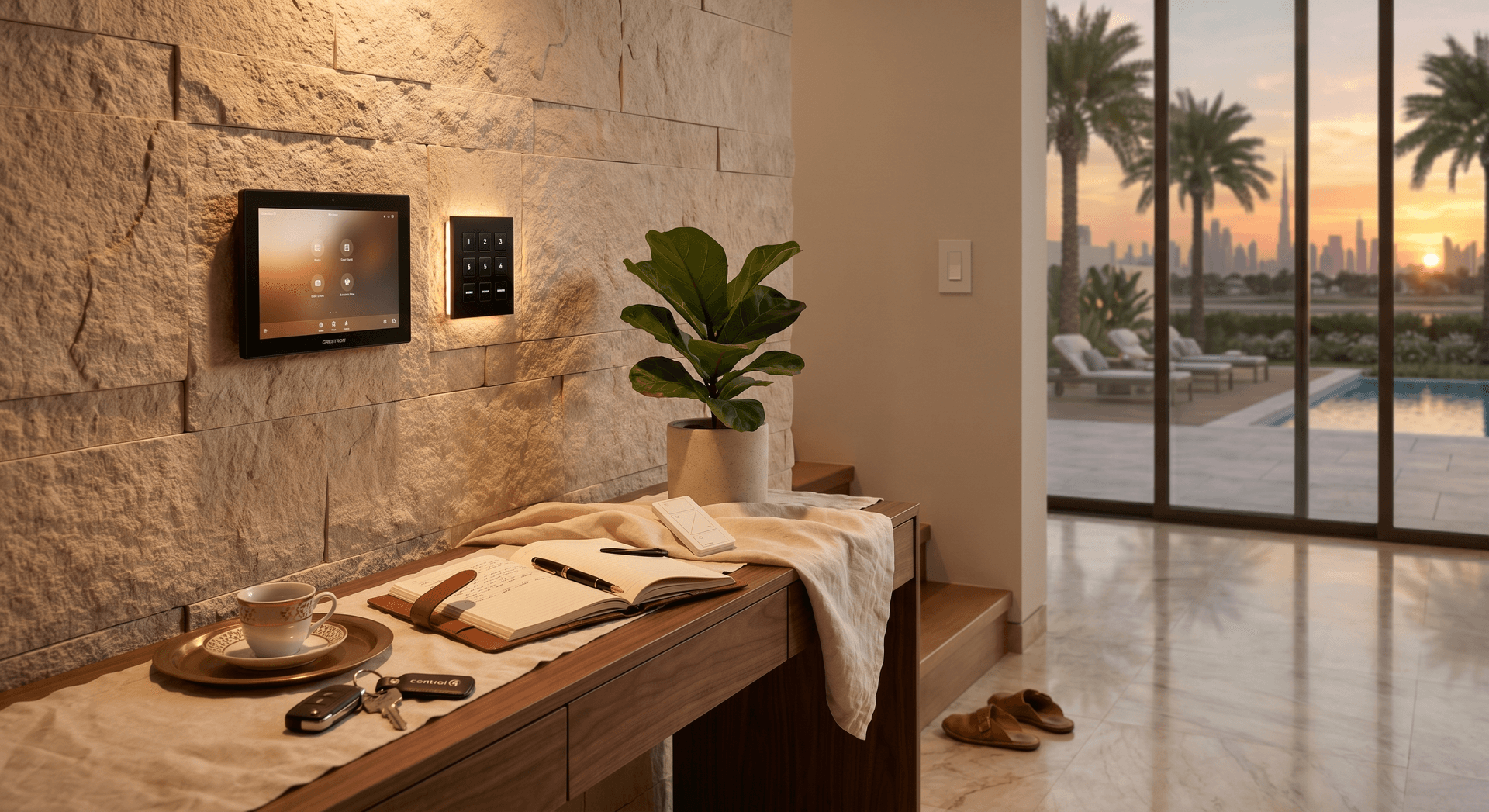
A friend who moved into Dubai Hills last month sent us a pair of quotations on Tuesday. One was for Crestron, AED 285,000 for his 5-bedroom villa. The other was for Control4, AED 92,000 for the same scope from a different dealer. He asked the obvious question. Why is one three times the other, and which one is right for him.
This is the conversation we have with someone every few weeks. It almost never ends where the client expects it to end. The answer is rarely Crestron. It is sometimes Control4. And in a growing share of Dubai villas now, it is neither.
This post walks through the seven questions that decide which platform fits which home, with the actual numbers, the honest tradeoffs, and the alternative that ends up being the right answer for most Dubai clients.
TL;DR: Crestron starts at AED 150,000 for a 3BR villa and earns its price tag if the home has 6+ rooms, a dedicated cinema, custom AV, and a household manager. Control4 starts at AED 25,000 for an apartment and AED 60,000 for a 3-5BR villa and is the right answer for most Dubai homes that want a polished dealer-managed system. An open platform built on Home Assistant, Lutron Caseta, Sonos, and Aqara delivers about 80 percent of either system for AED 15,000-40,000 in a 3BR villa and is what we recommend to most clients who ask. The seven questions below tell you which one you are.
What Each Platform Is, in Two Sentences
Crestron is a commercial-grade control and AV platform that started in industrial broadcast and migrated into corporate offices, five-star hotels, and the top end of residential. Every system is custom-programmed by a certified dealer over four to eight weeks before a single panel gets mounted, and the interface is built from the icon up.
Control4 is a residential-first platform built around standardized templates that a dealer configures and customizes for each home, with a mature catalog of supported devices and a faster install timeline. It belongs to Snap One, which was acquired by Resideo Technologies in 2024 for USD 1.4 billion and now manages over 500,000 homes worldwide through about 12,000 authorized dealers (Snap One, 2024).
Both are dealer-only. Both lock you into a programming relationship for changes. Both run on dedicated controllers in a rack room out of sight. The interface and ongoing support model is where they part ways.
Question 1: How Many Rooms Are You Automating
This is the question that decides the most. Crestron earns its price tag in homes with eight or more rooms running on the same system, where the cost of custom programming gets amortized across enough complexity to matter. Control4 fits two-bedroom apartments to five-bedroom villas without breaking a sweat. Below five rooms, the gap between Crestron and Control4 is mostly cost with little user-visible difference.
A 3-bedroom apartment in Dubai Marina running on Crestron starts around AED 80,000 to 100,000 for the basic stack (7Mayfair, 2026), and the same scope on Control4 runs about AED 25,000 to 40,000. The features the owner uses every day are the same. The difference shows up in things the owner rarely interacts with, like the customization depth of touch panels and the granularity of the dealer relationship.
A 6-bedroom villa in Emirates Hills is a different conversation. The lighting circuits alone often run 200 or more. The AV distribution spans four zones. The pool, gate, staff quarters, cinema room, and gym all need to integrate with the same scenes. Now Crestron is doing work that Control4 templates struggle to keep up with, and the price gap closes because the Control4 dealer is writing custom integrations that look more like Crestron programming anyway.
The crossover point is somewhere between 5 and 7 rooms with significant AV scope. Below it, Control4 wins on price-to-experience. Above it, Crestron's commercial heritage starts to matter.
Question 2: How Polished Does the Touch Panel Need to Look
This is the question Crestron owners do not always articulate but often feel. A Crestron touch panel is custom from the icon up. The fonts, the colours, the room names, the page layout, the gesture behaviour, the way a scene transitions from one state to another, all of it gets specified by the dealer and the client during programming. The result, when it is done well, looks like a hotel front-desk interface that belongs in your villa.
Control4 OS 3 ships with strong templates that the dealer customizes inside a framework. The result is polished, but it is recognizable as Control4 across most installs you walk into (Definitive Electronics, 2025). For most Dubai clients, this is fine. For some, it matters. The owner of the Emirates Hills villa we worked on in January cared about this. The owner of a 4-bedroom Dubai Hills villa we surveyed in March did not.
The honest test is this. Open the photo of a Crestron touch panel and a Control4 touch panel side by side. If you can tell which one is yours within ten seconds and you care about that, Crestron is making an argument worth listening to. If you cannot tell or you do not care, the AED 150,000 you would have spent on Crestron is better spent on Lutron HomeWorks lighting, motorized drapes, and an upgraded cinema room.
Question 3: Do You Have a Household Manager or Property Manager
This is the question almost no one asks themselves before they sign a Crestron quotation. Crestron is built on the assumption that someone in the household, or someone working for the household, owns the ongoing relationship with the dealer. The kind of person who calls the dealer when the dining room scene needs an extra step, who schedules the service visit, who reviews the maintenance retainer once a year, who fields the call when the firmware update breaks one of the integrations.
In a household that has a manager, a property manager, or a full-time PA, this is fine. The dealer relationship is one more vendor in a portfolio someone is already managing.
In a household where the owner is also the IT person, the project manager, and the one who calls plumbers when something leaks, Crestron is a heavier load than Control4, and Control4 is a heavier load than an open platform that the owner can change themselves. We have seen Crestron systems in 4-bedroom Dubai Hills villas where the owner stopped calling the dealer after the first year because each service visit was AED 500 and the owner did not want to schedule it. The result is a polished system that drifted out of date, scenes that no longer matched the family's routine, and a touch panel that nobody touched.
If the owner of the home is going to be the de-facto household manager for the smart system, Control4 is a more honest fit than Crestron. An open platform on Home Assistant is more honest still.
Question 4: How Much AV Integration Do You Need
This is where Crestron's commercial heritage becomes a real argument and not a marketing one. Crestron was distributing video before residential smart home was a category, and the depth of its AV matrix work, room-to-room video routing, and 4K signal management is genuinely a step beyond what Control4 manages comfortably.
A villa with a dedicated cinema room, a media room, a billiard room with a TV, an outdoor projection setup by the pool, and two zones of family-room AV that all need to share sources, get scheduled, and respond to one set of touch panels, is a Crestron-shaped project. The AV programming is most of the value.
A villa with two TVs, a Sonos system, and a soundbar in the living room is a Control4-shaped project, or honestly an open-platform-shaped project. The AV work is the easy bit and any of the three platforms handle it without breaking a sweat.
The test we run with clients on this question is to count distinct AV zones. One or two zones, almost anything works. Three to four zones, Control4 starts pulling ahead on price and Crestron stays comparable on capability. Five or more zones with shared sources, Crestron starts earning the price tag we keep quoting.
Question 5: What Are You Doing About Lighting
This is the question where the answer is almost always the same, regardless of which platform you choose. The premium lighting control system for both Crestron villas and Control4 villas in Dubai is Lutron. On Crestron, it is usually Lutron HomeWorks, the commercial-grade variant with extensive scene programming and a tight integration into Crestron Home OS 4. On Control4, it is often Lutron RA2 Select or HomeWorks depending on scale, integrated through Control4's mature Lutron driver.
The reason this question matters is that Lutron is the most expensive single line item in many villa projects. A 3-bedroom villa runs AED 30,000 to 60,000 on Lutron alone. A 5-bedroom villa runs AED 60,000 to 150,000. The platform you choose on top of Lutron, Crestron or Control4, adds to that bill. It does not replace it.
In a smaller home where Lutron Caseta covers the lighting and the scope is mostly switches and dimmers without a full architectural lighting design, the open-platform path becomes attractive. Home Assistant integrates with Lutron Caseta directly and runs the scenes that 80 percent of clients use in practice (Residential Tech Today, 2025). The remaining 20 percent, the scenes that are nice to have but rarely used, are not worth the AED 100,000 platform jump for most homes.
Question 6: How Long Are You Living in This Home
This is the question the dealers do not ask, and it shapes the recommendation more than people expect. A 6-bedroom Crestron build that takes 4 to 8 weeks of programming before installation makes sense for an owner who has bought the villa and intends to live in it for a decade. The system is part of the property. The maintenance retainer is part of the household budget. The dealer becomes a long-term relationship.
For a tenant on a 2-year lease, even a luxury 3-year lease at an Emirates Hills or Palm Jumeirah rental, Crestron is the wrong answer in almost every case. The infrastructure stays with the villa when you move. The customization, programmed for your specific use, gets reset for the next tenant. The AED 200,000 you spent is not portable.
Control4 sits in the middle. For a 5-year horizon, in a villa the family expects to renew on or eventually buy, Control4 makes sense and the dealer relationship is sustainable. For a 2-year tenancy, even on a large villa, an open platform built on Home Assistant, Lutron Caseta, and a handful of Aqara sensors gives the family 80 percent of the experience and almost all of the equipment can be uninstalled and taken to the next home.
Question 7: Are You Specifically Trying to Match the Office
This is the question that decides a meaningful share of Crestron villa installs in Dubai, and clients almost never bring it up unprompted. The owner of the company has a Crestron panel in their boardroom. They have used it a hundred times. They like the way it works. They want the same logic, the same panels, the same UI in their villa. This is a legitimate reason to specify Crestron and it is the strongest single argument for the platform in a Dubai context.
If the answer to this question is yes, the conversation is shorter. Crestron is the right call regardless of how the other six questions land, because the value is the continuity, not the absolute capability. We will scope it, we will build it well, and we will be transparent that the price reflects the continuity, not the engineering differential over Control4.
If the answer is no, this question removes one of the most common reasons people pick Crestron over Control4. The rest of the decision goes back to the first six questions.
What This Costs in Dubai in 2026
Both platforms have stable enough pricing bands in Dubai to plan around.
Crestron in Dubai:
- Apartments (2-4BR): from AED 80,000-100,000 basic, AED 150,000+ with AV
- Standard villas (3-5BR): AED 150,000-300,000
- Large villas (6+BR): AED 300,000-500,000+ (Ziotech, 2026)
- Maintenance retainer: AED 6,000-18,000/year, or AED 400-800 per service call
Control4 in Dubai:
- Apartments (2BR): from AED 25,000
- Villas (3-5BR): AED 40,000-120,000 most of the time
- Large villas with custom AV: AED 120,000-200,000+
- Service calls: AED 300-500 each, or bundled into annual maintenance plans
- UAE smart home market USD 654M in 2024, projected 10.7% CAGR through 2033 (Research and Markets, 2025)
Open platform (Home Assistant + Lutron + Sonos + Aqara):
- Apartments (2-4BR): AED 8,000-25,000
- Villas (3BR): AED 15,000-40,000
- Villas (5BR+): AED 25,000-80,000
- No mandatory dealer relationship. Owner can change scenes themselves through a documented UI.
For a like-for-like 3-bedroom villa scope, expect roughly Crestron AED 150,000, Control4 AED 60,000-90,000, and open-platform AED 20,000-30,000. The user-facing difference between Control4 and open-platform is the polished single-vendor interface and the dealer relationship. The user-facing difference between Crestron and Control4 is the level of touch-panel customization and the AV depth.
What Bayora Will Talk You Out Of
This is the section where the honest-recommendation principle does the work. We have walked clients away from each of these in the last twelve months.
Crestron in a 3-bedroom apartment. We have never seen the math work outside of one specific case (a client whose company runs Crestron and wanted the continuity). For everyone else, the AED 100,000 floor versus AED 8,000-25,000 for an open-platform apartment build is a hard sell that we will not make.
Control4 for a 2-year tenant. The dealer relationship is built around homeownership. We will quote it if the client insists, but our recommendation will be Home Assistant + Lutron Caseta for portability.
Crestron without an architectural lighting plan. Crestron's value compounds when paired with Lutron HomeWorks lighting designed by a lighting designer. If the villa is being smart-home-fitted as an afterthought to a finished interior, Crestron is unlikely to earn the price. A Control4 build with the lighting the home already has is a stronger fit.
Either platform with an AED 12,000-18,000 wall-mounted bedroom touchscreen. Nobody walks to a wall and touches a screen in their bedroom in 2026. A Lutron Pico keypad next to the bed is AED 220-349 and gets used a hundred times more often. We will tell every client this regardless of platform.
Either platform if the owner is also the IT person of the household. Open platforms exist for this person. Home Assistant gives them control, transparency, and a community of millions of users for support. Locking that person into a dealer-only platform is a tax on their nature.
When We Recommend Each One
After seven questions and a thousand words, the honest recommendations break down like this.
Recommend Crestron when:
- 6+ bedroom villa
- Custom AV across 4+ zones with shared sources
- Dedicated cinema room and at least one architectural lighting design
- Household has a manager, property manager, or full-time PA
- Owner plans to live in the villa for 10+ years
- Or the owner specifically wants continuity with a Crestron-installed workplace
Recommend Control4 when:
- 3-5 bedroom villa or premium apartment
- Standard AV (1-2 zones, soundbar + Sonos + cinema)
- Owner wants a polished dealer-managed system without paying for full customization
- 5-10 year ownership horizon
- Lighting design is real but Lutron HomeWorks is over-scope (RA2 Select or Caseta fits)
- Owner does not want to manage scenes themselves
Recommend open platform (Home Assistant + Lutron Caseta + Sonos + Aqara) when:
- Tenant on a 2-3 year lease (large villa included)
- Apartment of any size
- 3-4 bedroom villa where the family wants the experience without the dealer dependency
- Owner is willing to change scenes themselves or have us teach them
- Budget below AED 80,000 for the whole system
In practice, the third category is the largest by a wide margin in the projects we scope in 2026. The open-platform path has matured fast over the last three years and is now genuinely capable in villa-scale projects. We have written about why Bayora picked Home Assistant as the open-platform anchor for most of our builds in our platform-choice piece.
The Hybrid: When We Build Both
For one specific kind of client, the answer is genuinely both. The Emirates Hills villa we rebuilt in January runs Crestron on the front end for the touch panels and the AV distribution, and Home Assistant on the back end for the long-tail integrations that the owner writes himself. Crestron handles the polished interface, the staff access, the AV programming, and the maintenance relationship. Home Assistant handles the dozens of smaller integrations that the owner wants to control himself, exposed back to Crestron through a documented bridge (Residential Tech Today, 2025).
This is how a meaningful share of Crestron projects globally are now being built. It is the model we recommend for clients who have the scale to justify Crestron but want the freedom of an open platform underneath. It costs slightly more than pure Crestron because there is a small additional integration layer, and it pays itself back many times over the first year when the owner stops booking dealer visits for the small changes.
We have not built a pure Crestron villa in 2026. Every Crestron project we have scoped this year has been the hybrid. This is worth knowing if you are weighing Crestron and you are not sure what the long-term ownership cost looks like.
What the Dealer Will Not Tell You
A Crestron dealer makes their living on programming time. A Control4 dealer makes a living on the configuration template, the device catalog, and the service relationship. Neither of them is incentivized to walk you toward an open-platform path. The reason we keep recommending it is not ideological. It is that we see the 18-month outcome more often than the dealer does. The Crestron client who stopped calling the dealer after the first year because each visit was AED 500 and the family did not want to schedule it. The Control4 client whose home became static because the dealer was the only person who could change a scene.
For a meaningful share of Dubai homes, the system that gets used the most over a decade is the one the owner can change themselves at 11pm on a Saturday when an idea occurs to them. That is the open-platform argument in one sentence, and it is what shapes the recommendation we make to most clients who ask us to scope Crestron or Control4.
If you're still at the stage of comparing companies rather than platforms, the questions worth asking before you sign are mostly the same ones: see our broader guide to choosing a smart home company in Dubai.
Frequently Asked Questions
Can Crestron and Control4 be in the same home?
Technically yes, in rare cases where a villa was wired for Crestron by a previous owner and the new owner wants to extend with Control4 in a guest house or annex. In practice it is not a configuration we recommend. The two platforms do not talk to each other natively and the dealer support fragments across two vendors. If you have a Crestron villa and want a Control4 annex, an open-platform bridge using Home Assistant between the two is a cleaner answer.
What about KNX, where does it fit?
KNX is a strong wired protocol that competes more directly with Lutron HomeWorks than with Crestron or Control4 at the user-facing level. Many Crestron and Control4 installs use KNX underneath for the wired backbone, with Crestron or Control4 doing the orchestration on top. We have written about how KNX compares to Home Assistant as a residential platform in Dubai. The short version is that KNX is the wired foundation; Crestron, Control4, or Home Assistant is the brain.
How long does each install take in Dubai?
Crestron runs 4-8 weeks of programming before installation, then 1-3 weeks on site depending on villa size. Control4 runs 1-2 weeks of pre-programming, then 1-2 weeks on site. An open-platform Home Assistant build runs 1-3 days of configuration and 3-7 days on site for a typical villa. The Crestron timeline is largely the cost of the custom programming, and it is non-negotiable for a properly built system.
What happens if my dealer disappears?
For Crestron, you go through Avientek as the regional distributor and they will assign a replacement dealer. The programming code is portable across certified Crestron dealers. For Control4, Snap One maintains the dealer network and you can transfer to any authorized Control4 dealer in Dubai. For an open-platform build, you do not have this risk by design. We document every build so a competent integrator can pick up the system without dependency on a single vendor.
Which one is most reliable in a power cut?
All three platforms recover well from a power cut once the wired infrastructure is reliable. The difference shows up if the internet drops for an extended period. Crestron and Control4 run their core scenes locally and stay functional. Home Assistant runs entirely locally by default and stays functional. The cloud-only smart-home setups some clients try to build on consumer-grade WiFi devices are the ones that struggle in a Dubai apartment summer when the router needs a reboot. None of the three platforms we are discussing have that problem.
Where to Start
If you are weighing Crestron or Control4 for a Dubai villa, start with the seven questions above. Run through them honestly. If five or more of them point toward Crestron, get two quotations from certified Crestron dealers through Avientek and budget for a 4-8 week programming runway. If five or more point toward Control4, ask Bayora or another integrator for a scoped quotation and expect AED 60,000-120,000 for a 3-5BR villa. If five or more point toward the open-platform path, the conversation gets simpler and the budget drops by half.
We will tell you which category your home is in honestly. We will quote any of the three. We will not pick the most expensive option because it is the most profitable. The villa is yours for the next decade. The system inside it should fit the way you live, not the way the dealer's sales target was written.
Get a free consultation and we will walk through the seven questions together. We will tell you which platform fits your home, what it will cost, and what we would recommend if you were our cousin asking us the same question.
Ready to Get Started?
Get a free consultation and we'll recommend what makes sense for your situation.
Get Free Consultation