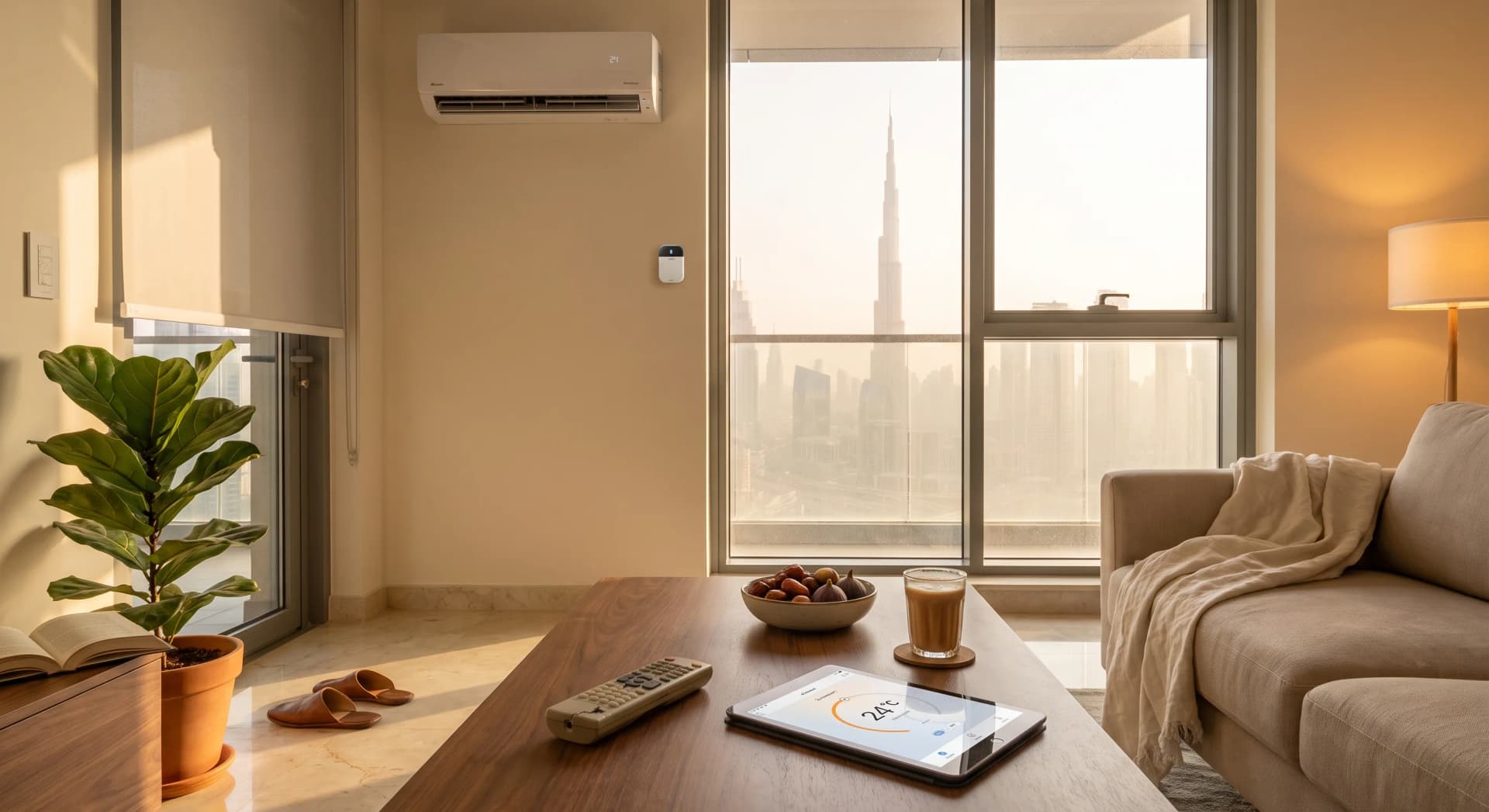
Sometime before dawn on July 3, the first stars of Gemini rose over the eastern horizon, and by the old Emirates calendar that is the exact moment the year gets as hot as it is going to get. The Emirates Astronomical Society calls the next 40 days Jamrat Al Qayth, the embers of summer, running through August 10. Coastal Dubai sits at 41 to 43 degrees. Inland pushes past 45. Some desert stretches cross 50. Your air conditioner is about to run more hours, at a lower setpoint, against a hotter wall, than at any other point in the calendar.
Most apartments meet that with the same setup they used in March. A remote with a cracked screen and a habit of leaving the AC on all day so the place is bearable when you walk in.
TL;DR: The UAE entered Jamrat Al Qayth on July 3, its hottest and driest 40 days (through August 10), with coastal Dubai at 41 to 43 degrees and inland past 50. During peak heat your AC works hardest, so a smart controller earns its keep here more than any other time of year. Pre-cool before you arrive, let each room hold its own setpoint, and cut cooling to empty rooms. A basic setup starts from AED 3,000 installed, no wiring or landlord approval needed, and the lower DEWA bill is a side effect of the comfort.
For the next six weeks, the difference between a home that runs itself and a home you fight every afternoon is not new hardware in the wall. It is whether the AC knows three things: when you are coming back, which rooms are in use, and how hard it needs to work before the sun does its worst. Here is what changes when it does.
What Jamrat Al Qayth Means for the Box on Your Wall
Jamrat Al Qayth is a seasonal marker, not a weather warning. It names the 40-day stretch when heat, dryness, and the hot desert wind the region calls samoom all peak together. Ibrahim Al Jarwan of the Emirates Astronomical Society ties the start to the rising of the Gemini stars before dawn, and the window carries its own heatwave pattern, Waghrat Al Qayth, where temperatures stay at least 4 degrees above normal for two or more days running.
For your AC, the calendar name matters less than the physics behind it. A wall facing west now absorbs sun for six hours and radiates that heat inward well past sunset. The 3pm problem that already makes a Dubai apartment hottest two hours after peak sun gets sharper for the whole window. Your compressor stops getting the overnight break it relied on in spring, because even the nights stay warm. This is the one stretch of the year where a smart AC controller pays back the fastest, because it is the stretch where a dumb one wastes the most.
Pre-Cooling Beats Leaving It On All Day
The instinct during peak heat is to leave the AC running so you never come home to a hot apartment. It works, and it is the single most expensive habit in a Dubai summer. Cooling an empty two-bedroom from 8am to 6pm at a low setpoint burns through the higher DEWA slab rates for ten hours a day to keep furniture comfortable.
Pre-cooling does the same job backwards. A smart controller starts the AC roughly 30 minutes before you arrive, so the apartment is comfortable the moment you walk in, and stays off or idles high the rest of the day. When we set this up in a Business Bay apartment for a marketing manager who works from an office three days a week, the change was not the temperature she came home to, which was the same. The change was that the box stopped cooling an empty room for nine hours. Same comfort, a fraction of the runtime, during the exact window when runtime costs the most.
Every Room Holding Its Own Setpoint
A single thermostat in the hallway is the reason one bedroom sits at 22 while the west-facing living room never drops below 27. During Jamrat Al Qayth that gap widens, because the rooms taking direct sun heat up faster than the sensor in the corridor ever sees.
Zone control puts a sensor in each room and a controller on each unit, so the room that is hot gets the cooling, and the room nobody is in does not. We have run this on original 2005-era AC units in villas and on the standard split systems in Marina and Business Bay towers, and the pattern holds: the bedrooms become sleepable again, and the AC stops overcooling the half of the apartment that was already fine. During the hottest 40 days, this is what stops the nightly argument about which room is too warm.
The Dust and the Samoom Change the Air, Not Only the Heat
Jamrat Al Qayth brings the samoom, the hot dry desert wind that carries dust across the city. June is already Dubai's most polluted month, with PM2.5 peaking around 59, and a dust day can push the outdoor air quality index above 200 in some districts. The reflex is to shut every window, which is right. The catch is that indoor air in a sealed apartment can end up worse than outside when nothing is moving it.
A smart setup handles both without you tracking the forecast. Motorized blinds drop on the dusty, sun-heavy windows to cut the radiant heat before the room warms up. If you run an air purifier, an air-quality sensor can trigger it when particulate climbs instead of leaving it on all day. During peak heat you are indoors more than any other time of year, so the air you are breathing for those six weeks is worth getting right. Our full indoor air quality build for a Dubai dust day goes deeper, but the principle is simple: let the home react to the dust so you do not have to.
What This Costs, and Why the Bill Is the Side Story
A basic smart AC setup starts from AED 3,000 installed, which covers the controller, configuration, and the app so you can pre-cool from your phone. Adding zone control for extra rooms runs from around AED 1,500 per zone. None of it needs wiring, and none of it needs landlord approval, because the controller sits alongside your existing AC and reads the same signals your remote sends.
The DEWA math is real. Smart AC control cuts cooling costs by 20 to 30 percent on average, and with AC making up 60 to 70 percent of a summer electricity bill, that lands on the part of the bill that hurts. A summer two-bedroom crossing into the 32 and 38 fils slab bands feels the difference. We still do not lead with it. The reason to do this before the worst of the heat is that your apartment stops fighting you every afternoon for six weeks. The lower bill in September is the part of the comfort you did not have to pay for.
What Bayora Will Talk You Out Of
Peak heat and the Dubai Summer Surprises sales at the same time make this the season people over-buy. These are the four things we tell clients to skip.
Skip the second AC unit. If your bedroom will not cool, the problem is almost never the compressor. It is a single thermostat trying to read a room it cannot see and a west wall radiating heat all evening. Zone control and a blind fix that for a tenth of the price.
Skip the standalone smart plugs bought to "monitor energy." They tell you what a socket drew after the fact. They do not cool a room. If the goal is a lower summer bill, the AC is where 60 to 70 percent of it lives, so that is where the money goes first.
Skip the AED 12,000 wall touchscreen. Your phone already does everything it does, and during a heatwave you are controlling the AC from bed or from the office, not from a panel by the door.
Skip the whole-apartment package in one go. Start with the AC, live with it through this window, and add lighting or blinds when you know what you reach for. A smart AC controller is not a smart thermostat, and knowing which one your apartment needs saves you buying the wrong box twice.
Where to Start This Week
If you do one thing during Jamrat Al Qayth, put a controller on the AC in the room you use most and set a pre-cool schedule around when you get home. That single change removes the most expensive habit of the Dubai summer, the empty-apartment AC running all day, and it is reversible in 20 minutes if you rent.
From there the order is simple: the bedroom that will not sleep gets its own sensor, the west-facing living room gets a blind, and the rest waits until the heat breaks in autumn. You do not need the whole system in July. You need the AC to stop working against you during the six weeks it works hardest. Our honest guide to smart AC control across apartments and villas lays out the full picture if you want to plan the whole thing.
Frequently Asked Questions
Does a smart AC controller work with my existing apartment AC?
Yes. Smart controllers work with any split AC or ducted unit that has a remote, regardless of brand or age. The controller learns your remote's signals and sits alongside the unit, so there is no rewiring and nothing permanent. It connects to your home WiFi and lets you pre-cool, schedule, and set each room independently from your phone.
Will pre-cooling really lower my DEWA bill during peak heat?
It lowers runtime, which is what drives the bill. Instead of cooling an empty apartment for ten hours a day through the higher summer slab rates, the AC cools for the window you are actually home. With AC at 60 to 70 percent of a summer bill and smart control cutting cooling costs 20 to 30 percent, the saving lands on the part of the bill that grows most in July and August.
Can renters install this without landlord approval?
Yes. A smart AC controller needs no wiring and no changes to the AC unit, so it needs no landlord approval. It reads the same infrared signals your remote sends and mounts nearby without drilling. When you move, it comes off the wall in a few minutes and goes with you, so nothing is left behind and nothing is damaged.
What temperature should I set my AC to during Jamrat Al Qayth?
Around 24 degrees is a comfortable and efficient target for most Dubai apartments. Pushing it to 18 does not cool the room faster, it only makes the compressor run longer and lifts your bill. A smart controller holds a steady setpoint and pre-cools before you arrive, which feels better than a colder number and costs less to run through the hottest 40 days.
Do I need internet for the AC to keep working if WiFi drops?
No. Your schedules and automations run locally on many controllers, so the AC keeps following its program even if your internet drops for a while. You need WiFi for remote control from your phone and for the initial setup, but a temporary outage does not leave you without cooling. The pre-cool schedule you set continues on its own.
Jamrat Al Qayth runs 40 days. Your apartment is going to be the coolest place you spend time in for all of them, so it is worth making it a place that handles the heat on its own instead of one you manage from a cracked remote. Tell us about your apartment and we will tell you exactly where to start, no obligation and no surprises.
Ready to Get Started?
Get a free consultation and we'll recommend what makes sense for your situation.
Get Free Consultation