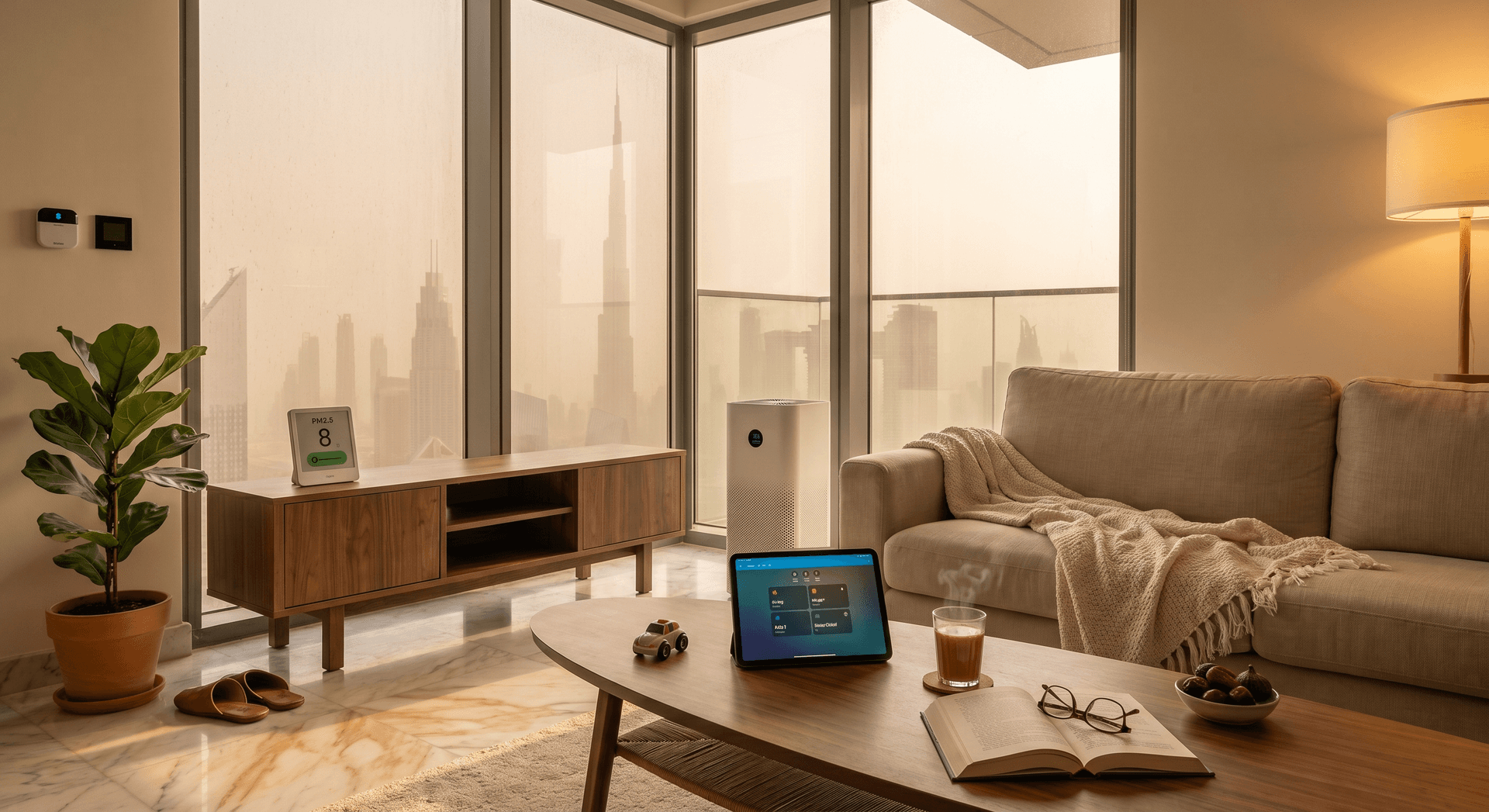
The balcony rail has a film of dust across it that was not there on Friday afternoon. The kids' rooms smell faintly chalky. The weather app says AQI 74, Moderate. You shrug, close the app, and walk to the kitchen to make karak. The apartment around you does not know it is a dust day. The central AC is running on the same schedule it ran yesterday and last Tuesday and a Tuesday in January. The compressor pulls air through a filter that was last changed when you signed the tenancy in 2024. The front door opens twice in the morning, once for the cleaner and once for a Deliveroo coffee, and a small pressure wave drags Business Bay air into the corridor and then into your hall. None of this shows up on the AQI app, because the AQI app reads Dubai, not your apartment.
This is the part of a smart home that most people skip and most installers do not pitch. The cooling layer is now well covered (Smart AC control across the UAE). The lighting layer is well covered (4 lighting layers that make 7am, 1pm, and 9pm all work). The shading layer is well covered (the three-visit blinds sequence for hosting). The air layer is the one nobody puts on the proposal because it is invisible until you start measuring it. Once you measure it, it is hard to go back.
TL;DR: A Dubai apartment on a dust day leaks air through five quiet routes closed windows do not stop. One PM2.5 sensor, one HEPA on a smart plug, and a controller that ties them to your AC keeps the indoor reading under 12 µg/m³ on a 38 µg/m³ outdoor morning, without you opening the weather app. From AED 1,400 for renters, no wiring. From AED 4,500 for a standard 2BR. Open platform, no lock-in, comes off the wall in twenty minutes when you move.
This is not a piece on cleaning your AC filter. This is on what your home should be measuring, what it should be running on its own when the air outside changes, and what the build costs in a 2BR Business Bay rental on a working-day Tuesday in June.
The Tuesday Morning Reading Your Phone Will Not Show You
The Dubai-wide AQI on Tuesday 16 June 2026 read 74 (Moderate) at 11:49 in the morning, with PM₂.₅ at 23 µg/m³ and PM₁₀ at 60 µg/m³ (aqi.in, 2026). The NCM forecast called the day "fair in general, dusty at times, low clouds over northern areas," with northwesterly winds 10-25 kmph freshening and blowing dust gusting to 40 kmph (Khaleej Times NCM daily, 2026).
Twenty-three µg/m³ in the citywide reading does not sound alarming. It is more than four times the WHO recommended PM₂.₅ guideline of 5 µg/m³ (Emerald Insight, mitigating indoor air pollution in UAE high-rise apartments, 2026), and Dubai's annual average sits closer to 43 µg/m³ (same study, 2026). On a dust morning the gusts push your apartment reading above 35 µg/m³ at the front door, which is the threshold where industry guidance recommends a filtration upgrade (Saniservice, Dubai regulations for air quality standards, 2026). The NCM advisory on the same day was direct: keep doors and windows closed to prevent dust from entering homes and buildings (Khaleej Times NCM dust advisory, 2026).
The citywide AQI tells you the average across a sensor in Hatta and a sensor near the airport. It does not tell you what your hallway is at after the cleaner walked in twice and the corridor pressure changed. The only sensor that can tell you that is one on your wall.
The Five Quiet Routes Dust Takes Into a Closed Apartment
In our experience surveying Business Bay, Marina, and Downtown apartments after dust events, the same five infiltration vectors come up every time. The owners always close the windows. The dust always gets in anyway.
The Building Riser and Central AC
Most Dubai apartments are on district cooling, Empower in Business Bay and JBR and JLT, Emicool in many newer towers, Tabreed in others (Property Finder, chiller-free vs district cooling, 2026). The chilled water arrives clean. The air it cools, the air that enters your fan-coil unit and exits your supply grille, comes through your building's MEP path and the filter inside your unit. That filter is typically a MERV 8 to 11 pleated media filter (Sethnco, AC filter cleaning Dubai 2026, 2026), which is designed to catch lint, hair, and large dust particles. It is not designed to catch PM₂.₅. The fine particles pass through it, ride the cool air, and arrive in your living room. If you have not changed that filter in eighteen months, the larger particles join them.
The Front Door and Corridor Pressure
Every time the front door opens, the pressure differential between the corridor and your apartment pulls a small volume of corridor air in. Corridors in Dubai towers are pressurised for fire-safety reasons and the air there comes through a separate building filter, but on a dust day the corridor itself is loaded. Every open-door event, cleaner in, Deliveroo coffee, friend visiting, package delivery, is a small dust dose. Across a working day a Business Bay 2BR with a cleaner morning and afternoon deliveries can see six to ten door events.
Window Seals and Balcony Tracks
Window and balcony-door rubber seals are not airtight. They are weather-resistant, not dust-tight. On a 40-kmph gust day, fine particles ride the pressure into the gaps. Older apartments and ground-floor units are worst. Anyone who has cleaned a balcony track after a sandstorm has seen the evidence: a fine grey line of dust along the runner.
Footwear, Bags, and Cleaner Returns
Dust comes home on shoes. It comes home in the bottom of a delivery bag. It comes home on a cleaner's mop bucket from the previous apartment. We have walked into apartments where the carpet under the entry mat tested PM₂.₅ four times higher than the living room because the dust was being trampled in and disturbed every time someone walked over the mat.
Cooking, Smoking Neighbours, and TVOCs
Beyond dust there is a second invisible layer. Cooking on a gas hob releases combustion particles and TVOCs (total volatile organic compounds). A smoking neighbour two floors below can have their smoke migrate through unit-to-unit shafts and arrive in your kitchen as a faint smell at 9pm. Candles, cleaning sprays, and new furniture all add TVOCs that a PM₂.₅-only sensor will not show. This is why the better builds use a sensor that reads PM₂.₅ and TVOC, not one or the other.
What a PM₂.₅ Reading on the Wall Changes
The first time a client puts an air quality sensor on the wall, two things happen in the first week. The first is that they discover their reading is 18 in the morning, 14 by noon, and 9 by evening. The second is that they discover the spikes. The reading climbs to 28 every time the front door opens for the cleaner. It climbs to 42 every time the gas hob is on. It climbs to 35 during the 4pm dust gusts and stays there until 7pm.
Once you can see those spikes, you can do something about them. Schedule the HEPA purifier to run hard for thirty minutes after the cleaner leaves. Run the extractor harder during cooking. Boost the purifier from 5pm to 9pm on dust days, automatically. None of this is hard to set up. All of it is impossible without the sensor.
Long-term PM₂.₅ exposure is associated with asthma, bronchitis, and cardiovascular conditions, and the fine particles reach deep into the lung (Springer, air quality and health risk assessment during Middle Eastern dust storms, 2024). Those are reasons to care. They are not reasons to panic. In our experience, the strongest motivation for getting the air layer right is not health. It is the morning the kids' room does not smell chalky and the parent realises the apartment handled it overnight without anyone opening the weather app.
The Five-Layer Build for a Standard Dubai Apartment
The build is small. It is also under-specified by most installers because the equipment is cheap, the labour margin is thin, and the client did not ask for it. Here is what it looks like.
Layer 1: One PM₂.₅ + TVOC Sensor on the Wall
The Aqara TVOC Air Quality Monitor reads TVOC, temperature, and humidity, runs on Zigbee 3.0, displays values on an E-Ink screen, and lasts more than a year on battery (Aqara TVOC product specs, 2026). The Aqara S1 Air Quality Monitor adds PM₂.₅ and CO₂ on top of that, and works with Apple HomeKit and the Aqara Home app (SpanningGlobal Aqara S1, 2026). Both are available in the UAE through Smartify Spaces and Modo Store. Place the sensor in the main living area at sitting height. One sensor in a 2BR is enough for triggers. A second one in the master bedroom is useful for sleep data, not essential for the system to work.
Layer 2: One HEPA Purifier on a Smart Plug
The Xiaomi Smart Air Purifier 4 Pro covers 35-60 m², runs at 500 m³/h CADR, catches 99.97 percent of particles 0.3 µm or larger through a HEPA + carbon stack, and integrates with the Mi Home app (Sharaf DG UAE listing, 2026; Amazon.ae listing, 2026). For renters or smaller apartments the Levoit Core 300S sits under AED 500 and is one of the most-cited budget HEPA picks in the UAE (Bio-On 2026 UAE air purifier guide, 2026). Both run on a smart plug if their built-in app is not the route you want. The smart plug lets the home control them through your sensor, not through Xiaomi's cloud.
Layer 3: One Smart AC Controller
This piece is doing two jobs at once. It already handles your cooling schedules and pre-cool routines as covered in the smart-AC control guide. On a dust day it does a second job: it senses indoor temperature and humidity, and it can run on a "do not pull more air than necessary" pattern. A Sensibo Sky on a split AC, or an apartment-tier integration on a district-cooled fan-coil, keeps the cooling cycling without forcing the central AC to over-run during a dust gust. We pair this with the sensor so the system stops asking the AC to do air-quality work it cannot do, and instead routes the air-quality work to the HEPA.
Layer 4: One Door / Window Sensor on the Most-Leaky Entry
This is the layer most builds skip. A small wireless contact sensor on the front door tells the home when the cleaner walked in. The home runs the HEPA on boost for thirty minutes after every door event. A second contact on the balcony door tells the home when the gusty afternoon has been let in for fifteen minutes, and the HEPA boosts again. The Aqara P2 Door/Window sensors run Zigbee, fit the door frame in under two minutes, and cost under AED 100. There is no wiring. No drilling.
Layer 5: Cross-System Automation
The five layers above are useful individually. They become a system when one event triggers several actions at once. On a dust gust day, the indoor PM₂.₅ climbs past 25 µg/m³. The home does four things at the same time: motorized blinds close to 70 percent on the windward side (cuts heat and keeps the seal tighter against the gusty face), the HEPA boosts to high, the AC drops a degree to compensate for the extra ambient warming, and the home sends one quiet notification to your phone: "indoor air boost active." You do not need to know it happened. The kids' room does not smell chalky on Wednesday morning.
What the Build Costs in 2026
Three tiers. Each one earns its place. None of them require anyone to rewire the apartment.
Tier 1: Renter Starter, From AED 1,400
- Aqara TVOC Air Quality Monitor, around AED 280-380 retail
- Aqara Hub (M2 or M3), around AED 350-450
- Smart plug (Aqara, Sonoff, or Shelly), AED 60-120
- Levoit Core 300S HEPA purifier, AED 400-500 (Bio-On 2026 UAE air purifier guide, 2026)
- Aqara P2 door sensor on the front door, around AED 90
Total around AED 1,180-1,540 in hardware, AED 200-400 in install and configuration if Bayora sets it up for you. You move out, everything comes off the walls in under twenty minutes, and the next apartment gets the same build.
Tier 2: Standard 2BR Build, From AED 4,500
- Aqara S1 Air Quality Monitor with PM₂.₅ + CO₂ + HomeKit, around AED 750-950 (SpanningGlobal Aqara S1, 2026)
- Aqara Hub, AED 450
- Xiaomi Smart Air Purifier 4 Pro for the living room, around AED 1,200-1,500 with installment options (Amazon.ae Xiaomi 4 Pro, 2026; Sharaf DG, 2026)
- Sensibo Sky smart AC controller, around AED 400 for the living room or main AC zone
- Two Aqara P2 contact sensors (front door + balcony), around AED 180 the pair
- Smart plug for purifier, AED 80
- Bayora install, configuration, and Home Assistant or HomeKit setup, AED 800-1,200
Total around AED 3,860-4,760 fully installed. This is the most common build for a Business Bay or Downtown 2BR rental.
Tier 3: Premium Multi-Room, AED 8,500-12,000
Two sensors (living room + master bedroom), two HEPA purifiers (living + master), tied into motorized blinds and smart AC controllers on multiple units, fully orchestrated through Home Assistant or Crestron with a Home Assistant bridge for villas. We have built this in larger apartments where one parent works from home and a child has mild respiratory sensitivity. It is rarely the right starting point. It is sometimes the right destination once the standard build has proved itself.
A Real Business Bay 2BR Build, June 2026
A Business Bay 2BR tenant, district-cooled by Empower, two-year tenancy, two children under eight, came to us after the Hijri New Year long weekend with a specific complaint: the kids' rooms smelled chalky on Monday morning and she could not work out why. Windows had been closed the whole weekend. The central AC had run on its normal schedule. No new furniture, no candles, no cooking smoke.
We installed the standard 2BR build the following week, Aqara S1 monitor in the living room, Aqara TVOC monitor in the master bedroom (already had a Hue setup so the second sensor paired into the existing hub), Xiaomi Smart Air Purifier 4 Pro in the living room, Sensibo Sky on the master AC, Aqara P2 contact sensors on the front door and the balcony door, and a Home Assistant instance running on a small mini-PC under the TV console. Total installed cost AED 4,340. Configuration and tenancy training took two hours one afternoon.
In the first week the data showed exactly what we suspected. Indoor PM₂.₅ averaged 18 µg/m³ overnight, spiked to 32 µg/m³ every morning at 7:30 when the cleaner arrived, and stayed elevated for forty minutes after she left. The kids were asleep until 6:30. Their rooms had been holding overnight dust from Friday and Saturday because the central AC was the only air movement and the MERV 8 filter was not catching PM₂.₅. By the second week the automation was tuned: HEPA on boost from 7:00 to 8:30 every weekday morning, boost again for 30 minutes after the front door opened, boost on any reading above 25 µg/m³, and the master bedroom HEPA on low all night below 18 µg/m³ and high above. Indoor PM₂.₅ overnight averages dropped to 8 µg/m³. The kids' rooms did not smell chalky on Monday mornings any more. The Empower bill in May 2026 was AED 1,180, against an estimated AED 1,220 for the same month without the sensor-driven AC tuning, a small DEWA-and-Empower side effect, not the reason we did the work.
What we have found across these builds, in our experience, is that the comfort change is what the household notices first. The data is for the parent who wants to see it work. The smell-free Monday morning is the reason it stays installed.
What Bayora Will Talk You Out Of
Across the air-quality builds we have scoped this year, four asks come up that we politely walk people back from.
The AED 3,500 Dyson Pure Cool tower for a 12 m² bedroom. The Levoit Core 300S at under AED 500 will hit the same indoor PM₂.₅ reduction in a small bedroom. We have run them side by side. The Dyson is a beautifully engineered fan-with-purifier. It is not a HEPA that earns AED 3,000 of incremental margin over a Levoit. Save the difference for a second monitor and a smart plug.
Whole-home ducted air-purifier upgrades costing AED 25,000. Some contractors will quote a building-wide HEPA upgrade on the central AC. In a Dubai apartment on district cooling, you do not own the AHU. The fan-coil unit and its filter are the only thing inside your demised area. The honest answer is point-of-use HEPA per room, not a fictional duct upgrade you cannot install in a rented apartment.
The full HomeKit Secure Video + Aqara + Hue + Sonos bundle at AED 18,000 for a 2BR. You can get to a properly working air-quality automation for AED 4,500 and a fully orchestrated 2BR for AED 14,000 (Friday Night Dinner choreography build covers the cross-system case). The AED 18,000 stack is not wrong. It is sold to someone who does not need it yet.
A AED 1,800 wall-mounted touchscreen "control panel" to read the AQI. Your phone reads the AQI. The Aqara monitor's E-Ink screen reads the AQI. A wall touchscreen is for households that want the lighting / AC / blinds at a single physical place, not for households that want one number on the wall. We almost never recommend a touchscreen as the second purchase. We sometimes recommend it as the seventh.
How the Air Layer Plays With the Rest of the Apartment
The air layer is a small build but it has natural handshakes with three other systems that may already be in your apartment.
Motorized blinds. On a dust gust day with the wind running northwesterly, the windward face of the apartment leaks more dust through the window seals. Closing the windward blinds to 70 percent cuts the heat at the same time as tightening the seal slightly (the blind body provides a small additional pressure barrier across the seal). The motorized-blinds build is covered in Smart Blinds for Dubai hosting and the 4pm glare-trap living-room build. The blind and the purifier and the AC controller all reading the same dust event is the whole point.
Smart AC controllers. The cooling layer should not be fighting the air-quality layer. When the indoor PM₂.₅ is elevated, the AC controller eases back on aggressive air movement, the HEPA boosts, and the system settles for the next hour. This is the cross-system integration explained piece by piece in Smart AC Control across the UAE and the DEWA AI Virtual Engineer build for your apartment.
Lighting scenes. A dust-day light scene is a small but real comfort move: warm 2700K, slightly dimmer ambient, no cool-white overheads. The lighting layer is covered in the 4-layer kitchen build. On the dust day automation, the home dimming the cool overheads by 20 percent and warming the colour temperature reads as "indoor weather mode" without you knowing why the room feels calmer.
Where to Start When You Are Renting
If you are renting and you want to get the air-quality layer working in one Saturday afternoon, the order is:
- Buy the Aqara TVOC monitor and the Aqara Hub (or use the Aqara M3 hub if you already own one). Put the monitor in the main living area at sitting height. Let it log for three to four days before you change anything.
- Buy the Levoit Core 300S and place it within five metres of the entry to the kids' or master bedroom. Plug it into a smart plug.
- Add an Aqara P2 contact sensor to the front door. Pair it to the hub.
- Set three automations: HEPA on for 30 minutes after every front-door event, HEPA on boost above PM₂.₅ 25, HEPA on low overnight below PM₂.₅ 18.
- Live with it for two weeks. Look at the data. Decide whether you need a second sensor in the master bedroom, a second HEPA, or a smart AC controller.
That is it. AED 1,400-2,000 in hardware, no wiring, no landlord conversation, no permanent changes. When you move out, the system comes with you. The next apartment gets the same build in twenty minutes.
Frequently Asked Questions
Does an air purifier work if my apartment is on central or district cooling?
Yes. A stand-alone HEPA purifier works independently of your central AC. It cleans the air inside your demised area, room by room. Your central AC handles the cooling and exchanges some air through the building's MEP path with a MERV 8 to 11 filter that does not catch PM₂.₅. The HEPA catches what the central filter cannot. The two systems do not interfere with each other.
Is the air that bad inside a closed Dubai apartment?
It depends on the day and the unit. The 2023 Dubai annual PM₂.₅ average was around 43 µg/m³ outdoors, against a WHO guideline of 5 µg/m³ (Emerald Insight, mitigating indoor air pollution UAE high-rise, 2026). Indoors with windows closed but normal door usage and a MERV 8 central filter, expect 12-28 µg/m³ on a calm day and 20-40 µg/m³ on a dust day. A working HEPA setup with sensor triggers keeps the indoor figure under 12 µg/m³ most days, including dust days.
Do I need PM₂.₅ specifically, or is TVOC enough?
A TVOC-only monitor catches cooking, candles, cleaning sprays, new furniture off-gassing, and smoke. A PM₂.₅ monitor catches dust, sand, traffic-related fine particles, and cooking particles. The two readings tell you different stories. For Dubai the dust signal is the headline story, so we lead with PM₂.₅, then add TVOC as the second layer for cooking and cleaner footfall. The Aqara S1 reads both. The Aqara TVOC monitor reads TVOC only and pairs well with the apartment that has not had cooking smell issues.
How often do I change the HEPA filter?
The Xiaomi 4 Pro filter and most apartment-tier HEPAs last 6-12 months in a clean room with moderate use, 4-8 months in Dubai with dust events and cooking. The app gives you a percentage. Plan to keep one spare in the cupboard. A filter change costs AED 150-280 depending on the brand. The Levoit's filter is on the lower end of that range; the Dyson's is at the upper.
Will this lower my DEWA or Empower bill?
A little, as a side effect. When the AC controller is tuned to the indoor sensor and the HEPA handles air-quality work the central AC cannot do, the central AC tends to cycle slightly less aggressively and the bill ticks down a small amount. In our experience this is AED 30-80 per month on a typical 2BR Empower account, not the headline reason to do the work. The headline reason is comfort. The savings are a side effect, not the pitch.
A Closing Sentence on Dust
The dust came in through five quiet routes you did not choose to open. The sensor saw it. The home did the work. The kids' rooms do not smell chalky on Wednesday morning. That is the version of "smart" that earns the word.
Ready to think about your apartment's air layer? Tell us about your home and we will tell you whether you need the AED 1,400 starter, the AED 4,500 standard build, or something in between. No obligation, no surprises.
Ready to Get Started?
Get a free consultation and we'll recommend what makes sense for your situation.
Get Free Consultation