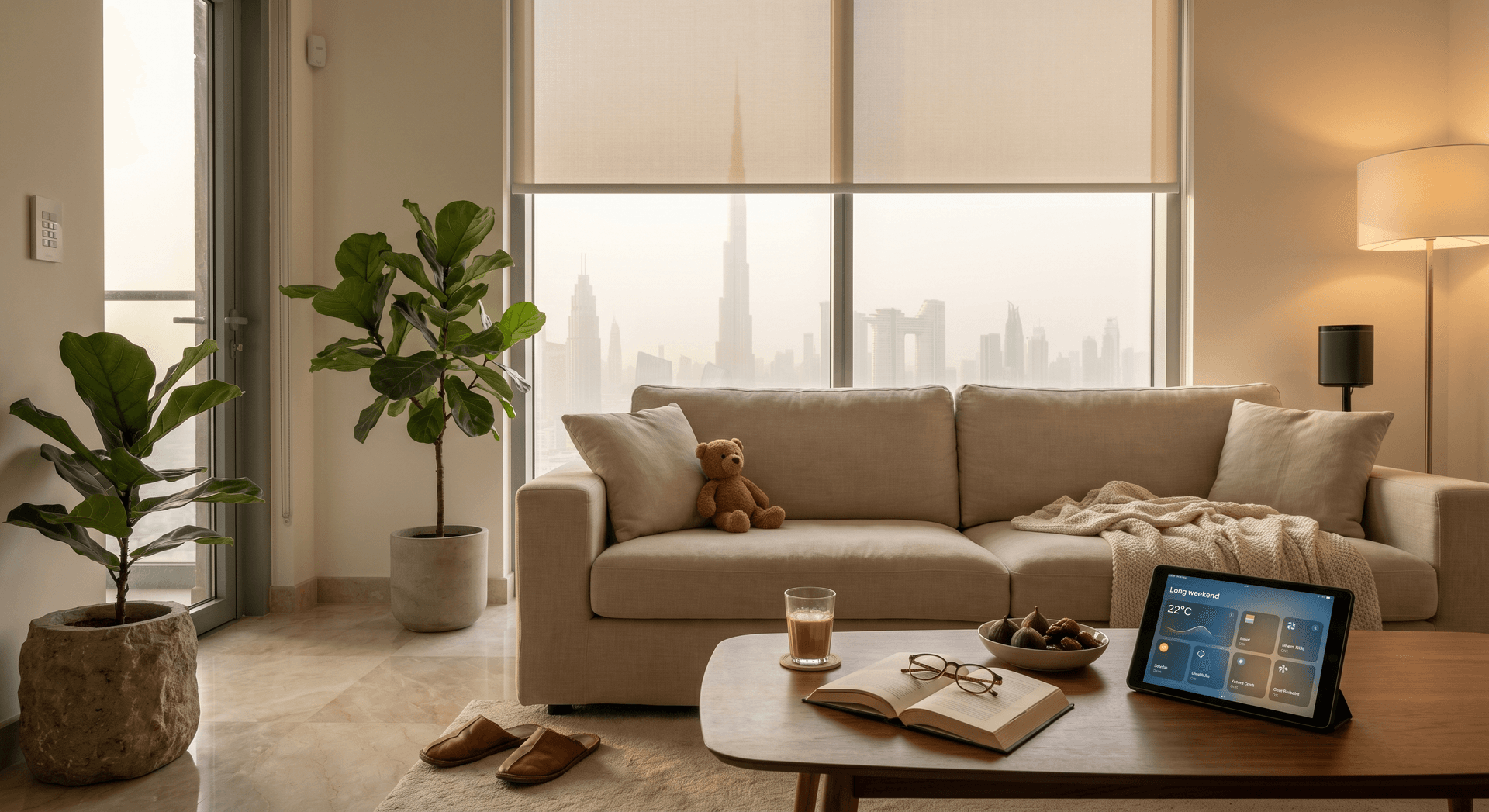
The blackout curtain in the kids' room has a gap of light down each side. At 5:30 in the morning on Saturday it is already 32 degrees outside, the dust is starting to lift on the road, and the seven-year-old is awake. The forecast for the day is 42 degrees in Dubai, 47 inland, dust through Sunday, fog probable along the coast tonight (Khaleej Times NCM daily, Jun 12). Monday is the Islamic New Year, public holiday for public and private sectors confirmed (Khaleej Times, 2026). Schools and universities are off. The family is staying in.
Three days at home in 42 degrees of heat is the real test of a Dubai apartment.
TL;DR: A 72-hour Hijri New Year long weekend at home in 42C-with-dust is what tells you whether your apartment is a place you live in or a place that requires constant management. A smart home does five things you stop noticing across those three days: it cools the right room at the right hour, closes the blinds before the heat wave hits the window, runs the air purifier through every dust gust, switches the lights from morning to wind-down without you touching a switch, and keeps the household quiet by Sunday night because nobody has had to fight the place. From AED 3,000 for the smallest useful setup. From AED 14,000 for a full apartment.
This is not a piece about hosting a dinner, or about saving the highest possible amount of AED on the chiller bill, or about a single bedroom. It is what 72 hours of staying in feels like when the apartment is set up to handle it, and what those 72 hours feel like when it is not.
The Three Days You Do Not Leave the Apartment
Mallathon launches Monday morning, the same day as Hijri New Year. It runs to 15 September, three months of malls turned into air-conditioned running tracks open 7 to 10 in the morning across nine venues (Time Out Dubai, 2026). The midday outdoor work ban starts the same day, 12:30 to 3 in the afternoon, for the 22nd year running, fines up to Dh50,000 per employer (Gulf News, 2026). Global Village closed at the end of May. Miracle Garden too. Dubai Safari Park is dark for the season.
The city has formally moved indoors for the next three months. The Hijri long weekend is the bookmark.
What we have found in apartments across Marina, Business Bay, JBR, and Downtown is that the smart-home question is no longer "what gadget do I buy." It is "what does the home do on its own when nobody is leaving for three days."
The honest answer is that a Dubai apartment with no automation makes you the operator. You wake up to a hot kids' room because the AC was off. You realise at one in the afternoon that the west side of the living room is twenty-nine degrees because the blind is open. You turn the AC down to eighteen on Sunday because the bedroom is not cooling, then forget to put it back up, and the bill carries it into July. You spend the long weekend feeling slightly like the apartment is fighting you.
A Dubai apartment with even basic automation makes you a resident. The home runs itself in the background and you only notice the things that need a person. The kettle, the conversation, what is for dinner.
Saturday Morning: The Home Wakes Up Before You Do
The first thing a useful smart-home setup does on a Saturday is decide, on its own, that nobody is on a school run.
In our experience installing smart homes across Dubai, the school-week schedule that wakes the bedroom AC at 5:45 and the kettle plug at 6:10 is the single most-relied-on automation in a young-family home. On a Saturday, that schedule has to know to stand down, either through a "weekend off school" calendar, or because the home detects nobody has moved past the hallway sensor by 6:30. What we have found is that the families who skip this step end up with a Saturday that starts at 5:45 anyway because the AC turned on, the lights came on at the entrance, and the kids' rooms cooled into the seventy-percent fan speed they associate with school mornings.
On the long weekend, the cooler version of the morning is simple. The master bedroom holds 22 degrees through the night and slides to 23.5 at 8:00 to keep the parents asleep on a slower start. The kids' rooms, which were sealed dark and cool through 6, hold their pre-set temperatures until the door sensor opens, at which point the schedule switches to "kids awake," ventilation up, blackout blinds opening on a 30-minute fade.
The kitchen lights come up to forty percent on the same fade. The kettle plug is enabled but not on. The Sonos starts a quiet playlist if and only if somebody walks into the kitchen.
Nobody touches a switch. There was no alarm. The seven-year-old woke up in a room at 21 degrees that was 32 degrees outside, and the family did not have to think about why.
This is what we mean by "the home runs itself." It is not glamorous. It is mostly invisible. It is also the part of a smart-home install that the household stops noticing inside two weeks, which is the only honest measure of whether it was worth the money.
The Saturday Afternoon Heat Wall (and the Blinds You Do Not Notice Closing)
By 1:30 in the afternoon, the long-weekend forecast hits its target. NCM lists Dubai high at 42 degrees, inland 47, dust at ten to twenty-five kilometres an hour gusting forty (Khaleej Times, 2026). The west-facing windows in a Business Bay 2-bedroom take roughly 1,000 watts of solar gain per two square metres at the peak of the afternoon. A typical Marina or Business Bay west wall runs 6 to 8 kilowatts of incoming heat between two and six in the afternoon if the glass is uncovered.
The blind in front of that window is the most-overlooked smart device in a Dubai apartment.
The home should be closing the west-facing blinds to seventy percent at 1:45, before the heat reaches the glass, not at 4:00 after the room is already 27 degrees and the family is asking why the living room is hotter than the kitchen. We have seen the pattern over and over again in 2-bed apartments where the AC is set to 22 degrees: the system is running flat out trying to undo a problem the blind would have prevented if it had closed twenty minutes earlier.
A motorized blind on a schedule does not feel sophisticated. It is not. It is a small motor and a Wi-Fi or Zigbee bridge that knows what time it is. But the difference between a 2-bed living room at 26 degrees at 5pm and a 2-bed living room at 23 degrees at 5pm is whether the family wants to sit there together for the evening or retreats to the bedroom because the sofa is uncomfortable. On a Saturday in the middle of a three-day weekend, the second option is the slow tax that wears a household down.
What changes when the blind handles this for you: the AC compressor cycles less, the bill is a little lower as a side effect, but the headline is that the living room stays usable across the afternoon. The family eats lunch there. The kids do homework there. By the time the sun is gone at 6:45, the blind opens again and the room cools naturally on the second hour of evening shade.
Read which windows need a motorized blind first before you spec the whole apartment. The answer in most 2-bed and 3-bed layouts is two to four windows, not all of them.
Saturday Evening: The Home Becomes a Venue, Not a Workshop
By seven in the evening the household has been together for thirteen hours. Nobody has left. The fridge has been opened forty-three times. Three of the four people in the household have used the iPad. The dishwasher has run once. The vacuum has run once. The seven-year-old has watched an animated film and is now drawing.
A long weekend at home is not a hosting event. It is closer to a long, slow Friday night (the dinner scene we wrote about a week ago extended into a 72-hour version of itself). The evening difference between a 2-bed apartment that is running smoothly and one that is not is whether somebody has to act as the operator.
A useful smart-home setup at 6:45 in the evening does this on its own. The west-facing blinds open. The living-room downlights soften from 4000 Kelvin daylight to 2700 Kelvin warm. The cove light around the ceiling perimeter comes on at thirty percent. The Sonos picks up a low-volume playlist in the living room and kitchen, not the bedrooms. The AC in the bedrooms steps up by a degree because nobody is sleeping in them yet. The kettle plug is enabled. The front entry light at the door comes up to thirty percent so the seven-year-old does not run into the wall on the way to the kitchen.
We do not think of any of this as "an evening scene." It is what a residential apartment should do when the time crosses 6:45 and the building has registered movement past the kitchen sensor in the last thirty minutes. The fact that it is on Lutron Caseta picos and Sonos and Aqara temperature sensors is somebody else's problem. The household experience is that the lights got softer, the music started, and dinner happened.
The detail that matters most across three days: the home does not have to be different on Saturday than Sunday than Monday. The same time-of-day logic carries through. Nobody has to remember to switch off a "hosting" scene. There was no hosting. There was being home. The one room that stays off-limits across a summer long weekend is the balcony, and if you want it back for the cool evening hour, our guide to making a Dubai balcony usable in summer walks through the shade, air, light, and sound it takes.
Sunday's Slow Hours: The Rooms That Are Not Being Used
This is the part of a long-weekend at home that wastes the most money on a system that is not paying attention.
A typical 2-bed Dubai apartment without smart AC control runs every room cold all day. The master bedroom is at 22 degrees through Sunday lunch because the AC has been on the same setting since Friday night and nobody has gone back in to change it. The guest bedroom is also at 22 degrees, even though it has been empty all weekend because nobody is staying over. The study, with the door shut, has been cooled since Wednesday for the office work-week. Three rooms cooled to apartment-spec on a day when the household is sitting together in the living room and kitchen.
We have seen Empower bills in Business Bay 2-bedrooms run AED 700 to AED 1,200 in the summer (Markets and Markets, 2025; Empower coverage 80%+ of Dubai district-cooled capacity, AED 0.568 per RTH). The chiller charge on a district-cooled apartment is the consumption line. The more rooms you actively cool, the higher it climbs. The pattern we see most often is not extreme. It is steady. The household pays for cooling rooms it is not in for three months straight, and then the August bill is the one that prompts the search query.
A useful smart-home setup on Sunday does something quiet. It detects the rooms with no movement in the last 90 minutes and steps the setpoint from 22 to 24 in those rooms. The master bedroom climbs to 24 by midday. The study climbs to 24.5 by 11. The guest bedroom climbs to 25. The living room and kitchen, where the household is, hold at 22. At 5pm the master steps back down to 22, so the room is comfortable when the family comes in to change before dinner. Nobody touched a thermostat.
Smart AC control is the layer that does this. The dirhams saved are not the headline. The headline is that the apartment is set up to ask "is somebody in this room" before it asks "what temperature is this room." That is the difference between an apartment that is responsive and an apartment that is on full power because nobody is in charge of turning anything down.
The honest version of the math on a 2-bedroom is in our smart AC control buyer's guide. The shorter version: the controller pays the dirham math back in three to four months in the summer and is invisible the rest of the year.
Sunday Night: Keeping the Air Clean While You Sleep
By Sunday evening the dust has been blowing for thirty-six hours. NCM had it at ten-to-twenty-five kilometres an hour through the weekend, gusting forty. Even with the windows sealed and the AC running, the dust gets in through the building MEP, through the front door, through the cleaner's footfall on Saturday morning, through the kids opening the balcony door for ninety seconds to look at the lightning over Sharjah.
A Dubai apartment in a dust day is meaningfully more polluted indoors than out. Dust particles do not settle quickly indoors because the building keeps the air circulating. By Sunday night the surfaces are dusty even though nobody has been outside.
A useful smart-home setup runs an air purifier on a schedule that follows the air-quality reading from a sensor in the living room. It does not run flat out for three days. It steps up during dust gusts and steps back down once the room reads clean. We use Aqara air-quality monitors paired with a Dyson or IQAir purifier, or any HEPA-rated unit that has a smart plug or a documented HomeKit integration. The home turns it on when it needs to be on. The household sleeps better. The full build for a working-day dust morning, with sensors, HEPA, smart plugs, and the five quiet routes dust takes into a closed apartment, is covered in our indoor air quality dust-day build for Dubai apartments.
The bedroom variant is the one most families care about. We set the air purifier in the kids' room to run from 7:30 in the evening until 8 in the morning, with the controller stepping the speed up on dust readings above a threshold. By Monday morning the household has slept through three nights of dust and woken up with no scratchy throats, no clogged nose, and a bedroom that smells clean rather than stuffy.
The Cleveland Clinic note we cited in our kids-room blinds piece is that ideal child sleep temperature is 18 to 21 degrees (Cleveland Clinic, 2024). On a dusty long weekend the temperature side is handled by the AC schedule. The air-quality side is what most apartments forget about until somebody starts coughing.
Monday Morning: Hijri New Year, and the Quiet Your Home Holds for You
The Hijri New Year is a quiet day. It is observance, not festivity. Hijri 1448 is one thousand four hundred and forty-eight lunar years since the migration from Mecca to Medina in 622 (Khaleej Times, 2026). The household wakes slowly. There is no school run. There is no work email. Most families we know spend the morning at home, then walk to the mall later if Mallathon is running near them (Time Out Dubai, 2026).
The home should hold a slow Monday morning gently.
What that means in practice: the lights come up at 8:30 instead of 6:30. The bedroom AC slides from 21 to 23 through the morning instead of pushing the household out of bed with a school-routine setpoint. The kettle plug is enabled but not pre-empting anybody. The Sonos is silent unless somebody walks into the kitchen and asks. The cove light in the living room comes on at fifteen percent so the room is not bright when the seven-year-old wanders in still tired.
The household experience is that the apartment respects the slow morning. Nothing buzzes. Nothing comes on at full strength. Nothing demands attention.
This is the bit of a smart-home install that is hardest to justify on a spreadsheet and easiest to feel on a long weekend. A home that is set up to be quiet on quiet days, and busy on busy days, is the actual point.
Open platforms are what make this kind of multi-day, multi-rhythm logic possible. The closed-brand version, where the lights and the AC and the blinds each have their own app and their own schedule, falls apart on a Monday that is not a Sunday that is not a Saturday. The household ends up turning manual everything because the system cannot tell what kind of day it is. We talk about why we picked Home Assistant as our open-platform default for this reason.
What 72 Hours Teaches You About Your AC, Blinds, and Lights
By Monday night the long weekend is over. The household has spent three days indoors in 42-degree heat. The Empower bill that lands at the end of the month will tell one story. The household experience tells another.
In our experience, the families who installed even a basic smart-home setup before this long weekend send us the same WhatsApp on Tuesday morning: "We did not realise how much we had been doing manually." They name three specific things, and they are always the same three.
The first is the AC. They had no idea how much they had been adjusting setpoints across the apartment by walking from room to room with a remote. The home did it for them across three days.
The second is the blinds. They had no idea how much the afternoon heat in the living room was about a window that was open at the wrong time. The home closed it before they noticed it had started warming up.
The third is the lights. They had no idea how much they had been turning on and off, dimming and brightening, finding switches in the dark, asking the partner to please get the cove. The home handled it.
The pattern that matters: none of these three things sound impressive when you read them. The whole point is that they should be invisible. A smart home you have to think about is a failure of design. A smart home that runs through a three-day Hijri long weekend in 42-degree heat without anybody touching a switch is, finally, a home.
This is the six-month indoor season we are now twelve days into. The long weekend is a stress test. The apartment is the venue.
The Honest AED 3K Starter for a Long-Weekend Home
We can talk you into the AED 35,000 build. We have. The full-home Home Assistant with Lutron Caseta lighting, motorized blinds on every west window, multi-zone smart AC with sensors per room, and an air-quality stack with two HEPA purifiers is what a 2-bed Marina or Business Bay apartment looks like when nothing is left manual. It runs through a long weekend the way the family in the section above experienced it.
But the smallest useful version of this is much smaller than that. We have written about it in our smart AC control guide and we will say it again here because it matters: the AED 3,000 starter is the most-recommended Bayora install of the last twelve months, and it is the version we will recommend first to a household that has never done this before.
AED 3,000 for a typical 2-bed Dubai apartment buys you a smart AC controller (Sensibo Sky or Aqara Smart Thermostat), a single Lutron Caseta dimmer on the living-room overhead light, a Phillips Hue starter pack with a Tap Dial controller for one room, and one motorized roller blind for the worst west-facing living-room window. The installation is two hours. The configuration is another two. Nothing is permanent. The renter packs it all up in twenty minutes when they move.
A 2-bed apartment with the AED 3,000 starter handles the Saturday evening + Sunday afternoon + Monday morning portions of the three-day weekend cleanly. It does not run the whole apartment on schedules. It does not have an air-quality sensor or an automated kids' bedroom. It runs the rooms where the household spends its time.
The full apartment build is AED 14,000 to AED 22,000 depending on layout, hardware preferences, and which rooms get the deepest treatment. The four-room Business Bay 2-bed we are walking around in this piece would be AED 16,500. That includes everything we have described in the previous eight sections. The kids' rooms automated, the air-quality stack running through dust, the living-room cove on a scene, the Sonos in the kitchen, the multi-zone AC with sensors per room, the blinds on the west wall, and the open-platform Home Assistant brain holding it all together.
What we tell every household at the AED 3K starter level: build the smallest version first. Live with it for a month. See which parts you stop noticing. Then decide what to add. We do not pitch the AED 16,500 setup to a household that needs the AED 3,000 one.
What Bayora Will Tell You Not to Buy This Weekend
The long weekend is when people search "smart home Dubai." This is the part of the post where we tell you what to skip.
Do not buy a Wi-Fi smart bulb for every ceiling fitting. We have walked into apartments where the household put eighteen Wi-Fi bulbs in over a weekend. Most of them are now off the network because the router cannot hold that many devices. Two Lutron Caseta dimmers on the overhead fittings would have done the same job in the rooms that mattered, and they live on the wall switch where the household reaches.
Do not buy an AED 1,200 wall-mounted touchscreen for the living room. We have not specced a wall touchscreen on a residential project in over a year. The household uses their phone, their voice, and the Lutron pico on the wall. The touchscreen sits unused, then ends up at the back of a cupboard with a charging cable.
Do not buy a no-name IR blaster as a smart AC controller. We see this every few months in client homes from previous installers. The device is unmaintained, the cloud server it depended on is down, the AC will not respond to the app. We have removed dozens of these and replaced them with Sensibo or Aqara controllers that do the same job and are still going to be supported in three years.
Do not buy a smart device that requires a cloud subscription to keep functioning. The most-asked question we get on Tuesday after a long weekend is "why has my smart device stopped working." The answer is almost always that the brand stopped supporting it, sold the product line, or stopped paying for the cloud server. An open platform we host locally on a Home Assistant Green inside the apartment does not have this problem. It is the principle 4 thing we talk about more than any other.
The point of all four "do not buys" is the same: spend less, but spend it on the things that will still be working in three years.
The Three Days, in Two Sentences
The city is moving its workouts indoors. The grid is preparing for the load.
Your apartment should be the easiest part of the long weekend.
Frequently Asked Questions
Do I need to do all of this before Monday?
No. The 3-day Hijri New Year weekend is an example of when a smart-home setup pays off. A useful starter is AED 3,000 and takes about half a day to install. Nothing in this piece requires the long weekend to be useful. It is most-felt across multi-day at-home stretches, but it works every Saturday.
Will this work in a chiller-free (DEWA-only) building?
Yes. A smart AC controller works on any split AC with an IR remote regardless of building type. In a DEWA-only chiller-free apartment, the savings show up on the DEWA bill directly. In a district-cooled building like most of Business Bay or Downtown, the savings show up on the chiller consumption line of the Empower or Tabreed bill. The household experience is the same either way.
Does the kids' room temperature change need a wired thermostat?
No. A smart AC controller (Sensibo or Aqara) with a separate room-temperature sensor handles this on any split AC. The sensor reads the room temperature wherever it sits, not the temperature at the ceiling AC unit, and the controller adjusts the AC accordingly. The install is non-invasive. Nothing is wired into the wall.
What happens if the Wi-Fi drops during the long weekend?
On an open platform like Home Assistant, almost all schedules continue to run locally even if the internet is down. The AC, blinds, lights, and scenes all keep working on their schedules. The only things that stop working are remote-control features (controlling the apartment from outside the home) and voice assistants that route through the cloud. On a closed cloud-only platform, more things stop working. This is one of the reasons we install local-first.
How long does the AED 3K starter take to install?
Two hours of installation, two hours of configuration and household walk-through. Most setups are done by lunchtime on a Saturday. The configuration is the half nobody talks about. Getting the scenes right, the schedules sensible, and the household trained to know what is on autopilot and what is not. We do not consider an install finished until everyone in the apartment, including the cleaner, knows how to use it.
Ready to set up an apartment that handles a long weekend on its own? Tell us about your home and we will recommend the smallest useful version of this for your apartment. From AED 3,000.
If you work from home during summer, the daily WFH scheduling problem (study at 22°C, pre-cool at 7am, zone control across rooms while you are working) is covered separately in working from home in Dubai summer.
Ready to Get Started?
Get a free consultation and we'll recommend what makes sense for your situation.
Get Free Consultation