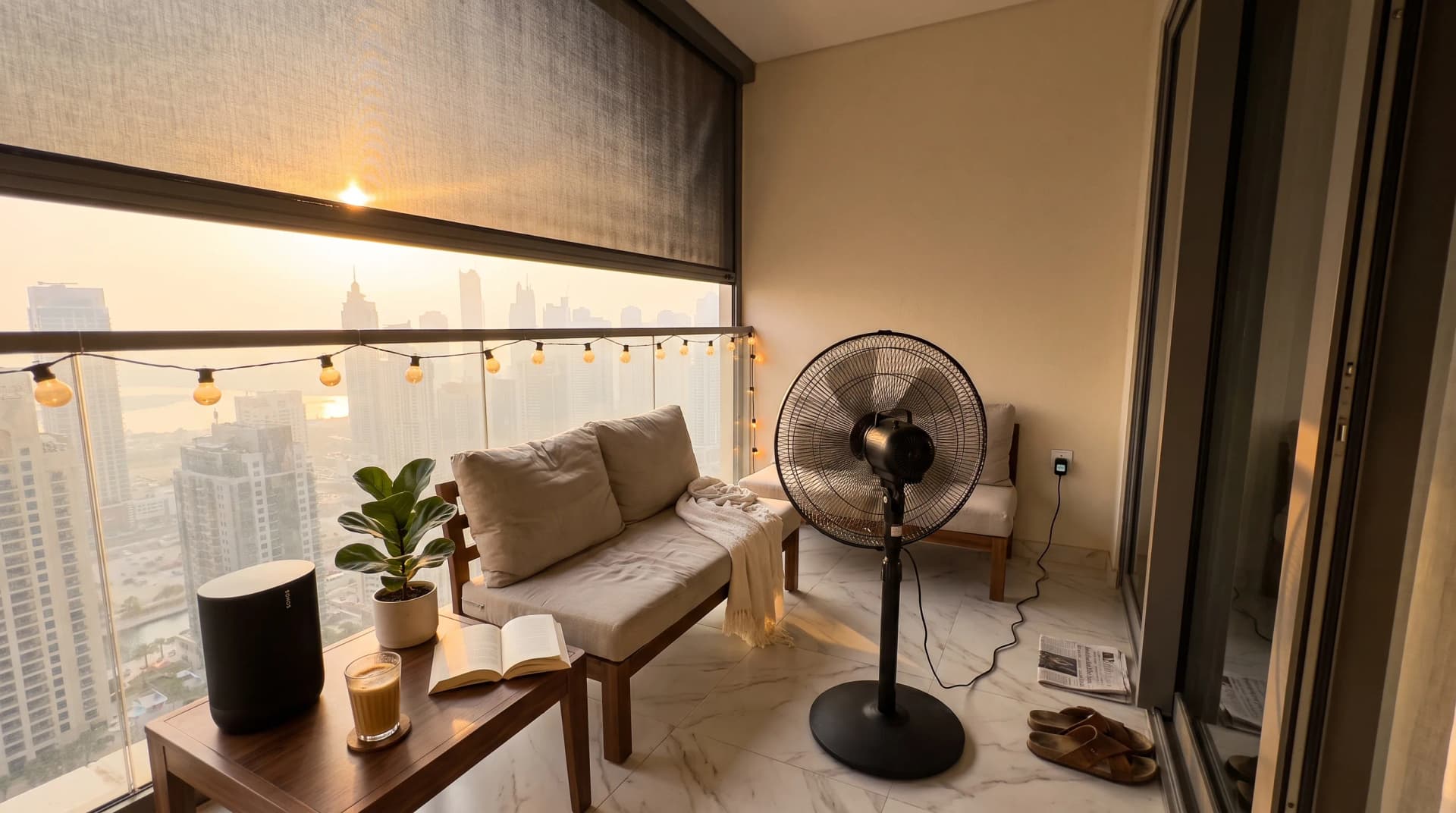
There is a balcony in your apartment that you paid for. It is part of the rent. It might be the reason you took this unit over the one down the hall. And you have not properly sat on it since March, because from April to October a Dubai balcony is not a place you relax. It is a place the heat lives.
The tiles bake all afternoon. The glass railing throws heat back at you. By four o'clock a west-facing balcony is a wall of warm air, and the one comfortable hour after sunset is the hour you are too tired to go set anything up. So the balcony becomes storage. A drying rack. A place the kids' bikes go. An outdoor room you are cooling nothing and using nothing, three floors above a city where every other outdoor space shut for the summer.
You can get it back. Not with one gadget, and not by pretending Dubai in July is Marbella. With four honest layers, in the right order, most of them renter-safe and none of them requiring a drill in the facade.
TL;DR: A Dubai apartment balcony becomes usable in summer when you fix four things in order: shade first (external shading blocks the sun before it hits you and cuts solar heat gain far more than any indoor blind), then moving air (a good fan makes it feel a few degrees cooler), then warm light and weatherproof sound for the evening. Skip the misting fan in humid coastal Dubai, it barely works. Most of this is wireless, renter-safe, and controllable from your phone. A starter balcony setup fits inside the AED 3,000 range.
The Balcony Is the One Bit of Outdoors You Control in Summer
From mid-June, Dubai's outdoors mostly closes. Global Village and Dubai Miracle Garden shut for the season around late May and do not reopen until the autumn (Gulf News, 2026), and the outdoor work ban clears the streets between 12:30pm and 3pm because peak-summer temperatures sit in the 45 to 50C band (Gulf News, 2026).
So the city agrees with you: the afternoon belongs indoors. But your balcony is not a park or a mall. It is yours, it is private, and after the sun drops it is the closest thing you have to sitting outside without getting in the car. One thing clients tell us often is that the balcony was the whole point of the apartment, and it is the one part they gave up on first. Making it work for the few pleasant hours a day it can offer is a better use of AED 3,000 than most things people spend it on inside.
Fix the Four Layers in Order: Shade, Air, Light, Sound
A usable Dubai balcony needs four things, and the order matters because each one unblocks the next. Shade comes first, because until you stop the sun hitting the space, nothing else helps. Then air movement, to make the shaded space feel cooler. Then warm light, because the balcony is an evening room in summer, not a midday one. Then sound, so it feels like somewhere you want to stay.
People usually start at the wrong end. They buy a Bluetooth speaker and some fairy lights, sit down at 5pm, and last eleven minutes because the space is still 40C. The gear was not the problem. The order was. Sort the heat, and the light and sound turn a shaded, breathable balcony into a place you use most evenings. Skip the heat, and you have a nicely lit oven.
Here is what each layer does, honestly, in Dubai's specific climate.
Shade First, and Outside Beats Inside Every Time
External shading is the single biggest lever on a Dubai balcony, and it works because it stops the sun before it reaches you. Exterior shades cut solar heat gain by around 55 percent, against roughly 18 percent for an interior roller shade doing the same job (PNNL / US Department of Energy, 2026). Industry figures put a good exterior shade at 59 to 77 percent solar heat rejection, higher with a dense fabric on a west face (Polar Shades, 2026). The reason is simple: an outdoor screen turns the sun into heat outside your space, where it blows away. An indoor blind lets the heat through the glass first, then traps it.
On a balcony that means an external option: a retractable awning, a drop-down zip-screen along the open side, or a shade sail. In our experience the drop-down zip-screen is the one that changes a Dubai balcony the most, because it takes the west or south face out of direct sun while you still see through it.
One hard rule for Dubai, though. Any outdoor shade needs to retract itself in wind, automatically, or a sudden gust destroys it. A wireless wind sensor like the Somfy Eolis retracts a motorized awning above a threshold you set, anywhere from about 10 to 50 km/h, even when nobody is home (Somfy, 2026). This is not a nice-to-have in a city that goes from still to 40 km/h in twenty minutes. If someone quotes you an outdoor awning with no wind retraction, that is the wrong quote.
Cooling a Balcony Honestly: What Works in Humid Heat
Moving air is the honest way to cool a shaded balcony, and misting is mostly not. Here is the part the misting-fan adverts leave out. A high-pressure misting system can drop the air in its zone by 12 to 15C, but only in dry heat, below about 60 percent humidity. In humid coastal air above 80 percent, which is Dubai most of the summer, that drop collapses to roughly 2 to 5C and the air just goes damp (MISTEC, 2025). On a July evening on a Marina balcony, a misting fan mostly gives you humidity you already had, plus water spots.
A fan is the better tool, because it works on you rather than the air. Moving air across skin produces real perceived cooling: around 0.5 metres per second of airflow feels like about 2C cooler, and stronger airflow around 2.8 m/s can offset up to 4C of warmth, even though the thermometer does not move (UC Berkeley Center for the Built Environment, 2020, citing ASHRAE 55). So a decent high-velocity outdoor fan on a shaded balcony, plugged into an outdoor smart plug so it comes on with your evening scene, buys you the few degrees that make the difference between sitting down and giving up. It is a floor fan and a plug, not an engineering project.
Light That Turns It Into a Room After Dark
Warm, weatherproof light is what makes a balcony an evening room, and the key spec in Dubai is that the fixtures survive the outdoors. Since the balcony is a summer space only after sunset, the lighting is doing most of the work of making it feel like somewhere to be. String or festoon lights along the railing at a warm colour, a floor lamp rated for outdoors, low glow rather than a floodlight.
The fixtures have to be genuinely outdoor-rated. A weatherproof smart strip like the Philips Hue Outdoor Lightstrip is rated IP67 and handles roughly -20 to 45C (Philips Hue, 2026), which is what you want for something sitting in Dubai sun and the occasional shamal dust. What we have found is that the smart part matters here more than people expect, because the whole point is that the balcony lights come up on their own at sunset as part of a scene, warm and dimmed, without anyone walking out to switch them on. If warm evening light is the layer you care about most, our guide to living-room evening lighting in Dubai covers the colour-temperature logic in more depth, and the same thinking applies outside.
Sound Without the Bluetooth-Speaker-on-a-Planter Problem
Good balcony sound means a speaker rated to survive the heat, not a phone speaker propped against a plant pot. The catch that trips people up is temperature tolerance, not waterproofing. The Sonos Roam is the more waterproof unit at IP67, but its operating range tops out around 35C, below a Dubai summer afternoon, so it struggles left out in the heat. The Sonos Move 2 is rated IP56 and, more importantly, operates from -10 up to 55C (Sonos, 2026; range via manufacturer-echoing reviews), which is the one that survives a shaded Dubai balcony and travels back inside to charge. For a renter that is the honest pick: portable, no wiring, and it joins the rest of your Sonos indoors.
Keep it neighbourly. Dubai residential noise limits sit around 40 to 50 dB in the day and 30 to 40 dB at night at the property line, with quiet hours from 10pm (Dubai Municipality residential noise guidance, 2026). Conversation-level music on a balcony fits inside that. A smart speaker can cap its own volume after 10pm so you never have to think about it. For the full trade-off between portable and mounted architectural outdoor speakers, and what survives ten Dubai summers, our outdoor speakers guide is the deep read.
The Balcony Scene: One Tap Instead of Four Trips Outside
The layers become a balcony worth using when they run as one scene instead of four separate errands. This is the home automation part, and it is what turns four gadgets into a room. An evening balcony scene, triggered at sunset or from one tap on your phone, does this: the zip-screen drops to shade the last of the low sun, the fan comes on through its outdoor smart plug, the string lights fade up warm, and the speaker starts a low playlist. You walk out to a balcony that is already set, instead of walking out four times to switch things on.
The wind sensor sits underneath all of it, quietly overriding the scene to pull the shade up if a gust arrives. In our experience the scene is the difference between a balcony people use twice a summer and one they use most evenings, because the friction of setting it up by hand is exactly what stops people. You slide the door open at eight, the light is already warm, the fan is already turning, and something quiet is playing over the sound of the traffic below. A balcony that is already ready when you open the door is a balcony you end up sitting on.
Renter-Friendly and Non-Permanent, Because the Facade Is Not Yours
Most of a good balcony setup is wireless and removable, which matters because the balcony is usually the part of a Dubai apartment you are least allowed to alter. Exterior changes to a building, balcony enclosures, tinting, fixed external fittings, typically need Owners' Association and often master-developer approval, because they change the shared facade; a tenant cannot alter the structure without the owner's permission, and balcony breaches can draw municipality fines in the AED 500 to 1,500 range (Property Finder, 2026).
So the renter version stays clip-on and freestanding. A freestanding or tension-mounted zip-screen instead of a drilled awning. A floor fan, not a wired ceiling unit. Portable speaker, plug-in string lights on an outdoor smart plug, all of which come off in an afternoon and move to the next apartment. If you own and can drill, a motorized awning with a proper wind sensor is worth it. If you rent, you can still get most of the result without touching the building. Either way, ask your building management before you fix anything to the outside wall, and keep the receipts on the removable version. Our guide to which windows to automate first uses the same renter-safe logic for the glass on the inside.
What Bayora Will Talk You Out Of
The honest part of a balcony project is the list of things we tell people not to buy. In our experience, three come up on almost every balcony survey, and skipping them is what keeps the project sensible.
Skip the misting fan in the humid months. On a coastal Dubai balcony in July it gives you damp air and water marks, not the 12-degree drop in the video, because the humidity is already too high for it to evaporate (MISTEC, 2025). If you love the idea, run it in the shoulder months when the air is drier, and lean on the fan the rest of the year. Skip the outdoor patio heater entirely, because the number of nights cool enough to want one in Dubai does not justify the cost or the storage. And skip the built-in wall-mounted outdoor touch panel a big installer might pitch; a phone and a wall keypad indoors run the balcony scene fine, and the panel is one more thing to bake in the sun. If your balcony is genuinely solved by a fan, a screen, some lights, and a speaker, we are not going to quote you a pergola with integrated cooling.
A Real Business Bay Balcony, Made Usable for AED 4,200
Here is what this looks like as a real, renter-safe project rather than a wish list. A two-bedroom in Business Bay, west-facing balcony over the water, unused since spring because it cooked from 3pm and had one dim bulb. The tenant did not own the unit and could not touch the facade.
We fitted a freestanding tension-mounted zip-screen across the open west side, a high-velocity outdoor fan on a Shelly outdoor smart plug, a run of Philips Hue outdoor string lights along the railing, and a Sonos Move 2 that lives inside and comes out in the evening. One balcony scene ties it together at sunset, and nothing needs a wind rule because the screen is tensioned by hand, not motorized at this scope. Total was around AED 4,200, all of it removable when the lease ends. The tenant's line back to us was that they had started eating dinner outside three or four nights a week, which they had not done in two years in the building. The bill did not change in any way worth mentioning. The balcony changed completely. That is the trade we were aiming for.
Frequently Asked Questions
How do you cool a balcony in Dubai summer?
Shade it first with an external screen or awning, then move air across yourself with a high-velocity fan. Moving air feels 2 to 4C cooler even without lowering the temperature. Skip misting fans in Dubai's humid summer months, they barely work above 80 percent humidity and mostly leave the air damp.
Do misting fans work in Dubai?
Not well in peak summer. High-pressure misting can drop air temperature 12 to 15C in dry heat, but only below about 60 percent humidity. Dubai's coastal summer sits above 80 percent, where the cooling drops to roughly 2 to 5C and the mist adds dampness rather than relief. A fan is the more effective and lower-maintenance choice.
Can renters set up a smart balcony without drilling?
Yes. A freestanding tension-mounted screen, a floor fan on an outdoor smart plug, plug-in weatherproof string lights, and a portable speaker all need zero drilling and come off when you move. Exterior building alterations usually need Owners' Association approval in Dubai, so the removable route keeps you clear of facade rules.
What smart speaker survives a Dubai balcony?
Choose for heat tolerance, not only waterproofing. The Sonos Move 2 operates up to 55C and handles a shaded Dubai balcony, while the more waterproof Sonos Roam tops out near 35C and struggles in summer heat. Bring any portable speaker inside to charge, and it joins your indoor system.
Do outdoor blinds and awnings need a wind sensor in Dubai?
Yes, this is essential. Dubai wind can jump from calm to 40 km/h quickly, and an exposed awning gets destroyed without automatic retraction. A wind sensor like the Somfy Eolis retracts the shade above a set threshold on its own, even when nobody is home. Never fit a motorized outdoor awning without one.
Get Your Balcony Back
Your balcony is the one outdoor room in your apartment that you already pay for and barely use for half the year. Shade, air, warm light, and sound, in that order, turn it back into somewhere you sit most evenings, and most of it is wireless and renter-safe. Tell us about your balcony and we will recommend exactly what fits your space and your lease. Free consultation, free survey, complete pricing in the proposal. No surprises.
Ready to Get Started?
Get a free consultation and we'll recommend what makes sense for your situation.
Get Free Consultation