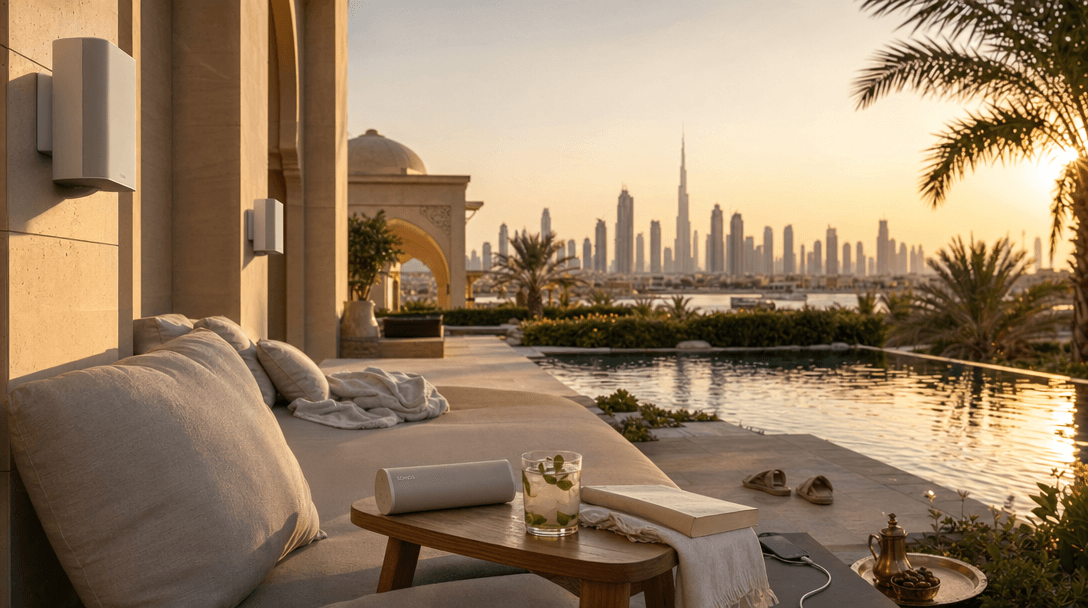
You spent AED 60,000 on landscaping. The pool light fades up at sunset. The dates are out. The mint lemonade is poured. And the music is coming from a Bluetooth speaker propped against a planter, cutting out every time someone walks past with a phone.
Outdoor audio is the last unfinished room in most Dubai homes. We see it constantly. A villa with full whole-home automation inside, then a tinny portable speaker on the terrace because the owner heard outdoor speakers "don't last in Dubai." That's half-true. The wrong ones don't. The right ones are still working ten summers in.
TL;DR: Outdoor speakers rated IP55 typically fail within 12-18 months in Dubai because the rating doesn't cover salt humidity, UV, and 50°C heat. You want IP66 or higher with MIL-STD 810 for villas, IP67 portables for renters and balconies. Budget AED 3,800-7,500 for a proper terrace pair installed, or AED 850-1,400 for a single waterproof portable. Stay under 50 dB at the property line and you're inside Dubai's noise rules.
The IP Rating Problem Nobody Explains
The IP rating on the box is the start, not the answer. IP55 means dust-protected and resistant to water jets (HARMAN Pro, 2025). On paper, that sounds fine for a covered balcony. In Dubai practice, IP55 speakers tend to die in 12-18 months because the rating doesn't test for what actually kills them here: 90% summer humidity, salt-heavy coastal air, UV that fades plastics in one summer, and ambient temperatures that hit 50°C inside a sealed enclosure on a south-facing wall.
The threshold most installers in the region trust is IP66, paired with a MIL-STD 810 environmental spec for humidity, salt spray, and temperature. Sonos Outdoor by Sonance is rated IP66 and MIL-STD 810 across an environmental range of -25 to 65°C (Sonos, 2025). That's the kind of spec sheet that survives a Dubai summer. IP67 is even better for poolside, especially if there's any chance of splash or rinse-down.
In our experience, the failure pattern is consistent. Cheaper IP55 speakers sound great on day one, develop a rattle by month nine, and lose one driver by month fifteen. The salt and humidity creep into the crossover, the surrounds dry out under UV, and the sealed enclosure gets warped by heat cycles. Spending an extra AED 1,500 on a properly rated pair upfront usually costs less than replacing a cheap pair twice.
Where Each Type of Outdoor Speaker Belongs
Outdoor audio splits into three setups that suit very different homes. Pick the one that matches your space, not the one with the best ad.
Architectural pair (mounted, wired, permanent). Two on-wall speakers powered by an amplifier inside the house. Best for villa terraces, large balconies in owned apartments, and pool decks. Wired install, clean look, even sound coverage. AED 3,800-7,500 installed for a Sonos Outdoor by Sonance pair (2026). This is the setup that disappears into the architecture and lasts a decade.
Portable waterproof. A single rugged battery-powered speaker that lives outside in nice weather and comes inside when it gets brutal. Best for renters, smaller balconies, and homes where you want music in different spots. The Sonos Roam 2 is IP67 rated and runs around AED 849 in the UAE (Sonos, 2025). The Move 2 is IP56, louder, around AED 1,400 (Amazon UAE, 2025). Zero installation, full app control, comes with you when you move out.
In-ceiling outdoor (covered ceilings only). Recessed speakers in a covered terrace, gazebo, or majlis ceiling. Invisible, even, and great for ambient music during gatherings. Only works if the ceiling is genuinely covered from rain and direct sun. We see these used well in Dubai Hills villas with covered outdoor majlises and on Palm Jumeirah covered terraces.
The mistake we see most often is owners trying to use a Bluetooth party speaker as a permanent outdoor system. It works for a season. Then it doesn't.
Dubai Noise Rules and Outdoor Audio
Dubai has clear residential noise limits, and they apply to your speakers exactly the way they apply to your neighbour's renovation. Permitted noise during the day is 40-50 dB, and at night it drops to 30-40 dB (Property Finder, 2025). Downtown Dubai gets a slight bump to 45-55 dB day and 35-45 dB night because of mixed-use zoning. Quiet hours are 10pm to 7am.
Those numbers are measured at the property line, not at the speaker. So a pair of speakers running at conversation volume on a villa terrace usually sits well within the rules. A pair running at "I want to feel the bass at the pool" volume at 11pm does not. The legal basis is Dubai Local Order 61/1991, which says noise must not interfere with the peace, comfort, and convenience of any person. Dubai Municipality enforces it through 800 900 and the smart app.
For renters in apartment buildings, the math gets stricter. A Marina or JBR balcony shares walls with neighbours on three sides. We tell renters to keep balcony audio under 50 dB at any time and to switch to indoor or headphone listening after 10pm. A smart system makes this easy. Set a schedule that automatically caps volume after 10pm, or a "night mode" scene that drops the outdoor zone to 20% and routes anything louder to indoor speakers. When we installed a JBR balcony setup last summer for a client who entertains often, the auto-cap at 9:45pm has gotten zero complaints in eight months.
What It Costs in Dubai (Real Numbers)
Outdoor audio in Dubai sits in a wider price range than most categories because the climate forces real engineering tradeoffs. Here's what we see in 2026.
| Setup | Hardware | Installation | Total |
|---|---|---|---|
| Single portable (Sonos Roam 2) | AED 849 | None | AED 849 |
| Single portable (Sonos Move 2) | AED 1,400 | None | AED 1,400 |
| Architectural pair (Sonos Outdoor) | AED 3,799 | AED 800-1,500 | AED 4,600-5,300 |
| Architectural pair + amp + multi-room | AED 5,500-7,500 | AED 1,500-3,000 | AED 7,000-10,500 |
| Full terrace zone (4 speakers + sub) | AED 9,000-14,000 | AED 3,000-5,000 | AED 12,000-19,000 |
The portable end is renter-friendly and zero-risk. The architectural pair is what most Dubai villa owners end up choosing because it disappears into the wall and integrates with the indoor system. The full terrace zone is for the homes that genuinely host weekly. We don't pitch the AED 14,000 setup to anyone whose problem can be solved by an AED 3,800 pair, and you shouldn't let anyone pitch it to you either.
For comparison, a Polk Atrium 6 pair runs about AED 1,800-2,400 in the UAE and works well for medium patios under cover (Outer Audio, 2026). The Bose 251 is sleek, durable, and ships with a 5-year warranty - a fair midrange option. Yamaha NS-AW150 is the budget end at under AED 700 a pair, sealed enclosures, fine for fully covered, lower-humidity spots. None of these match the Sonos Outdoor for environmental durability or whole-home integration, but they are real options if you're optimizing for cost.
The Wiring and Permission Reality
For renters, this is the easy part. Portable speakers need zero wiring, zero landlord approval, and zero hole in the wall. You charge them, you carry them outside, you bring them in. The only thing to think about is where to charge them out of direct sun. A Sonos Roam 2 left on a sunlit table at 48°C will lose battery cycles fast, even though the IP rating handles the heat for short stints. We tell renters to dock indoors and carry out for use.
For owned apartments, the architectural pair is usually doable but check three things first. Run the cable inside the wall (not surface-mounted) so it survives heat and looks clean. Confirm with the building that you can install on-wall speakers and route audio cabling - most Dubai towers will say yes for owner units, no for rentals. Follow your building's quiet-hours rules as well as Dubai Municipality's, since towers usually have stricter limits.
For villas, you have full control, but plan the cable runs before tiling or finishing. We see too many villa owners who fall in love with outdoor audio post-handover and end up running cable along the outside of a wall in conduit because the conduits inside were never planned. The right time to plan outdoor speakers is the same time you plan landscape lighting - at the design stage, not after.
Integration With the Rest of Your Smart Home
The reason most outdoor audio setups feel like an upgrade and not a project is when they share the same control system as everything else. With a Sonos system, your outdoor zone shows up in the Sonos app next to the living room and the bedroom. With a whole-home automation setup running Home Assistant or Control4, the outdoor zone joins automated scenes.
Some examples we set up for clients regularly:
Sunset scene. When the outdoor temperature drops below 32°C and the sun is below the horizon, terrace lights warm up, motorized blinds on the inside windows open to extend the evening light, and outdoor music starts at 30% volume on the terrace zone. One trigger, full atmosphere.
Hosting mode. One tap on the kitchen tablet. Indoor and outdoor zones grouped, kitchen and dining lights at 80%, terrace lighting at 50%, AC dropped 1°C in the rooms guests will use, music starts on a "dinner party" playlist at 35% volume. Nobody walks around fiddling with five apps.
Quiet-hours auto-cap. At 9:45pm any night, outdoor zone volume caps at 25%. At 10pm, it drops to 15%. At 10:30pm, it switches off and any active music routes to the indoor zone instead. Keeps you on the right side of the building rules without thinking about it.
Multi-room audio is where outdoor speakers stop feeling like a separate purchase and start feeling like part of the home. If you want a deeper read on the trade-offs between Sonos and HomePod ecosystems, our multi-room audio guide for Dubai apartments covers it. For comparing soundbar versus AV receiver versus in-ceiling for indoor cinema, see our soundbar vs AV receiver vs in-ceiling guide. And if the speaker is going on an apartment balcony that bakes all afternoon, sound is only one of four layers that space needs, so our guide to making a Dubai balcony usable in summer covers the shade, air, and light that come first.
What We Tell Clients to Buy First
If you're new to outdoor audio and you live in a Dubai apartment with a balcony, start with one Sonos Roam 2. AED 849, IP67, lives indoors, comes outside when you want it. After three months you'll know if you want more.
If you own a villa with a terrace or pool deck, skip the experimentation and go straight to a Sonos Outdoor by Sonance pair, properly mounted, wired into the indoor system. AED 4,600-5,300 installed, ten-year horizon. You won't think about it again until the warranty letter shows up in the mail.
If you're entertaining genuinely often - hosting 10+ people most weekends, running an Airbnb, doing seasonal Eid gatherings on the terrace - look at a four-speaker setup with a covered subwoofer. That's the AED 12,000-19,000 zone. Most homes don't need it. The ones that do, know.
The brand that comes up most in our installs is Sonos because the ecosystem is the easiest to expand and the warranty support is real in the UAE. But this isn't a Sonos pitch. If you already have a Bose audio system indoors, stay in that ecosystem. If you have nothing yet, Sonos is the safest bet for a system you'll be happy with in five years.
Frequently Asked Questions
What IP rating do outdoor speakers need in Dubai?
For mounted, exposed outdoor speakers in Dubai, target IP66 minimum with MIL-STD 810 environmental certification. IP55 speakers often fail within 12-18 months because the rating doesn't cover salt humidity, UV, and 50°C heat. For poolside or splash zones, IP67 portable speakers like the Sonos Roam 2 work well because they handle full immersion up to 1m for 30 minutes.
Can renters install outdoor speakers on a Dubai balcony?
Yes, with portable speakers. A Sonos Roam 2 (AED 849) or Move 2 (AED 1,400) needs zero wiring, zero landlord approval, and zero permanent installation. They charge indoors and travel out to the balcony. Wired architectural speakers usually need landlord and building approval and are not worth the effort if you're renting on a one or two year lease.
What are the noise limits for outdoor speakers in Dubai apartments?
Dubai residential noise limits are 40-50 dB during the day (7am-8pm) and 30-40 dB at night (8pm-7am), measured at the property line. Downtown Dubai allows 45-55 dB day and 35-45 dB night. Quiet hours are 10pm-7am. Conversation-volume music on a balcony usually fits, but loud bass at 11pm doesn't. Smart speakers can auto-cap volume at quiet hours.
Will outdoor speakers work with my existing Sonos system?
Yes. Sonos Outdoor by Sonance speakers connect through a Sonos amp (Sonos Amp, around AED 2,800) and show up in the Sonos app as another zone. You can group them with indoor speakers, set up automated schedules, and run different music in different rooms. If you have a Sonos system indoors, the outdoor expansion is the easiest path forward.
How long should good outdoor speakers last in Dubai?
Properly rated speakers (IP66+, MIL-STD 810) typically last 8-10 years in Dubai with no major issues. We have client installs from 2018 still running fine. Cheaper IP55 speakers usually need replacement within 12-18 months because Dubai's combination of UV, salt air, and heat is brutal on enclosures and drivers that aren't environmentally certified.
Ready to Finally Hear Your Garden?
Most Dubai homes have great indoor audio and a forgotten Bluetooth speaker outside. Closing that gap is one of the highest-impact upgrades you can make for AED 4,000-7,000, and it pays itself back the first time you host a dinner that doesn't end with someone asking "what's that buzzing sound?"
Tell us about your space and we'll recommend exactly what fits - portable, architectural, or full multi-zone. Free consultation, free survey, complete pricing in the proposal. No surprises.
Ready to Get Started?
Get a free consultation and we'll recommend what makes sense for your situation.
Get Free Consultation