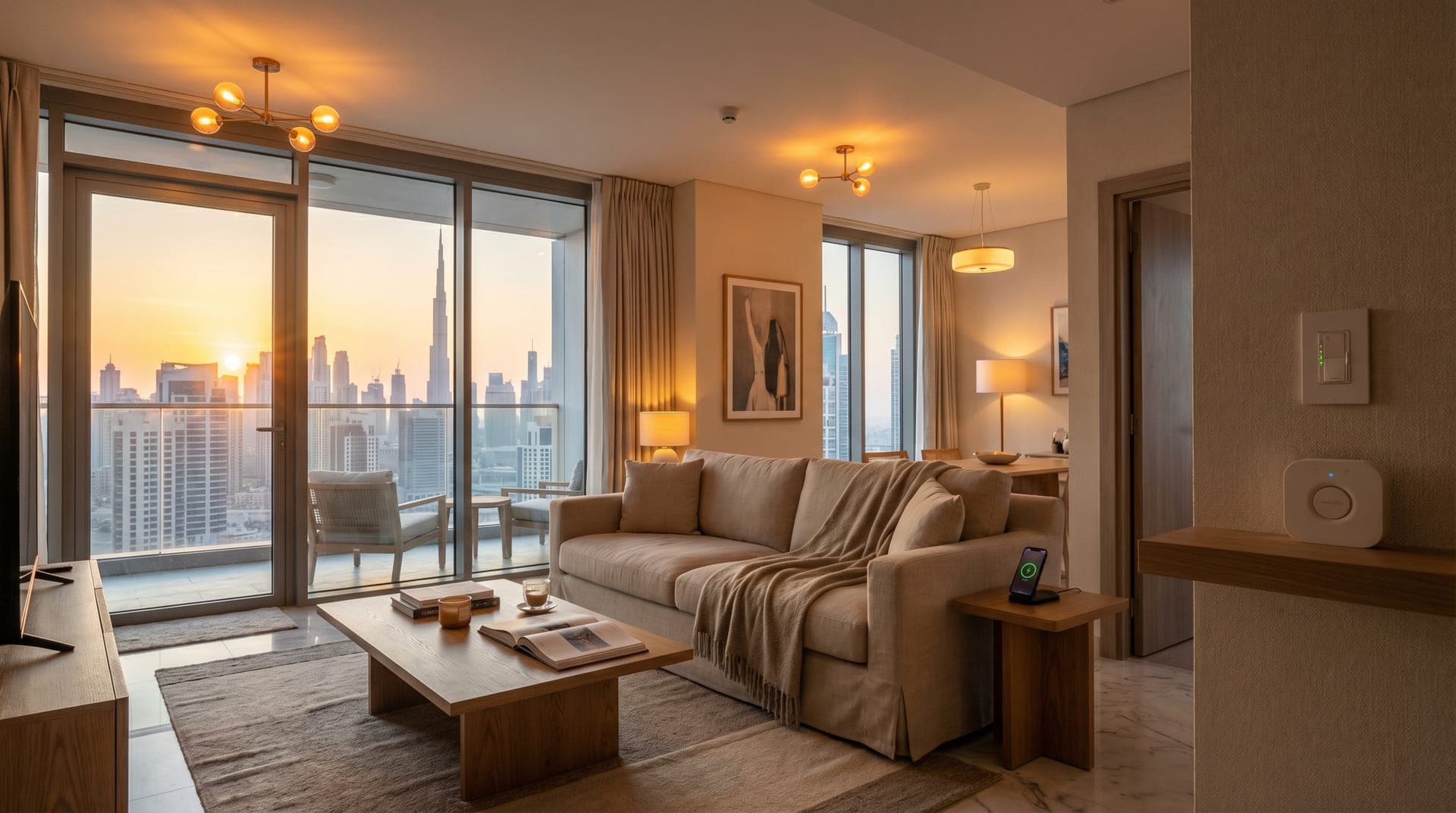
The UAE smart lighting market hit USD 90.7 million in 2024 and is growing at 18.66% per year (IMARC Group, 2025). That means thousands of Dubai residents are upgrading their light switches right now. And most of them are doing it wrong - buying one Philips Hue bulb, plugging it into a lamp, and wondering why their apartment still feels like a hotel room with one lighting mode: on.
TL;DR: Smart lighting in Dubai starts from AED 50 per smart bulb or AED 150 per smart switch. A complete 3-room setup runs AED 1,500 to AED 5,000 depending on bulbs or switches. Renters should pick bulbs (take them when you move). Owners should pick switches (cleaner, more permanent). The real value comes from scenes and schedules, not the bulbs themselves.
Most people think smart lighting means controlling bulbs from your phone. Phone control is a side effect. The real value is in scenes (one tap for "movie night") and schedules (warm dim light every evening at sunset, no thinking). Do it right and your apartment stops having one mode. Do it wrong and you have a AED 379 bulb you control with your phone instead of the switch on the wall.
This is the complete guide. What it costs, which brands work in Dubai, how renters and owners should approach it differently, and the four scenes every Dubai apartment should have.
What Smart Lighting Is
Smart lighting replaces your standard bulbs or switches with versions that connect to your home network. Once connected, you can dim them, change their color temperature, schedule them, and group them into scenes. You control everything from an app, a voice assistant, or a wall remote.
The category splits into two approaches. Smart bulbs (like Philips Hue) screw into your existing fixtures and work immediately. Smart switches (like Lutron Caseta or Shelly) replace the wall switch itself, making every bulb in that circuit smart regardless of brand. Both approaches solve the same problem from different ends.
Lighting accounts for roughly 15% of an average home's electricity use (US Department of Energy, 2024). That's not the biggest line item on your DEWA bill (AC is 60-70%), but it's not nothing. The bigger win is how your apartment feels when lighting stops being a switch you flip and starts being something that responds to your life.
What Smart Lighting Costs in Dubai
A basic smart bulb in Dubai starts from AED 50. An in-wall smart switch starts from AED 150. A Philips Hue starter kit with Bridge plus 3 color bulbs runs about AED 379 (Tech Hack, 2025). For a typical 2-bedroom apartment, a complete smart lighting upgrade sits between AED 1,500 and AED 5,000 depending on whether you pick bulbs or switches and how many rooms you cover.
Here's the math on what that gets you:
- Living room: 4-6 smart bulbs or 2-3 smart switches = AED 400 to AED 1,200
- Master bedroom: 2-3 smart bulbs or 1-2 switches = AED 200 to AED 600
- Hallway and kitchen: 3-4 smart bulbs or 2 switches = AED 300 to AED 700
- Bridge or hub (one-time): AED 200 to AED 500
- Professional installation (switches only): AED 2,000 to AED 5,000 for a full apartment (ServiceMarket, 2025)
Bulb-only setups skip the installation cost entirely. You unscrew the old bulb, screw in the new one. That's it. For renters, this is the whole appeal.
Whole-apartment mid-range automation (lighting plus AC plus security) runs AED 10,000 to AED 20,000. KNX professional systems for villas start around AED 30,000 and can go past AED 80,000 depending on scope. Most Dubai apartments never need that level.
Smart Bulbs vs Smart Switches: How to Choose
The choice comes down to what you own and how permanent your setup is. Both work. Both have tradeoffs.
Smart bulbs are right when: You rent. You want to take everything with you. You want color changing (sunset oranges, party pink, study blue). You have lamps and fixtures with exposed bulbs. You want to start tomorrow without an electrician.
Smart switches are right when: You own your apartment or villa. You have fixtures that use GU10 spotlights, chandeliers, or hidden bulbs. You want the wall switch itself to keep working for anyone who walks in. You want one switch to control 6 bulbs instead of 6 separate smart bulbs.
When we installed smart lighting in a Dubai Hills villa last month, we went with switches throughout - 23 Lutron Caseta dimmers across the ground floor. The owner wanted consistency. No guest, no housekeeper, and no kid would ever have to learn an app. They just flick a switch the way they always have, and the scenes run automatically in the background. For a deeper comparison on these tradeoffs, read our smart bulbs vs smart switches guide.
Top Smart Lighting Brands Working in Dubai
Dubai apartments work with most major smart lighting brands, but some suit the local conditions better than others. Heat, WiFi density, and apartment wiring all factor in.
Philips Hue is the most common in Dubai. Huge product range from basic white bulbs to outdoor garden lighting. Uses Zigbee through a Bridge hub, so devices don't clog your WiFi. Works with Alexa, Google Home, and Apple HomeKit. Widely available on Amazon.ae and Noon. Starter kit around AED 379. Its newer Bridge Pro adds MotionAware, which turns the bulbs themselves into motion sensors, and we cover what that does and what an AI label is really worth separately.
Lutron Caseta is the professional choice for switches. A standalone smart dimmer switch retails around AED 349 on Amazon.ae. Rock solid reliability, works with virtually every LED bulb, and has the smoothest dimming in the industry. Better for villa installations and high-end apartments where consistency matters.
Shelly is the hidden champion. Tiny modules that fit behind your existing wall switch, making whatever switch is already there smart. Cheaper than Lutron, works with Home Assistant, and doesn't require proprietary hubs. Popular with tech-savvy owners who want open-platform flexibility.
Aqara is the accessible option. Full range of bulbs, switches, sensors, and motion detectors at roughly half the price of Philips Hue. Works with Apple HomeKit natively. Good for starter setups.
Philips Hue alternatives on Amazon.ae include TP-Link Tapo, Yeelight, and Tuya-based bulbs at AED 30-60 per bulb. These work for people on tight budgets but cut corners on color accuracy, app reliability, and standby power draw.
The 4 Scenes Every Dubai Apartment Needs
Scenes are where smart lighting stops being a gimmick and starts being useful. A scene is a saved state - specific bulbs at specific brightness and color temperature - activated with one tap, one voice command, or automatically at a set time. These four cover 90% of what people use day to day.
Good Morning (7:00 AM weekdays): Bedroom lights rise slowly from 10% to 70% over 10 minutes, color temperature shifts from warm 2700K to cool 4000K. The kitchen lights turn on at 100% when you walk in. This mimics sunrise and signals your body to wake up. When we set this up for a Business Bay client, she stopped needing her phone alarm within two weeks.
Work From Home (9:00 AM weekdays): Office or living room lights go to 100% at 4000-5000K cool white. Research shows cooler light temperatures during working hours improve alertness and reaction times (The Lighting Practice, 2024). In our experience, clients who set this up see it as the single biggest productivity change from smart lighting.
Dinner Mode (7:00 PM daily): Dining and kitchen lights dim to 40% at warm 2700K. Living room at 50% warm amber. This single scene is what makes your apartment feel like a home instead of a rental. One tap and the energy of the space shifts. For the lounge on a quiet night, the living-room evening wind-down scene goes deeper on replacing the one harsh ceiling light.
Good Night (11:00 PM daily): Most lights off, hallway glows at 10% warm amber, bedroom at 20% deep warm 2200K. This cuts blue light exposure before bed, which helps preserve melatonin production (Consumer Reports, 2024). If a child wakes up at 3 AM, the hallway lights don't blind anyone.
These four scenes don't require a hub, expensive bulbs, or professional installation. They require about 30 minutes of setup in an app and a willingness to think about lighting differently. If you want a deeper setup guide, we wrote the 3-scene lighting routine Dubai renters can set up in one evening.
Smart Lighting for Dubai Renters
Rental contracts and landlord permission are the biggest blockers people imagine - and smart bulbs make all of them disappear. You're not drilling, wiring, or modifying anything. You unscrew a bulb, screw in a new one, pair it with the app on your phone. When your lease ends, you reverse it.
The 2025 Rently Smart Apartment Trends Report shows 54% of renters now expect smart lighting, smart locks, and smart climate control as standard features in a modern apartment (Rently, 2025). Dubai is catching up to this fast. Landlords in JBR, Dubai Marina, and Downtown are starting to add smart features to listings because tenants stay longer.
For renters, our recommendation: start with a Philips Hue starter kit (AED 379) for your living room. Add 2-3 bulbs in the bedroom and hallway over the next month. Don't bother with smart switches - the wiring work isn't worth it when you'll move in 12-24 months. Read our full smart home guide for Dubai renters for the broader approach.
One thing clients always ask is whether smart bulbs are a fire risk in Dubai summer heat. They aren't. Smart LEDs run cooler than old incandescent bulbs because they're LED. The smart chip inside draws about 0.5-2 watts standby, which is nothing. Your AC will still be your biggest problem, not the bulbs.
Smart Lighting for Owned Apartments and Villas
When you own the property, the calculation flips. You're staying long enough that installation costs amortize across years. You want clean, permanent, everyone-can-use-it. Smart switches beat smart bulbs for owned homes almost every time.
For villas specifically, smart switches solve a problem bulbs can't touch: circuit control. A single switch in a Palm Jumeirah villa might control 8 downlights in the ceiling. Replacing 8 bulbs with smart ones means managing 8 devices. Replacing the switch means one device controls all 8 and they dim perfectly together. Our smart home guide for Dubai Hills villas goes deeper on villa-specific setups.
Owned apartments benefit from smart switches too, though they need fewer of them. A typical 2-bedroom apartment has 8-12 light switches total. Replacing 4-6 of them (living room, bedroom, hallway, kitchen) gets you 80% of the value at roughly AED 2,500 to AED 4,000 installed.
KNX is the gold standard for villas above 5,000 square feet - fully wired, integrates with HVAC, curtains, security, and audio into one system. Installation runs AED 30,000 to AED 80,000+ but the result is everything working together without WiFi or apps. For most apartments and smaller villas, that's overkill.
Control: Apps, Voice, and Wall Remotes
Smart lighting comes with three control options. Most people use all three, but in different situations.
App control is the baseline. Every smart lighting system has an iOS and Android app that lets you see every light, dim them individually, create scenes, and set schedules. Good for initial setup and occasional tweaks. Bad as a daily driver - nobody wants to unlock their phone to turn on a light.
Voice control is the daily driver. "Alexa, movie night." "Hey Google, dim the living room." "Hey Siri, good morning." Works with all the major smart lighting brands. For the deeper comparison, read our Alexa vs Google Home vs Apple HomeKit guide.
Wall remotes are the secret weapon. Philips Hue Dimmer Switches and Lutron Pico Remotes let you mount a remote anywhere - on a wall with magnet-adhesive, on a bedside table, next to the sofa. Press a button, scene runs. No phone, no voice, no thinking. This is what separates smart lighting from gimmick smart lighting: your lights get smart but your habits don't have to change.
Energy Savings: What to Expect
Smart lighting saves energy in three ways: LED efficiency (75-80% less energy than incandescent, per US Department of Energy), scheduling (lights never get left on overnight), and dimming (a light at 50% uses about half the electricity).
Realistically, a Dubai apartment moving from mixed incandescent/CFL to full smart LED saves roughly AED 30-60 per month on the lighting portion of the DEWA bill. That's not the headline number people wish it were, but it stacks. Pair it with smart AC scheduling and a schedule on the water heater, and you're looking at AED 300-500 per month in aggregate savings (DEWA, 2026).
The bigger energy story is avoiding waste. Our Dubai apartment electricity audit found 30% average waste across surveyed units. A big chunk of that was lights left on in empty rooms. Smart lighting with motion sensors or schedules eliminates that waste entirely.
Installation: DIY vs Professional
Smart bulbs are strictly DIY. Unscrew, screw, pair with app. Takes 10 minutes for the first bulb and 3 minutes per bulb after that. No electrician needed. No permissions needed. No excuses not to start.
Smart switches require an electrician if you're not comfortable working with live mains wiring. Dubai apartment wiring includes a live, neutral, earth, and sometimes a switch loop - Shelly modules need a neutral wire to work, and not every apartment has one at every switch location. A professional install runs AED 250-500 per switch depending on access and complexity (FIX IT UAE, 2025).
For anything beyond bulbs, we recommend getting a professional survey first. Dubai apartment wiring has quirks: missing neutrals, shared circuits, or fixtures that do not accommodate smart drivers. A free survey catches these before you order hardware.
Common Mistakes to Avoid
Buying one Philips Hue bulb and expecting magic. One bulb is a gadget. Four bulbs grouped into a scene is a smart home. Start with a room, not a lamp.
Mixing too many brands. Philips Hue plus Aqara plus TP-Link means three apps, three hubs, three logins. Pick one platform and stick with it for your first 10-15 devices. You can bridge them later through Home Assistant if you want.
Skipping the Bridge. Philips Hue bulbs work without the Bridge via Bluetooth - but only for a single room, with no schedules, no away-from-home control, and no integrations. The Bridge is the whole system. Budget for it.
Forgetting the housekeeper. Smart lighting has to work for everyone who walks into the apartment. If your system requires opening an app, your cleaner will find the physical switch and use it. That's fine - but make sure the physical switch still works and doesn't fight the smart system. For switches, Lutron keeps the physical paddle functional. For bulbs, leave wall switches on and control the bulbs themselves.
Over-buying color. Color-changing smart bulbs cost 2-3x more than tunable white bulbs. Unless you genuinely want purple for a Diwali scene or pink for a birthday party, tunable white (2200K-6500K) gets you 95% of the value at a fraction of the price.
Frequently Asked Questions
How much does smart lighting cost for a 2-bedroom apartment in Dubai?
A complete smart lighting setup for a 2-bedroom Dubai apartment runs AED 1,500 to AED 5,000 depending on your approach. Smart bulbs for the main rooms cost about AED 1,500-2,000 total. Smart switches with professional installation sit closer to AED 3,500-5,000. Either approach covers living room, bedroom, hallway, and kitchen with enough scenes for daily use.
Do I need WiFi for smart lighting to work in Dubai?
You need WiFi for the initial setup and for controlling lights when you're outside your apartment. Philips Hue and Lutron both work locally through their hubs even if your internet drops - scenes still run, schedules still work, and voice commands through HomeKit still function. Only cloud-dependent features like remote access pause until WiFi returns.
Can renters install smart lighting without landlord permission?
Yes, renters can install smart bulbs without any landlord permission. They screw into existing fixtures, require no wiring or tools, and remove cleanly when you move out. Smart switches require touching wall wiring - that typically does need landlord approval. For renters, smart bulbs are the no-friction path.
Which smart lighting brand is best for Dubai heat?
Philips Hue, Lutron Caseta, and Aqara all handle Dubai indoor temperatures without issues. Smart LEDs run cooler than old incandescent bulbs because they're LED. For outdoor smart lighting (garden or balcony) in direct 45C sun, use brands with IP65 or higher weather ratings - Philips Hue Outdoor range and Lutron outdoor switches are both rated for harsh climates.
Do smart lights use more electricity than regular LEDs?
Smart LEDs use about 0.5-2 watts extra in standby mode to stay connected to WiFi. Over a year, that adds roughly AED 5-15 per bulb to your DEWA bill. It's genuinely trivial compared to the savings from proper scheduling and dimming, which easily save 10-20x more.
Your Next Step With Smart Lighting
Smart lighting is the second-biggest quality-of-life upgrade in a Dubai home after smart AC, and it's by far the easiest to start with. You don't need an electrician for your first bulbs. You don't need landlord approval. You need 30 minutes and a plan for three or four scenes that match how you live.
Tell us about your apartment and we'll recommend exactly where to start. Free consultation, honest advice, no pressure. If your problem is solved with AED 2,000 of bulbs, we won't pitch AED 25,000 of switches. That's how we work.
Ready to Get Started?
Get a free consultation and we'll recommend what makes sense for your situation.
Get Free Consultation