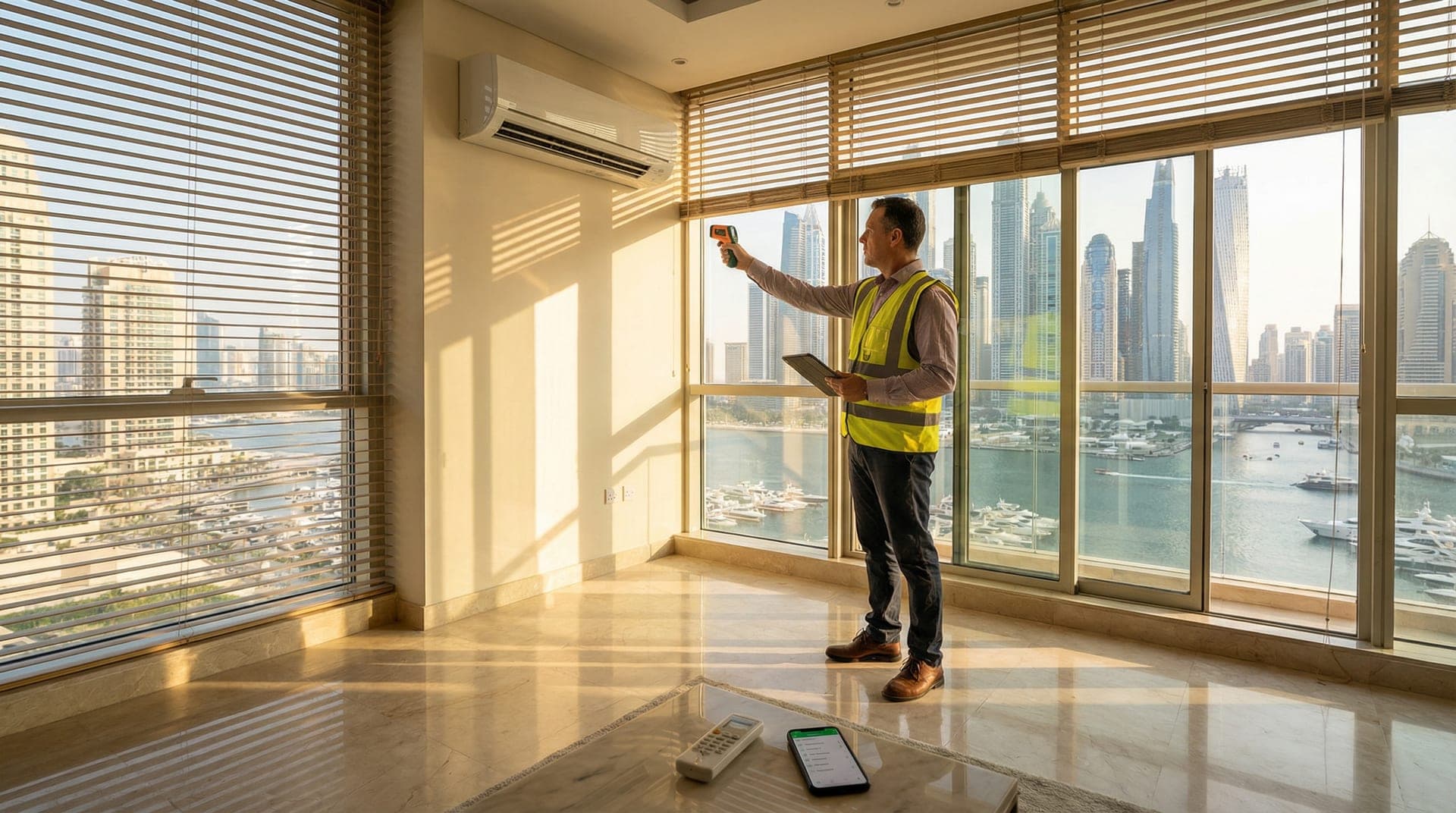
We've walked into enough Dubai apartments to spot the pattern.
Every time we do a home survey, we check the same things: how the AC runs, what the windows are doing, where the phantom loads hide. And every time, the same five problems show up. Different buildings, different tenants, different layouts. Same waste.
Air conditioning alone accounts for roughly 70% of residential energy use in the UAE (IEA, 2024). But the AC is only part of the story. The other four items on this list quietly add AED 200-400 to your monthly DEWA bill without you noticing.
TL;DR: We find the same five electricity-wasting patterns in nearly every Dubai apartment we survey: AC running nonstop at one temperature, blinds wide open during peak sun, water heaters on standby 24/7, no smart AC controls, and phantom loads from always-on electronics. Fixing all five can cut your DEWA bill by 25-40%.
1. Is Your AC Running 24/7 at One Temperature?
In almost every apartment we survey, the AC is set to one temperature and left there all day. Whether the tenant is home, at work, or on a weekend trip, the AC runs the same way - no schedule, no adjustment, no reason to change.
The average 2-bedroom apartment in Dubai pays AED 800-1,200 per month in summer for electricity (Khaleej Times, 2025). Air conditioning drives 60-70% of that number (SolarisKit, 2024). So when the AC runs at 22 degrees for 16 hours while nobody is home, that's real money cooling empty rooms.
When we set up smart AC scheduling in apartments, clients typically see a 20-30% drop in cooling costs. That's AED 150-300 back every summer month. The fix is simple: a smart controller that turns the AC off when you leave and pre-cools before you get home. No wiring, no landlord approval needed.
2. Why Are the Blinds Wide Open at 2pm?
This one surprises people. Walk into any south- or west-facing apartment in Dubai Marina or JBR between 1pm and 5pm, and the blinds are wide open. Afternoon sun pours through floor-to-ceiling windows, heats up the living room by 3-6 degrees, and the AC fights to keep up.
The U.S. Department of Energy found that managing window coverings properly can reduce solar heat gain by up to 77% (DOE, 2024). In Dubai, where summer temperatures hit 45 degrees and most apartments have glass facades, that heat gain forces your AC to work much harder than it needs to.
In our experience, this is the easiest win we recommend. Motorized blinds on a schedule close automatically when the sun hits your windows and open again in the evening. You get the view when you want it and lower bills when you don't. One client in a west-facing Business Bay apartment told us her AC used to run non-stop from noon to 8pm. After adding automated blinds, it cycles off for 15-20 minutes every hour during that same window.
3. Is Your Water Heater Running All Day for 15 Minutes of Use?
Every apartment we walk into has a storage water heater tucked behind a cupboard door. And in every apartment, it's on 24/7. These heaters keep 50-80 litres of water hot around the clock for the 15-20 minutes someone actually runs a tap.
A standard 2,000-watt storage water heater cycles on and off throughout the day, consuming roughly 360 kWh per month just on standby (Utility Bill UAE, 2025). At DEWA's slab rates - which climb from 23 fils/kWh to 38 fils/kWh the more you use (DEWA, 2026) - that standby cycling adds AED 100-160 to your bill every month.
The simplest fix is a schedule. Turn the heater on for 30 minutes before your morning shower and 30 minutes before you get home. That covers your actual hot water needs and eliminates the other 23 hours of standby waste. In most Dubai apartments the heater has no plug at all: the cable runs straight into the wall, so the schedule goes on its own wall switch. If you rent, a button-pusher on that switch does it with no wiring. We set out the options in our guide to putting a water heater on a smart schedule. We walk clients through it during every smart home consultation.
4. How Much Does That Cracked AC Remote Actually Cost You?
We see it in every apartment: the original AC remote with a cracked screen, sticky buttons, and no memory of what temperature it was set to yesterday. These remotes have exactly two modes in practice - on and off. They can't schedule, they don't know when you've left, and they can't coordinate between rooms.
Google's analysis of real-world Nest thermostat data found that smart temperature controls save an average of 15% on cooling costs (Google Sustainability, 2024). That saving comes from three features a cracked remote will never have: automatic scheduling based on your routine, occupancy detection that adjusts when you leave, and the ability to control your AC from your phone so you can turn it off from the office.
What we've found is that the remote itself becomes the bottleneck. People don't adjust their AC because the remote is inconvenient. They leave it at one setting because changing it means finding the remote, squinting at a dim screen, and pressing tiny buttons. A smart AC controller replaces all of that with your phone and a schedule you set once.
5. How Many Devices Are Draining Power Right Now?
Count the red standby lights in your living room. TV, gaming console, set-top box, soundbar, router, charger cables plugged in with nothing connected. Every one of those draws power around the clock. The U.S. Department of Energy estimates that standby power accounts for 5-10% of residential energy use (NRDC, 2023).
In a Dubai apartment where the total DEWA bill runs AED 800-1,000 per month in summer, that 5-10% translates to AED 40-100 per month in phantom loads. Over a year, you're paying AED 500-1,200 to power devices that aren't doing anything.
Smart plugs and power strips solve this without changing your habits. Plug your entertainment setup into a smart power strip, and everything shuts off completely when you turn off the TV. Your whole-home automation system can cut standby power to all non-essential devices when you leave the house or go to bed. After setting this up in a few apartments, we started adding it to every survey recommendation because the savings are easy and immediate.
What Does All of This Add Up To?
Here's the breakdown for a typical 2-bedroom apartment in Dubai during summer:
| Waste Source | Monthly Cost | Fix |
|---|---|---|
| AC running 24/7, no schedule | AED 150-300 wasted | Smart AC controller |
| Open blinds during peak sun | AED 50-100 in extra cooling | Motorized blinds on schedule |
| Water heater on standby | AED 100-160 wasted | Scheduled at its own switch |
| No smart AC controls | AED 80-150 in inefficiency | Smart thermostat/controller |
| Phantom loads | AED 40-100 wasted | Smart power strips |
That's AED 420-810 in potential savings every month. Even fixing two or three of these drops your DEWA bill noticeably. And most of these fixes are wireless, portable, and don't need landlord approval - perfect for renters.
Frequently Asked Questions
How much can I actually save on my DEWA bill with smart home changes?
In the apartments we have surveyed, addressing the five issues in this post cuts 25-40% off the total DEWA bill. The biggest single saving comes from smart AC scheduling, which typically cuts cooling costs by 20-30%. Combined with water heater scheduling and phantom load reduction, the total adds up to AED 300-600 per month during summer.
Do I need my landlord's permission for any of these fixes?
Four of the five are wireless and portable. Smart AC controllers, smart plugs, and smart power strips all plug in or connect to your WiFi without drilling, wiring, or permanent changes, and you can take them with you when you move. The water heater schedule happens at the heater's own switch; if you rent, a button-pusher sits on that switch and comes off when you leave.
What should I fix first to get the biggest impact?
Start with smart AC control. Air conditioning is 60-70% of your electricity bill, so even a small improvement there has the biggest impact on your total. A smart AC starter setup costs from AED 3,000 installed.
Does DEWA charge more per unit the more I use?
Yes. DEWA uses a progressive slab tariff. The first 2,000 kWh costs 23 fils per unit, but consumption above 6,000 kWh costs 38 fils per unit (DEWA, 2026). This means every extra kilowatt you waste pushes your remaining usage into a more expensive bracket. Reducing waste keeps you in the lower slabs.
How long does a home survey take?
A typical Bayora on-site survey takes 1-2 hours. We check your AC setup, window exposure, water heater configuration, and identify where your electricity is going. The survey is free for most projects, and you get a custom proposal within a week.
Your Apartment Probably Has All Five
We're not guessing. These five patterns show up in nearly every home we walk into across Dubai Marina, Downtown, Business Bay, and Dubai Hills. The good news is that every one of them has a straightforward fix, and most of those fixes start working on your next DEWA bill.
Curious what's wasting electricity in your apartment? Book a free survey and we'll show you exactly where your money is going.
Ready to Get Started?
Get a free consultation and we'll recommend what makes sense for your situation.
Get Free Consultation