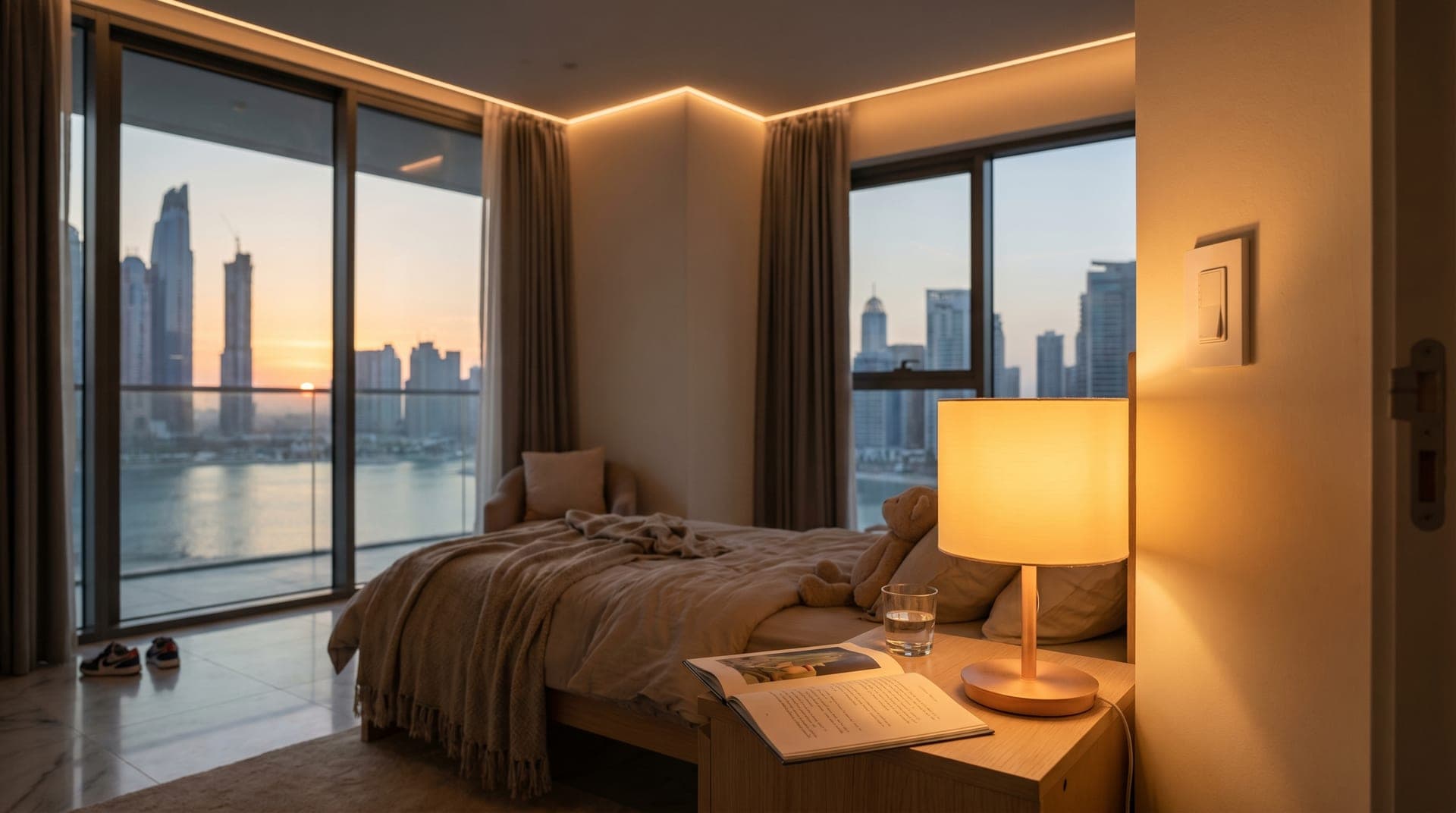
The lamp in your 6-year-old's bedroom is a 60W cool-white bulb from Carrefour. At 8pm you switch it off. He asks for water. You switch it back on and the whole room goes from dark to daylight in half a second. Now he is awake. You read one more book. Lights off. He wants to go to the bathroom. Lights on. Daylight again.
This is a lighting problem pretending to be a parenting problem.
TL;DR: Kids' bedrooms in Dubai need three lighting scenes: a warm low bedtime mode (2200K, 10% brightness), a gradual morning wake-up, and a cool bright homework mode. A smart bulb plus dimmer switch setup costs AED 400-900 per room installed. Evening light at normal room brightness can suppress a child's melatonin by up to 99 percent, which is why bedtime with regular bulbs is harder than it should be.
Now that UAE schools are back in session after the seven-week closure (Gulf News, 2026) and families across Dubai are rebuilding morning and evening routines, the lighting in kids' bedrooms matters more than it did two months ago. A good setup is not cosmetic. It is a real tool that makes bedtimes shorter, mornings smoother, and homework less of a fight.
Here is how to do it properly for a Dubai apartment, starting from AED 400 per room.
Why Kids' Bedrooms Need Different Lighting Than Yours
Preschoolers are far more sensitive to light at night than adults are. In a University of Colorado Boulder study, evening light exposure suppressed melatonin in preschool-aged children by an average of 78 percent, and in some children by up to 99 percent (PubMed, 2022). That is at light levels of 5 to 40 lux, which is far dimmer than a standard bedroom ceiling light.
In plain terms: the regular bulb in your child's room is punching way above its weight on the biology. Even if your child looks fine reading in bed, the light is telling their body it is not bedtime yet. That is why the whole sleep process drags.
In our experience surveying family apartments across Dubai Marina, Downtown, and Arabian Ranches, about 9 in 10 kids' bedrooms still run on a single cool-white ceiling bulb and a matching bedside lamp. One brightness, one color temperature, one purpose: on or off. The room has to serve three completely different jobs (homework, play, and sleep) with one setting. So all three suffer.
Smart lighting fixes this without moving a piece of furniture.
The Three Scenes Every Kid's Room Needs
We build every kids' room setup in Dubai around the same three scenes. Each one serves a specific moment in the day, and each one uses a different color temperature and brightness. Together they cover more than 90 percent of the lighting a child's room actually does.
Scene 1: Bedtime Mode
Warm amber light, 2200K, around 10 percent brightness. No blue at all. The light should feel like candle flame through a lampshade.
This is the scene you run for the 30 to 45 minutes before sleep. Reading, brushing teeth, one more story, lights out. At this brightness and color, the brain gets the signal that the day is over. A 2025 study in adolescents found that evening bright light exposure reduces later melatonin production (Nature, 2025), and the effect is even stronger in younger children.
Set it on the dimmer switch, set it on voice ("Alexa, bedtime"), or set it on schedule. Whatever works. The point is that one action drops the whole room into the right state.
Scene 2: Wake-Up Mode
Cool white, 4000-5000K, ramping from 10 percent to 80 percent over 20 minutes. Starts 20 minutes before the alarm.
This one mimics sunrise. The room gradually gets brighter and cooler in color, which is what daylight does outside. The brain wakes up faster and more pleasantly than it does to a blaring alarm with the curtains still closed.
Dubai school mornings are brutal in summer. Sun is up early but the curtains stay closed because of the heat. Wake-up lighting gives you the circadian signal of sunrise even when your actual sunrise is blocked out. After setting up dozens of these for Dubai parents, the feedback is consistent: the kids stop needing to be dragged out of bed.
Scene 3: Homework Mode
Cool white, 5000K, 90 to 100 percent brightness on the desk area.
Homework needs focus. Focus needs cool, bright light. This is the opposite of the bedtime scene and it should feel that way. A Sleep Foundation review found cooler, brighter light supports alertness and cognitive performance (Sleep Foundation, 2025), which is exactly what you want for the hour between after-school snack and dinner.
One button. One tap. Desk light on, ceiling light on, 5000K, 95 percent. Kid sits down. Homework starts.
What You Actually Install: The Setup for a Dubai Apartment
You have two good paths here. Which one you pick depends on whether you rent or own, and whether you want to drill into the wall.
Path A: Smart Bulbs Only (Renter-Friendly, No Drilling)
Replace the existing bulbs with tunable smart bulbs. Use a small hub or connect via Matter. Control with your phone, voice, or a physical smart button that sticks to the wall.
Typical setup for one kids' bedroom:
- 2x Philips Hue White Ambiance E27 bulbs (ceiling + bedside lamp): AED 440-500 total
- 1x Philips Hue Smart Button or Aqara wireless switch (wall-mounted, no wiring): AED 120-180
- Hub if you don't have one (Aqara M2 or Hue Bridge): AED 250-350
- Optional: 1 LED light strip along the desk or bed ledge: AED 280-400
Total: AED 400-900 per room, depending on brand and whether you need the hub.
Philips Hue starter kits in the UAE are TRA registered and sold through Amazon.ae, Noon, and Sharaf DG (Tech Hack, 2025). Aqara bulbs with Matter and Zigbee support are also available via Smartify Spaces with same-day Dubai delivery.
Nothing gets drilled. Nothing gets wired. When the lease ends, the bulbs come with you. This is the renter path and it works.
Path B: Smart Switches (Owners, Permanent Install)
Replace the dumb wall switches with smart dimmers and keep regular dimmable LED bulbs. This is cleaner, more reliable long-term, and works with any bulb.
Typical setup for one kids' bedroom:
- 1x Lutron Caseta or Shelly Dimmer 2 wall switch: AED 280-450
- 1x Shelly or Lutron Pico remote for bedside: AED 180-280
- Hub (Lutron needs its own, Shelly works over WiFi): AED 0-350
- Labour (certified electrician, 1-2 hours): AED 150-250
Total: AED 600-1,200 per room installed.
Lutron Caseta is available in the UAE via Noon and through authorized smart home dealers (Monarca, 2025). Shelly is cheaper, works over standard WiFi, and has a strong Dubai distributor network.
In our experience, owners in villa communities like Dubai Hills or Arabian Ranches usually go with Path B because the setup lasts longer and controls any future bulb change. Renters in Marina, JBR, and Business Bay almost always go with Path A because nothing is permanent.
The Schedule That Runs the Whole Room
This is the part most DIY setups skip. Scenes on their own are useful. Scenes on a schedule run the room for you.
A working template for a 6 to 10 year old in Dubai during school term:
| Time | Scene | What Triggers It |
|---|---|---|
| 6:15am | Wake-Up Mode (ramp from 10% to 80% over 20 min) | School-day alarm |
| 7:00am | Off | Out the door |
| 3:00pm | Homework Mode (cool 5000K, 95%) | After-school, manual button or voice |
| 6:30pm | Warm transition (3000K, 50%) | Sunset trigger (geolocation) |
| 8:00pm | Bedtime Mode (2200K, 10%) | Schedule + voice "goodnight" |
| 8:45pm | Off, with a 5-minute fade | 15 min after bedtime mode |
| Overnight | Nightlight (amber, 2%, motion-activated near door) | PIR sensor |
This runs on its own. You program it once. A parent's only job after setup is to say goodnight.
One detail that matters: the nightlight should be warm (amber, under 2200K) and triggered by motion, not always on. Always-on nightlights keep suppressing melatonin for the whole 10-hour sleep window. Motion-activated warm nightlights only fire when the child gets up, and they auto-off after a minute. That "fire on movement, then auto-off" behaviour comes down to how motion and presence sensors actually work, and why a plain motion sensor is exactly the right tool for a hallway.
Homework Mode: Why This Scene Pays for Itself
The hardest sell on smart lighting for parents tends to be the bedtime side, because sleep improvements feel diffuse and slow. Homework mode, though, is immediate.
A cool, bright, focused desk area reduces eye strain and keeps kids alert through the hour of work they have to do after school. A Sleep Health consensus review in 2024 found that bedtime screen use was strongly associated with shorter sleep and increased sleep latency in youth (Sleep Health Journal, 2024), largely because of time displacement and light exposure. If homework gets done faster and in better light, screens come out earlier, screens go away earlier, and bedtime happens earlier.
What we have found is that after a homework scene goes in, parents report the evening "pulling forward" by 20 to 40 minutes on average. The room is set up for the task, so the task gets done.
How This Ties Into the Rest of Your Smart Home
Kids' bedroom lighting works best when it is talking to the rest of your home. A few examples we have built for Dubai families:
- Bedtime bundle: When the kids' Bedtime Mode triggers at 8pm, the hallway dims to 20%, the living room TV goes into movie mode, and the main AC adjusts to 24°C so cooling does not wake anyone up at 2am. For a deeper look at how scheduling cuts summer bills, see our AC pre-cooling schedule guide.
- Morning wake-up: Wake-Up Mode for the kids triggers the master bedroom lights, the coffee machine on a smart plug, and the living room blinds to open at 30%. The whole house comes alive in sequence.
- Leave the house, trust it: Lights off, AC to 26°C, hallway night-light armed. Covered in our guide to what your smart home does while you're out.
This is the part worth paying for. A single tap runs a moment, not a room.
For a broader view of what smart lighting does across a Dubai apartment, read our complete smart lighting guide. For the renter version covering whole-home lighting without drilling, see The 3-Scene Lighting Routine for Dubai Renters.
What This Costs, All In
For a family with two kids' bedrooms in a Dubai apartment, here is the honest pricing range:
- Renter path (bulbs + buttons, 2 rooms): AED 900-1,800 total, installed in one afternoon
- Owner path (switches + dimmers, 2 rooms): AED 1,400-2,800 installed
- Add the parents' bedroom and a hallway nightlight: AED 500-1,000 more
- Professional setup of scenes, schedules, and voice commands: included in a Bayora install
A starter Bayora project covering two kids' rooms, hallway, and the master with full scene programming typically lands at AED 2,500-4,500 installed. That is the same ballpark as a good stroller. The difference is that this one gives you back 20 minutes every evening for the next several years.
Frequently Asked Questions
What color temperature is best for a child's bedroom at bedtime?
The warmest your bulb can go, ideally 2200K or lower, at 5 to 10 percent brightness. This mimics candle flame or a very low sunset and minimizes melatonin suppression in children. Avoid anything above 3000K in the hour before sleep.
Are smart bulbs safe for kids' rooms?
Yes. Smart bulbs are standard LED bulbs with a wireless chip inside. They do not emit more radiation than your WiFi router, they run cooler than traditional bulbs, and brands like Philips Hue and Aqara are TRA registered for UAE use. No special precautions are needed beyond normal bulb handling.
Can smart lighting help my child sleep better?
It cannot fix a sleep problem on its own, but it removes one of the biggest environmental barriers to good sleep: bright evening light. Studies show evening light can suppress a young child's melatonin by up to 99 percent. A proper warm, dim bedtime scene removes that barrier, which typically shortens sleep onset by 10 to 30 minutes in our client reports.
Do I need WiFi for every bulb?
No. Most modern smart bulbs use Zigbee or Thread protocols that connect to a single hub. The hub connects to your WiFi. If your WiFi drops, the schedules and scenes still run locally through the hub. This is why we recommend hub-based systems (Philips Hue, Aqara, Lutron) over cheap WiFi-only bulbs for family setups.
What if my child wants colored lights for fun?
Most good smart bulbs do both. Philips Hue color bulbs and Aqara T2 bulbs switch between full color (for playtime) and tunable white (for circadian scenes). Set a "play" scene with rainbow colors at 80 percent and a "bedtime" scene with 2200K at 10 percent, and the same bulb handles both.
Ready to set this up in your Dubai apartment? Get a free consultation and we will come look at the rooms, plan the scenes around your kids' schedule, and give you one complete quote. No drilling required for renters. No surprises in the pricing. A bedroom that works at bedtime, finally.
Ready to Get Started?
Get a free consultation and we'll recommend what makes sense for your situation.
Get Free Consultation