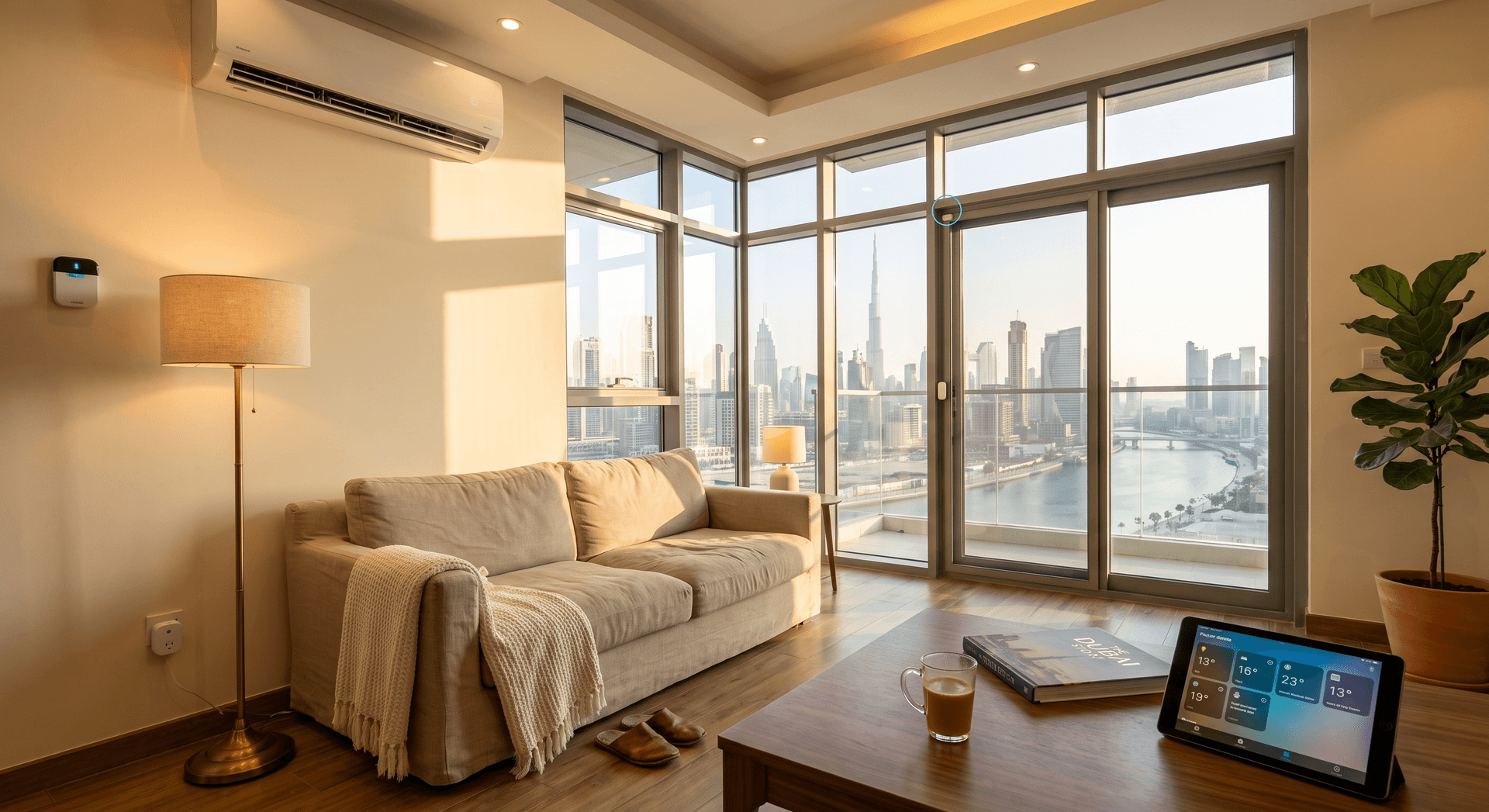
Your apartment is in one of the most connected cities in the world. DEWA runs on 110,000 smart sensors. The metro adjusts in real time. The airport knows your face before you reach the gate.
Inside your apartment, you still have three remotes on the coffee table and an AC that runs empty every time you forget to turn it off before leaving.
The gap is not technology. Everything you need to fix this already exists, fits in a Dubai apartment, and does not require a single wall modification. The problem is most guides bury you in product names before they explain what your apartment needs.
This guide works differently. It tells you what to fix first, what you can skip, and what a real setup costs - whether you rent or own.
TL;DR: A smart Dubai apartment starts with AC control (AED 350-900 plug-in, or AED 3,000 installed as a complete starter kit). Add lighting next, then security if needed. Renters can do the first two layers with zero drilling and take everything when they move. Owners can go further with switches and whole-home integration. Order matters more than budget. The UAE smart home market is growing at 26.4% annually (Grand View Research, 2026), and the household penetration rate is already 78.3%.
Why a Dubai Apartment Is Different From Any Other Home
The average two-bedroom apartment in Dubai runs a DEWA bill of AED 600-1,000 per month in summer, with AC accounting for 60-70% of that. Outdoor temperatures hit 41-48C from June through September. The midday work ban (12:30-3pm daily until mid-September) means residents and their families are home during the hottest part of the day, windows sealed, AC running continuously.
These are not abstract statistics. They shape which smart home upgrades make the most difference.
In our experience surveying apartments across Business Bay, Dubai Marina, and Downtown, the single most common feedback from new clients is that they had no idea how much their AC was running when nobody was home. One senior manager in Business Bay we worked with was leaving her AC on all day from June to August because she was afraid the apartment would take too long to cool down when she got back. She was right about the slowness - her unit took 45 minutes to reach setpoint after the Dubai summer heat had baked the space all day. She was wrong about the solution: a simple schedule and a pre-cool window fixed it without upgrading any hardware.
Smart home in a Dubai apartment solves a small set of problems that matter a great deal. Getting the order right matters more than the product names.
The Three Layers Worth Fixing in a Dubai Apartment
Most guides list fifteen things. In practice, a Dubai apartment has three upgrade layers that change daily life. Everything else is optional.
Layer 1: Climate. Your AC is the single most impactful thing to automate. Scheduling, occupancy-based on/off, remote pre-cooling before you arrive. This layer delivers the largest change in comfort and the largest reduction in DEWA bills. Start here, always.
Layer 2: Lighting. Scene-based lighting changes how your apartment feels morning, evening, and when guests arrive. It also cuts unnecessary consumption from lights left on in rooms nobody is using. The second upgrade because it builds on the comfort you have already fixed.
Layer 3: Security and access. Smart locks, a video doorbell, and sensors for the main door. Relevant if you have a cleaner, a courier problem, or care about knowing who is at your door from the gym. Third because it is less daily-life-critical than climate and lighting for most apartment residents.
Whole-home automation - scenes that combine all three layers into one tap - comes after you have set up at least two of the above. Jumping to a hub or a whole-home scene before fixing the individual layers is the most common reason setups feel underwhelming.
Smart AC Control: Layer 1 for Every Dubai Apartment
A smart AC controller plugs into the wall behind your existing split unit and replaces the remote. No wiring. The installation takes under ten minutes and the devices work with every split AC brand sold in the UAE, regardless of age or model. In our experience, if it has an IR remote, we can make it smart.
The setup gives you scheduling (AC turns on one hour before you get home), occupancy sensing (off when nobody is there), remote control from anywhere, and geofencing (the unit turns off when your phone leaves the building).
For a Business Bay 2BR working from home in summer, this typically means the AC runs 8 hours a day instead of 14. Sensibo estimates savings of up to 40% on cooling bills. Our client data from similar apartments averages closer to 20-25% - still AED 120-250 per month saved in peak summer, which for a starter device costing AED 350-900, is a payback measured in weeks, not years.
What you can buy:
- Sensibo Sky or Air: AED 350-600 from Amazon.ae or local retailers. Plug-in, no drilling.
- Aqara M3 hub + IR cube: AED 450-700 for a setup that also supports Matter and other devices.
- Full installed starter: Bayora's Smart Home Starter starts from AED 3,000 including configuration, setup, and app training for your whole household - including the housekeeper.
What renters need to know: Nothing about this requires landlord approval or leaves any mark on your apartment. The device clips to the existing IR receiver window on your unit and plugs into a standard socket. Take it when you move (Smart Citizens, 2026).
What owners can add: For owners, a thermostat-style device like Nest or Ecobee gives you a wall-mounted control panel with occupancy sensing built in. More accurate, more visible, but requires a professional to wire it into the central AC system. This is the right call for larger apartments or those with central cooling.
Smart Lighting: Layer 2
Smart lighting in a Dubai apartment runs on two different paths, and choosing the wrong one is expensive.
Path A - Smart bulbs. Replace existing bulbs with Philips Hue or Aqara bulbs. Works in any socket. No electrician. Renters love it. The limitation: every switch becomes a kill switch. Anyone who turns off the wall switch at 11pm cuts power to the bulb and breaks any automation. Manageable, but worth knowing.
Path B - Smart switches. Replace the wall switch with a Shelly or Aqara module. The existing bulbs become smart. The switch stays functional. Automations survive someone toggling the switch. The catch: UAE masonry walls have shallow back-boxes (typically 30-35mm) and some smart switch modules need more depth (the full guide is here). Check dimensions before ordering from Amazon US.
For renters, Path A is the right default. For owners doing a renovation or anyone with an electrician on site already, Path B pays back faster.
What does lighting automation do for a Dubai apartment?
The practical payoff is two things: not thinking about lights when you arrive, and not leaving them on when you leave. After installing smart lighting in a Business Bay 2BR, what we find is that residents stop walking in to a dark apartment at 8pm - the evening scene is already set - and stop paying for lights running in empty rooms. The DEWA saving is smaller than AC (lighting is 10-15% of most bills in UAE apartments), but the comfort change is immediate.
A scene-based setup gives you four presets: morning, day, evening, away. You set them once. The apartment runs them. Philips Hue and Lutron Caseta are the two clearest options in Dubai for different reasons - Hue for colour and flexibility, Lutron for rock-solid reliability and better compatibility with existing wiring.
Smart Security and Access: Layer 3
Most apartments in Dubai have a building intercom system. Most of them are useless if you are not in the room. Smart security for apartments fills three gaps that the building system does not.
Video doorbell. You see who rings from your phone, anywhere. You can speak to them, tell the courier to leave the package with reception, or let the cleaner in with a digital key. Works on battery or a USB power bank cable. No wiring. Aqara G4 and Ring Video Doorbell work well in Dubai apartment buildings - check with your building management before installing externally as some communities require NOC sign-off for external fixtures (European Technical, 2026).
Smart lock. A smart lock replaces or augments your existing deadbolt. The cleaner has a time-limited code that expires when the cleaning window ends. You get a log of every entry. No physical key to duplicate or hand over. Most smart locks in the UAE fit standard mortise and deadbolt cutouts without drilling new holes. Best Smart Locks for Dubai Apartments has the full comparison.
Door and window sensors. The cheapest security upgrade in any apartment: a sensor on the front door notifies your phone when it opens. AED 60-80 per sensor. Works with Aqara, Shelly, or any Zigbee hub. Useful for knowing when the cleaner has arrived, when a child is home from school, or when you want a notification that someone opened the balcony door while the AC is running.
Security is the third layer because most apartment residents get more daily value from fixing the AC and the lighting before worrying about the front door. If your door is fine and your courier situation is manageable, start with Layer 1.
The Order That Works
The most common mistake we see is buying everything at once without a plan for how the pieces connect. Here is the order that works in a Dubai apartment.
Week 1: Smart AC controller. One device, plug-in, set up schedules and geofencing. DEWA difference visible within 30 days.
Week 3-4: Smart lighting in the living room and bedroom. Start with two rooms. See how you use the scenes. Add the kitchen and hallway in a second pass.
Month 2 (if needed): Video doorbell and door sensor. Set up the cleaner access code. Connect to your phone.
Month 3+ (optional): A hub like Home Assistant or Apple Home to tie the three layers together into scenes. One tap: AC to 22, lights to evening mode, blinds half-down. This is where the apartment starts to feel genuinely different.
You do not need a hub to start. The Sensibo app, the Hue app, and a smart lock app each work independently. You add the hub when you want the three layers to talk to each other.
What DSS Means for Apartment Smart Home Buyers
Dubai Summer Surprises opens on July 2, 2026, with electronics and homeware named as the key sale categories with up to 90% off at 1,500+ stores (Gulf News, 2026). Smart home hardware - controllers, bulbs, sensors - falls squarely in these categories and typically sees meaningful price cuts.
The practical implication: if you are planning a Layer 1 or Layer 2 build, buying devices during DSS (July 2 through August 30) can cut the hardware cost by 15-30%. The installation and configuration cost stays the same. This is the right timing to expand a setup you have already started, or to buy the devices for a build you plan to install in September when the summer heat subsides.
What we tell clients ahead of DSS: do not buy the hub first. Buy the AC controller. See the first bill. Then decide how deep to go.
Honest Pricing for a Dubai Apartment
These are real numbers from real setups. Not the lowest we have seen advertised, and not the highest a dealer will quote.
Layer 1 - AC control only:
- DIY smart controller: AED 350-700 hardware, self-installed, 20-45 min setup
- Installed and configured (single unit): AED 800-1,200 including the device
- Full starter kit (2-3 units, scheduling, geofencing, app training): AED 3,000-4,500 installed
Layer 2 - Smart lighting (2-3 rooms):
- Smart bulbs (Path A, DIY): AED 400-800 for a living room and bedroom
- Smart switches (Path B, electrician required): AED 600-1,200 per room installed
Layer 1 + Layer 2 together:
- Installed, configured, trained: AED 5,000-8,000 for a 1-2 bedroom apartment
Layer 3 - Security add-on:
- Video doorbell + smart lock + 2 door sensors: AED 1,500-3,000 installed
What the price includes when you book through Bayora:
- Hardware (sourced at trade pricing)
- Professional installation
- Configuration of schedules, scenes, and automations
- App setup on every phone in the household
- Housekeeper training
- 2-week check-in
- 12 months support
The AED 3,000 starter kit is the honest floor. It covers AC control for a 1-2 bedroom apartment and leaves you with a setup that runs itself, rather than a device that sits on the shelf after the first week.
Renter Checklist: What You Can and Cannot Do
If you rent, here is the honest checklist.
You can do without asking anyone:
- Any plug-in AC controller (Sensibo, Aqara IR, Tado)
- Smart bulbs in existing sockets
- Battery-powered or adhesive smart sensors
- A smart speaker (Alexa, HomePod)
- A video doorbell using the existing doorbell wiring or a battery version
You may want to flag to building management but usually face no obstacle:
- A video doorbell mounted on the external door frame (most buildings allow this)
- A smart lock that replaces the deadbolt (you replace it back when you move)
You cannot do without landlord approval or an electrician:
- Smart switches inside the wall (requires opening the back-box)
- Any wired lighting integration
- Thermostats wired into central AC (if applicable)
In our experience with renters across JBR, Business Bay, and Marina, landlords almost never object to Layers 1 and 2 when the setup is wireless. The most common question is "will it damage the walls?" The answer for everything in the first two layers is no.
Frequently Asked Questions
Does a smart AC controller work with my existing split unit?
Yes. Smart controllers work with any split AC that has an infrared remote, which covers every residential split unit sold in the UAE, regardless of brand or age. Hitachi, Daikin, Toshiba, LG, Midea - they all work. The controller learns your remote's signals during a 30-second setup step.
Do I need to buy a hub before starting?
No. The Sensibo app, Philips Hue app, and Aqara app each work as standalone platforms. You only need a hub (like Apple Home or Home Assistant) when you want devices from different brands to respond to a single command. Start without one. Add it later if the multi-layer combination is something you use. Our smart home hub guide covers what changes when you do.
Can I take my smart home devices when my lease ends?
Everything in Layers 1 and 2 is portable. Smart bulbs unscrew. Smart controllers unplug. Battery sensors peel off. Smart locks unscrew and your original lock goes back. The only things that stay are wall switches (if you installed Path B) and any wired thermostat. Most of what Bayora installs in rental apartments is designed to move with you.
Will a smart home lower my DEWA bill in summer?
Smart AC control cuts cooling consumption by 20-40% in most Dubai apartments (Sensibo, 2026). For a 2BR apartment running a summer bill of AED 800, that is AED 160-320 per month saved. Smart lighting adds a smaller saving of 10-15% of the lighting portion. The bigger payoff for most residents is comfort, not the bill - coming home to a cool apartment and leaving in the morning without worrying about what you left on.
How long does a Bayora installation take?
A Layer 1 starter kit (smart AC for a 1-2BR apartment) takes 2-3 hours. Layer 1 and 2 together (AC plus lighting in 3 rooms) takes a full day. We do not leave until everything works, every phone is set up, and anyone else in the household knows how to use it. The two-week check-in catches anything that needs adjusting after you have lived with it.
Ready to see what your apartment could look like? Get a free consultation - we will tell you exactly what makes sense for your place, in what order, and what it costs before any work starts.
Ready to Get Started?
Get a free consultation and we'll recommend what makes sense for your situation.
Get Free Consultation