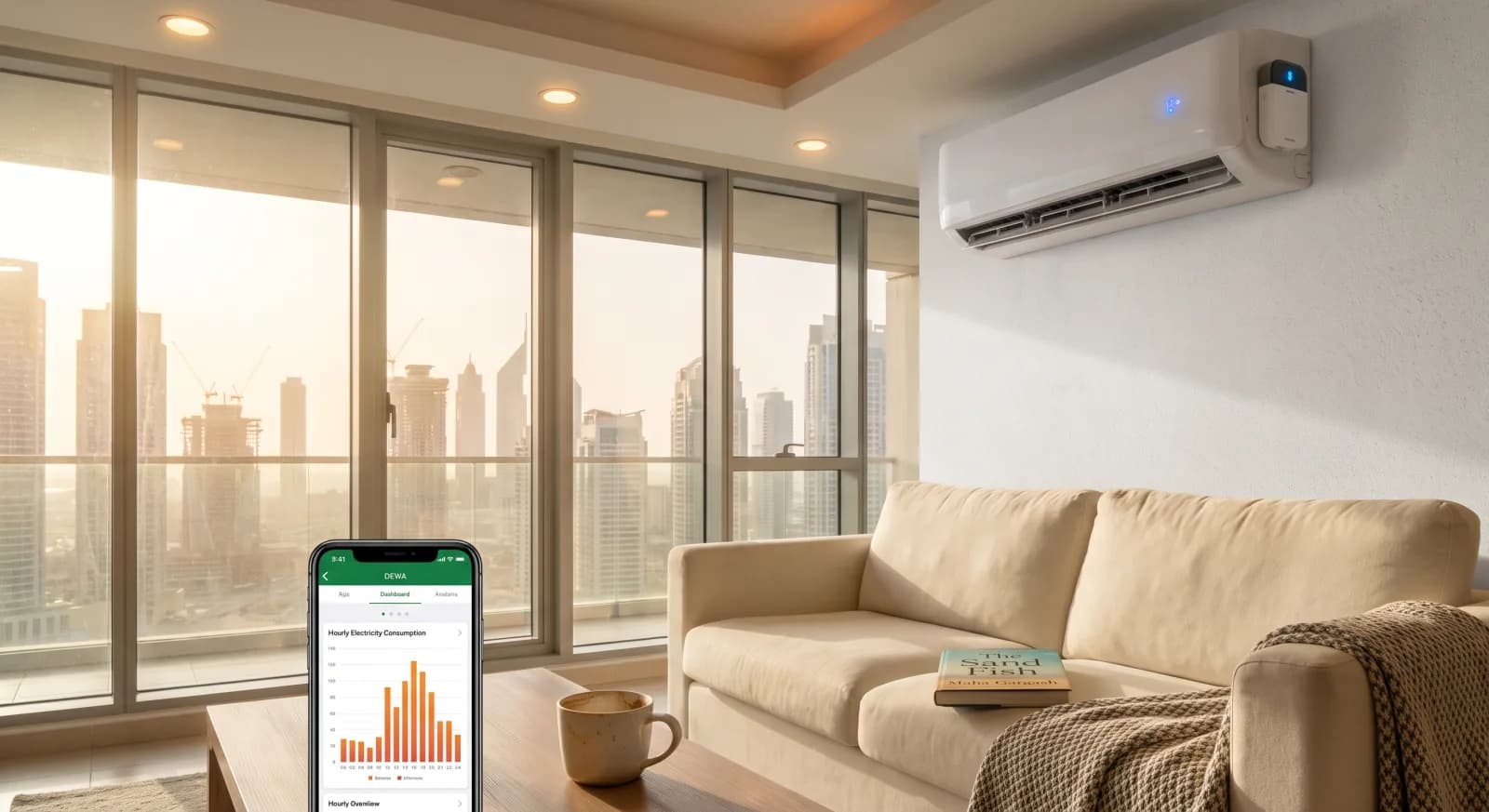
Your DEWA app can now tell you, to the hour, what your AC ran yesterday.
It will tell you how many kilowatt-hours your apartment consumed, which slab of the tariff bracket you hit, and how your usage compares to similar homes in your neighbourhood. The dashboard is live. The data is yours.
What it cannot do is close the bedroom door, change the setpoint, turn the unit off when you left, or schedule the pre-cool for when you land at DXB. That gap - between knowing what happened and having your home respond to it - is where smart AC control sits.
TL;DR: DEWA's 2026 summer conservation campaign tracks your household electricity consumption in real time and compares it to efficient homes nearby. The tool tells you what happened. A smart home goes further: it prevents waste before it appears in the dashboard. Smart AC controllers like Sensibo Sky or Aqara M3 add scheduling, occupancy detection, and remote control from AED 350, without rewiring anything. Full setup starts from AED 3,000 installed.
What DEWA's Summer Campaign Does
DEWA launched its 2026 summer conservation push under the banner "Expand Your Smart Choices This Summer." The campaign bundles two tools that most residents have never opened (DEWA Smart Living, 2026; Zawya, 2026).
The first tool is the Smart Living Dashboard - available through the DEWA app and website. It shows your daily, weekly, and monthly electricity and water consumption. For smart meter subscribers, the data updates hourly. You can see exactly what your apartment drew during the 12:30pm-3pm window when the midday work ban had everyone indoors at peak heat.
The second tool is the My Sustainable Living Programme. It pulls your consumption and compares it against similar high-efficiency homes in your area. The programme sends you monthly reports and gives you a step-by-step plan to close the gap between your usage and the efficient-home benchmark nearby.
The Smart Living initiative, since its launch in July 2020, helped Dubai residents collectively save 179.5 million kilowatt-hours of electricity and 67.7 million gallons of water, the equivalent of AED 52.6 million in savings (MEP Middle East, 2021). That is what behavioural awareness alone achieves, when people can see their consumption clearly.
The awareness tool works. The question is what you do after you close the app.
The Problem with Knowing After the Fact
In a Business Bay 2BR we surveyed in April, the occupant - a senior marketing manager who works from home three days a week - told us she checked her DEWA app monthly, usually when the bill arrived. She saw high consumption in summer. She knew the AC was the main driver. She set it a degree warmer. The next bill was marginally lower.
What she did not know: on the four days she left for the office and forgot to turn the AC off, the apartment cooled an empty living room for six to nine hours at 21°C. She also did not know that the bedroom unit ran simultaneously with the living room unit every evening because she left both on when she moved between rooms. This is exactly the gap our guide on why a DEWA bill jumps and how to find the real culprit is built to close: the app tells you the number went up, not which room or habit did it.
Neither of those patterns showed up as a moment to act - they showed up as a number at the end of the month, after the consumption had already happened.
This is not a criticism of the DEWA app. The app is doing what it was designed to do: give you visibility. But visibility after the fact and control in the moment are two different things.
AC Accounts for 60-70% of Your Summer DEWA Bill
Before talking about what smart control changes, it is worth being clear on the scale of the problem.
Air conditioning accounts for 60-70% of residential electricity consumption during Dubai's summer months (European Technical, 2026; UAE Utility Bill Calculator, 2026). For a typical 2-bedroom apartment in Business Bay or Marina running through June to September, that translates to a DEWA bill between AED 600 and AED 1,000 per month - with cooling being the single largest and most controllable line in that total.
The DEWA slab tariff punishes heavy consumption progressively. Residential use above 6,000 kWh per month is billed at 38 fils per kWh, versus 23 fils for the first 2,000 kWh (DEWA, 2026). An apartment that crosses into the upper slab because the AC ran unchecked for a week of travel is paying a premium for every kilowatt-hour above that threshold.
Smart AC control that prevents empty-apartment cooling, tightens setpoint discipline, and adds pre-cool scheduling can cut AC consumption by 15-25% according to smart-home efficiency studies (Sensibo, 2026). On a summer bill where AC is 70% of the total and the bill runs AED 800, that is AED 85-140 per month back - or AED 340-560 across a four-month peak summer window.
In our experience setting up smart AC in apartments across Dubai, the biggest single saving comes not from lower setpoints but from eliminating the hours the unit runs when nobody is in the room.
What Smart AC Control Does That the DEWA App Cannot
The DEWA app is a reporting layer. Smart AC control is a prevention layer. They do different things.
Here is what smart AC control does in the same Business Bay apartment where the DEWA app is already installed:
Geofencing leave-home trigger. When she leaves the building, her phone crosses a geofence. The AC setpoint lifts to 28°C automatically - still enough to prevent the apartment from hitting 38°C, but not enough to cool an empty room at 21°C for six hours. On return, the geofence triggers a pre-cool back to 23°C fifteen minutes before she arrives. She walks into a comfortable apartment without having opened an app. This single automation eliminated an average of four hours of full-cooling daily during her office days, based on what we measured on a Sensibo device over a 30-day period in a JBR renter client's apartment.
Occupancy scheduling. The bedroom unit runs on a sleep schedule: it starts at 23°C at 10pm, drifts to 25°C at 1am (the temperature where most people sleep better), and turns off at 6am when the outdoor temperature is still manageable. The living room unit has a weekday work-from-home window and switches off at noon when the kitchen becomes the work zone. These are not automations she thinks about - they run themselves.
Remote off from anywhere. She opens a meeting at the office and remembers she left the AC on. One tap on the DEWA app would tell her exactly how much it has run. One tap on a Sensibo or Aqara app would turn it off. The difference: one is monitoring, one is control.
Multi-unit coordination. On evenings when she is in the living room, the bedroom unit is off. When she moves to the bedroom, the living room unit turns off after a ten-minute delay. The DEWA app shows total household consumption. The smart AC layer stops the two units from running simultaneously when only one is needed.
The Three Layers of Smart AC Control in Dubai
The right setup depends on your property type and what you are renting versus owning. In our experience installing across apartments and villas across Dubai, three configurations cover the majority of cases.
Layer 1: Plug-in Smart AC Controller (AED 350-900, renter-safe)
A plug-in smart AC controller replaces your existing IR remote with a Wi-Fi-connected device that clips to the unit or sits on a shelf. Sensibo Sky (AED 550-700), Aqara M3 IR Hub (AED 350-500), and similar controllers connect your AC to an app with scheduling, geofencing, and remote control.
Installation is five minutes with no tools and no landlord approval needed. This is the entry point for any Dubai renter who wants to stop cooling an empty apartment.
The limitation: the controller reads your AC's current state by sending IR signals, but it cannot read back what the AC did. If the AC self-recovers from a power cut and defaults to a different setting, the controller may not know. For most renter use cases this is acceptable. The DEWA Smart Living Dashboard fills the monitoring gap; the controller handles the control layer.
Layer 2: Smart Thermostat (AED 1,200-3,500, for central cooling systems)
If your building runs district cooling through an Empower or Tabreed thermostat, you may be able to replace the wall thermostat with a smart model like an Ecobee or a building-approved equivalent. This gives you scheduling and remote control at the room level.
The distinction matters in Dubai because roughly 45% of Dubai apartments use district cooling rather than split-unit AC (Tabreed, 2026). A smart AC controller handles a split unit. A smart thermostat handles a district-cooled unit. Knowing which system your building uses before you buy either device saves a wasted purchase.
In our experience auditing apartments across Business Bay, DIFC, and Marina, most residents do not know which cooling system their building uses until they look at their utility bill and see Empower or Tabreed listed as a separate line item.
Layer 3: Whole-Apartment Climate Stack (AED 3,000-12,000 installed)
For renters who want everything in one place, and for owners who want the full picture, a whole-apartment climate setup integrates all AC units, the thermostat (if district-cooled), room sensors, and occupancy detection into a single automation layer running through Home Assistant or a similar open platform.
This is the setup where the bedroom and living room units coordinate, where room sensors report actual temperature rather than the AC's internal sensor (which is notoriously inaccurate on Dubai split units), and where the DEWA Away Mode becomes redundant because the home already handled the empty-apartment state automatically.
Starting prices for a 2-bedroom apartment setup, including devices, configuration, and a professional handover: AED 3,000-5,500 depending on the number of AC units and whether any wiring is involved.
DEWA's Summer Campaign and What It Is Telling You
The DEWA conservation campaign is worth taking seriously for one reason that goes beyond your monthly bill.
The My Sustainable Living Programme compares your consumption to similar high-efficiency homes in your area. If you are hitting AED 900/month while a similar apartment two floors up is hitting AED 600, the gap is almost entirely explained by when the AC runs, not how often you are home or what temperature you set it to. We laid out the full picture of what those control decisions look like in the smart AC guide for UAE apartments and villas.
The high-efficiency homes in the comparison group are not necessarily smarter people. They are, in our experience, more likely to be homes where the AC does not run unchecked. Some have smart control. Some have more disciplined manual habits. The data DEWA is showing you is a behavioural gap, not an equipment gap.
What smart AC control does is close the behavioural gap without requiring the discipline. The schedule runs whether you remember it or not. The geofence triggers whether you think about it on the way out or not. The DEWA app then shows you the result: your consumption line drops, your comparison to neighbourhood peers improves, and the monthly report shows consistent rather than spiked usage.
What the Skip-Buy List Looks Like
Before you spend anything, a few things that are not worth buying in this context:
A new AC unit. If your existing split unit works, a smart controller extends its useful life and fixes the behavioural problem without a capital expense. New AC units do not schedule themselves.
A smart plug for the AC. Cutting power to an AC unit at the wall socket is a bad idea - it bypasses the unit's shutdown sequence and, in some models, can cause compressor faults over time. Use a proper smart AC controller that communicates via IR, not a smart plug that cuts mains power.
Any proprietary system that locks you into a specific app. If the smart home vendor stops operating or the app goes down, your AC should still work from its original remote. Open-platform setups (Home Assistant, Aqara hub + app) are the standard we recommend because they do not depend on a cloud service to function.
An expensive upgrade because DEWA's app is showing a high number. The DEWA app is a monitoring tool. High consumption is the symptom. The cause is almost always one of three things: empty-apartment AC running, excessive overnight setpoints, or simultaneous multi-unit operation. Fix the behaviour first. If consumption is still high after three months of smart scheduling, then investigate the equipment.
Frequently Asked Questions
Does smart AC work with my existing split unit?
Yes. Smart controllers like Sensibo Sky and Aqara M3 work with any split AC unit that has an IR remote, regardless of brand or age. They connect to your Wi-Fi network and replicate the remote's signals on a schedule you set.
Can I use smart AC control in a rented Dubai apartment?
Yes. Plug-in smart AC controllers require no wiring, no drilling, and no landlord approval. You mount a small device near the AC unit (or place it on a shelf with line of sight), download the app, and set your schedule. The device comes with you when you move.
How do I know if my building uses split AC or district cooling?
The fastest way is to check your DEWA bill. If you see a separate line item from Empower or Tabreed, you are on district cooling. If your AC units are standalone wall-mounted or cassette units with their own outdoor compressors on the balcony, you are on split-unit AC.
How much does smart AC control save on a Dubai DEWA bill?
It depends entirely on the current behaviour gap. A household where the AC runs empty for four hours on office days and a spare bedroom runs simultaneously with the living room every evening can reduce AC consumption by 25-35% with scheduling alone. A household that already turns the AC off manually when leaving and runs only one unit at a time may see 8-12% savings. The DEWA Smart Living Dashboard is the right tool to measure the baseline before and after.
Will DEWA's app and a smart AC controller work together?
They do different things and work well in parallel. DEWA's app gives you consumption monitoring and peer comparison - the "what happened" layer. The smart AC controller gives you scheduling, geofencing, and remote control - the "prevent it from happening" layer. Running both is the full picture: your home manages itself, and DEWA confirms it worked.
DEWA's conservation campaign is useful. It surfaces a number many residents have never looked at closely. But awareness of a problem and a system that prevents the problem are two different things.
Your DEWA app will show you what your AC consumed yesterday. A smart home ensures that tomorrow's reading is lower, without you checking anything.
Tell us about your apartment and we will recommend what fits - no obligation, no surprises.
Ready to Get Started?
Get a free consultation and we'll recommend what makes sense for your situation.
Get Free Consultation