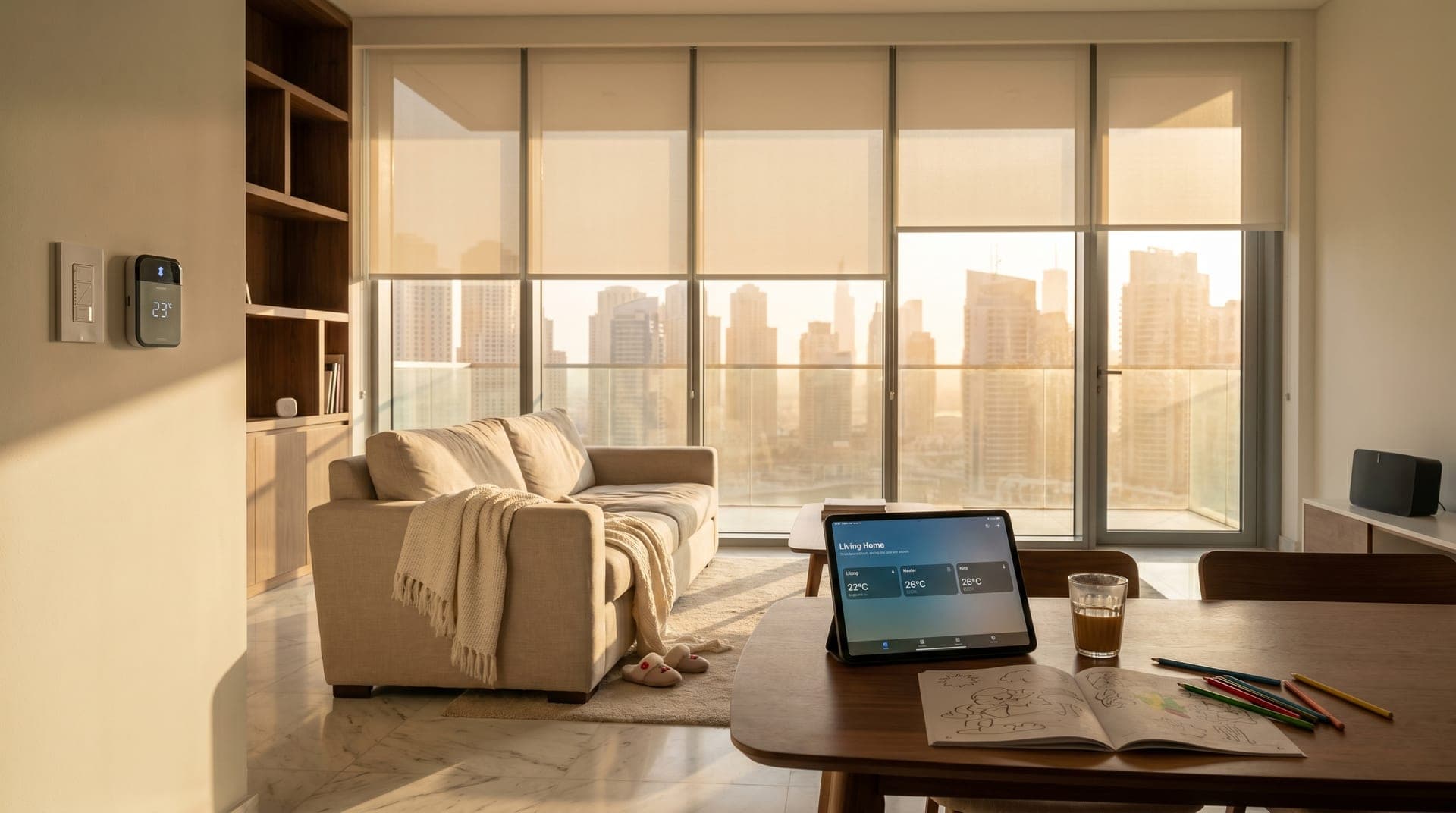
The National Center of Meteorology is forecasting a 47C peak across Dubai and Abu Dhabi tomorrow, Monday May 25, ahead of Arafat Day. From Tuesday through Friday, the holiday window settles into 39-42C daytime highs with overnight lows of 25-28C (Khaleej Times, 2026; Gulf News, 2026). Five consecutive days where the AC runs harder than any other week of the year, with the household full, kids home from school, and visitors coming through.
TL;DR: A 47C peak day followed by five sustained days at 40C is the hardest workout a Dubai AC will get all year. Without smart control, a typical 2-bedroom apartment AC will run 18-22 hours a day, cool empty rooms, fight a half-drawn blind, and push the DEWA bill into the higher slabs without you noticing. With a smart AC setup from AED 3,000 installed, the AC pre-cools before guests arrive, sleeps the rooms nobody is in, and trims 15-30% off the cooling load. Setup takes a few hours. The bill effect is visible in the very next cycle.
We have spent the last week walking apartments where the family is preparing for a houseful of visitors. The same pattern keeps showing up. The AC is set to 22C, running flat out, in a flat where four out of six rooms are empty at any given moment. The kitchen extractor is on. The dining room is being prepped for a dinner that starts in six hours. The west-facing living room is hitting 28C at 4pm despite the AC fighting it. Nobody is in the bedrooms, but every bedroom AC is running.
This is not an AC problem. This is a control problem. And this week is the week the difference shows up in the bill.
Why a 5-Day Heat Stretch Is Different From a 5-Day Heat Day
A one-off 45C day is recoverable. The AC works hard for 12 hours, the building's thermal mass cools overnight, and the next day starts from a reasonable baseline. We covered the pre-flight routine for that scenario in Your First 40C Day Is Coming.
A 5-day stretch is a different problem. The building envelope, the walls, the floors, the furniture, the curtains, all hold heat. Night cooling does not fully reset because overnight lows are still 25-28C (Gulf News, 2026). Each morning the AC starts from a warmer baseline than the day before. By day three the AC is fighting compounded thermal load, not a single day of heat.
Layer on a full household. Kids are not at school. One parent or both are home. Guests cycle through for breakfast, lunch, late-afternoon karak, dinner, and post-Maghrib visits. The kitchen runs the oven and stove for hours. The dishwasher and washing machine cycle more often. The lights are on. Every appliance running is heat the AC has to remove on top of the 40C outside.
A typical 2-bedroom apartment that pulls AED 500-700 in a normal summer month can pull AED 800-1,000 in a hosting-heavy hot week (mydewabill.store, 2026). That is the difference between staying in the 28-fils slab and pushing into the 32 or 38-fils slabs (DEWA Slab Tariff, 2026). The slab structure is what punishes you for a single bad week.
What a Dumb AC Setup Will Do This Week, Hour by Hour
Most Dubai apartments have a single thermostat in the living room or hallway, controlling a central FCU or split system that serves multiple rooms. The compressor sees one temperature and reacts to it. The bedrooms have their own thermostats most owners do not look at, often set to 22C and left there since 2019.
Here is what that setup will do on a 47C Monday with a full household:
- 6am to 9am. Overnight setpoint of 22C met around dawn. AC cycles down. As soon as the sun clears the building opposite, the west-facing rooms start gaining heat. Living room hits 24C by 8am. Compressor restarts. By 9am it has not stopped.
- 9am to 12pm. Kitchen runs breakfast and lunch prep simultaneously. Oven is on. Living room is between 24-26C with AC at flat-out. The bedrooms are 19-20C because nobody adjusted them after Friday's overnight setpoint. Empty rooms being chilled.
- 12pm to 3pm. Outside hits 45C, climbing toward 47C. West-facing glass is now radiating heat into the living room at 800-1200W per square meter of glass area (US Department of Energy, passive solar home design, 2024). Compressor never stops. Living room sits at 25-26C despite the thermostat asking for 22C.
- 3pm to 6pm. Peak. Outside at 47C. West-facing rooms hit 27-28C. Compressor running flat out, drawing peak power. Guests start arriving for late-afternoon karak. Doors open and close. Cool air rushes out, hot air rushes in. Bedrooms still empty, still being cooled to 19-20C.
- 6pm to 10pm. Dinner prep + dinner + dessert. Kitchen pulls heat into the rest of the flat. The flat is now in its highest load state of the day: full of people, kitchen running, sun setting through west glass, doors opening for arrivals. AC is the loudest thing in the apartment.
- 10pm to 2am. Guests leave. Doors stop opening. Kitchen winds down. The flat is still warm from accumulated load. AC keeps running until around 1-2am. Setpoints in empty rooms unchanged.
- 2am to 6am. Brief overnight rest. Compressor cycles. Building thermal mass still warm. AC restarts at first light tomorrow.
Over five consecutive days of this, the apartment never gets a clean reset. The compressor runs 18-22 hours a day instead of the 12-14 a smarter setup would manage (utilitybilluae.com, 2026). On a 1.5-ton split that is 1.4-1.7 kWh per running hour, or 25-37 kWh per day per split unit (utilitybilluae.com, 2026). Multiply by 3-4 split units in a 2BR or 3BR apartment, multiply by 5 days, and you can see how a single Eid week can add AED 200-400 on top of a normal summer week.
What Smart AC Control Changes, Hour by Hour
Smart AC control is two things. A controller on each AC unit that listens to its own thermostat, your phone, your schedule, and your motion sensors. And a brain that decides what each room should be doing right now based on who is in it.
Same scenario, same 47C Monday, same household, same hosting schedule. With a smart setup:
- 6am to 9am. Bedrooms wake up to 23C at 6am for whoever is up early, then drift to 26C as people leave the rooms. Living room pre-cools to 22C by 7am, before the western sun starts to hit. The first 90 minutes of the day are done while electricity demand is still in the lower slab and outside is still 32-35C, which is when the AC works most efficiently (Mckleenz, 2024).
- 9am to 12pm. Smart blinds on the west-facing windows close to 60% by 10am, before the sun starts driving glass temperature up. Kitchen runs but the AC is not also fighting unshaded glass. Bedrooms drift to 26C, empty and untouched. Compressor cycles instead of running flat out.
- 12pm to 3pm. Living room sits at 23C because the blind closed the gain off before it started. Compressor runs at maybe 70% of what the dumb setup is doing. Bedrooms still at 26C, doors closed, not contributing to load.
- 3pm to 6pm. Pre-cool sequence runs for the rooms that will be in use. Living room drops to 22C by 5pm, ready for guests. Dining area pre-cools by 5:30pm. Bedrooms still drifting at 26C until somebody walks into one.
- 6pm to 10pm. Doors opening for guests trigger a brief boost, then the AC settles back. The rooms hosting people are at 22-23C. The rooms not hosting people are at 26-27C. The compressor is doing only the work that matters.
- 10pm to 2am. Guests leave, the system notices the household density dropping, and starts to drift the unused rooms up. Master bedroom pre-cools for sleep around 11pm to 22C, holds for 3 hours, then drifts to 24C overnight.
- 2am to 6am. Compressor mostly off. Building gets its night reset.
The difference is not magic. It is removing the four most common wastes: cooling empty rooms, fighting unshaded west glass, reacting to heat instead of getting ahead of it, and running 24C-friendly rooms at 22C because nobody adjusted them.
Smart controllers like Sensibo claim 25-40% cooling savings over time when used with schedules and occupancy logic (Sensibo, 2026). In our experience with Dubai apartments through their first full summer on smart control, the realistic range is 15-30% across the season. The savings compress hardest in extreme weeks like this one, where dumb setups waste the most.
Where the Savings Come From in a Hosting Week
The dumb savings story is "set your AC higher and save money." That works in a normal week. In a hosting week, the savings come from somewhere else, because you cannot ask a flat full of guests to sit in 26C.
The four real savings levers during this week are:
1. Rooms not in use should not be at 22C. If three bedrooms are empty between 11am and 9pm because the family is in the living and dining areas, those three rooms drift to 26C. The compressor only does the work the people in front of it need. This is the single biggest lever and it requires per-room control, which means a controller on each split or fan coil unit.
2. Pre-cool, don't react. Cooling a room from 28C to 22C in 30 minutes is one of the most energy-intensive things an AC does. Cooling it from 24C to 22C is half the load. A smart setup brings rooms down in stages before they get hot, so the AC never has to recover from a high baseline.
3. Close the heat gain before the AC has to fight it. West-facing glass on a 47C day is letting 800-1200W per square meter of solar radiation into the apartment in the afternoon (US Department of Energy, 2024). A blind that closes at 1pm instead of being closed by hand at 6pm cuts that gain by 60-70%. The AC then has less heat to remove. We covered this in Motorized Blinds for Dubai Living Rooms.
4. The slab structure punishes single bad weeks. DEWA's tariff is progressive. The first 2,000 kWh in your billing month are at 23 fils per kWh, the next 2,000 are at 28, the next 2,000 are at 32, and anything above 6,000 is 38 (DEWA Slab Tariff, 2026). A single hosting-heavy hot week can push you from the 28-fils slab into the 32 or 38-fils slab for the whole month. Trimming 15-30% off this week's runtime can be the difference between staying in slab 2 and crossing into slab 3 or 4.
What This Looks Like in a Real Apartment This Week
A Business Bay 2BR we set up three months ago is hosting three family lunches and two evening visits across this Eid window. The household: two parents working hybrid, one child on school break, both grandparents visiting from Friday through the following Monday. Six people across the apartment, peaking at 14 during Wednesday's lunch.
The smart setup is three Sensibo controllers (one per split: living room, master bedroom, second bedroom), two motorized blinds on the west-facing living room windows, and the existing Home Assistant green hub that runs the schedules. Total install was AED 4,940 covering equipment, configuration, and a follow-up tune-up after the first week. Setup ran on a Saturday afternoon, 4 hours including the blinds.
The schedule that runs through Eid week:
- 5:30am. Master and second bedroom pre-cool to 22C, hold for 90 minutes.
- 7am to 11am. Both bedrooms drift to 26C, doors usually open by then. Living room holds 22C for breakfast and morning hosting.
- 11am to 1pm. Living and dining hold 22C, west blinds at 65% closed, lighting at warm-pendant scene.
- 1pm. West blinds close to 100% if outside temp is above 42C. Living room AC drops to 21C to compensate for the human load coming in for lunch.
- 3pm. Lunch ends, guests usually leave. Living room drifts to 23C. Master bedroom pre-cools to 22C for the parent who takes an Eid nap.
- 6pm. Pre-cool sequence again for living and dining. West blinds open to 60% as sun drops below the next building.
- 7pm to 10:30pm. Evening hosting. Living and dining at 22C. Bedrooms at 26C.
- 10:30pm. Master bedroom pre-cools for sleep. Second bedroom pre-cools for the child. Living room AC switches to night mode at 24C.
- 11:30pm. Bedrooms hold for sleep. Living and unused rooms drift.
The owner's DEWA cycle for last May was AED 1,490 against a non-hosting baseline of around AED 940 for that flat in spring. With this setup running through Eid 2025 (a smaller hosting load, three rather than five days), they recorded AED 1,190 against a comparable expected AED 1,480 unmanaged. The 20% trim landed almost entirely on the days the household was busiest, when waste compounded fastest.
This year, with five hosting days instead of three and a hotter forecast, they are running the same scheme. We will tune the next time on Thursday Jun 5 against the early June meter read.
What Bayora Will Tell You Not To Buy This Week
The trap in a peak heat week is buying things that feel like a response to the heat but do not address the actual waste:
Do not buy a new AC. A 4-5 star ESMA-rated inverter unit will cut consumption by 20-30% versus a 10-year-old conventional split (Sethnco, 2024). That math is real over a 5-year horizon. But replacing functioning AC units mid-week before Eid is not the move. Smart control over your existing units gets you 15-30% this week, no installation disruption, and is portable to your next apartment. AC replacement is a 2027 decision.
Do not buy a portable AC unit "to help out". Portable units are typically 40-60% less efficient than the split they are "helping," they vent through a hose that leaks heat back in, and they pull energy that pushes you into a higher slab. We have walked into apartments where the portable added AED 80-120 to the month without measurably improving comfort.
Do not buy a wall touchscreen for AED 1,500 to "control the AC". Your phone already does this. The touchscreen is a vanity object. If you want a single-tap surface for guests, a AED 200-350 Lutron Pico keypad in the entryway works better and looks more discreet.
Do not buy AED 3,000-5,000 of smart curtain motors before checking which windows need them. West and southwest windows are the high-impact ones. North-facing windows in a Marina apartment can be left manual. We get a third of our blinds clients to specify fewer windows once we walk the apartment with them, which we covered in Which Windows to Automate First.
The honest version is that AED 2,500-4,500 of smart AC controllers, set up properly with a schedule that matches your week, will outperform AED 12,000 of partially-installed hardware that nobody uses correctly.
The 30-Minute Setup You Can Do Before Monday
If you already have any smart AC controller installed, even a basic Sensibo Sky or a Tado, here is the schedule to push to it tonight, before tomorrow's 47C peak:
- Set every bedroom to 26C between 10am and 9pm. Default away setpoint. The only reason to break it is if a specific person is sleeping in that bedroom during those hours.
- Set living and dining to 22C between 11am-3pm and 6pm-10:30pm. Hosting blocks.
- Set living and dining to 24C between 3pm-6pm and 10:30pm-11pm. Drift blocks.
- Set master bedroom to pre-cool at 10:30pm for 11pm sleep, 22C, drift to 24C by 2am.
- If you have motorized blinds on west-facing windows, set them to 65% closed at 11am and 100% closed at 1pm. Open to 60% at 6pm.
- If you have leak sensors under the AC drain trays, check the app once today. Drain pans clog during heavy compressor weeks and a leak this week is the worst possible time for one.
This will not change the bill in week one if you are already in the higher slabs. It will pull this week's consumption down enough to keep you out of the next slab up for the May or June billing cycle, depending on your meter read date.
If you do not have any smart AC control installed and want to fix this for next summer rather than this week, a typical 2BR Dubai apartment Smart Home Starter setup with three controllers, leak sensors, and basic blind motors lands in the AED 4,500-7,000 range installed. That sets up properly for the 6-month indoor season we covered in The Six-Month Indoor Season.
Frequently Asked Questions
Will smart AC control save money even in a hot week if I'm hosting a lot?
Yes, often more than in a normal week. The waste in a busy hot week is concentrated in two places: empty rooms being cooled to bedroom temperatures, and the AC reacting to high heat instead of pre-cooling before it. Both are exactly what smart control fixes. We typically see 15-30% trim on hosting-heavy hot weeks against a comparable unmanaged baseline.
Can I install a Sensibo controller before the long weekend?
Yes if your AC has a standard infrared remote. A Sensibo Sky controller is a 20-minute setup per unit including the app pairing and schedule build. The unit costs AED 380-470 from UAE retailers (Sharaf DG, 2026). You can self-install if you are comfortable, or we can do a same-day install for a typical 2BR for around AED 1,200 including three controllers and schedule build.
Does smart AC need fast internet to work?
The schedules run locally on most controllers, so a brief WiFi drop will not stop your AC from running its current schedule. Remote control from outside your home and voice control through Alexa, Google, or HomeKit need internet. If your WiFi is flaky, we covered the fix in Why Your WiFi Keeps Dropping Smart Devices.
My building has central chilled water, not split AC. Does any of this apply?
The setpoint principles are identical, but the controller hardware is different. Central chilled water buildings use fan coil units in each room, which need an FCU thermostat replacement rather than an IR controller. The Aqara or Shelly thermostat options work well for FCUs. We cover this in Smart Home for Dubai Hills Villas which has a section on chilled-water setups.
If I'm only home half of Eid, should I set everything to away mode the rest of the time?
For tone-sensitive families or anyone who would rather not telegraph an empty apartment publicly, the schedule alone does most of the work without anyone needing to know whether you are home. Set bedrooms to 26C, living and dining to 24C, and have the schedule pre-cool only when you are arriving back. The AC system does not need to know whether you are out at a relative's house or at the airport.
What This Looks Like When the Week Lands
Five days from now, on the Friday evening of the Eid window, the difference between a smart and dumb apartment is not loud. It looks like the AC unit you stopped noticing. The compressor cycles instead of running flat out. The bedrooms you are not in are 26C and you do not think about them. The living room is 22C when the guests arrive and 24C the rest of the time. The west-facing glass is shaded by 1pm and you forgot about it. The bill that arrives at the start of June is 200-400 dirhams lighter than it would have been, and you cannot quite point at the moment that saved you the money.
That is the right outcome. The home worked harder so you did not have to think about it.
If you want help setting this up for your apartment before next summer, or honest advice on whether the spend makes sense for your specific flat, book a free consultation. We will walk through your AC layout, your hosting pattern, and your DEWA history. If a AED 3,000 setup solves your problem, we will recommend a AED 3,000 setup. If your apartment does not need any of this, we will tell you that too.
Outside is forty-seven tomorrow. Your apartment does not have to be a competition.
Ready to Get Started?
Get a free consultation and we'll recommend what makes sense for your situation.
Get Free Consultation