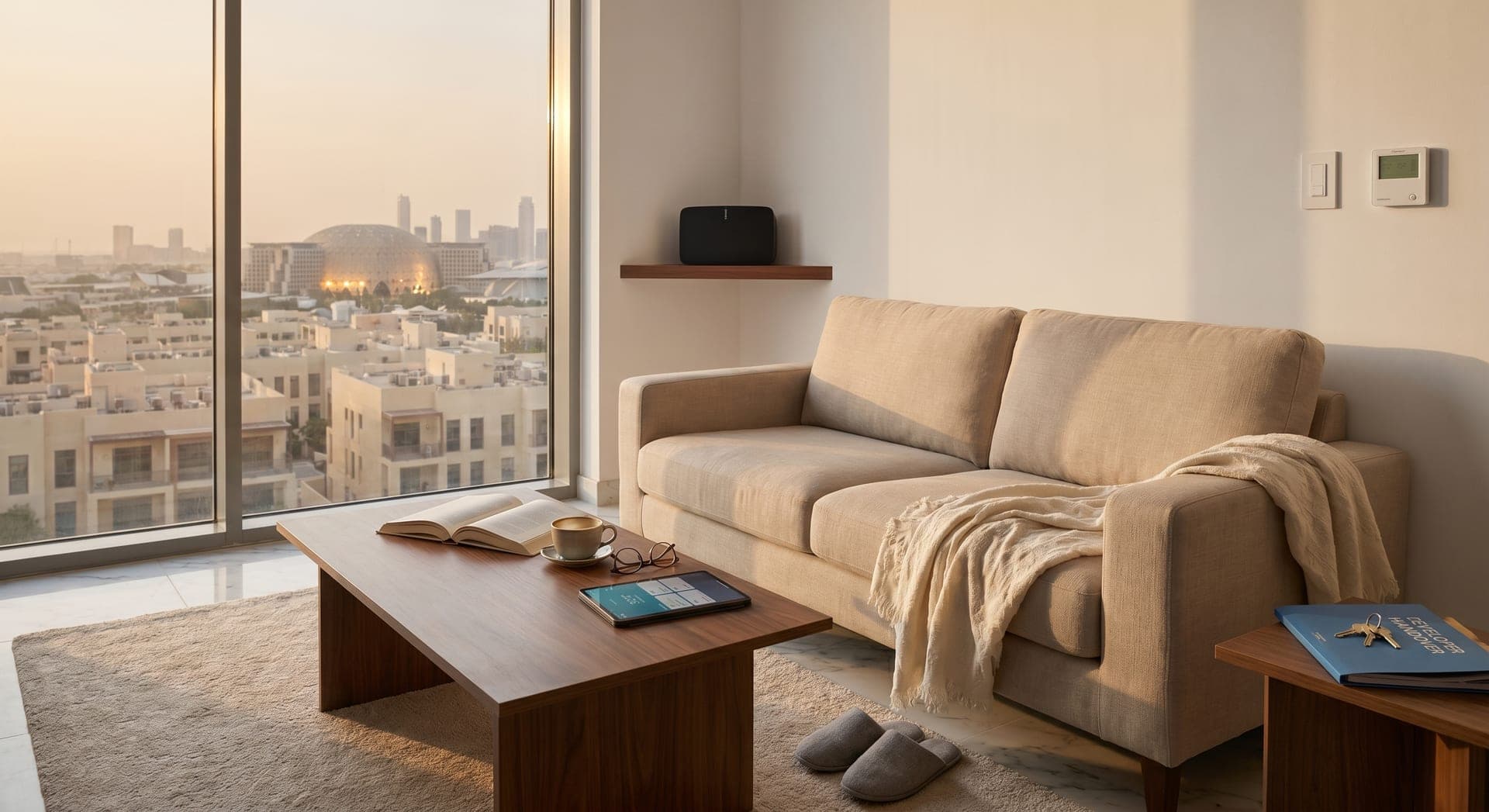
The handover envelope is heavier than you thought. Snagging report, keys, three remote controls, a folder of warranty cards, a sticker on the AC vent. The painters left this morning. Furniture is two weeks out. The fridge arrives Thursday. And you are standing in an empty apartment in Dubai South with the strange privilege of an empty wall, an empty schedule, and the only thirty days you will ever have where adding a smart home costs less than your first DEWA bill.
This is the Dubai South handover window. Greenway Residences, Greenway Townhouses, South Bay, Beachfront Gates, the Azizi Venice early phases, clusters are landing through Q3 and Q4 of 2026 (Dubai-South.ae, 2026). Most owners discover the smart home conversation about three months in, after a few summer DEWA bills, after a few times they came home to a hot apartment, after the kids' bedtime fight about who left the lights on. By then the walls are full, the routine is set, and every install is a retrofit on top of a habit.
The thirty-day move-in window is the cheapest, easiest one you will ever have. Here is the setup.
TL;DR: Dubai South handovers in 2026 fall into two cooling categories, district-cooled apartments (Emicool serves the Expo and South Bay clusters, Empower serves others) and chiller-free villas with their own split AC. The smart home setup is different for each. For apartments, the focus is lighting, blinds, security, and bedroom AC scheduling for the rooms the thermostat does not reach. For villas, full zone-control on the split AC is the spend with the biggest summer payback. Either way, a useful starter setup runs AED 3,000-7,000 installed, takes one day, and ends about five small frustrations before they become routine. Do it in the empty-apartment window before the furniture arrives.
Why Dubai South Is the Best Window for a Move-In Smart Home
Dubai handed over fewer units than forecast in 2025-2026, about 48 percent of the 71,613 units originally scheduled for 2026 are projected to complete this year, roughly 34,740 homes (Property Stellar, 2026). Dubai South is one of the active handover zones in that 34,740. Three things make the moment unusual.
The wall is empty. Every smart-home installer in Dubai will tell you the same thing, the cheapest possible day to add a wall-mounted controller or run a low-voltage cable is the day before the sofa arrives. Once the TV unit is up and the artwork is hung, the same install is two extra hours of moving furniture and protecting finishes.
The DEWA pattern is unset. You have no usage baseline yet. The first three months of bills are the diagnostic window. If you put smart controllers in before that, you get to compare a Dubai South May to a Dubai South July with the same schedule and watch what changes. Most owners install AFTER the bill shock, which means they spend the rest of their tenancy guessing at what saved what.
The defects period is open. Dubai handovers include a 12-month Defects Liability Period in which the developer must fix construction defects at no cost (Iman Developers, 2026). If a smart controller exposes a thermostat that was never wired correctly, or a vent that does not seal, that finding goes to the developer, not to you. The first month is also when you have the best chance of getting the snagging team back to fix anything you missed.
In our experience, owners who set up in this window spend about 30 percent less on the same outcome and report fewer "the apartment is fighting me" moments through the first summer.
Step One: Find Out Which Cooling System You Have
This is the first phone call to make, and it is the one that decides what kind of smart home you can build. Dubai South has both district cooling and chiller-free split AC, and the right setup is different for each.
If your handover documents mention Emicool or Empower, you have district cooling. The chiller plant lives somewhere on the master community. Cool water is piped to a fan-coil unit inside your home. You pay a separate monthly cooling bill, consumption charges of AED 0.568 per refrigeration ton-hour plus a fixed demand charge of around AED 750 per RT per year and a maintenance fee of AED 30 per month (Empower, 2026; Property Finder, 2026). Your DEWA bill covers lights, plugs, water heater, and very little else. The Emicool plant at the Expo City site serves about 15 residential buildings in the Expo and South Bay area.
If your handover documents say "split AC" or you can see a condenser unit on your balcony or roof, you are chiller-free. Cooling is on your DEWA bill, and every dirham of waste is yours.
The reason this matters: smart AC scheduling, geofencing, and per-room control move the needle aggressively when cooling is on your DEWA bill, because the savings show up on a line item you control. On a district-cooled apartment, the same scheduling still helps comfort, but the financial payback shifts to demand-charge management rather than consumption. Both are real. They are different.
Ask your developer or building manager today, before you buy anything. The answer is on page two of the handover folder you have not opened yet.
Step Two: WiFi Before Anything Else
Every smart device in your home is going to talk through your network. A weak network means lights that miss a command, an AC schedule that skips a Tuesday, and a doorbell camera that goes offline the one time someone rings it. About half of the "the smart home is broken" complaints we get on year-three visits trace back to the WiFi, not the smart device.
For a new Dubai South apartment or villa, do three things on Day One. Place the router somewhere central, not in the meter cupboard by the front door where the ISP technician put it. Use a mesh system with at least two nodes for any home over 90 sqm, the concrete walls in new Dubai builds eat 2.4 GHz signal at about twice the rate of drywall. And put your smart devices on a dedicated 2.4 GHz SSID rather than letting them fight your laptop for 5 GHz airtime. We covered the WiFi-first principle in detail in our guide for renters, and the same logic applies to new owners.
This part is not glamorous. It also costs about AED 1,500 in equipment for a typical 1-2 bedroom apartment and saves you about three callouts a year. We recommend a mesh kit from Asus, Eero, or TP-Link Deco, depending on what you already own.
Step Three: Lighting and Blinds Before the Curtains Go Up
This is the move-in-window-only win. Once curtains are hung, motorised blind retrofits are still possible, but they cost more and look messier. Once the lighting fixtures are installed and tested, swapping switches becomes a finishing-touch job rather than a fit-out job.
For a Dubai South apartment, our default starter setup is two things. Lutron Caseta or Aqara H1 in-wall switches on the main living and bedroom circuits. The Caseta version runs about AED 350 per switch plus install and gives you scenes, schedules, and dimming on the existing wiring with no new neutral required (Lutron, 2026). The second is battery-powered motorised blinds on the west and south-facing windows. Aqara and Soma both make retrofit motors that clip onto existing roller blind tubes for around AED 600-900 per window, and they charge with a USB cable about every six months.
For villas, add two more things. A motion-sensor circuit on the upstairs landing and the kids' bathroom, these are the two places where lights get left on for hours by accident. And a doorbell camera. New Dubai South villa clusters are still in their first occupancy phase, which means delivery drivers, gardeners, and snagging-fix teams are coming and going. A doorbell camera plus a simple front-door notification routine answers the "who keeps ringing the bell" problem before it becomes a daily annoyance.
What to skip in this window. Smart bulbs in every room. They are tempting because they are cheap and they ship in five days. The problem is that smart bulbs only work when the wall switch is left on, and your guests will turn off the switch out of habit. In-wall switches are the better spend on a fresh build. Read our smart bulbs vs smart switches comparison for the full reasoning.
Step Four: AC Control, Tuned to Your Cooling Type
For chiller-free villas, Fairway Villas 2, the Emaar South townhouse clusters, any cluster with its own condensers, the biggest single-spend win is a smart controller per indoor unit. Sensibo Sky, Tado, or Cielo Breez each run about AED 380-1,200 per unit installed, and they sit between the AC and the original remote (7Mayfair, 2026). The setup gives you geofencing (AC kicks on when your phone crosses a virtual fence near the community gate), schedules (off at 9am, back on at 5:30pm), per-room sensors so the upstairs master does not have to be 18 degrees just because the downstairs hallway thermostat reads 24, and a phone app that works from anywhere.
For chiller-free 2-3 bedroom villas, three controllers and three room sensors run about AED 3,500-5,000 installed. For 4-5 bedroom villas, four to five controllers plus a leak sensor or two under the drip trays runs AED 4,500-6,500. This is the same playbook from our Springs zone-control guide, adapted to a brand-new build rather than a 20-year-old one. The difference: in a new Dubai South villa, you are tuning a system that still works correctly. You are not compensating for a 2003 AC unit running on a 2026 climate. Smart controllers should cut your summer DEWA cooling cost by 15-30 percent in this scenario, with the upper end realistic for villas where you previously left AC running while out (Sensibo, 2026).
For district-cooled apartments, Greenway Residences, Beachfront Gates, the Expo City-area clusters, the controller story is different. Your in-room fan-coil unit usually has a wall-mounted thermostat already, and you cannot retrofit the chiller plant. What you can do is add a smart thermostat that replaces the developer-default unit on the wall, or use a smart sensor-and-actuator pair on the bedroom fan-coil specifically. Honeywell, Resideo, and a handful of UAE-spec smart thermostats can be retrofitted to district-cooling fan-coils, Honeywell T5 or Resideo VisionPro typically install for AED 800-1,800 per zone. The reason to do this on a district-cooled apartment is the bedroom-specific schedule. The default developer thermostat treats the whole apartment as one zone, and the bedrooms that need 21 at midnight do not need 21 at 10am. A smart thermostat lets you schedule that without needing to remember to push a button at bedtime.
We have done both. The chiller-free villa setup has the bigger DEWA-bill story. The district-cooled apartment setup has the bigger comfort story. Both are worth the move-in-window timing.
Step Five: Security on the First Night You Sleep Over
The first night in a new Dubai South home is also the night you have the most reason to think about security. The building is new. The community is filling up. The cleaning crew has a key. The maintenance team has a key. The previous viewing agent has a key, or has had one at some point. And your snagging report has not been signed off yet.
Three things, on the first night, in this order. A smart lock retrofit. Igloohome, Yale, and Aqara all make options that fit standard Dubai handover door hardware for AED 1,200-2,500 installed, and they let you issue and revoke time-limited PIN codes for the cleaner, the AC technician, the painter coming back to fix the wall (our smart locks guide walks through the renter-friendly variants that also work for new owners). A doorbell camera. AED 600-1,200 for a Ring or a Aqara G4 doorbell that pairs with your existing door, gives you a record of every visit, and answers the door when you are at work. And one indoor camera in the hallway or living room, not in the bedroom, for the AED 449 Aqara G3 or the AED 199 Eufy C220. We covered indoor camera placement and the Dubai rules in detail here. The point is not paranoia. It is a record of who came and went during the snagging-fix period, which sometimes runs for 60-90 days after handover.
Skip outdoor floodlight cameras and full perimeter coverage on day one. New Dubai South clusters have community-level security. Add to it only if a specific concern shows up.
What This All Costs, Honestly
We sized this as a move-in-window spend, not a whole-home retrofit. The numbers below assume you do it in the first 30 days, while the apartment is still empty enough for one-day installs.
| Setup | What it covers | Cost (installed) |
|---|---|---|
| Apartment Starter (1-2 BR, district-cooled) | Mesh WiFi, 4 smart switches, 2 motorised blinds, smart lock, doorbell camera | AED 3,000-5,000 |
| Apartment Plus (2-3 BR, district-cooled) | Above + 1-2 smart fan-coil thermostats, 1 indoor camera, presence routines | AED 5,000-8,000 |
| Villa Starter (2-3 BR, chiller-free) | Mesh WiFi, 3 smart AC controllers, room sensors, smart lock, doorbell, 4 smart switches | AED 5,500-8,500 |
| Villa Plus (4-5 BR, chiller-free) | Above + 1-2 more AC controllers, motorised blinds on west-facing rooms, leak sensors, indoor camera | AED 8,000-13,000 |
Three pricing patterns we have seen work and one we have seen waste money. Bundled into one visit with a configured handover (one tablet, one app, one password list) is the cheapest per device. Done in stages over six months as you live with the place is the most owner-controlled but adds about 25-30 percent in callout overhead. Done by a single supplier who insists on a closed proprietary ecosystem is the most expensive over a 5-year horizon and the easiest to walk into without realising, we wrote about why we use open platforms instead in our Home Assistant manifesto.
If you spend under AED 5,000 on a Dubai South starter, an annual service plan is overkill, a bundled 12-month warranty is plenty. Above AED 10,000, an AMC tier between AED 800-1,500 per year starts to make sense, and we covered that math in our smart home support guide.
What We Will Tell You Not To Buy
This is the principle that matters. If your problem is solved by AED 4,000 of equipment, we will tell you that.
Voice assistants on day one. Alexa, Google, HomePod, these are nice-to-haves, not load-bearing. They work better added in month three after your routines are stable. Bought too early they create a "why did it not understand" frustration that turns the household against the whole project.
Whole-home audio in an apartment until you know which rooms you live in. A Sonos system is wonderful. It is also AED 3,000-12,000 for a setup that, in our experience, gets used in two rooms 95 percent of the time. Wait three months. We covered the room-by-room logic in our multi-room audio guide.
A 10-inch wall touchscreen anywhere except the foyer of a 4-bedroom villa or larger. They look beautiful in renders. In a new 1-2 BR apartment they replace a phone you already own and add a maintenance burden. Phone-only control is fine for the first year.
A AED 25,000 "smart home package" pitched by the developer's recommended vendor before you have spent a single summer in the place. The developer recommendation is rarely best-fit. It is usually the vendor who has a sales agreement with the developer. Get a second opinion.
What Good Looks Like Three Months In
We did a 2-bedroom apartment in a Dubai South residential cluster earlier this year. AED 4,800 installed, one day. Mesh WiFi, four Lutron Caseta switches on the living and bedroom circuits, motorised blinds on the two west-facing windows, a smart fan-coil thermostat on the master bedroom only, a smart lock, and a doorbell camera. The owners moved in two weeks later.
Three months in, the routines that stuck were the two that took the least training. The blinds drop at 4pm in the living room and lift again at 7am. The bedroom thermostat goes to 22 at 10:30pm and back to 25 at 8am. The doorbell records every delivery, useful when the AC technician came back twice for snagging fixes and they could send him a one-time code. The owners stopped using the AC remote entirely within two weeks. They never plugged in the voice assistant they bought separately. The smart lock got used by the cleaner Mondays and Thursdays, which removed the "did I leave a key under the mat" problem.
DEWA bill comparison is partial, they only have three months of usage and no prior-year data because the apartment is new. What we can compare is to the building-average usage for their unit size, which the developer publishes. They sit about 18 percent below building average so far. We will know more after the first July bill.
Frequently Asked Questions
Should I wait until I move in to do this, or set it up before?
Before, if you can get access. The empty-apartment install is roughly 30 percent faster and avoids any furniture-protection markup. If you cannot get access before, the first 14 days post-move are the next best window, the boxes are still being unpacked and we can route around them.
Is smart home worth it in a district-cooled apartment where I do not pay for the AC consumption?
Yes, but for different reasons. The AC bill savings are smaller because you do not own the chiller. What you do get is bedroom-specific scheduling so you sleep at the temperature you want, demand-charge management on the fan-coil so the unit is not running at full draw all afternoon, and the lighting/blinds/security setup that has nothing to do with cooling. The starter setup pays back through comfort and reduced "the apartment is fighting me" moments more than through the chiller bill.
Do I need landlord or developer approval to install this in a Dubai South apartment?
For renter-friendly devices like smart plugs, smart switches in compatible boxes, and battery-powered blinds, no. For anything that drills into walls, runs cable, or modifies the developer-supplied thermostat, yes, and the answer in the 12-month defects period is almost always to call the developer first, because they would rather their snagging team did the modification than have a third party touch it. Owner-occupiers have more freedom, but the same DLP rule applies.
Will smart home installation affect my snagging or warranty?
If done by a competent installer it should not. Snagging covers construction defects, not modifications. Where things go wrong is when an unqualified installer touches the AC fan-coil or the electrical panel and creates a fault that the developer then refuses to fix under DLP. Use installers who work in the community already and who know the developer-specific quirks (Emaar South wiring is different from Azizi wiring, for example).
Will the same setup work if I rent the apartment out next year?
Most of it, yes. Smart locks transfer (you can issue new codes for the tenant). Mesh WiFi transfers if you leave it. Smart switches and motorised blinds stay with the apartment as fixtures and add to your rental listing's appeal, especially in newer communities where comparable units compete on amenities (Property Finder, 2026). The room sensors and the smart thermostats can stay or go with you depending on the lease agreement. Keep the admin account on your phone, issue the tenant a guest account.
The Move-In Window Closes Faster Than You Think
The thirty-day window is real but it is not generous. The furniture arrives, the rugs go down, the curtains get hung, the routines set. Within six weeks of moving in, every smart-home install starts to feel like surgery on a living patient rather than work on an empty stage.
You are about to spend the next five summers in this home. The first one is when the patterns are made. The cheapest possible time to decide what your apartment knows about you is right now, in the week the painters left, before the kettle has been used.
If you have a Dubai South handover landing this summer, tell us what you are working with. We will tell you what we would do if it were ours, including the parts we would not pay for. The discovery call is free, the site visit is free, and the proposal is fully priced before we touch anything. Empty walls are easier than full ones. Every installer in Dubai will tell you the same.
Ready to Get Started?
Get a free consultation and we'll recommend what makes sense for your situation.
Get Free Consultation