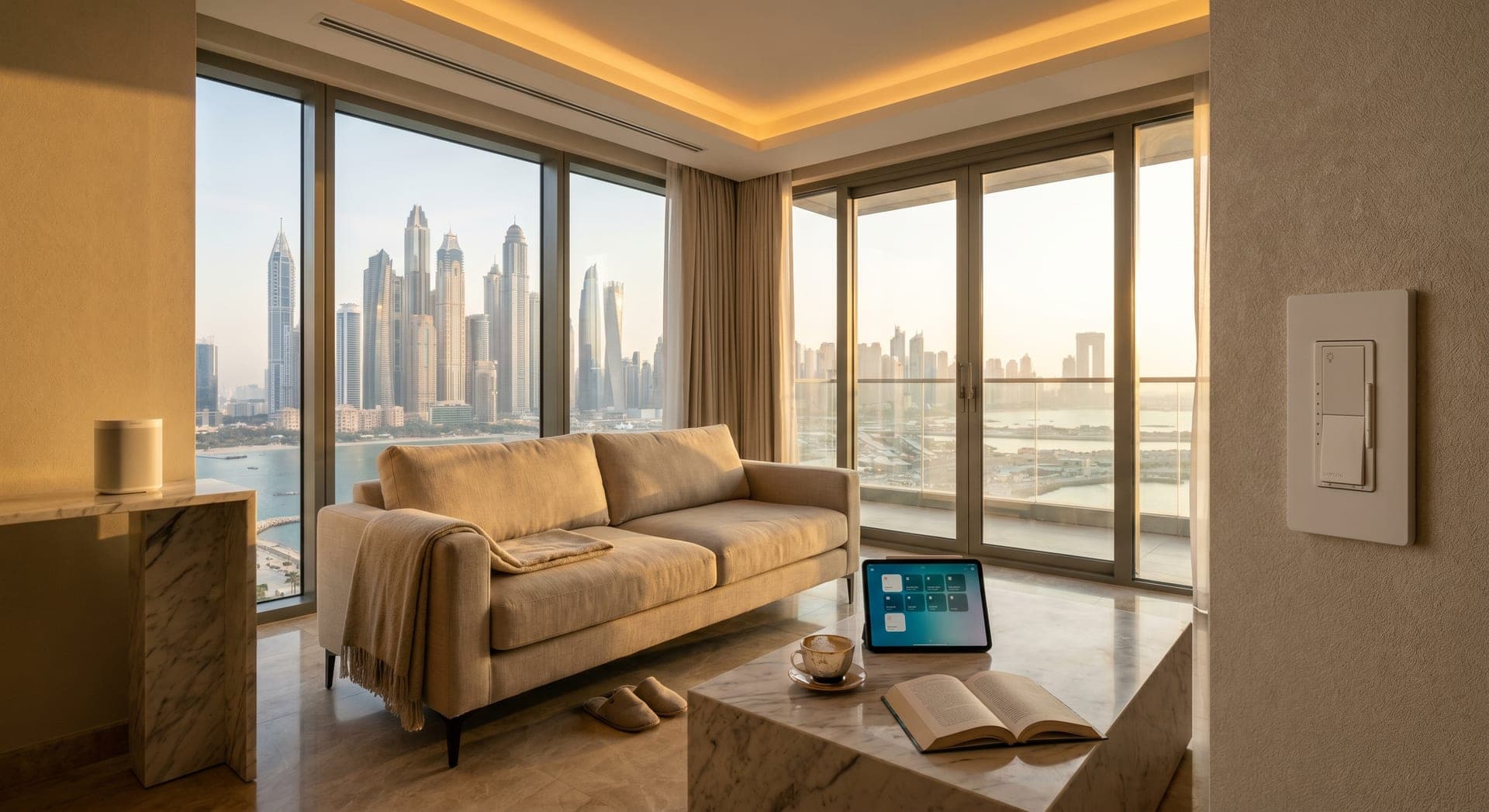
Most smart home projects in Dubai go beautifully on installation day. The technician hands you a freshly configured app, walks you through the scenes, takes a photo for their portfolio, and drives off. Day 30, day 90, and year three are when the relationship gets tested. Year three is also when most smart home companies in Dubai have moved on, the WhatsApp number you saved is on read, and the app you depend on is showing a "service unavailable" screen.
This post is about the unglamorous part. After installation. The 11pm "my hallway lights are not turning on" message. The April update that breaks the AC schedule. The "we have moved offices, please update your records" email three years in. What good smart home support in Dubai looks like in practice, what it costs, what your legal rights are if something goes wrong, and the questions to ask any installer before you sign anything. We are writing this in our first year as a company, so we have a clear interest in being clear about how this works. The rest of the industry would rather you focused on installation day.
TL;DR: A good smart home installer in Dubai should give you a 12-month parts warranty, a 90-day workmanship warranty, a written response-time commitment, and a documented handover. An annual maintenance contract for a Dubai apartment runs AED 800 to AED 5,000 a year depending on coverage. UAE consumer protection law requires the seller to repair, replace, or refund a defective product, and to provide a temporary replacement if a repair runs over seven days (Federal Law on Consumer Protection, 2020). Before you sign with any installer, get three things in writing: who picks up the phone at 9pm on a Friday, what counts as "covered," and what happens if their company goes out of business.
Why Support Is Where Smart Home Goes Wrong in Dubai
Most installation problems in Dubai are not installation problems. They are support problems disguised as installation problems. A scene stops firing because a firmware update changed an API. A motion sensor falls off the network because the router got replaced. The AC controller works perfectly, but the schedule does not run because the time zone reset after a power cut. None of these are catastrophic. All of them require someone to log in, look, and fix. If that someone has moved on, the smart home is broken. The firmware and app-update category is the one you can often triage yourself, and we set out what to check the morning after an app changes overnight separately.
Contractor abandonment is a documented problem in Dubai across construction, renovation, and smart home work. One Dubai renovation firm put it plainly in a public guide: "Disputes or delays may cause contractors to prioritise other commitments, leaving you to start over with a new team, which is exhausting and consumes time and finances" (RENO, 2026). In smart home specifically, the failure mode is quieter. The company does not disappear. They stop returning messages. The system keeps running until the day it does not, and then nobody answers.
In our experience surveying client homes from previous installers, the most common scene is a system that works mostly, with one or two automations that stopped firing a few months ago, that the client gave up trying to fix because the original installer was three messages deep and slow. The home is half-smart and getting slowly dumber.
What a Good After-Install Relationship Looks Like
A good after-install relationship has five things in it. None of them are technically complicated, but all of them require a company that has decided to stay in the support business rather than the installation business.
The first is a documented handover. You should leave installation day with a one-page document that lists every device installed, every scene configured, the network it is on, the room it is in, and which account holds the admin side of each platform. It should not contain a single password. Without this, the installer is the only person who can ever maintain the system. With it, any technically minded person can. We give every client this document and keep a synced copy ourselves, because their home is theirs, not ours.
The second is a clear warranty. Industry standard in Dubai is 12 months on hardware (limited by manufacturer warranty), 30 to 90 days on workmanship, and clarity on what is covered (European Technical, 2026). A loose smart bulb six months in is hardware. A scene that stops firing because of a configuration drift two weeks in is workmanship. The line matters because the price tag attached to each is very different.
The third is response-time clarity. Reputable maintenance providers in Dubai commit to a 2 to 4 hour emergency response for critical failures and a same-day window for non-critical issues, and they put it in writing (Paklink, 2026). "We will get back to you" is not a response time. "If your front door lock is offline we are on it within two hours, otherwise we are back to you by end of next working day" is.
The fourth is a remote-first first response. Most smart home issues in Dubai can be diagnosed and often fixed remotely. One Dubai provider publicly cites resolving a customer issue in under 10 minutes via remote assistance. We have seen the same pattern. When your scene fails, the first action should be a technician looking at your system from their laptop, not a van scheduled three days out. Site visits are for things that need hands on hardware.
The fifth is an honest year-three plan. What happens if the installer's company is sold, downsizes, or goes quiet? The answer should not be "we trust that will not happen." The answer should be: your system runs on a documented open platform, your handover document tells any competent installer how to take over, you own the admin account, and there is a clear path off if you want one. This is why we build our whole-home systems on Home Assistant, and why we tell clients up front that they can fire us. It tends to be the reason they do not.
What Smart Home Support Costs in Dubai
Support pricing in Dubai falls into three patterns. Knowing them helps you read a proposal honestly.
The first pattern is bundled warranty, no AMC. The installer gives you 12 months of parts coverage and 90 days of workmanship, with anything after that billed at hourly rates (typically AED 150 to AED 300 per hour for a smart home technician, plus parts). This works for small apartment installs where the system is simple and failure modes are few. A studio with one AC controller and four smart bulbs probably never needs an AMC. The bundled-warranty model fits.
The second pattern is an annual maintenance contract (AMC). For Dubai apartments, AMC pricing is well-documented. Basic apartment plans start around AED 800 to AED 1,500 a year, standard plans run AED 1,500 to AED 3,000, and premium plans with priority response sit at AED 3,000 to AED 5,000 (SnapFixNow, 2026). These plans typically bundle a set number of scheduled visits, unlimited remote support, response-time SLAs, and a labour pool against repairs (with parts billed separately). What is included is the line item to read carefully. Some AMCs cover scheduled visits only, others cover unlimited callouts but only on a defined device list.
The third pattern is hybrid: warranty plus a retainer. Common for villa installs and whole-home builds. You pay a small monthly or quarterly retainer (AED 250 to AED 800 a month is typical for a 3-bedroom villa setup), which buys you a defined number of remote-support hours and a discount on site visits beyond that. Hybrid suits clients who want predictability without a one-size-fits-all AMC.
Which pattern is right depends entirely on the size and complexity of the install. Our honest recommendation: if you spend under AED 8,000 on hardware, bundled-warranty is plenty. AED 8,000 to AED 25,000, look at AMC. Above AED 25,000 (full villa or whole-home apartment), the hybrid retainer is what we suggest, with the option to scale up if usage warrants it.
Your Legal Rights as a UAE Smart Home Buyer
This is the part most installers do not mention. UAE Federal Law on Consumer Protection (Decree-Law No. 15 of 2020) and its 2023 executive regulations give you specific rights as a smart home buyer that override anything the installer's contract says (UAE Government Portal, 2026).
If a smart home device is defective, the seller (the installer, the retailer, or the manufacturer) is legally required to halt sales, notify the authorities, and offer you a refund, replacement, or repair. If the same defect appears three times within the first year, a full refund or replacement becomes mandatory. If a repair will take longer than seven days, the seller must provide a temporary replacement at no extra cost (Hogan Lovells, 2024). Pickup and technician visits for warranty work cannot be charged separately.
Penalties for non-compliance are not symbolic. A supplier who fails to repair or replace a defective product without charge can face up to two years' imprisonment and fines up to AED 2 million (Lexology, 2023). This is the legal floor every smart home installer in Dubai operates on. If an installer asks you to pay for a callout to fix a 60-day-old motion sensor that failed for no reason, they are quietly outside the law.
The practical takeaway: keep your invoice, take photos of installation, and save the WhatsApp thread. If a dispute escalates, you have a route to the Department of Economy and Tourism (the consumer-protection enforcement body), and the law is on your side more than most buyers realise.
The WhatsApp Question and What It Says About Your Installer
In April 2026, the UAE Central Bank told every bank in the country to stop using WhatsApp for customer communications by April 30, citing fraud risk, data residency, and the difficulty of auditing decisions made in a casual chat thread (Khaleej Times, 2026). Banks are now pushing customers into their own apps for anything that touches account data.
For a smart home installer the calculation is the opposite. The reason your bank had to leave WhatsApp is also the reason your smart home installer should be on it: WhatsApp is where the convenience economy in Dubai lives. You order food on it, you book your cleaner on it, you message your interior designer on it. The reason WhatsApp is wrong for banking (informal, hard to audit, hard to authenticate at scale) is the reason it is right for home services. When your bedroom lights stop responding on a Friday at 11pm, you do not want to file a ticket in an app. You want to send a voice note.
Our position is that smart home support in Dubai should live where the convenience economy lives. We are on WhatsApp. We reply, often within minutes, sometimes within an hour, and at worst within a working day. Your data does not leave the country, because we do not put account-grade information in chat. We put diagnostics, photos, and "yes the technician will be there at 4pm tomorrow" in chat. That is what WhatsApp is for, and pretending otherwise was never honest.
The lesson is broader than chat apps. A good installer meets you where your life is, and adapts when the rules change. A bad installer hides behind a service portal that nobody opens, and treats your second message as an intrusion.
What to Look for in a Smart Home Support Agreement
Before you sign with any installer, ask for the following five things in writing. If they will not put them in writing, that is the answer.
Response-time commitments. What is the SLA for critical failures (lock offline, security camera down)? What is the SLA for non-critical (a scene that stopped firing)? Reputable Dubai providers commit to 2 to 4 hours for critical, same or next working day for non-critical. Anything vaguer than that is a red flag.
What is covered and what is not. Hardware failure within warranty. Configuration drift after a firmware update. Network issues caused by a new router. Damage from a power cut. The line between "covered" and "billable callout" should be in plain English on page one, not buried in a 12-page T&Cs document.
Remote-first diagnostics. Will the first response be a technician looking at your system from their laptop, or a site visit booked for next week? Same-day remote support is industry standard in 2026. If the installer cannot diagnose remotely, they have not built the system to be supportable.
The handover document. Will you leave installation day with a written record of every device, every scene, and which account owns each platform? Will you own the admin side, or will the installer hold the keys? The right answer is yours, not theirs, and your password should never end up written into that record. If the installer needs ongoing access, it should be their own login on your account, one you can switch off the day you part ways.
What happens if the company stops trading. This is the question installers find hardest to answer. The honest answer is: the system was built on a documented open platform, the handover document is up to date, you hold the admin account, and the next installer can take over without scrapping anything. Anything less than this is a lock-in dressed up as a warranty.
What We Do at Bayora
We are a new company, so this list is short and specific. We are not promising a 20-year track record we do not have. We are promising the things we do every week for the clients we have already taken on.
Handover document on installation day. A one-page record of every device, every scene, and which account owns each platform. No passwords on it: you hold those, we never keep copies, and if we ever need standing access to support you we ask for a separate login on your account that you can switch off any time. You get a printed copy. We keep a synced version that auto-updates if we make any later changes.
WhatsApp first response. Send us a voice note when something is not working. We reply within an hour during working hours and within the day on evenings and weekends. The first thing we do is open your system from our laptop and look. Most issues are diagnosed remotely.
12-month parts warranty, 90-day workmanship warranty. Standard for the industry, in writing, with the line between hardware and workmanship spelled out.
No mandatory AMC. We sell AMCs to clients who want one, but we do not bundle one into the install price. If your system runs cleanly on its own (most apartment installs do for the first 18 to 24 months), there is no reason to pay for a service you are not using. We will tell you when an AMC starts to make sense and not before.
Open platform, your accounts. Our whole-home systems run on Home Assistant, open source, locally hosted. Small single-product jobs, a Hue sync kit or a gate relay, stay in the manufacturer's own app, because putting a hub behind a two-hour visit would be billing you for our convenience. Either way the accounts are in your name and you own the admin side. If we go quiet, any competent installer in Dubai can pick up where we left off, and the handover document tells them how. This is not a marketing line. It is a structural choice that costs us a lock-in we would otherwise have. We think it is worth it.
Two-week and three-month check-ins. We message you at 14 days and 90 days post-install to ask what is working, what is not, and what we missed. The answer is sometimes "nothing." More often it is something small that the original walkthrough did not cover. Either way the question gets asked.
If you are about to sign with another installer, that is fine. Ask them for the same five things in writing, and decide from there. If they say yes to all five, you have a good installer. If they hedge on one or two, ask why. If they hedge on all five, look elsewhere.
What This Looks Like on a Real Apartment
We installed a smart home setup in a 2-bedroom Business Bay apartment last quarter. AC controllers in each room, smart switches in the living area, motion sensors in the hallway, a video doorbell, and a single iPad mounted on the kitchen wall as the dashboard. Hardware and install came in at AED 12,400.
Day 14 check-in. The owner told us the morning lighting scene was firing 20 minutes earlier than expected. We logged in remotely, found a daylight-saving offset we had missed on the schedule, fixed it in 4 minutes, sent her a screenshot. No site visit.
Day 47. The hallway motion sensor stopped triggering. Voice note in WhatsApp at 9pm. We looked at the system from a laptop the same evening, saw the sensor had dropped off the mesh. Walked the owner through a 30-second pairing process on her phone, lights worked again before bed.
Day 92 check-in. Everything running. The owner mentioned she had bought a second video doorbell for the storage entrance. We added it to the dashboard remotely and updated her handover document. No charge. We told her up front that small additions like that are free for the first year as long as the hardware is one she bought.
This is what after-install support looks like when an installer has decided to stay in the support business. It is not glamorous. It is not most of the installer's day. But it is the difference between a smart home that stays smart for ten years and one that quietly stops working in year three.
Frequently Asked Questions
How long should a smart home warranty last in Dubai?
Industry standard in Dubai is 12 months on hardware (limited by manufacturer warranty) and 30 to 90 days on workmanship. Anything shorter is below market. Some installers offer 24 months on workmanship for whole-home installs. UAE consumer protection law also gives you the right to a refund or replacement if the same defect appears three times within the first year, regardless of what the installer's warranty says.
Do I need an annual maintenance contract for a smart home in Dubai?
Most Dubai apartment installs do not need one in the first 18 to 24 months. AMCs make sense once your system is large enough that a single visit covers multiple small issues, or once it is critical enough that you need a guaranteed response time. For systems under AED 8,000 of hardware, hourly billing for occasional issues usually costs less than an AMC. Above AED 25,000 of hardware (full villa or whole-home apartment), an AMC or hybrid retainer is worth it.
How quickly should my smart home installer respond when something breaks?
Reputable Dubai installers commit to 2 to 4 hours for critical failures (security camera offline, smart lock not responding) and same or next working day for non-critical issues (a scene that stopped firing). The response should be remote first. If your installer's only answer is to book a site visit for the following week, the system was not built to be supportable.
What if my smart home installer goes out of business?
This is why open-platform builds matter. If the system runs on a documented open platform like Home Assistant, you own the admin account, and you have a written handover, any competent installer can take over. If the system runs on a closed unified app where the installer holds the keys, you are stuck. Before you sign with an installer, ask explicitly what happens to your system if their company stops trading. The answer tells you a lot. If you are already in that position, we have written a separate guide on taking over a smart home when the installer is gone.
Can I switch smart home installers without replacing the hardware?
Yes, if the system was built on an open platform. You take the handover document to a new installer and give them their own login on your account, and they take over the maintenance. If the system was built on a closed proprietary platform, switching is much harder, because the new installer typically has to be certified by the same brand and the existing setup may not be transferable. The cleanest way to keep your options open is to insist on open-platform from day one.
Get a Smart Home That Stays Smart
The work of building a smart home in Dubai is a week. The work of keeping it running is ten years. Most installers in this market are very good at week one. The questions that decide the next decade are the ones we have walked through in this post.
If you are thinking about a smart home install and want to see what a written support agreement looks like before you commit to anything, get in touch. We will share the handover document template, our warranty terms, our response-time SLA, and our open-platform handover plan up front. No deposit, no pressure. The first conversation is the place to ask hard questions, and we would rather you asked us than nobody.
You can also see what our installs include on the home automation and smart AC service pages, or read more about why we build our whole-home systems on an open platform you own. The office you work in already has IT support, an SLA, and a handover plan. Your home deserves the same.
Ready to Get Started?
Get a free consultation and we'll recommend what makes sense for your situation.
Get Free Consultation