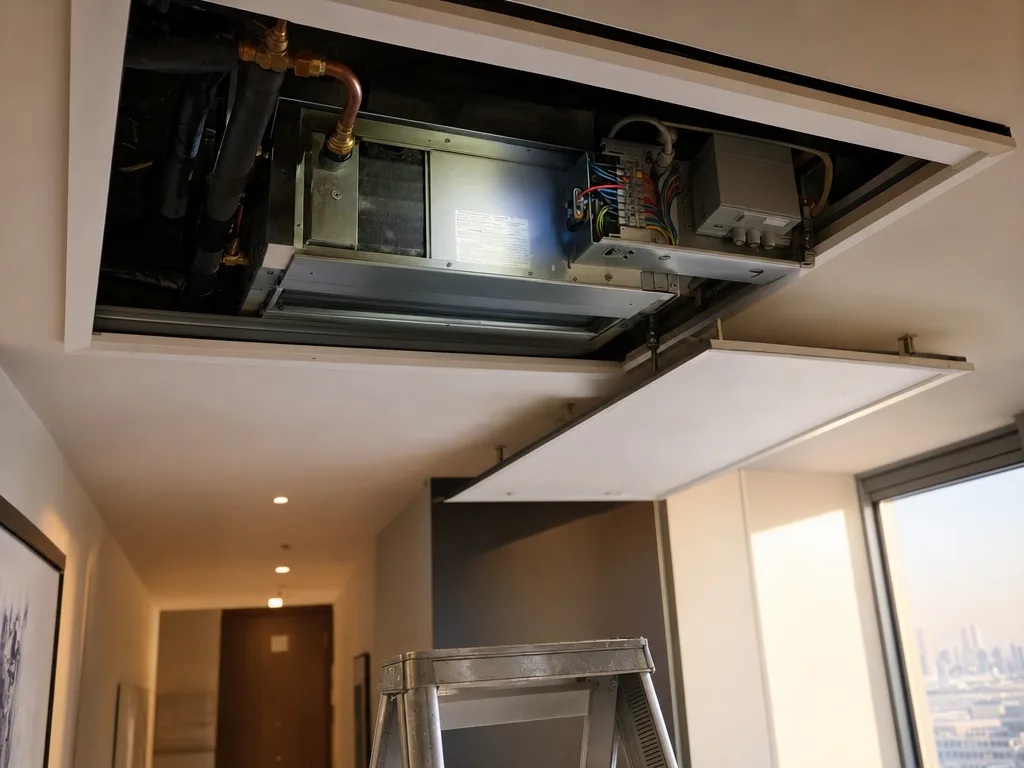
An order sat unplaced on our side for weeks. The client had paid. What was missing was a model number on a sticker inside a ceiling hatch, and until somebody climbed up and read it, nobody could say which converter the job needed, or whether the quote on the table was for the right part at all.
That sticker is the most expensive piece of information in a Dubai smart AC project, and almost nobody asks for it before quoting.
TL;DR: A smart thermostat speaks 24 volts. Most Dubai fan coils and ducted units switch at 220-240V, so a converter sits between them. Which converter depends on whether you have a wall split, a chilled-water fan coil, or a ducted system, and the price gap between those three is large. Split with an IR remote? No converter, and you can do it yourself.
What a Converter Does, and Why Dubai Needs One
A converter is a small box that sits between a smart thermostat and your air conditioning, because the two of them do not speak the same language. The thermostat sends a low-voltage signal. Your AC expects something else entirely. Without the box in the middle, it does not work.
Here is the gap in plain terms. Ecobee was designed around North American central heating and cooling, which runs its control wiring at 24 volts. Ecobee says so directly: their thermostats "are compatible with most 24-volt residential heating and cooling systems in North America, including gas, oil, electric, and dual-fuel systems", and "High-voltage systems are not compatible with ecobee thermostats" (ecobee).
Dubai homes are mostly on the other side of that line. The thermostat already on your wall here is commonly a mains-voltage device, not a 24-volt one. Honeywell's TB3 fan coil range is a fair example: the mains model is specified at "100~220 VAC".
The box is what lets a 24-volt brain drive a 220-volt body.
Three Systems Behind a Dubai Wall, Three Different Answers
The converter question has three answers in this city, and they are not close to each other in price or in difficulty. Which one applies to you is decided by what is behind your wall, not by which thermostat you liked online.
Wall split with an infrared remote
You need no converter and no electrician, and nobody opens a wall. If your AC is a split unit with a handset, the smart layer talks to it the same way the handset does, over infrared. Sensibo puts it plainly: their device "is an IR (infrared) blaster that communicates with your AC unit the same way your remote control does - by sending infrared signals", and "doesn't require any wiring or permanent installation" (Sensibo). Tado describes the same approach for "most existing air conditioners that have an infrared remote with a display showing the current settings" (tado).
This is the honest cheap route, and we tell people to take it when it fits. Plug it in, point it at the unit, done in an afternoon.
Chilled-water fan coil
This is the district cooling case, and it covers a lot of Dubai Marina, Business Bay and Downtown. The cooling is produced centrally, not in your apartment. Empower describes it as "the centralized production and distribution of cooling energy", where "Chilled water is delivered via an underground insulated pipeline to office, industrial and residential buildings", and "Specially designed units in each building then use this water to lower the temperature of air passing through the building's air conditioning system" (Empower).
The unit in your ceiling is a fan coil. On the common two-pipe layout, the thermostat is doing two simple jobs: switching fan speeds, and opening or closing a motorised water valve. A converter here is a modest part. On our own quotations it has sat at AED 195 for the part, with installation from AED 325 per unit.
Ducted split
This is the villa and the larger apartment, and it is the expensive answer. A ducted system has no water valve to open and usually no handset to copy. The smart thermostat has to talk to the indoor unit's own control board, which means a bus adapter rather than a voltage converter, and those run several times the price of the fan coil part.
Mitsubishi makes an interface for exactly this. Its spec sheet, for a model now superseded, carries two lines worth reading. The interface "enables the use of a third-party thermostat to control your Mitsubishi Electric indoor units", and then, flatly: "Line Voltage Thermostats will not work." It also sets a limit that matters more than either: one thermostat connects to one interface, and that interface controls a single indoor unit, even on a multi-zone system (Mitsubishi PAC-US444CN-1 spec).
Read that last part again if you are pricing five rooms. One interface per indoor unit. Five rooms is five interfaces, five thermostats and five lots of labour, which is why a five-room number lands so far from a one-room number that people assume somebody is being greedy.
The Model Number Decides the Price, and Sometimes the Product
Within the ducted case there is a second fork, and it is the one that caught us out. Some indoor units carry a serial control port, the CN105 connector on Mitsubishi boards being the common example. If the port is there, the serial adapter we specify gets full control: inverter modulation, all fan speeds, all modes. If the unit only offers dumb terminals, control degrades to on and off.
That matters more than it sounds. You still get an app. You still get schedules. What you lose is the ability to run the compressor gently, which is most of the reason to make an AC smart in the first place. In our experience the people who end up disappointed with a smart AC install are rarely disappointed with the app. They are disappointed that the house now has an expensive on-off switch.
You cannot tell which you have from the brand, the age of the building, or a photograph of the wall plate. It is on a label on the indoor unit. That is the sticker in the ceiling hatch, and that is why we will not price a ducted job without one.
What Goes Wrong When the Converter Is Guessed
Two things, and they fail in opposite directions.
The first is the wrong part. A popular fan coil thermostat drives its load through valve relays, which is the right design for chilled water and useless on a ducted unit, because a ducted unit has no water valve for a valve relay to open. The hardware arrives, the technician opens the box, and the job stops.
We have done this ourselves. A standing note in our own records said a certain thermostat needed no converter, and that note was true, for the system it was written about. Somebody applied it to a different site without checking whether the condition still held. Seven photographs of the actual units corrected it on the same day, which is how cheap the check was. A supplier quoting from what was true on the last job is not quoting your home.
The second failure is the one nobody expects. When the system gets mis-identified, the quote usually comes out too low, not too high, because the cheap converter got priced for a job that needed the expensive one. On a recent internal review the corrected figure was several thousand dirhams above the version on the table.
So the instinct that a high quote means somebody is overcharging is worth resisting for a moment. Sometimes the lower number is the one that has not yet found the problem. We wrote a fuller guide on how to read a smart home quote in Dubai if you have two in front of you and they do not agree.
Four Questions to Ask Before Anyone Quotes You
Ask these of us, and of whoever else you are talking to. They take about five minutes and they resolve most of the price confusion.
- Which of the three systems do I have, and how did you establish it? A photo of the indoor unit beats a conversation about the wall plate.
- Does this quote include a converter, and which class? Fan coil and ducted converters are different parts at different prices.
- One converter per room, or one for the apartment? For ducted, it is per indoor unit, and that changes a five-room number completely.
- If my unit turns out not to have a serial port, what do I lose and does the price change?
A supplier who answers all four without needing to check is guessing at least one of them.
When Doing It Yourself Is the Right Call
Wall splits with working remotes: buy the controller and fit it yourself. The hardware is on the shelf locally, there is no wiring, no landlord conversation and no reason to pay anyone. Our guide to smart AC control in the UAE covers what the setup involves, and the controller versus thermostat comparison will tell you in thirty seconds which camp your home is in. If it is a Nest you had your eye on, the Aqara and Nest comparison covers why that one in particular struggles here.
Where self-sourcing goes sideways is the wired cases. A fan coil or a ducted unit means mains voltage behind a plate, a part selection that depends on a label you have to go and find, and a system that belongs to your building as much as to you. A contractor booked by the hour to fit a thermostat is quoting to fit a thermostat. Nobody in that transaction is answering for whether the right thermostat was chosen.
That is the whole difference, and it has nothing to do with the brand on the box.
Frequently Asked Questions
Do I need a converter for a smart thermostat in Dubai?
Only if your AC is wired rather than remote-controlled. A wall split with an infrared handset needs no converter at all. A chilled-water fan coil or a ducted split almost always does, because the thermostat runs on a low-voltage control circuit and the unit is switched at mains voltage.
How much does an AC converter cost in the UAE?
The chilled-water fan coil converter is the cheaper one. On our quotations it has sat at AED 195 for the part with installation from AED 325 per unit. Bus adapters for ducted systems run several times that. Ask which class is in your quote, because the two are not interchangeable.
Can an electrician fit a smart thermostat to my Dubai apartment?
Physically, usually yes. The wiring is the easy part. The hard part is choosing between a fan coil converter and a bus adapter, which depends on your indoor unit model, and an hourly electrician is not being paid to make that call or to answer for it afterwards.
Why are two smart AC quotes in Dubai so far apart?
Most often because they are not quoting the same job. One has priced a converter per indoor unit and the other has not, or one has assumed a fan coil where the home has a ducted system. Compare the converter line and the per-room count before comparing the totals.
Does smart AC control reduce my DEWA bill?
It changes when and how hard the AC runs, which is where the cooling cost sits. DEWA's own peak load campaign puts air conditioning at about 60% of peak load use (DEWA, 2016). What you save depends on your schedule and your tariff slab, so treat anyone quoting you a fixed percentage with caution.
Find Out What You Have Before You Buy Anything
The cheapest step in this whole process is free, and for a lot of readers it stops here.
- Look for a handset. If your AC came with an infrared remote that has a display showing the current settings, you are almost certainly in the no-converter case. If that is you, nothing below applies and nothing needs opening.
- No handset, only a panel on the wall? Then the answer is above your head. The indoor unit usually sits behind a ceiling access hatch, and it carries a printed label with the model number on it.
- Photograph the label and one wider shot of the whole unit. Do not unscrew anything, do not move wiring, and if the hatch will not open by hand or you cannot reach it safely, leave it. The wide shot and your building name are enough for us to start.
We do this work as smart AC and climate control, so we have an interest, and the answer is still free. Send us the photo and we will tell you which system you have, whether you need a converter, and whether this is a job you should be paying anyone for at all. We will say so if the answer is an AED 600 controller you can fit yourself. And if you already have a quote in hand, send that instead and we will tell you whether the converter line is on it.
Ready to Get Started?
Get a free consultation and we'll recommend what makes sense for your situation.
Get Free Consultation