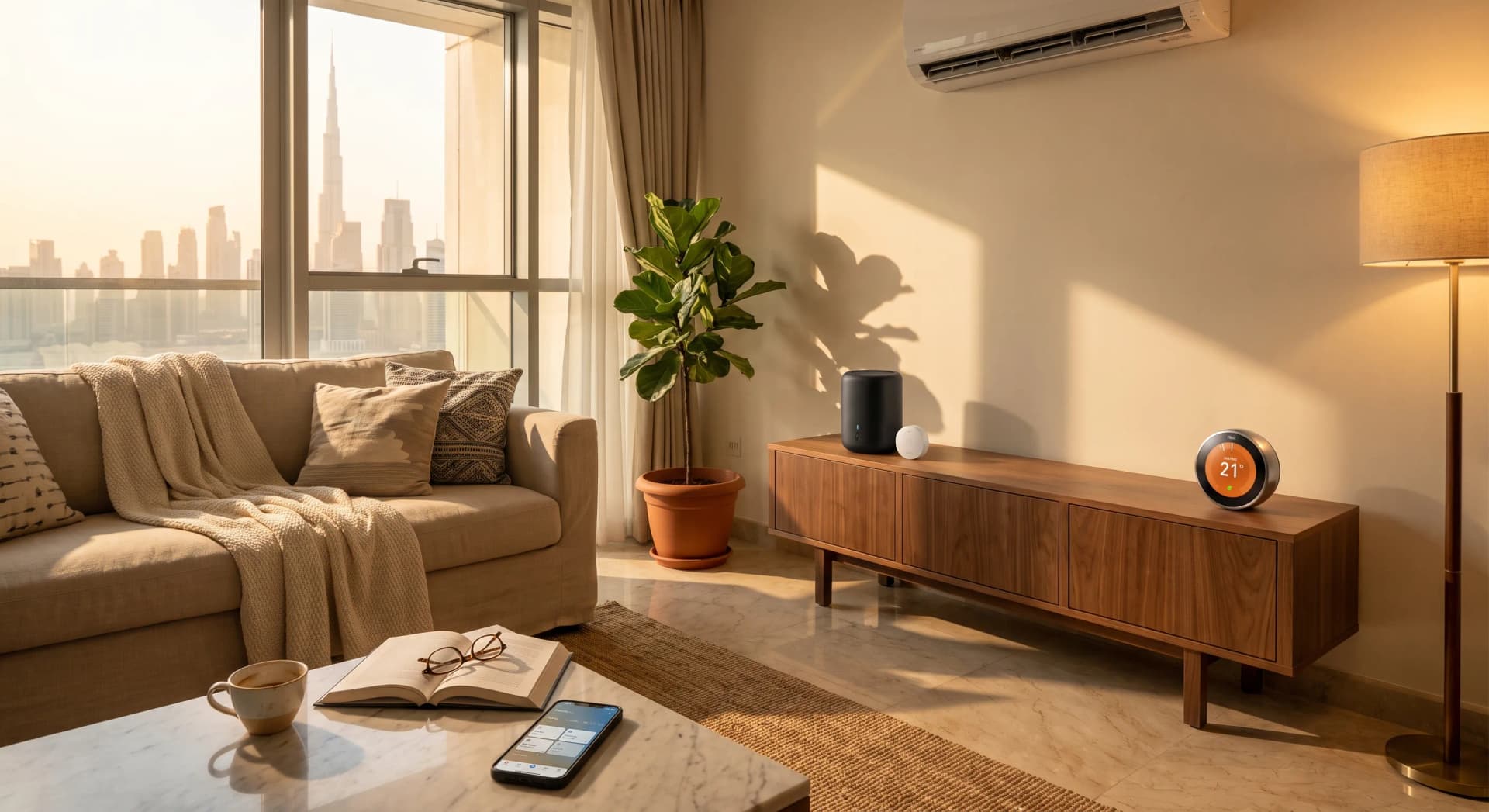
You picked a phone and got pulled into a world. Buy an iPhone and you are in Apple's. Buy a Pixel and you are in Google's. A smart home works the same way, except most people never notice they made the choice until they own six devices that only half talk to each other.
Aqara and Google Nest are the two names that come up most for a Dubai apartment, and they sit on opposite sides of that choice. One keeps the brains of your home inside your apartment. The other keeps them on Google's servers, a few thousand kilometres away, running on Google's timeline. That difference sounds abstract until the day it stops being abstract, and we have watched it stop being abstract for real people.
TL;DR: Aqara runs on a local hub you own (from AED 319), speaks Zigbee, Thread, and Matter, and works with Apple Home, Alexa, Google, and Home Assistant without locking you in. Google Nest is a cloud-first world where remote control routes through Google, and Google has twice switched off features people paid for. For a Dubai apartment, Aqara also wins on the thing that matters most here: it controls your existing split AC over infrared with zero wiring, while Nest thermostats fight the 220V system in your wall.
The Real Question Is Not Which Gadget
Most comparison guides line up two boxes and count features. That misses the decision in front of you. A single smart plug is a gadget. A hub, a few sensors, and the automations that connect them are a system, and a system lives inside one company's rules.
The moment you buy your second device, you are choosing a platform, not a product. That platform decides whether your automations run when the internet drops, whether a device you bought in 2026 still works in 2031, and whether you can add a lock from a different brand without everything breaking. Aqara and Nest answer those three questions in almost opposite ways, so that is where an honest comparison has to start.
Where Aqara Keeps the Brains: Inside Your Home
Aqara's whole design assumes the thinking should happen in your apartment, not in a data centre. The Aqara Hub M3 is a Thread border router and a Matter controller that speaks Zigbee 3.0, and it stores your device list, settings, and automations in 8GB of encrypted local storage on the hub itself (Aqara, 2025).
What that buys you is simple. When your building's internet has one of its afternoon wobbles, your motion-triggered hallway light still fires, your door sensor still logs, and your morning scene still runs, because none of it needed to phone home. The hub is the brain, and the brain is in the room. One thing clients always ask is whether they will be locked into the Aqara app. They will not. The same hub bridges into Apple Home, Alexa, Google Home, SmartThings, and Home Assistant, so you keep whatever voice assistant you already talk to.
Where Nest Keeps the Brains: On Google's Servers
Google Home was built cloud-first, and offline handling only arrived in 2024 (FindArticles, 2026). Remote control, live camera streaming, and alerts still travel through Google's servers before they reach you. When those servers have a bad day, the smart part of your smart home has a bad day with it.
That is the trade for Nest's polish, and the polish is real. A Nest camera and a Nest doorbell inside the Google Home app is one of the smoothest experiences in the category. If your household is already deep in Google, Android phones, Google Photos, a Nest Hub on the kitchen counter, Nest gives you a tidy, handsome, well-supported corner of that world. The catch is who holds the keys, and what happens when they decide to change the locks.
Google Has Switched Off Devices People Paid For, Twice
This is not a hypothetical about a company that could one day let you down. It has already happened, on the record, more than once.
In 2019 Google shut down its Works With Nest program, and people lost the automations that let a Nest device talk to a Philips Hue light or a smart garage door (Consumer Reports, 2019). Then in October 2025 Google cut app and cloud support for the 1st and 2nd generation Nest Learning Thermostats (eFixx, 2025). Overnight, a thermostat people had paid a premium for lost its schedules, its phone control, and its alerts. It still turns the AC on and off if you walk over and touch it. It is a dial again.
We are not telling you this to scare you off Google. We are telling you because it is the clearest illustration of the platform question. On a closed cloud platform, "smart" is a service the vendor rents you, and the vendor can end the lease. On a local platform like Aqara, the automation lives on your hardware, so it keeps working whether or not anyone is still updating the app.
The Dubai Detail That Settles Most of It: Your AC
Here is where the comparison stops being philosophical and starts being about the wall in front of you. In our experience walking through apartments in Business Bay, Dubai Marina, and JBR, the single most valuable thing a smart home does in this city is control the air conditioning. And this is exactly where Nest struggles in Dubai and Aqara does not.
Nest thermostats are built for 24V North American and European heating systems. Most Dubai apartments and villas run 220V split units or district-cooled fan coils, so a Nest usually needs a 24V converter wired in by a technician, and it is sold here through third-party importers rather than official channels (JustCare Tech, 2026). That is a closed wall, an electrician, and a warranty question before you have controlled a single degree.
Aqara skips all of that. The M3 hub has a two-way infrared blaster that learns your existing AC remote, so paired with an Aqara temperature sensor it becomes a smart AC controller for the split unit you already have (Aqara, 2025). No converter, no electrician, no wall opened. You point it at the AC, and the AC that ignored you for years starts following a schedule. Renters can take the whole thing with them when they move.
What Each One Costs to Start in Dubai
You can start an Aqara setup for the price of a nice dinner. The Aqara Hub M2 sells for AED 319 in the UAE, the multi-protocol M3 sits higher, and sensors run from roughly AED 65 to 85 each through Amazon.ae, Sharaf DG, and Modo Store. A hub plus two or three sensors plus AC control is a genuinely capable starter for well under AED 1,000 in hardware.
Nest pricing in the UAE is murkier, because the thermostats and cameras arrive through third-party retailers with third-party warranties, and the thermostat's install cost sits on top once you add the converter and the technician. The cameras and doorbell are the strong buy in the Nest range for a Dubai home. The thermostat is the weak one, and the thermostat is usually the reason people were looking at Nest in the first place.
What We Would Tell You to Do
We have set up smart homes across Dubai on both, and our honest recommendation is rarely all-or-nothing. If you want your apartment to run itself, notice when you are home, control the AC, and stay flexible for whatever you add next, Aqara is the better spine. It is open, it is local, it is cheaper to start, and it fits the AC in your wall.
If you are already living in Google's world and you mostly want a camera and a doorbell that feel effortless in the Google Home app, a couple of Nest devices are a fine thing to own. What we would talk you out of is building your whole apartment on the Nest thermostat in Dubai. It is the wrong tool for a 220V split AC, and it puts the brain of your home on a platform that has already switched things off twice. Thanks to Matter, you can even run Aqara as the foundation and let a Nest camera sit alongside it, so this is not a war you have to pick a side in.
Frequently Asked Questions
Is Google Nest available in the UAE?
Nest cameras, doorbells, and thermostats are sold in the UAE, but mostly through third-party retailers rather than official Google channels, so you are relying on the importer's warranty. Nest thermostats also need a 24V converter to work with common 220V Dubai AC systems, which adds an install step Aqara does not require.
Does Aqara need the internet to work?
No, not for the core automations. The Aqara hub stores your device list and automations locally, so motion triggers, schedules, and scenes keep running if your building's internet drops. You only need the internet for remote control from outside the home and for cloud features.
Can Aqara control my existing AC in Dubai?
Yes. The Aqara M3 hub has an infrared blaster that learns your existing AC remote, so with a temperature sensor it acts as a smart controller for your split unit. There is no wiring, no converter, and no wall opened, which is why it suits both renters and owners in Dubai.
Will Aqara and Nest work together?
They can, through Matter. You can run Aqara as your local foundation for sensors, AC control, and automations, and add a Matter-compatible Nest device alongside it. You do not have to commit your whole home to one brand, though keeping the automation logic on the local Aqara hub keeps you in control of it.
Which is better for a renter in Dubai?
Aqara, in most cases. Everything clips on and comes off in minutes, the AC control needs no wiring, and the starter cost is low. You take the hub and sensors with you when you move, and set them up again in the next apartment in an afternoon.
Not sure which foundation fits your apartment? Tell us about your home and we will recommend where to start, with no obligation and no surprises.
Ready to Get Started?
Get a free consultation and we'll recommend what makes sense for your situation.
Get Free Consultation