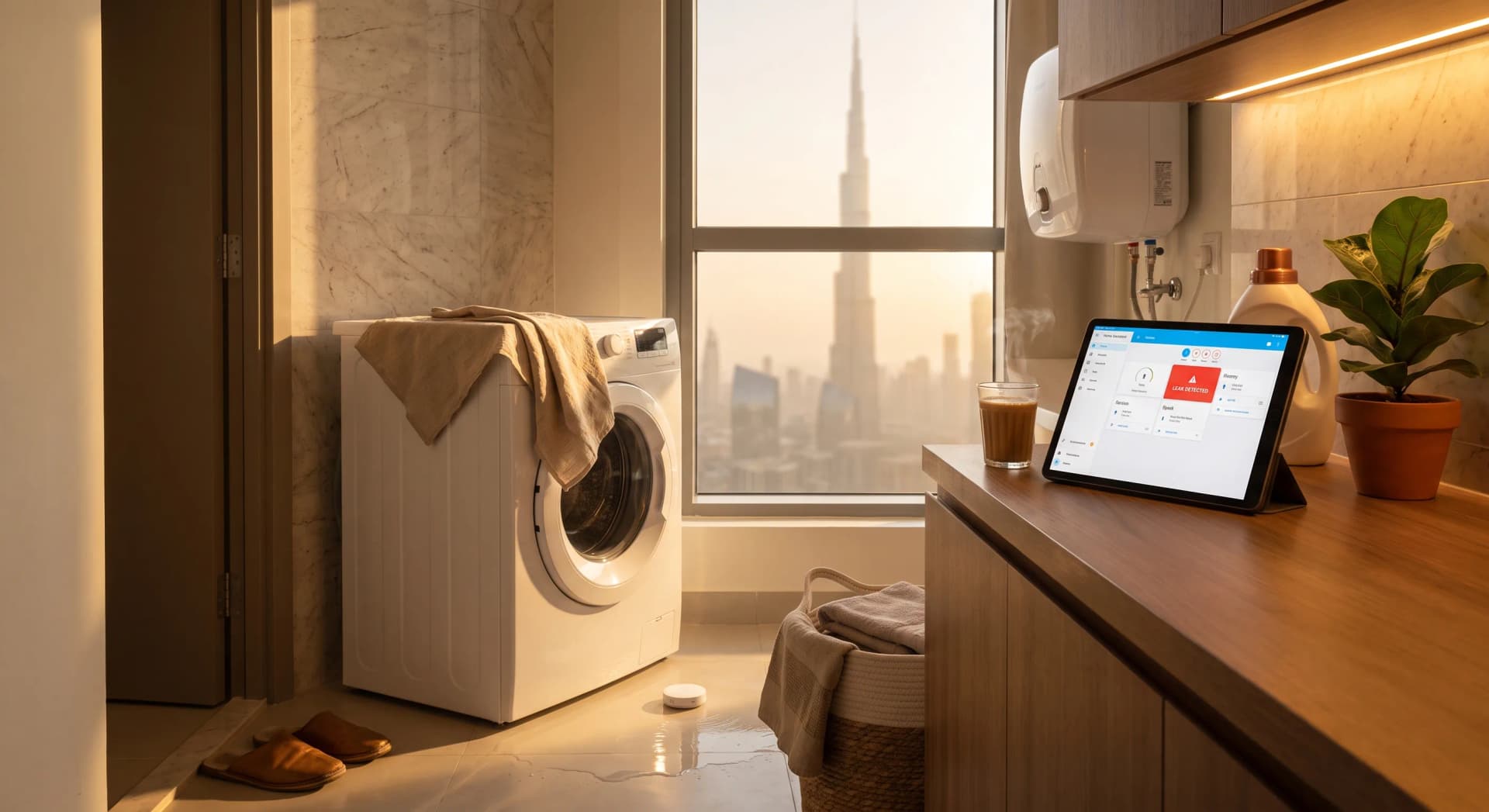
The most expensive thing in your apartment is not the TV or the AC. It is water, in the wrong place, that nobody sees for six hours. A washing-machine hose lets go behind the machine while you are at work. A water heater that has been quietly corroding for seven years splits its tank overnight. The AC drain, choked with the dust every Dubai summer produces, backs up and sends water down inside the wall. By the time you notice, the floor is soaked, the skirting is swollen, and the family below you is knocking on your door.
Your phone tells you when your Careem is two minutes away. Your bank pings you the second a card is used. Your apartment, meanwhile, will let itself flood without a word.
TL;DR: A smart water-leak sensor is a AED 40 to 100 device that sits where water fails (behind the washing machine, under the sink, by the water heater, at the AC drain) and pushes an alert to your phone the moment it gets wet. A hub-based setup can also sound a siren and, with a valve controller, shut the water off on its own. Renters can start with a stick-on WiFi sensor, no hub needed. It is the cheapest smart-home layer you can buy and the one most likely to save your deposit.
Where Dubai Apartments Leak
Four things cause most apartment water damage in Dubai, and none of them announce themselves. The AC condensate drain is the most common. In peak summer a single unit can collect a large volume of condensate every day, and in Dubai's dust the drain line clogs with dust and algae, backs up, and overflows into the ceiling or down the wall (Al Alim AC Fix Dubai, 2025). Second is the water heater. Third is the washing machine or dishwasher inlet hose. Fourth is a concealed supply pipe developing a slow pinhole leak inside the wall.
What these share is that they start small and stay hidden. A drip becomes a puddle becomes a soaked slab, and the first real sign is often a stain spreading across a ceiling or a smell that will not go away. In our experience surveying apartments, the leak is almost never where the damage shows.
Why the Water Heater Is a Ticking Clock
Your water heater is on a shorter fuse in Dubai than the label suggests. Heaters here typically last only five to eight years rather than the rated ten, because the city's hard water leaves limescale and sediment building up inside the tank faster than in most places (European Technical, 2026). Dubai's supply carries a high mineral content, which is why plumbers recommend flushing the tank at least once a year (EmirateFix, 2026).
When a heater fails, it does not always drip politely. A corroded tank or a stuck pressure-relief valve can release a lot of water quickly, and many apartments have the heater tucked in a ceiling void or a service cupboard where nobody looks for months. One thing clients always ask is how old their heater is, and most have no idea. If yours is past eight years, it is worth knowing before it decides for you.
What a Leak Sensor Is and How It Warns You
A smart water-leak sensor is a small, cheap puck with two metal contacts on the bottom. Set it flat where water would pool if something went wrong, and the moment those contacts get wet it fires an alert. A basic one detects water as shallow as half a millimetre, so it catches a leak while it is still a film on the floor, not a flood.
The alert path depends on the setup. A standalone WiFi sensor pushes a notification straight to your phone within seconds, no hub needed (Amazon.ae, 2026). A hub-based sensor does two things at once: it pings your phone and it sets off a siren on the hub, loud enough to wake you at 3am, and it can trigger any automation you have built (Vesternet, 2026). Both are useful. The difference is what happens next, which is where the real value sits.
Detection Is Good. Shutting the Water Off Is Better.
Knowing about a leak while you are at the office is only half the fix. You still have to get home and turn the water off, and by then the damage may be done. The upgrade that changes the outcome is a valve controller: a motorised actuator that clamps onto the manual water valve you already have and turns it for you.
The Aqara Valve Controller T1 fits over an existing lever ball valve without any pipe-cutting, and when a paired leak sensor detects water it shuts the main valve automatically (Modo Store UAE, 2026). That is the whole game. A sensor by the water heater sees the first cup of water, the valve closes, and a heater failure that would have flooded the apartment becomes a wet patch and a phone alert. In our experience, this is the layer worth paying for in an owned apartment, especially if the water heater or the mains valve is easy to reach.
What This Costs in a Dubai Apartment
A smart water-leak setup starts from around AED 40 and scales with how much protection you want. There are three sensible tiers.
For a renter, the entry point is a standalone WiFi sensor like the Moobody, at AED 39.89, that sticks on with tape and talks straight to your phone over WiFi with no hub (Amazon.ae, 2026). Buy three or four, place them where water fails, and you have covered the apartment for under AED 200. Nothing to drill, nothing to leave behind when you move.
For an owner who wants sirens and automations, a hub-based system is the step up. Zigbee sensors run from AED 59.99 for a MOES unit to AED 69 for a SONOFF to AED 99 for the Aqara Water Leak Sensor T1 (Amazon.ae, 2026), and a hub adds roughly AED 85 to 320 depending on the model. A full multi-sensor setup installed and configured lands around AED 400 to 900.
For the full detect-and-shut-off system, add the AED 270 valve controller and a professional check that your mains valve is the right type, and you are in the AED 1,400 to 2,800 range installed. Against a Dubai leak bill that has hit Dh22,000 and Dh54,000 in real cases (The National, 2022), the maths is not close.
Your Deposit and the Neighbour Below
Water damage in a rented apartment is where your deposit goes to die. Dubai law lets a landlord hold a security deposit of five per cent of the annual rent and return it only if the property comes back in its original condition, keeping back what it costs to repair damage beyond normal wear and tear (Kayrouz & Associates, 2026). A landlord carries the main duty to maintain the property, so genuine building faults are on them, but damage caused by a tenant's own negligence is a valid deduction (The National, 2025). A washing-machine hose you never checked is an argument you may not win.
The bigger exposure is downstairs. When a leak from your unit ruins the ceiling of the flat below, liability turns on cause, and a leak traced to poor maintenance can see the repair bill forwarded to you (The National, 2020). A sensor that catches the leak in the first hour is the difference between a mop and a claim.
Why We Build This on Open Platforms
We install leak detection on open platforms so it keeps working no matter what else you change, and so nothing traps you with one brand. The Aqara Valve Controller T1 officially works with Home Assistant alongside Apple Home, Google Home, Alexa and SmartThings (Aqara, 2026), which means your leak sensors, your AC control and your lights all live under one roof and one app. If you switch providers next year, the hardware stays and still works.
This matters more with leak sensors than with almost anything else, because they are the layer you install and forget. It has to run silently for years and be there the one night it counts. Locking that into a closed system that can change its rules or add a subscription is the wrong bet for a device whose whole job is to be reliable while you ignore it.
What Bayora Will Talk You Out Of
The honest recommendation on leak detection is that most people are better off spending less, not more. Here is what we steer clients away from.
Do not wire the whole apartment for leak detection when four sensors and a valve controller cover the real risk. The washing machine, the water heater, under the kitchen sink, and the AC drain pan are where it happens. A sensor in the bedroom is a sensor doing nothing.
Do not buy a system that needs a monthly subscription to send you an alert. A leak alert is a push notification. It should be free and it should be local. Paying a recurring fee to be told your floor is wet is a bad trade.
Do not skip the battery discipline. The well-known weakness of every battery leak sensor is that a dying cell can drop the sensor offline quietly, and some report a healthy battery reading in the app right up until the device stops (Whizz Experts, 2026). We set up an offline alert on every sensor, so a silent sensor is a notification, not a surprise.
A Real Business Bay Setup
A Business Bay couple renting a two-bedroom called us after a scare, not a disaster: they came home to a small puddle creeping out from under the washing machine, caught by luck on a weekend they happened to be in. The hose had started to weep. Had it gone on a Sunday they were away, it would have run for two days.
We fitted four Aqara sensors, one behind the washing machine, one under the kitchen sink, one by the water heater in the service cupboard, and one in the AC drain pan, on an Aqara hub already running their lights, for around AED 620 all in. Two months later the AC drain backed up in the July heat. The sensor caught the overflow at a few millimetres, the siren went off, and they cleared the drain before a drop reached the ceiling. No stain, no neighbour, no claim. The most reassuring device in their apartment cost less than a dinner out.
Where This Fits the Rest of Your Home
Leak detection is one layer of a home that watches itself, and it pairs naturally with the others. The same hub that runs your leak sensors can run your smart AC control, so the unit whose drain overflows in summer is on a system that also manages the cooling load. It sits alongside humidity and condensation control, which handles the slow moisture problem while leak sensors handle the sudden one, and it is one more device in the sensor layer that already includes air-quality, motion and door sensors. The one layer that works differently is fire and gas, because in a UAE home those detectors are usually part of a mandated or building-owned system rather than yours to add.
If you are setting up a Business Bay apartment or any Dubai flat from scratch, leak sensors are the cheapest thing on the list and the one we would fit first. With a wetter-than-normal autumn forecast for the UAE this year (Gulf News, 2026), it is a good season to close the loop.
Leak detection matters most where nobody is present to notice. If you own the apartment but live abroad, the alert path and who attends it are the whole question, and we take it apart in managing a Dubai apartment from abroad.
Frequently Asked Questions
Where should I put water leak sensors in a Dubai apartment?
Put them where water fails: flat on the floor behind or beside the washing machine, under the kitchen and bathroom sinks, next to or under the water heater, and in the AC indoor unit's drain pan. Four to five sensors cover the real risk in a typical two-bedroom. A sensor detects water as shallow as half a millimetre, so placement beats quantity.
Do smart water leak sensors need WiFi or a hub?
Both options exist. A standalone WiFi sensor connects straight to your 2.4GHz WiFi and pushes an alert to your phone with no hub, which suits renters. A Zigbee sensor needs a hub but gains a local siren, automations, and the ability to trigger an automatic water shut-off. If you already run a smart-home hub, add Zigbee sensors to it. If not, a WiFi sensor is the simplest start.
Can a smart home shut off the water automatically when it leaks?
Yes. A valve controller such as the Aqara Valve Controller T1 clamps onto your existing manual water valve without any plumbing work and closes it automatically when a paired leak sensor detects water. It needs a hub and a separate leak sensor to trigger it. This turns a potential flood into a wet patch and a phone alert, which is the single most valuable upgrade for an owned apartment.
Who pays for water damage in a Dubai rental?
It depends on the cause. Genuine building faults and general maintenance are the landlord's duty, but damage from a tenant's own negligence, such as an unchecked appliance hose, can be deducted from your security deposit and, if it reaches the flat below, the repair bill can be forwarded to you. Catching a leak early with a sensor is the cheapest way to keep it your problem, not a claim.
How long do leak sensor batteries last?
Most run for two years or more on a single coin cell, and some rate the battery for over five years. The catch is that a dying battery can drop the sensor offline before the app clearly warns you. We recommend setting an offline alert for each sensor so a quiet device pings you rather than failing unnoticed the one night you need it.
Water is the one thing in your apartment that can do five figures of damage while you sleep, and it is also the cheapest to guard against. A AED 40 sensor by the washing machine, or a full system that shuts the mains off on its own, both start from the same idea: your home should notice before you do.
Tell us about your apartment and we will recommend where to place the first few sensors. No obligation, no surprises.
Ready to Get Started?
Get a free consultation and we'll recommend what makes sense for your situation.
Get Free Consultation