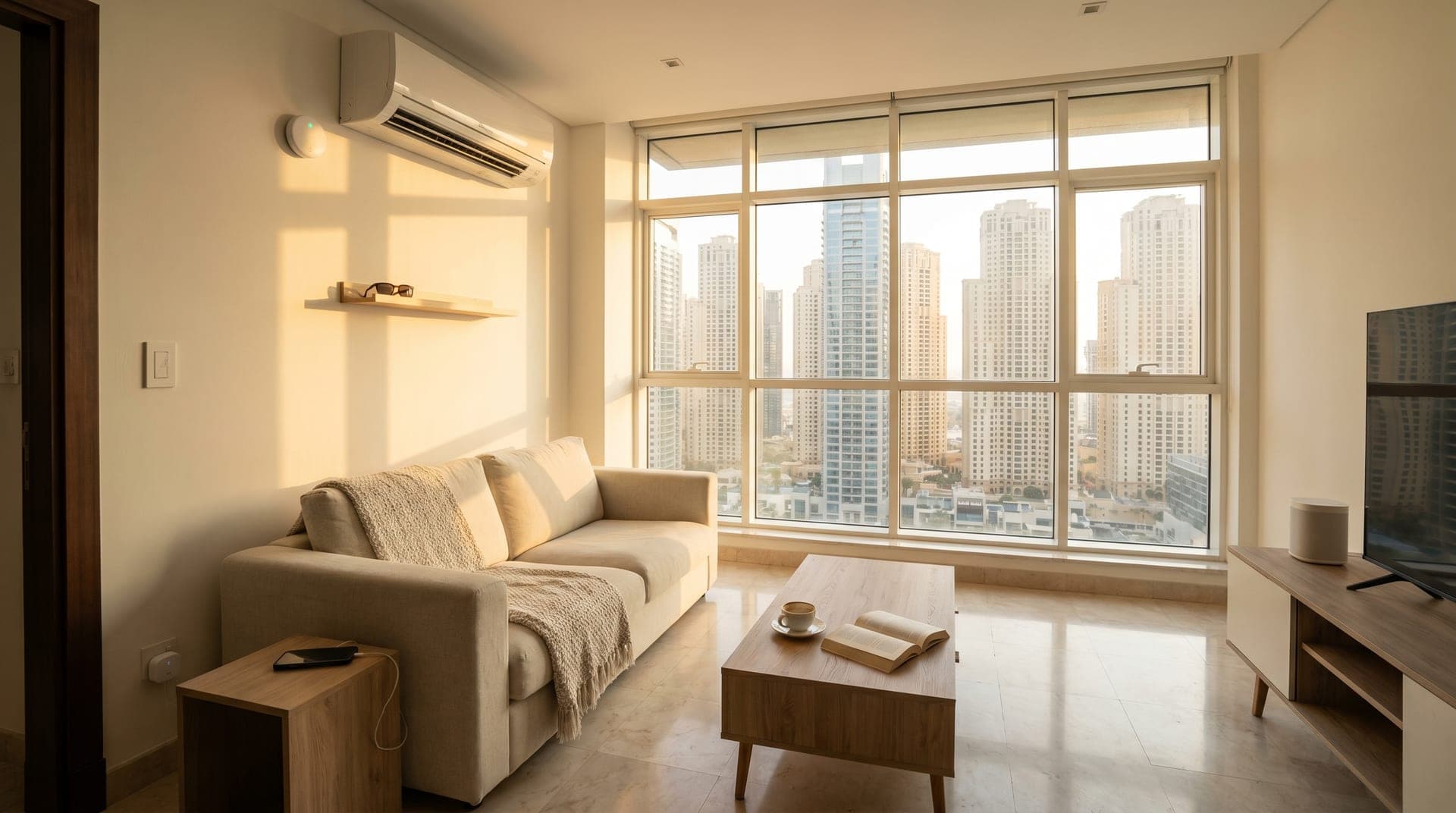
You signed a one-year lease. Your landlord pays nothing toward your DEWA bill. The apartment is theirs. The AC unit is theirs. The wall-mounted thermostat is theirs. But every kWh that runs through it from May to September is yours.
That is the renter's summer. You inherited a cooling system you cannot modify, in a city where AC eats 60-70% of your electricity bill from June to September (Utility Bill UAE, 2026), and your only tool to fight back is a remote with a cracked screen and three buttons that already do nothing.
This guide is about what you can actually do. No drilling. No new wiring. No emails to the landlord asking for approval. Just devices you plug in, mount with a magnet, or stick on with adhesive that comes off cleanly when you move.
TL;DR: A typical 2-bedroom Dubai apartment renter pays AED 850-1,100 on a peak summer DEWA bill, and 60-70% of that is AC. A renter-friendly smart home setup costs AED 1,500-3,500 installed, needs no landlord approval, and cuts that bill by 20-30%. Smart AC controllers, no-drill blinds, leak sensors, and a smart plug or two cut AED 200-330 a month off a typical summer bill.
Why Renters in Dubai Pay More Than They Should
Most renters in Dubai pay more than they have to because the apartment was set up for someone else. The previous tenant left the AC on a setting that suited their schedule, not yours. The blinds the developer installed were chosen for cost, not for blocking afternoon sun. The water heater is on 24 hours a day because nobody ever flipped the switch.
In our experience surveying Dubai apartments, the same five wasteful patterns show up in almost every rental: AC running in empty rooms, west-facing windows with thin fabric blinds, water heaters with no schedule, fridges set 4 degrees colder than they need to be, and standby loads from devices nobody uses. Together, these add AED 250-450 to the average monthly bill (DEWA conservation guide, 2025).
The reason renters do not fix any of this is not laziness. It is permission. You assume you cannot change anything because the apartment is not yours. The truth is that almost every fix lives outside the wall. You can do it in an evening, take it with you when you move, and your landlord will never know.
Smart AC Without Touching the Thermostat
Almost every Dubai apartment has split AC units with infrared remote controls. That is the only fact you need. Any AC with a remote can be made smart in about 10 minutes by adding a small device called a smart AC controller, which sits on the wall or on a shelf, learns your AC's remote codes, and connects to your phone over WiFi.
The two most common options in Dubai are Sensibo Air and Tado Smart AC Control V3+. Both work with 95%+ of split AC units regardless of brand or age (Sensibo, 2026). Setup takes about a minute: scan a QR code, connect to WiFi, point it at the AC, done. Sensibo retails for around AED 450-550 per unit, Tado for AED 600-750. For a 2-bedroom apartment with two AC zones, a full install runs AED 900-1,500 hardware-only or AED 1,500-2,500 if you want us to handle setup, scheduling, and integration.
Here is what it does for your DEWA bill. Every degree above 24°C cuts your AC's energy use by roughly 6-8% (US Department of Energy, 2025). A schedule that pre-cools the apartment to 24°C 30 minutes before you get home, raises it to 27°C while you are at work, and holds at 25°C overnight will cut a typical apartment's summer AC consumption by 20-30%. On a AED 950 peak summer bill, that is AED 190-285 back in your pocket every month from May to September.
Renter-Friendly Blinds That Block 4-6 Degrees of Heat
Most rental apartments come with thin roller blinds or sheer curtains the developer chose to hit a price point. They look fine. They block roughly 30% of solar heat. The other 70% comes through the glass, hits your marble floor, gets absorbed for the next four hours, and slowly releases into the room while you are at work.
By 6 PM, the south or west-facing room you are about to spend the evening in is 4-6 degrees hotter than the rest of the apartment (US Department of Energy, 2024), and your AC has to work twice as hard to fix it. You walk in, blast the AC to 18°C, and pay for the cool-down on top of the heat gain.
The renter-friendly fix is not motorized blinds, which usually need wiring. It is solar screen film or thermal blackout curtains on a tension rod for the worst-affected window. Solar screen film blocks up to 80% of solar heat gain and sticks to the inside of the glass with no adhesive residue (3M, 2025). It costs AED 150-300 per square meter, comes off cleanly when you move, and your landlord will probably thank you for it. Pair it with a smart blinds controller like the SwitchBot Curtain (AED 350-450, magnetic mount, no drilling) on the heaviest curtain rod in the apartment, and you have automated shading on the one window that matters most.
When we set this up for a Marina renter last year, the temperature in their west-facing living room dropped 5 degrees by 6 PM, and their AC ran 90 minutes less per evening. The combined savings on their July bill were AED 220.
The Three Cheapest Renter Wins
Nobody talks about these three. They are not Alexa and they are not Philips Hue. Two of them quietly cut your bill all summer, and the third protects your deposit.
The first is a schedule on your water heater. Most Dubai apartment water heaters run 24 hours a day even though you only use hot water for 60-90 minutes total. Cutting the runtime to 4-6 hours a day saves AED 80-150 per month (Dubai Carbon, 2024). The heater is the one thing here you should not put on a smart plug: in most apartments it has no plug at all, and the cable runs straight into the wall. It switches at its own wall switch, and a button-pusher that sits on that switch schedules it with no wiring and comes off when you move. We set out the options in our guide to putting a water heater on a smart schedule.
The second is a smart plug or two on standby loads. The TV, soundbar, gaming console, microwave, and chargers in your apartment draw 30-90 watts continuously even when off. Across a year, that is AED 180-400 of pure waste. A smart plug with an "off when nobody is home" automation kills standby draw the moment you leave the building.
The third is a leak sensor. Not for the bill, for the deposit. A AED 60 leak sensor under your sink or behind your washing machine pings your phone the moment water touches the floor. Most renters lose their security deposit to a slow leak they did not notice for three days. One sensor saves you AED 5,000+ in damages and gets you a 30-second warning instead of a 30-day cleanup.
What a Full Renter Setup Actually Costs
Most renters think a smart home in Dubai costs AED 25,000+. That is true if you wire a villa. For an apartment renter who plans to move in 12-24 months, the math is dramatically different.
A complete renter-friendly setup for a typical 2-bedroom apartment in Marina, JBR, Business Bay, or Downtown looks like this. Two smart AC controllers (AED 900-1,100). Solar screen film on the worst window (AED 400-600). One automated curtain (AED 400). Three smart plugs (AED 240). One leak sensor (AED 60). Configuration, scenes, and scheduling done properly (AED 500-1,000 if we do it for you). Total: AED 2,500-3,400 installed. The water heater schedule sits outside that total: a button-pusher on the existing switch is the renter route, and a switch job is priced once we have seen the circuit.
When we install this package for a renter, the conversation we have at handover is always the same: AED 200-330 in monthly DEWA savings starting with the first full summer bill, and zero conversations with the landlord.
What you get back is AED 250-400 per month in DEWA savings from May through September. Across one summer, that is AED 1,250-2,000 back. By the second summer you are still saving the same AED 250-400 a month. When you move out, every device comes with you in a single box and reinstalls in the new apartment in 90 minutes. We have set this up for clients in JBR, Dubai Marina, and Business Bay.
If you want to see what AED 3,000 buys in a real Dubai apartment, our breakdown of what AED 3,000 gets you in smart home automation walks through every device and the scenes we configure.
What You Can Set Up This Week (Even Before Calling Anyone)
If you want to start tonight, the order matters. Do this in sequence and you will see savings on your next DEWA bill, not the one after.
Start with one smart AC controller on the AC unit you use most. That is usually the bedroom or living room. Set a single schedule: 27°C while you are at work, 24°C from 30 minutes before you arrive home until 1 AM, then 25°C overnight. That one schedule, on one AC, will cut AED 80-150 off your next bill.
Next, put your water heater on a schedule. A button-pusher on the existing wall switch does it with no wiring and no landlord conversation. Set it to run 5:30-7:30 AM and 6-8 PM. Most renters never need hot water outside those windows. That is another AED 80-150 saved.
Third, add solar screen film to your single worst window, the one that gets afternoon sun. This is the one DIY task that needs an hour and a smooth wall. The 6 PM heat gain in the room behind that window is your single biggest comfort problem in summer, and the film fixes it permanently for AED 200-400.
Everything else, the second AC controller, the additional plugs, the leak sensor, the curtain automation, can come in the second month. By July, the full setup is in place, and your August DEWA bill will be the lowest summer bill you have ever paid in Dubai. We cover the broader renter playbook and the specific smart AC for renters guide if you want more depth on any single piece.
Frequently Asked Questions
Do I need landlord approval for any of this?
No. Every device described here plugs into an existing outlet, sticks on with removable adhesive, mounts with a magnet, or films onto the inside of glass. The water heater schedule uses a button-pusher that sits on the existing switch, so nothing modifies the wall, the wiring, or the AC unit itself. When you move out, everything comes with you in a single box and the apartment looks exactly as you found it.
How much can I realistically save on my summer DEWA bill?
A 2-bedroom Dubai apartment with a typical peak summer DEWA bill of AED 850-1,100 can expect AED 200-330 in monthly savings from a renter-friendly smart home setup, based on a 20-30% cut to AC consumption (DEWA conservation data, 2025). Across May through September, that is AED 1,000-1,650 back over one summer.
What happens to my smart home when I move apartments?
You take it with you. Smart AC controllers unmount in 30 seconds and re-pair with the new AC in about a minute. Smart plugs unplug. Leak sensors lift off. Solar film peels cleanly off glass. The full reinstall in a new apartment takes 60-90 minutes, and your scenes and schedules carry over through the app.
Will my smart home work with my building's WiFi?
Yes, if your apartment has a normal home router (Du or Etisalat). Smart AC controllers, plugs, and sensors connect to standard 2.4 GHz WiFi like any phone or laptop. The only setup that gets tricky is buildings with shared mesh WiFi where you cannot access the router settings. We cover that in why your WiFi keeps dropping smart devices if you want the troubleshooting playbook.
What if I rent for less than 12 months?
The smart AC controller alone accounts for most of that saving. Even on a 9-month lease, you come out ahead, and the device follows you to the next apartment. The math only fails if you plan to move in under 4 months and never own another rental property in Dubai, which is rare.
Ready to stop paying for an apartment that does not know you live there? Tell us about your place and we will recommend the smallest setup that gets you the biggest summer savings. No obligation, no surprises, no landlord conversation required.
Ready to Get Started?
Get a free consultation and we'll recommend what makes sense for your situation.
Get Free Consultation