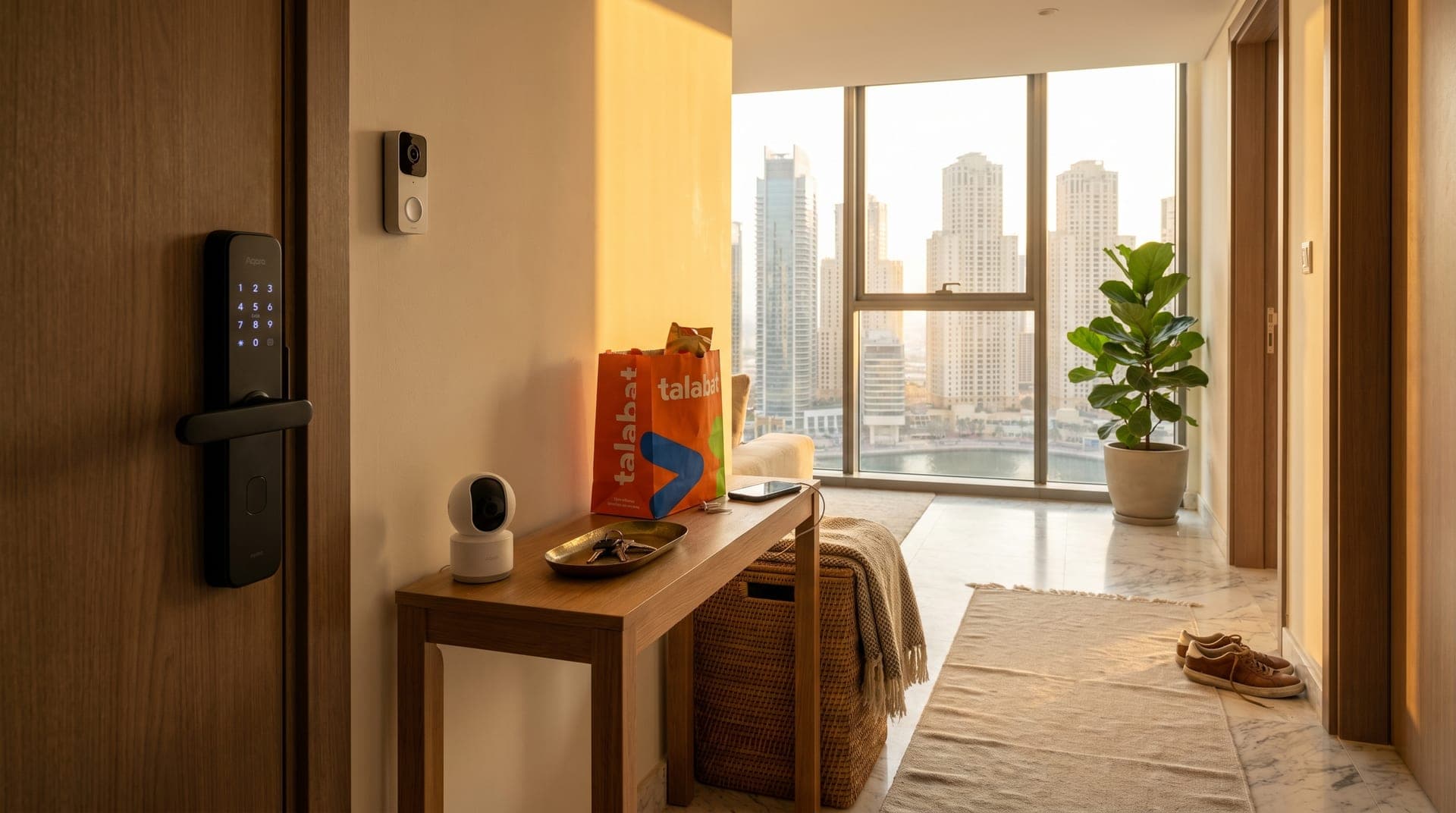
There is a moment every Dubai renter knows. You are at the airport, you have just watched the cabin doors close, and a small voice in your head says: "Did I lock the door?"
Your apartment has a modern kitchen, a marble floor, and a view of the Marina. The front door still has a key your building gave you four years ago. The intercom is a handset from 2010. If someone rings the bell while you are at work, you will never know.
This is the gap. Your life runs on apps and notifications. Your home's security runs on a key and hope.
TL;DR: A renter-friendly smart security setup for a Dubai apartment starts from around AED 1,500 and covers the four jobs that matter: a smart lock you can reverse before move-out, a video doorbell that works without rewiring, one or two wireless cameras, and a leak sensor. No drilling, no landlord approval for most of it, and all of it fits in a suitcase when you move.
Why Dubai Apartments Need Smart Security in 2026
Dubai is one of the safest cities on earth. The Numbeo Crime Index for 2025 puts Dubai at 15.5, among the 10 lowest in the world (Numbeo, 2025). That is not the argument for smart security.
The argument is that residential burglary attempts in Dubai rose 12% in 2025 (Dubai Police, 2025) and the residential security market crossed AED 480 million the same year (SecureBlitz, 2025). Installations have doubled as prices fell. Three years ago a full residential security package cost AED 15,000 to AED 25,000. Today, equivalent systems run AED 6,000 to AED 12,000.
For renters, the shift is bigger. Wireless, battery-powered devices now cover every job the wired system used to do. You get the alerts without the contractor. When your lease ends, you pack it all into a box.
The Four Jobs a Smart Security Setup Does
Before shopping for gadgets, understand what you are actually trying to solve. A good apartment setup covers four jobs:
- Knowing who is at the door. Deliveries, housekeepers, friends, strangers. Note: a video doorbell handles the apartment door; the building intercom that buzzes the lobby is a separate access layer with its own three-option fix.
- Controlling who comes in. No more handing out physical keys or worrying about lost ones.
- Seeing what happens when you are not home. One or two camera angles on your living space.
- Catching the slow disasters. Leaks, smoke, and the front door being left open.
In our experience, people often start with a camera because cameras feel dramatic. The real wins come from the other three. We installed a renter setup in a JBR one-bedroom last year where the leak sensor under the washing machine caught a slow drip on day three. The camera was the last thing she actually looked at.
Smart Locks That Work for Dubai Renters
A smart lock is usually the first upgrade, and the one most renters think they cannot have. You can.
Most smart locks fit on your existing door without changing the frame. You remove the original lock, keep every piece, install the smart one, and reverse it before you hand the keys back. Installation in Dubai typically starts from AED 250 for basic models (DEX Key Maker, 2026), and reputable brands like Aqara and Yale sit in the AED 900 to AED 2,200 range at UAE retailers like Sharaf DG and Amazon.ae.
What you get: codes for family, temporary codes for your housekeeper that expire after her shift, auto-lock after 30 seconds so you never wonder if you locked it, and a log of every entry. The same one-time codes let a delivery courier drop a parcel inside your door when you are at work. When we set one up for a Dubai Hills tenant, she stopped cutting extra keys for her mother's monthly visits. One code, one expiry date, done.
For a deeper comparison of specific models, see our guide to the best smart locks for Dubai apartments.
Wireless Video Doorbells: The Most Useful AED 600 You Will Spend
A video doorbell is the single device that changes daily life fastest. It answers "who is there" from anywhere with internet.
Most Dubai apartments have a metal front door and a narrow frame. A wired doorbell retrofit is a landlord conversation. A battery-powered video doorbell is not. It mounts with 3M adhesive or a slim bracket, pairs to your WiFi, and sends a push notification the second someone rings. You see who it is on your phone, talk to them through the speaker, and tell the Talabat rider to leave the food at the door.
Building management approval is usually only needed for external facade-mounted cameras. Doorbells at your own apartment entrance, inside a shared corridor, almost never trigger that rule (HomeControl, 2026). Check your building's NOC rules before you mount anything outside your door frame.
What clients always ask is: "What if my building's Wi-Fi is weak in the corridor?" A dual-band mesh router with a node near the front door fixes this. Our WiFi guide covers the full setup.
Wireless Indoor Cameras: Less Is More
A Dubai apartment does not need five cameras. Most of ours end up with one or two.
One angle on the main living area covers 80% of the value. It catches whoever walks through the front door (your housekeeper, your guests, your dog at 2pm). A second camera on a balcony-facing sliding door adds reassurance if you travel often. That is it.
Stick to wireless, battery-powered or USB-powered models. They sit on a shelf, mount to a wall with a small adhesive bracket, and move with you. Privacy shutters (physical lens covers that close when you are home) matter if the camera is in a living area. Aqara, Eufy, and TP-Link Tapo all sell sub-AED 400 models at UAE retailers.
The rules that matter: Dubai privacy regulations require cameras to capture only your own entrance, balcony, and interior. You cannot point one at a neighbour's door or a shared hallway without permission, and these rules are enforced, not suggested (Dubai Police Home Security, 2026).
Leak and Door Sensors: The AED 150 Upgrade Most People Skip
The boring devices do more than the interesting ones. A water leak sensor costs AED 80 to AED 150, runs on a coin battery for three years, and sends a push notification the moment it touches water.
In Dubai, the three worst apartment disasters come from water, not burglars: a burst washing machine hose, a slow AC drain leak, and a hot water heater quietly failing above a ceiling. One afternoon while you are at work, any of them can turn into a claim with your building's insurance and a week in a hotel. We had a Business Bay client whose leak sensor caught a pinhole leak in a bathroom supply line two hours before the downstairs neighbour noticed the stain on their ceiling. AED 100 sensor, AED 30,000 problem avoided.
Door and window sensors do the same job for physical security. One on the front door, one on a balcony sliding door. You get a notification if either opens when you are not expecting it.
How to Pair All of This With Dubai Police Smart Home Security
If you want a monitored layer on top of your setup, Dubai Police runs a formal Smart Home Security service in partnership with e& UAE. IoT sensors on doors and windows link to a 24/7 monitoring centre (Dubai Police, 2026). Tenants and owners can both register with a valid Emirates ID and active email.
This is optional. For most apartment renters, the phone-notification setup above is enough. If you travel for weeks at a time or live alone and want human eyes on alerts, the monitored service is worth the monthly fee.
The combination that works well: your wireless smart home devices handle daily convenience (locks, doorbell, leak sensors), and Dubai Police's service handles the "something is really wrong at 3am" alerts.
What the Full Setup Costs in 2026
Here is what a renter-friendly smart security setup actually runs in Dubai in 2026, with devices available at UAE retailers:
- Smart lock (Aqara A100 or Yale Assure): AED 900 to AED 1,500
- Video doorbell (Aqara G4 or equivalent): AED 450 to AED 750
- Two indoor cameras (Aqara, Eufy, Tapo): AED 500 to AED 800
- Four door/window sensors: AED 240 to AED 360
- Two leak sensors: AED 160 to AED 300
- Matter-compatible hub (optional, if using a mix of brands): AED 250 to AED 500
Total: AED 2,500 to AED 4,200 for the hardware. Professional installation and configuration typically adds AED 500 to AED 1,200, depending on how many cameras and whether you want the whole thing linked to a single app.
Over 75% of new smart home devices sold in Dubai in 2026 use the Matter standard (Gulf News, 2026), which means devices from different brands work in the same app. A Yale lock, an Aqara camera, and a Philips Hue light can live in one HomeKit or Google Home dashboard. When we installed this in a Marina apartment last month, the client's whole system sat inside the Apple Home app on her iPhone. One tap, one view, everything.
The Honest Recommendation for a First Setup
If you have AED 1,500 to spend on apartment security today, here is the order. Smart lock first (AED 900 to AED 1,500 gets you a quality one installed). Video doorbell second (AED 450 to AED 750). Two leak sensors third (AED 160 to AED 300). Cameras last, only if you still feel a gap after living with the first three for a month.
Most of our clients who start with the lock and doorbell never end up adding cameras. The daily friction of not knowing who is at the door, and not trusting your own memory about whether you locked it, is what makes home security feel like a job. Remove those two and the job disappears.
For renters who want to understand the full picture of making a Dubai rental smarter without permanent changes, our complete guide to smart home tech for Dubai renters walks through the order we recommend.
Frequently Asked Questions
Can I install a smart lock in my Dubai rental apartment without landlord approval?
In most cases yes, because smart locks replace your existing door hardware without modifying the door itself. You keep every original part, install the smart lock during your tenancy, and reinstall the original before you hand the keys back. This reversibility is why most landlords do not have an issue with it. Check your tenancy contract for any specific clauses.
Do I need WiFi for smart security cameras to work?
Yes for remote monitoring. Your cameras, doorbell, and smart lock app notifications all run through your home WiFi. Without it you cannot view a live feed from outside the apartment. Most devices still record to local storage or an SD card during brief internet outages, so you do not lose clips during a drop.
Are wireless security cameras legal in Dubai apartments?
Inside your own apartment, yes. Dubai's privacy rules require cameras to capture only your own space. You cannot point a camera at a neighbour's door, into a shared hallway, or out of a window into another building. External wall-mounted cameras on the facade usually need building management NOC sign-off. Doorbell cameras at your own entrance are almost always fine.
What happens to my smart security system if I move apartments?
Everything moves with you. Battery-powered devices unmount with 3M adhesive remover or a screwdriver for brackets. Your smart lock reverts to the original hardware. Cameras, sensors, and the doorbell repackage into a box. You reinstall at the new apartment in an afternoon. This is the core advantage of wireless smart security for renters.
Does Dubai Police have a smart home security service?
Yes. Dubai Police runs a Smart Home Security service in partnership with e& UAE. It includes IoT door and window sensors, surveillance cameras, and 24/7 monitoring by e& UAE security centres. Both tenants and owners can register with a valid Emirates ID. It works alongside your own smart devices, not in place of them.
Ready to figure out the right smart security setup for your apartment? Book a free consultation and we will walk through your space, your building's rules, and exactly what you need. No surprises, no obligation, and no drilling unless you want it.
Ready to Get Started?
Get a free consultation and we'll recommend what makes sense for your situation.
Get Free Consultation