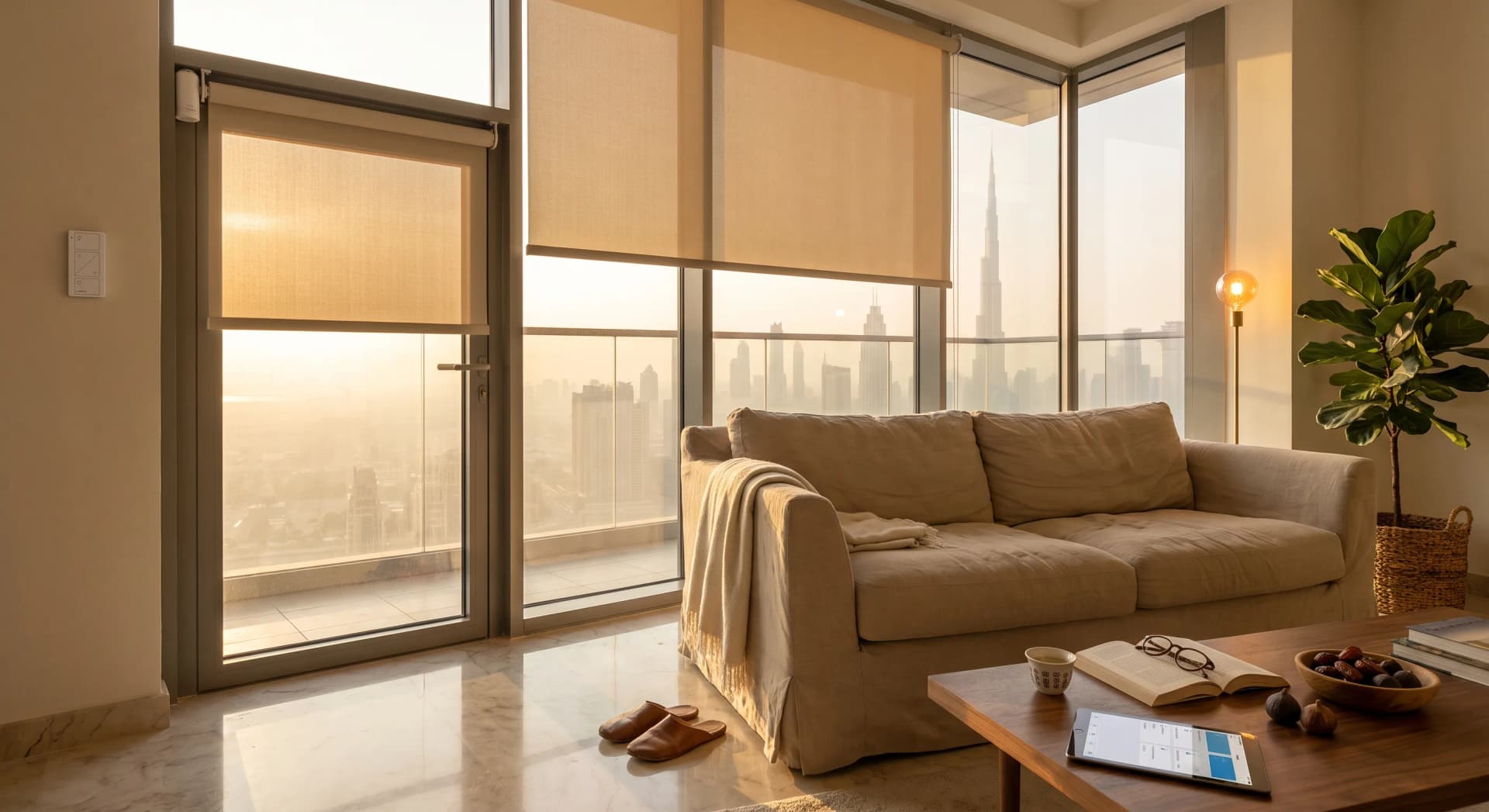
You have decided you want motorized blinds. Good. That was the hard call. Then you ask two companies for a quote, and one comes back at AED 500 a window and the other at AED 1,400 a window, for what looks like the same roller blind over the same glass. Nobody explains the gap. The gap is the motor.
The fabric you can see is the easy part. What moves it, and how that thing gets its power, is the decision that changes the price, the install, and whether you can take it with you when your lease ends. There are three ways to power a motorized blind in Dubai: a rechargeable battery, a hardwired mains connection, or a small solar panel. They are not interchangeable, and the right one depends far more on whether you rent or own than on your taste in fabric.
TL;DR: Battery motors slide onto your existing blinds with no wiring, recharge every few months, and are the right answer for renters, from around AED 300-600 a window installed. Hardwired motors need a power point at the window and suit owners and new fit-outs, AED 800-1,500 a window. Solar motors work in Dubai only on windows that get real direct sun. For most apartments, battery is where you start.
The Power Source Is the Real Fork in the Road
Every motorized blind decision splits at one question before fabric, brand, or app: where does the motor get its power. A battery motor carries its own rechargeable pack and needs nothing from the wall. A hardwired motor draws from mains and needs a cable run to the window head. A solar motor charges a small onboard battery from a panel stuck to the glass. That single choice decides your install cost, whether you drill anything, and whether the blinds move with you or stay with the apartment.
In our experience surveying Dubai apartments, this is the part people skip and then regret. Someone falls in love with a fabric and a brand, signs off, and only at install day learns there is no power point near the window, so the "simple" job now needs an electrician and a chase in the wall. Sort the power source first. Everything else follows from it.
Battery Motors Are the Renter's Answer
For most people renting an apartment in Dubai, a battery-powered motor is the correct starting point. It slides onto the tube of your existing roller blind, pairs with your phone, and needs no drilling, no rewiring, and no landlord approval. When the lease ends, you unclip the motor and leave the original blind exactly as you found it. Installation runs about 30 minutes a window.
The catch is recharging. A rechargeable lithium motor runs for months on a charge under normal use, then needs a couple of hours on a USB-C cable. The popular units bear this out: the Aqara Roller Shade Driver E1 is rated for about two months per charge moving a standard shade once a day (Aqara, 2021), the SwitchBot Roller Shade claims up to eight months and lands nearer four to six with daily use (SwitchBot, 2024), and Somfy's WireFree lithium motors are spec'd to need charging only once or twice a year (Somfy, 2023). That is the whole trade: a recharge now and then in exchange for zero wiring and full portability. For a renter, that trade is almost always worth it. You are not going to open the wall of an apartment you do not own, and you should not have to.
Battery motors do have a ceiling. They are built for standard apartment windows, not for wide or heavy shades. Industry guidance puts the line around 72 inches of width, above which a hardwired motor is almost always the better call, because a large blackout shade can weigh eight to ten pounds and push a battery motor past what it can comfortably drive (Weffort, 2024). If you have a six-metre run of living-room glass, one battery motor will struggle, and that is a signal you are into hardwired territory.
Hardwired Motors Are the Owner's and Renovator's Answer
If you own the apartment, or you are in the middle of a fit-out with the walls already open, hardwired is the better long-term build. A mains-powered motor connects to a power point or spur near the window head and never needs charging. You set the blind and forget the motor exists. It also handles larger and heavier shades that a battery motor cannot, which is why hardwired is the default for wide living-room glass and for villas. Mains motors in the Somfy Sonesse class drive shades up to roughly 120 inches wide, well beyond what any battery unit will manage (AV Outlet, 2019).
The cost is the cable. Getting mains power to the top of a window that was not built for it means an electrician, and in a finished apartment that means a chase in the wall, re-plaster, and paint. That is why hardwired makes sense during a renovation, when the wall is already open, and rarely makes sense as a retrofit into a finished home you plan to leave in two years. What we have found is that the clients happiest with hardwired blinds are the ones who planned them in before the fit-out, not after.
Hardwired motors also tie cleanly into a whole home automation system, so the blind can sit inside the same scenes as your lighting and AC without anyone worrying about a battery running flat mid-summer.
Solar Motors Work in Dubai, on the Right Window
Solar-powered blinds are the tempting middle option: no wiring like battery, no recharging like hardwired. A small panel clips to the top of the blind or sticks to the glass, faces out, and tops up the onboard battery from daylight. In a city with as much sun as Dubai, this sounds like the obvious answer. It works, but only on windows that receive real direct sun.
The panel needs real light on that specific glass to keep up with daily use. Somfy's solar kit, for example, is spec'd to run ten open-and-close cycles a day on about two hours of sunshine, with up to forty days of reserve when the sun does not show (Somfy, 2023). That is generous, but it assumes the panel gets those two hours. A west-facing living-room window that bakes from 2pm will keep a solar motor charged all summer. A north-facing bedroom, a window shaded by the balcony above, or glass behind heavy developer tint charges slowly and can fall behind, at which point you are back to plugging in a cable anyway. In our experience, solar is a strong choice for the one or two sun-facing windows in an apartment and a poor choice as a blanket answer for every room. Match it to the window, not to the wish.
How Dubai Heat Changes the Battery Math
Here is the part the imported spec sheet does not tell you. Battery-life figures are written for temperate rooms measured near 20 to 25 degrees, and a Dubai apartment window in July is not a temperate room. Glass that faces the sun can sit well above the room's air temperature, and the motor lives right at the top of that glass. Lithium batteries both discharge and permanently age faster when they run hot: every ten degrees above 25 roughly doubles the rate of degradation, and a cell held at 40 degrees retains only about 65% of its capacity after a year, against 80% at 25 (Battery University, 2021). So the months-per-charge you read online lands shorter on a hot, sun-facing window in a Dubai summer than it would in a mild climate, and the battery tires sooner over the years.
This is not a reason to avoid battery motors. It is a reason to plan for it. On the hottest, most sun-exposed windows, expect to recharge more often through July and August, or lean toward hardwired or solar on exactly those windows while keeping battery motors on the shaded, cooler ones. Whichever motor you pick, the schedule that runs it matters as much as the hardware, and on west-facing glass a sun-position schedule beats a fixed timer. One thing clients always ask is whether the heat will kill the motor. It will not. It just shortens the gap between charges on the windows that get cooked, which is worth knowing before you buy.
Matching the Motor to Your Home
The decision is less about the product and more about your situation. Here is how it usually shakes out.
You rent: Battery motors on your existing blinds. No approval, no wiring, fully portable. If one or two windows get strong direct sun and you hate recharging, put solar on those and battery on the rest.
You own and the walls are finished: Battery is still the low-friction choice for most windows. Go hardwired only where it earns the disruption, usually a wide living-room span a battery motor cannot drive.
You are mid-renovation or fitting out: Hardwired, planned in before the walls close. This is the one moment hardwired is genuinely easy and cheap to run, so take it. You get the most reliable motor with none of the retrofit pain.
You have wide or heavy shades: Hardwired, regardless of rent-or-own, because the torque is not optional. A battery motor asked to move a shade it was not built for will fail early, which comes down to how the motor and its gearing actually work.
For where these blinds should go first before you buy motors for the whole apartment, we wrote a separate priority guide to which windows need motorizing. Fewer, better-placed motorized windows beat a whole apartment of them.
What Each Setup Costs in Dubai
Pricing tracks the power source more than the fabric. These are installed, per-window ranges we see across Dubai apartments in 2026, and they line up with what local blinds companies publish: a standard battery or solar-powered motorized blind runs AED 550-1,500 a window fully fitted, with a full supply-and-install roller landing anywhere from AED 800-2,500 depending on fabric and size (Hayat Interiors, 2026).
Battery motor, per window: AED 300-600 installed when it clips onto your existing roller blind, working with what you already own. This is the renter entry point and the cheapest way into motorized shading. The driver itself, like the Aqara E1, sells for around AED 340-430 in the UAE (Sharaf DG, 2026), with installation on top.
Hardwired motor, per window: AED 800-1,500 installed including the blind fabric, plus any electrical work if there is no power point near the window. Better for owners who want a permanent, charge-free setup.
Solar motor, per window: sits between the two, closer to hardwired on hardware but with no cabling cost, and only worth it on genuinely sun-facing glass.
A typical apartment, three to five windows: AED 1,500-4,000 depending on the mix. Most apartments do not need every window on the same system. A common, sensible build is battery motors on the bedrooms and a hardwired or solar motor on the one big living-room window.
If you want the full picture on how motorized blinds pay for themselves through lower cooling load rather than sticker price, our broader motorized blinds guide covers the DEWA-bill side. The savings are a side effect. The point is a room that shades itself before it overheats.
What Bayora Will Talk You Out Of
We recommend what fits, not what costs the most, so here is what we steer people away from.
We will talk you out of hardwiring a finished rental. The chase, re-plaster, and paint cost more than the blinds, and you leave it all behind when you move. Battery does the same job with none of that.
We will talk you out of solar on shaded or north-facing windows. It looks clever and charges poorly, and you end up plugging in a cable you were trying to avoid. Put solar where the sun is and battery everywhere else.
We will talk you out of one giant battery motor on a six-metre living-room span. It is the wrong tool, it will strain, and it will not last. That window wants a hardwired motor sized for the load.
And we will talk you out of motorizing kitchens and bathrooms you use in short bursts. Those windows rarely need to move on a schedule, and a manual blind is the honest answer there.
A Real Business Bay Apartment
A two-bedroom in Business Bay came to us wanting "the whole place motorized," having seen a single AED 1,400-a-window quote and assumed that was the price for everything. We walked through it room by room instead.
The two bedrooms got battery motors on their existing blackout blinds, AED 500 each, installed in an afternoon with no drilling and no landlord conversation. The living room had a wide west-facing span that a battery motor would have struggled with, and it already had a power point nearby from the fit-out, so that one went hardwired at AED 1,200 including new solar-screen fabric. Total came to around AED 2,200 rather than the AED 5,600 the blanket quote implied.
The owner recharges the two bedroom motors roughly every few months, more often in peak summer on the sunnier of the two, and never thinks about the living-room blind at all because it runs off the wall. That is the whole idea: the right motor per window, not the most expensive motor everywhere.
Frequently Asked Questions
Do battery motorized blinds need landlord approval in Dubai?
No. Battery motors clip onto your existing roller blinds without drilling, rewiring, or altering anything in the apartment. You slide the motor onto the tube, pair it with your phone, and when your lease ends you take the motor and leave the original blind untouched. That is what makes them the standard choice for renters.
How often do battery motorized blinds need recharging in Dubai?
A rechargeable motor runs for several months on a charge under normal use, then needs an hour or two on a USB cable. On the hottest, most sun-exposed windows, expect to recharge more often through July and August, because heat shortens battery life. Shaded and cooler windows go longer between charges.
Do solar motorized blinds actually work in Dubai's heat?
Yes, on the right window. A solar panel that gets real direct sun, like a west-facing living-room window, will keep a motor charged through the summer. North-facing windows, glass shaded by a balcony above, or heavily tinted developer glass charge slowly and can fall behind. Solar suits your sun-facing windows, not every room.
Are hardwired motorized blinds worth it for an apartment?
For owners and for anyone mid-renovation, yes. Hardwired motors never need charging and handle wider, heavier shades. The cost is running mains power to the window, which is cheap during a fit-out and expensive as a retrofit into a finished home. In a finished rental, battery is usually the smarter call.
Which motorized blind is cheapest in Dubai?
Battery motors are the cheapest way in, from around AED 300-600 a window installed, because they use your existing blinds and need no electrical work. Hardwired runs AED 800-1,500 a window including fabric, plus any wiring. Most apartments end up with a mix rather than one type everywhere.
Motorized blinds are one of the quietest upgrades that make a Dubai apartment feel like it runs itself, and the motor is the part worth getting right. If you want an honest read on which type fits your specific windows, tell us about your home and we will recommend where to start. No obligation, no surprises.
Ready to Get Started?
Get a free consultation and we'll recommend what makes sense for your situation.
Get Free Consultation