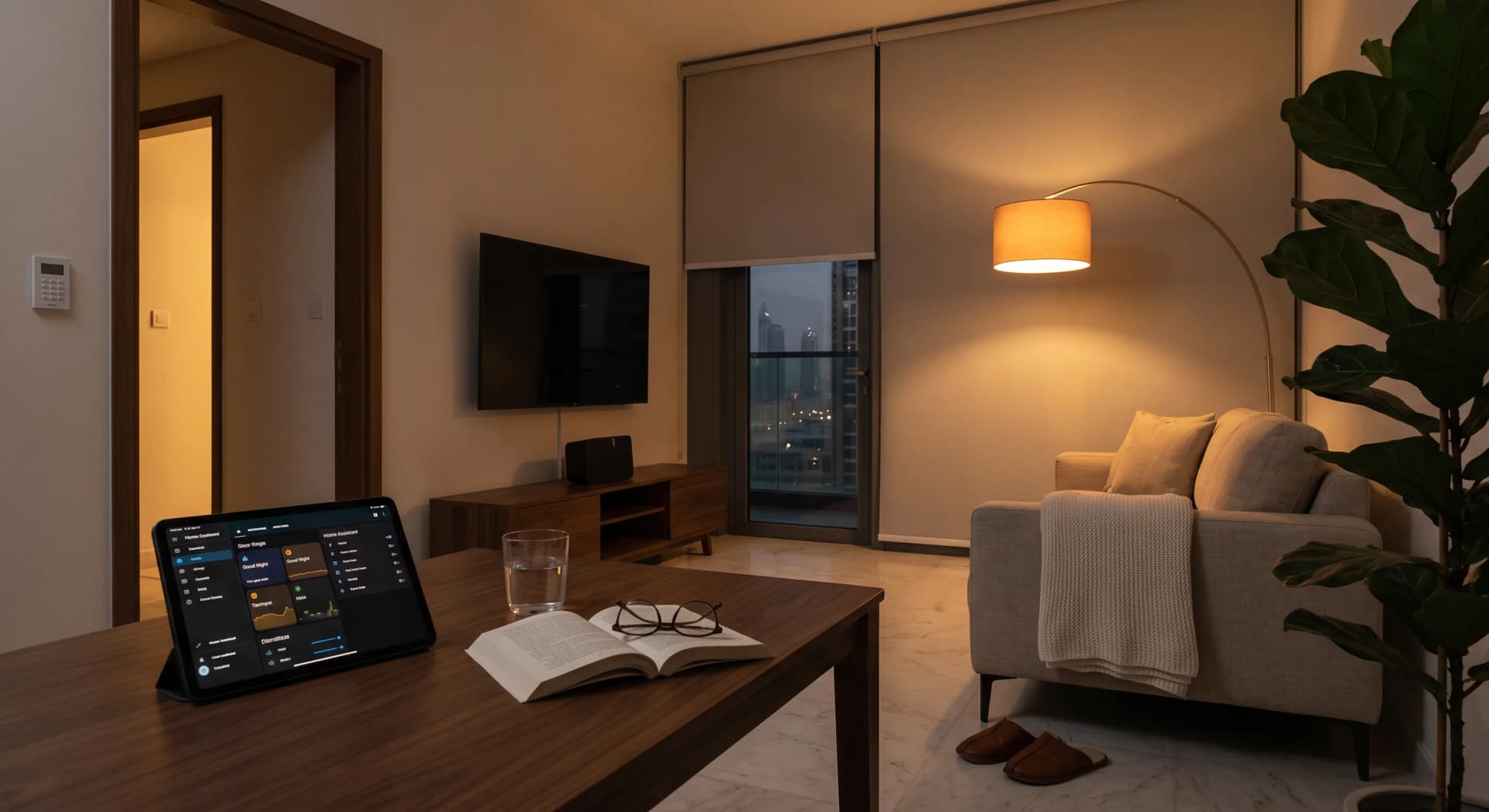
Here is the walk most people do before bed in a Dubai apartment. Living-room lamp off. Check the front door is locked. Kitchen light off. Nudge the AC down because the bedroom runs warm at night. Turn off the TV at the wall so the little red standby light stops glowing. Realize the balcony light is still on, walk back for it. Switch off the hallway light last, then feel your way to the bedroom in the dark and stub your toe on the same corner you stub it on every night.
You ran a team, a calendar, and three WhatsApp groups from your phone all day. The last job of your day should not be a lap of the apartment flipping switches.
TL;DR: A Good Night scene is one command, by voice or one button, that runs a fixed sequence in about ninety seconds: living-room lights ramp down and cut, the AC steps to a sleeping setpoint, standby loads on the TV and water dispenser switch off, the front door confirms it is locked, and a single low hallway light stays on for the 3am walk to the kitchen. You set it up once. A renter version runs from AED 3,000 installed, no wiring and no landlord approval. The order the actions fire in is the part that makes it feel like the home is putting itself to bed, not you.
The scene is not one big off switch. If everything cut at once, you would be standing in a pitch-black living room with no path to the bedroom. What a well-built Good Night scene does is sequence the actions so the room hands you off to sleep instead of snapping dark. Here is what happens, in order, and why the order matters more than the hardware.
What a Good Night Scene Is
A Good Night scene is a saved sequence of actions across your lights, AC, and a few plugs that all fire from one trigger. The trigger is two words to a voice assistant, or one press of a button by the bed, or a fixed time on a weeknight. Once it runs, you do not touch anything else. In our experience setting these up across Business Bay and Marina apartments, the scene is the single automation clients use every day without fail, because bedtime happens every night whether or not anyone remembered to plan it.
The important word is sequence. A light switch is on or off. A scene is a script. It can dim the living room over ten seconds so your eyes adjust, wait, then cut the last lamp only after the hallway light is already on. That timing is invisible when it works and glaring when it does not, which is why the order of operations is the real product here, not the bulbs.
The Ninety Seconds After You Say the Words
Picture a weeknight in a two-bedroom in Business Bay. It is 11:20pm. You say good night to the room, or press the four-button keypad by the bedroom door. Here is the sequence that runs.
First, the living-room and kitchen lights ramp down over about ten seconds rather than cutting instantly. A slow fade lets your eyes adjust and signals to your body that the day is closing. This is not decoration. Room-level light of around 200 lux before bed suppresses melatonin onset by roughly 90 minutes (Gooley et al., summarized 2024), and even dim light of 50 to 100 lux still cuts melatonin by 20 to 30 percent. Dropping the light gently is the first thing the scene does for your sleep, before it does anything for your convenience.
Second, the AC steps to a sleeping setpoint. During the day your split sits at 23 to cool an active room. The scene nudges it to a steadier overnight temperature, because your body core temperature naturally falls about two hours before sleep and a cooler room supports that drop (Sleep Foundation, 2025). Sleep efficiency is best when the room sits in the 20 to 25 degree band, and efficiency drops 5 to 10 percent as a bedroom drifts from 25 up toward 30 (NCBI, 2023). In a Dubai July that drift is exactly what happens to a bedroom left on a daytime setting.
Third, the standby loads cut. The TV, the set-top box, and the water dispenser switch off at the plug. A smart TV can pull up to 40 watts sitting in standby and a set-top box up to 30 (Reviewed, 2025). We will come back to this, because it is a supporting act in the scene and not the reason to build it.
Fourth, the front door confirms it is locked. If it is not, the scene locks it and the keypad or your phone tells you it did. No walking back to check.
Fifth, one light stays on. A single low hallway or bathroom light, warm and dim at around 2200K, remains at low level so the 3am walk to the kitchen for a glass of water is not a barefoot navigation exercise in the dark. Everything else is off. This one light is the difference between a scene people love and a scene people quietly stop using.
The whole thing takes about ninety seconds from the words to the last lamp settling. You are already in the bedroom before it finishes.
Why the Order Is the Whole Point
The reason a Good Night scene feels like the home putting itself to bed, rather than a blunt kill switch, is entirely in the sequencing. Cut every light at once and you have created the exact problem you were trying to avoid: a dark apartment you have to feel your way across. Sequence it, and the room stays one step ahead of you the whole way to the pillow.
A good sequence lights the path before it removes the light you were using. It turns on the hallway nightlight, then dims the living room, then cuts the living room, then confirms the door, then settles the AC. Nothing goes dark until the next safe light is already on. One thing clients always ask is whether this is over-engineering a light switch. It is not. It is the difference between a scene that survives past the first week and one that gets abandoned because somebody stubbed a toe on night three.
The Standby Cut Is a Side Effect, Not the Headline
The plugs that switch off your TV and water dispenser at night do trim a little off your DEWA bill. Standby loads across a home run around 5 to 10 percent of total electricity use (EnergySage, 2025), and in a summer where a Dubai two-bedroom is already paying AED 600 to 1000 a month with AC running most of it, every small cut is welcome. But the overnight standby saving is small money, and it is not why you build a Good Night scene.
We treat the standby cut as one leg of the sequence, not the reason for it. If your interest is specifically in what draws power around the clock in your apartment, we wrote a whole piece on the appliances running 24/7 in every Dubai apartment and another on the five things we find in every apartment survey that waste electricity. Those are the DEWA-first reads. This one is about the room putting you to bed. The lower bill is a side effect of the comfort, same as it is with a smart AC setup.
What It Costs to Build in a Dubai Apartment
The Good Night scene scales from a renter setup you can take with you to a fully integrated whole-home build. Here is the honest breakdown by tier.
Renter: AED 1,400 to 2,400
For a tenant in a one or two-bed with no landlord approval and no wires. A Philips Hue Starter Kit at AED 379-449 from Sharaf DG UAE (2026) gets you the Bridge and three bulbs, plus a few more White Ambiance bulbs at AED 149-249 each for the living-room lamps and the hallway light. Add an Aqara smart plug at around AED 335 from Altimus UAE (2026) for the TV standby cut, and a Sensibo Sky on the main split at AED 600-700 for the AC step. The scene fires from a voice assistant or a Hue button by the bed. Everything unplugs and comes with you when you move.
Fitted: AED 2,900 to 4,800
For an owner-occupier or long lease where a few wall changes are allowed. This adds Lutron Caseta dimmers on the primary lighting circuits with a four-button Pico keypad mounted by the bedroom door as the physical Good Night button, so the scene does not depend on anyone's phone or on a voice assistant hearing you correctly. Aqara sensors on the door confirm the lock state, and the AC controller and plugs join the same scene. This is the tier most families settle on, because the wall button by the bed is the thing everyone in the household, including guests, can find in the dark.
Whole-home: from AED 10,000
For a three-bed or larger, or an apartment being done in full, the Good Night scene becomes one of several routines running on a Home Assistant brain, alongside a morning scene and a Come-Home scene that pre-cools the living room before you walk in. Good Night is the night bookend of the same day. The night scene here can also arm cameras, close motorized blinds, and set overnight setpoints per room. This is whole-home automation, and the Good Night scene is the routine that gets used the most.
Across every tier, the platform is open. We build the same scene on Home Assistant, on Apple HomeKit, on the Aqara hub, or on a mixed Hue-plus-Sensibo household stitched together with a Hue button. All of them work. None of them lock you into one vendor.
What Bayora Will Tell You Not to Buy
The honest recommendation is the most useful thing we can give you here, so here is what we routinely talk clients out of when they ask us to build a Good Night scene.
Skip the wall-mounted touchscreen panel by the bed at AED 1,200 to 1,800. In a dark bedroom, a glowing touchscreen is the last thing you want, and a four-button Pico keypad you can find by feel does the job better for a fraction of the price. Skip putting smart bulbs on a circuit that still has a live wall switch, because the first person to flip that switch at the wall breaks the whole scene until someone flips it back. Skip motorizing every blind in the apartment to close them at night, when the two west-facing bedroom windows are the only ones that matter for sleep. And skip the subscription-based "sleep monitoring" add-ons, because a Good Night scene is a one-time setup that runs for free every night, not a service you pay monthly to keep.
We would rather build you the AED 2,000 scene that runs flawlessly for years than the AED 6,000 version with a panel nobody uses in the dark.
A Real Business Bay Two-Bedroom
A couple with a toddler in a two-bedroom in Business Bay came to us because the wife was doing the nightly lap and the husband kept leaving the balcony light and the TV on standby. We built a fitted-tier Good Night scene for AED 3,180. Hue bulbs on the living-room lamps and the hallway, a Lutron Pico keypad mounted by the master-bedroom door, an Aqara plug on the TV and the media console, and a Sensibo Sky on the bedroom split.
The scene runs from the keypad, from "good night" spoken to the HomePod, or automatically at 11:30pm on weeknights if nobody has run it. Living room ramps down over ten seconds and cuts, the master AC steps to a steady overnight setpoint, the TV and console standby cut at the plug, the door lock confirms, and the hallway light holds at 15 percent, warm, low enough not to wake the toddler but bright enough for the 3am kitchen trip. Six weeks in, the keypad had been pressed most nights, the nightly lap had stopped, and the surprise winner was the hallway light, which the toddler now uses to find their parents' room without crying in the dark. The DEWA saving from the standby cut was there but small, exactly as we told them it would be. What changed was that bedtime stopped being a chore.
Frequently Asked Questions
Does the AC really need to change at night?
Yes, if you want to sleep well. Sleep efficiency is best when the bedroom sits between 20 and 25 degrees, and it drops measurably as a room drifts warmer overnight. A Good Night scene steps the AC to a steady sleeping setpoint so the room does not sit on a daytime setting all night, which in a Dubai summer means it does not slowly warm past the point where you sleep soundly.
Voice command or a button, which is better?
Both work, and most households use both. A wall button by the bedroom door is the reliable one, because it works in the dark, needs no phone, and does not depend on a voice assistant hearing you over the AC. Voice is convenient when your hands are full. We usually set up a Pico keypad as the primary trigger and voice as the backup.
What happens if the WiFi drops mid-scene?
It depends on the platform. A scene running on a local hub like Home Assistant or an Aqara hub will complete even if your internet is down, because the devices talk to each other over the local network, not the cloud. A cloud-only setup can stall if the connection drops. This is one reason we favour local-first platforms for the scenes you rely on every night.
Can renters set this up without landlord approval?
Yes. The renter tier uses smart bulbs, plug-in smart plugs, and a plug-in AC controller. Nothing is wired into the wall, nothing needs a contractor, and everything unplugs and comes with you when you move. You can build a working Good Night scene from AED 1,400 to 2,400 with zero permanent changes to the apartment.
Why leave one light on instead of turning everything off?
Because a fully dark apartment is the exact problem the scene is meant to solve. One low, warm hallway or bathroom light keeps a safe path for the 3am walk to the kitchen. It uses almost no power at 15 percent brightness, and it is the single detail that separates a Good Night scene people keep using from one they abandon after stubbing a toe in the dark.
Say the Words and Let the Room Handle It
The nightly lap of the apartment is a habit, not a necessity. The lights do not need you to walk to them. The AC does not need you to remember it. The door can tell you it is locked without you checking. Once the scene is built, the last thing your day asks of you is two words, and then the room takes it from there.
Curious what a Good Night scene would look like in your apartment? Get a free consultation and we will tell you exactly what it takes to make your home put itself to bed, and where to start.
Ready to Get Started?
Get a free consultation and we'll recommend what makes sense for your situation.
Get Free Consultation