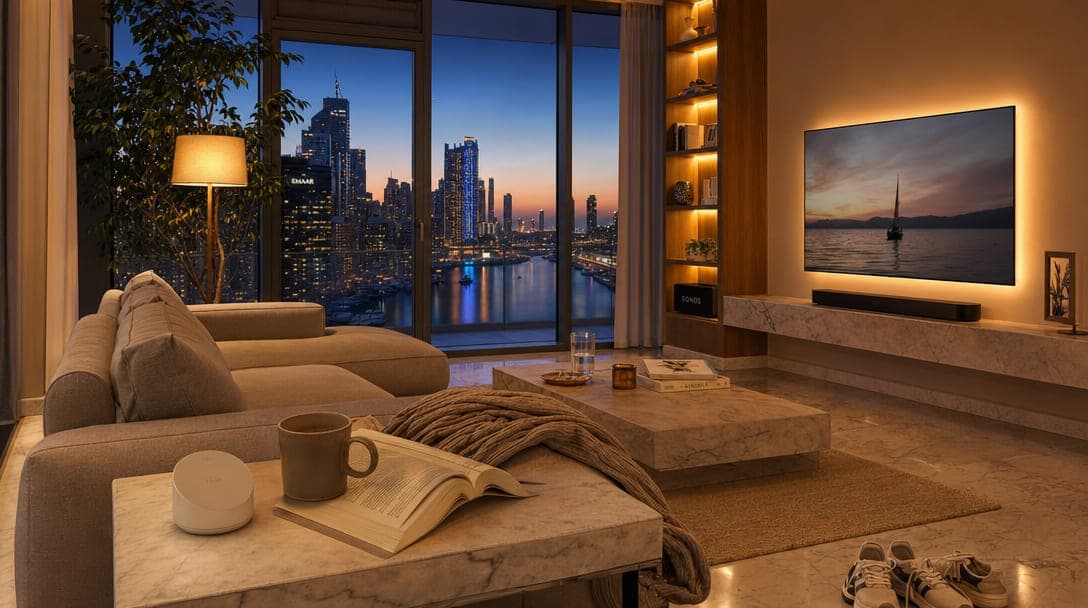
Most Hue setups in Dubai apartments look the same. Three colour bulbs in the living room, a starter kit box still in the cupboard, the app opened twice in the first week and never again. The lights are technically smart. The apartment isn't.
The problem isn't Hue. Hue is the best smart bulb system on the market for a reason. The problem is that almost everyone in Dubai buys Hue the way you'd buy regular bulbs, one fixture at a time, and never gets to the part where the apartment starts feeling different.
TL;DR: Get the Hue starter kit with the Bridge from day one (around AED 379-449 at Sharaf DG and Noon UAE). Add a Tap Dial Switch so you stop opening the app. Set up four scenes: Wake, Day, Sunset, and Wind Down. Use Hue for lamps, accent lighting, and bedrooms, not as a replacement for ceiling-circuit downlights. That gets you a Hue apartment that behaves like one, for around AED 1,500-2,500 instead of AED 5,000.
This is the buying guide we wish more clients had read before walking into Sharaf DG. What to pick, what to skip, and the four scenes that turn a box of coloured bulbs into a smart lighting setup that feels designed.
Why Hue Is Worth It (and Where It Isn't)
Hue is the most reliable, most polished smart bulb ecosystem available in the UAE. Bulbs are TRA-registered, you can buy them at Sharaf DG, Noon, IKEA, and Amazon.ae, and the firmware gets real updates instead of going stale after launch. The colour rendering is genuinely good for accent lighting, the Bridge is rock-solid, and the integrations with Apple Home, Alexa, and Google Home work without drama. After setting up Hue in roughly thirty Dubai apartments, we have not had a Bridge failure yet.
Where Hue stops being the right answer: anywhere the existing fixture is hardwired into a ceiling circuit and you only want it on or off. A standard Dubai apartment has 8-15 downlights wired to two or three wall switches. Replacing every one of those with a Hue bulb is expensive and pointless. A single Lutron Caseta or Shelly module behind the existing switch controls the whole circuit and costs less than three Hue bulbs. We cover the full hardware split in smart bulbs vs smart switches.
The honest rule we use on installs: switches for the workhorse circuits (downlights, hallway, kitchen). Hue bulbs for the things that make the apartment feel like an apartment (lamps, bookshelves, the wall behind the TV, bedside reading lights). Mixing both is what a real Hue setup looks like.
What to Buy First: The Starter Kit With Bridge
If you remember one thing from this guide, it is this. Buy the starter kit that includes the Hue Bridge. Not the Bluetooth-only bulbs.
The Bluetooth-only bulbs work. They are also a trap. They cap at 10 bulbs total, only work on one floor, do not support remote control, do not support automations, do not support routines, do not work with motion sensors, and do not group rooms (Philips Hue, 2025). The Bluetooth app gives you on, off, dim, and a couple of scenes, one bulb at a time. Once you outgrow it (you will), you have to buy the Bridge anyway, and the apartment goes through a transition phase nobody enjoys.
The Bridge unlocks the actual Hue experience: up to 50 bulbs, room and zone groupings, schedules, motion-triggered routines, Wake Up automation, remote control, and HomeKit/Alexa/Google integration (Philips Hue, 2025). It plugs into a free port on your router with an ethernet cable and runs in the background.
In Dubai, a Hue Starter Kit with three E27 White & Colour Ambiance bulbs and a Bridge sits at around AED 379-449 at Sharaf DG, Noon, and Amazon.ae (Sharaf DG, 2026). Individual White & Colour bulbs land around AED 149 each. The Bridge alone is in the AED 250-300 range, so the starter kit pays for itself the moment you would have bought a third bulb.
What we tell clients on a tight budget: the starter kit is the floor, not the ceiling. AED 449 gets you Hue running properly. Anything less and you are buying the wrong product.
What Bulbs Actually Belong Where
A Hue apartment that feels designed is not 15 colour bulbs everywhere. It is roughly four to seven Hue bulbs placed where they earn it, with the rest of the apartment running on smart switches behind the wall.
Here is where Hue is worth it in a typical Dubai 1- or 2-bedroom apartment:
| Fixture | Hue product | Why it earns the spend |
|---|---|---|
| Living room floor lamp or table lamp (1-2) | White & Colour Ambiance E27 | The single biggest mood-shifter in the room. Dimmable warm-to-cool light beats any ceiling spotlight for evenings. |
| Bedroom bedside lamp (1-2) | White Ambiance E27 (no colour needed) | 2200K warm light at 10% before sleep, ramp to 4000K for wake-up. Colour is wasted here. |
| Bookshelf or sideboard accent | Hue Lightstrip or Play bar | This is what makes guests ask who designed the apartment. |
| Wall behind the TV | Hue Lightstrip Plus or Play (gradient if you can stretch) | Reduces eye strain, makes the TV pop, costs less than a soundbar. |
| Hallway or entry accent | Single White Ambiance bulb in a feature lamp | Becomes part of the Sunset scene without needing the ceiling circuit. |
What does not need Hue: every ceiling downlight, the bathroom mirror lights, the kitchen pendants, the balcony spots. Those go on smart switches if you want control, or stay dumb if you do not. The downlights in particular are almost never worth converting to Hue, both on cost and because the existing fixtures are usually GU10 or recessed integrated LEDs that would need replacing.
In our experience, the apartments that feel best are the ones running 5-7 Hue bulbs in lamps and accent positions, with one or two smart switches handling the ceiling circuits. Total cost: AED 1,500-2,500, including a Tap Dial Switch and a motion sensor.
The Tap Dial Switch (and Why You Will Stop Opening the App)
The single most underrated Hue accessory is the Tap Dial Switch. Battery powered, sits on a console or sticks magnetically to a wall, runs for about two years on a CR2032 cell (Philips Hue, 2025). Four buttons map to four scenes. The dial dims everything in the room.
Why this matters: the Hue app is fine for setup. It is not what you want to use forty times a day to change the lighting. Phone-based control is the slowest possible way to interact with a smart light. The Tap Dial gets you back to the speed of a regular wall switch, but for scenes instead of single circuits.
A working setup we install often: Tap Dial on the coffee table maps button 1 to "Day" (full brightness, 5000K), button 2 to "Sunset" (60%, 2700K, accent lights up), button 3 to "Movie" (lamps off, accent at 20%, TV bias light only), button 4 to "Off". Dial dims whatever is currently on. After a week, nobody opens the app.
A Tap Dial Switch is around AED 280-350 at Sharaf DG and Noon UAE. The simpler Hue Dimmer Switch (on/off/dim, four scenes via long-press) is around AED 130-180 if you are tight on budget. Either one is the difference between a Hue setup that gets used and one that does not.
The Four Scenes Every Hue Apartment Needs
Hue ships with two dozen scenes by default. Most are decoration. The four below are the ones that structure the day in a Dubai apartment, and they take about twenty minutes to set up the first time.
Wake (06:30-07:30, weekdays): Cool white light, ramping from 0% to 80% over 20 minutes, finishing around 4000-5000K. Hue's Wake Up automation handles this natively in the app under Routines. Cool, blue-rich morning light supports alertness and helps shift the body out of sleep (Philips Hue, 2025). Set it on bedside lamps, not ceiling lights, and have the bedroom bulbs ramp first.
Day (08:00-17:30): Bright neutral white, 4000-5000K, 80-100% on lamps. This is the scene for working from home, kids' homework, kitchen prep. The cooler temperature keeps energy up and matches what daylight is doing outside. In summer, when blackout blinds stay closed against the 44C afternoon, this scene fights the cave effect.
Sunset (17:30-21:00): Warm white, 2700-3000K, 50-70% on lamps and accent strips, ceiling downlights off via your smart switch. This is the scene that makes the apartment feel residential instead of corporate. Hue's Natural Light scene transitions through this automatically if you set it to follow your local Dubai sunset, currently around 18:50 in May (Philips Hue, 2025).
Wind Down (21:30-23:00): Very warm light, 2200K, 10-20% brightness, on bedside and hallway only. Below 2700K with low brightness encourages melatonin and supports better sleep. Hue can dim through this automatically over 30 minutes if you use Routines, so you do not have to think about it.
The full schedule lives in your Hue Bridge once it is set up, and runs even if your phone is off. We covered the same idea with a renter-friendly variant in our 3-scene lighting routine for Dubai renters, and applied it to families specifically in our smart lighting for kids' rooms post.
Hue Plus a Motion Sensor Is the Step Most People Skip
A Hue Motion Sensor is around AED 220-280 at Sharaf DG. Pair it to your Bridge in the app, point it at the hallway or the kitchen, and set it to trigger the right scene at the right time of day: Day during morning hours, Sunset in the evening, Wind Down at night.
This is what shifts a Hue apartment from manual to automatic. Walking into the kitchen at 22:00 turns the lamp on at 15% warm white. Walking into it at 08:00 turns it on at 100% cool white. You never touch a switch.
In our experience, clients who add one motion sensor in the hallway and one in the kitchen stop opening the Hue app entirely after the first week. Two sensors in a 2-bedroom apartment cover roughly 70% of the daily lighting interactions. The Tap Dial handles the other 30% (mostly the living room scene changes).
What this does for the DEWA bill is a side effect, not the headline. Lighting is roughly 4-6% of a Dubai household's electricity, and a smart-controlled apartment cuts that figure by 24-50% through dimming and presence (U.S. Department of Energy, 2024). The actual reason to do it is that the apartment becomes pleasant. The bill saving (AED 30-90/month on a typical 2-bedroom) is a quiet bonus.
Hue and Everything Else: The Ecosystem Question
The UAE smart lighting market is set to grow from USD 107.7 million in 2025 to USD 467.6 million by 2034, a 17.2% CAGR (IMARC Group, 2025). What that means in plain language: more brands, more choice, more risk of buying things that do not talk to each other.
Hue plays nicely with the rest of a smart home setup. The Bridge speaks Zigbee, exposes lights to Apple Home, Alexa, and Google Home, and integrates cleanly with Home Assistant if you want to tie lighting to AC, blinds, or doorbell events. We routinely set up clients where the Hue lamps drop to Sunset scene the moment the motorized blinds close at 17:30, or where the hallway Hue bulb pulses softly when the video doorbell detects motion at the door.
What does not play well: trying to use Hue as your only smart home brand. Hue does lights. It does not do AC, security, blinds, or door locks. If you want a whole-home setup where one routine handles everything, Hue is one piece of the stack, not the stack itself. We size client setups around that reality. Hue lamps and accents, Lutron or Shelly switches for ceiling circuits, Sensibo or Tado smart AC controls, and Home Assistant or Apple Home as the conductor.
What a Real Hue Apartment Costs
Three configurations we install regularly, with 2026 UAE pricing from Sharaf DG, Noon, and Amazon.ae:
Starter (renter, 1-bed, around AED 1,500): Hue Starter Kit with Bridge (AED 449), 2 additional E27 White & Colour bulbs (AED 300), 1 Hue Lightstrip Plus 2m for behind the TV (AED 350), 1 Hue Dimmer Switch (AED 150), 1 Hue Motion Sensor (AED 250). Lamps and accent only, no switches. Takes one Saturday afternoon to set up.
Designed (renter or owner, 2-bed, around AED 2,500): Starter Kit (AED 449), 4 additional bulbs spread across living room and bedrooms (AED 600), 2m Lightstrip behind TV (AED 350), bookshelf Lightstrip (AED 350), Hue Tap Dial Switch (AED 320), 2 Motion Sensors (AED 500). All four scenes set up. The "guests will ask" tier.
Integrated (owner, 2-3 bed, around AED 5,000-7,500 including switches): Everything above, plus 2-3 Lutron Caseta or Shelly switches behind the wall on living room and bedroom downlight circuits (around AED 800-1,200 per switch installed), and a Home Assistant or Apple Home setup that ties Hue scenes to AC and blinds. This is where Hue stops being a lighting product and starts being part of the apartment's behaviour.
These are honest numbers. The first version of every project we quote starts here, not at the AED 12,000 "whole-apartment Hue replacement" some other installers will pitch. If your problem is solved by a starter kit and three accent bulbs, that is what we will recommend.
Frequently Asked Questions
Do I really need the Hue Bridge if I only have a few bulbs?
For two or three bulbs in one room, the Bluetooth-only version technically works. But Bluetooth caps at 10 bulbs total, has no schedules, no Wake Up, no motion sensors, and no remote control. Most people outgrow it within a month and end up buying the Bridge anyway. The starter kit with Bridge costs about the same as buying three Bluetooth bulbs separately.
Will Philips Hue work with my Apple HomeKit, Alexa, or Google Home setup?
Yes, with the Bridge. All three ecosystems integrate cleanly with Hue once the Bridge is on your network. You can ask Siri, Alexa, or Google to set scenes, dim rooms, or trigger routines. Without the Bridge, integration is limited to Bluetooth proximity, which is not useful in practice.
Can I install Philips Hue in a rental apartment in Dubai without modifying anything?
Yes. Hue bulbs screw into existing E27 fixtures the same as a regular bulb, the Bridge plugs into your router, and the switches and motion sensors are all battery powered with no wiring. Take the lot with you when you move. This is one reason we recommend Hue specifically for renters in Dubai Marina and JBR where you cannot touch the wiring.
How long does the Philips Hue Bridge last, and what happens if it fails?
The Bridge is essentially a small router and lasts for many years in normal home use. If it fails, all the bulbs stay paired to it but lose schedules and remote control until you swap it. A replacement Bridge runs around AED 250-300 and takes 10 minutes to set up. We have not seen one fail in three years of installs.
Are Philips Hue bulbs more energy-efficient than regular LED bulbs?
The bulbs themselves use roughly the same energy as a non-smart LED of the same brightness. The savings come from dimming (you rarely need 100%), schedules (lights match the hour, not your forgetfulness), and motion sensors (rooms turn off when empty). Smart-controlled lighting cuts overall lighting energy use by 24-50% in residential settings (U.S. Department of Energy, 2024). The savings are real but quiet.
If you are starting from scratch and want a Hue setup that changes how your apartment feels, tell us about your place and we will recommend the smallest version that gets you there. No AED 25,000 pitches for a problem that is solved by a starter kit and a Tap Dial.
Ready to Get Started?
Get a free consultation and we'll recommend what makes sense for your situation.
Get Free Consultation