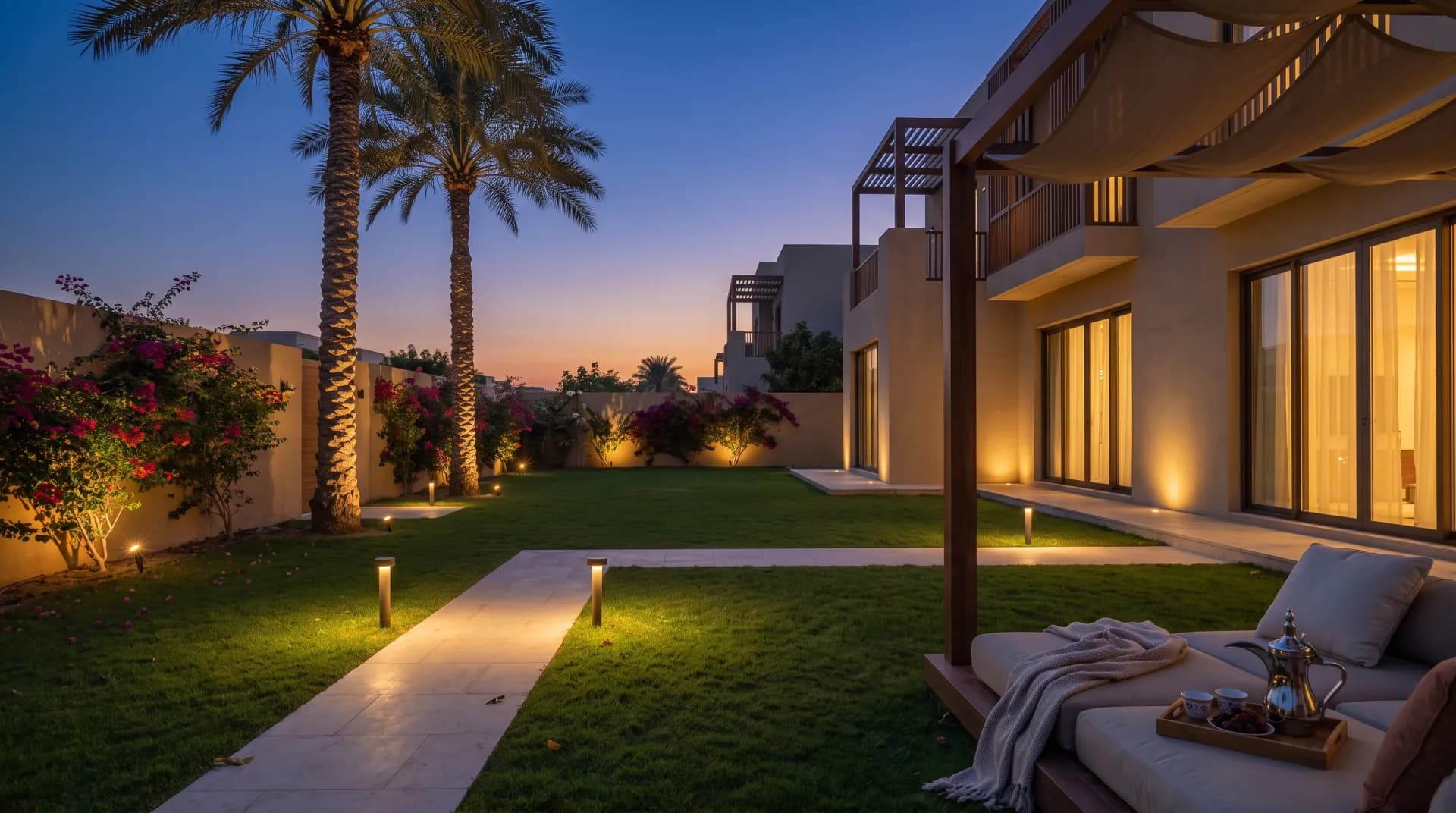
Somewhere in your Dubai villa there is a small grey box with a dial, or a timer module in the distribution board (the breaker panel, often in a utility cupboard or under the stairs), that switches the garden lights on every evening. Someone set it once, probably in a hot month, and nobody has touched it since. In July it switches on right as the sun goes down. By November the garden has been dark for over an hour before it clicks on, and that is exactly when you want to sit outside.
Smart garden lighting fixes this with a small change. The lights follow the sun and the front of the house lights up when you pull in. The control moves indoors, somewhere the summer cannot cook it.
TL;DR: Dubai's sunset shifts by about 1 hour 44 minutes between early July and late November, so a fixed garden timer is wrong for part of every year. A smart relay on each exterior circuit, kept indoors and run on a sunset schedule, fixes it without new fixtures. Check the heat rating on anything that lives outside.
The Timer Problem: Dubai's Sunset Moves by Nearly an Hour and Three Quarters
The latest sunset in Dubai this year falls in early July, at 19:14. The earliest falls in late November, at 17:30 (Sunrise-Sunset.org, 2026). That is a swing of 1 hour 44 minutes, and a clock timer does not know about it.
Set the timer to 19:15 in summer and it looks perfect. On 25 November the last usable daylight is gone by 17:53, when civil twilight ends (Sunrise-Sunset.org, 2026), and the path lights stay off until 19:15. That is about an hour and twenty minutes of a dark garden every evening, in the cooler months when families finally use it. Set the timer in winter instead, at 17:45, and in July the lights burn for about an hour and a half of full daylight.
The usual workarounds are nudging the dial twice a year, or leaving the lights on far too long so they cover both seasons. A sunset schedule removes the job. The system knows the date and the location, works out the sunset for that day, and switches on at sunset or at any offset you pick, such as 15 minutes after. It is the same reason sun-position automation beats a timer on west-facing blinds.
Photocell or Astronomical Schedule: Which One Knows It Is Dark
In a Dubai garden, the astronomical schedule is the more dependable of the two. A photocell reads daylight through a small sensor, while an astronomical schedule calculates sunset from the date and your coordinates. Both beat a fixed timer.
The photocell has two weak points. It has to see the sky, and it gets fooled. Dirt, spider webs, leaves or water droplets on the lens throw off its reading, and so does light from the lamps it controls, a streetlight or passing headlights (VIOX Electric, 2025). The same guide lists desert climates with persistent dust among its high-risk settings. On a villa, the tell is a garden that flickers at dusk.
An astronomical timer uses your location to calculate sunrise and sunset for every day of the year and adjusts itself as the seasons change (Alion, 2025). Nothing on it needs cleaning, and it can sit indoors. Home Assistant and Shelly, two of the platforms we set these up on, both do this in software, so the villa gets the astronomical behaviour without a separate timer box.
Where the Smart Control Should Live: Indoors, Out of the Heat
The best place for the smart part of your garden lighting is inside the house, with one relay per exterior circuit. A relay here is a small smart switch that sits in the distribution board or in a module box near it. The fixtures in the garden stay where they are, and the relay switches the circuit that feeds them.
Heat is the reason. A Shelly 1 Gen3, one of the relays we specify for exterior circuits, is rated for an ambient working temperature of -20°C to 40°C (Shelly, 2026). The UAE's average August maximum is 48°C, going by National Centre of Meteorology data for 2003 to 2016 (Gulf News, 2017). Put that relay in a junction box on a sunny garden wall and summer afternoons can take it past its rating. Beside a board inside an air-conditioned house, it stays well within it. If your board sits in the garage or an outdoor cabinet, that changes where the relays should go, so tell us before anything is ordered.
When we design a villa's lighting, each exterior circuit gets its own on/off relay, grouped indoors rather than out in the garden, and the front of the house can sit on one button by the door. The question to settle first is whether the garden and pool lights are on existing circuits or need new ones, because a new circuit means new cable from the board as well as another relay. You can make a start tonight: check the labels on the board and count the breakers marked garden, external or pool.
IP Rating and Operating Temperature Are Two Different Numbers
If you are adding or replacing any outdoor fittings, the IP rating on the spec sheet tells you how well a fixture keeps out dust and water. It says nothing about heat, which is a separate line: the operating temperature.
The first digit covers solids and the second covers water (indEx Enclosures, 2026). IP44 keeps out objects over 1 mm and splashing water, which the guide pairs with covered outdoor spots. IP65 is dust-tight and handles low-pressure jets, which we treat as the floor for an open garden with sprinklers. IP67 is where people assume they are safest, but the same guide notes that an IP67 device passed the immersion test and may not have passed the jet test.
The Philips Hue Flux outdoor lightstrip, a popular outdoor smart light, lists its IP code as "IP67 (IP20 PSU)" and its operational temperature as -20°C to 45°C on its US product page (Philips Hue, 2026). The strip is sealed and its power supply unit is not, since IP20 means no water protection at all, so the supply belongs indoors or in a proper enclosure. The strip's own limit also stops at 45°C, below that UAE-wide August average.
The same page lists the Flux strip as neither cuttable nor extendable, so measure the run before you choose a length. If an outdoor fitting's operating limit sits below that August average, give it shade or choose a different fitting.
Smart Fixtures or a Smart Circuit: Keep What You Have
For most villas the right move is to keep the landscape lighting you already own and make the circuits smart. Replacing working fixtures with app-controlled ones costs more, adds more things to fail in the heat, and often puts a power supply in the garden that should not be there.
Smart fixtures earn their place in a few spots: a shaded pergola where you want warm-to-cool white, or a feature wall where colour is the whole idea. Across a whole garden, colour-changing lights often end up parked on warm white after the first party, which is why our advice is warm white on the paths and colour only where it is the point, as in our Al Barari villa guide. The same logic we use indoors in smart bulbs vs smart switches applies outside: if the fixtures work, switch the circuit and leave the fixtures alone.
One practical check before planning any dim scene: a relay only switches on and off. If you want the path lights at half brightness late at night, the fixtures and their drivers (the small power units that feed each LED fitting) have to be dimmable, and that circuit needs a dimmer, or a dimming controller matched to those drivers.
Outdoor Lighting Schedules Worth Setting Up in a Dubai Villa
Each of these takes a few minutes to set up once the relays are in, and each assumes your path, feature, driveway and pool lights are on separate circuits.
The simplest is sunset on, fixed off: garden and facade lights come on 15 minutes after sunset and go off at midnight, and nobody touches a dial again. An arrival scene handles the driveway: when the gate or garage opens after dark, the driveway and entrance lights come on for ten minutes, so nobody walks up in the dark carrying shopping.
At 23:00, a quiet-hours step-down switches the feature lighting off an hour early and leaves the path and entrance circuits on until midnight, which keeps the house lit without lighting the neighbours' bedrooms. A "Garden" button ties the outside to the rest of the house, bringing up the terrace lights, the outdoor speakers and the pool lights together, and a "Goodnight" button indoors turns the whole exterior off.
If outdoor security cameras watch your driveway, the path circuit is the one to leave on through the night instead of switching it off at midnight, so the camera has steady light to work with. Run it dimmed if those fixtures are on a dimmer.
What a Smart Garden Lighting Upgrade Involves
The job is often smaller than it sounds. Exterior lighting on a villa tends to be split across a few circuits, such as front exterior, rear garden, and sometimes the pool or a facade run. Each one gets a relay, the schedules above get set up, and the circuits join whatever the rest of the house already runs on, whether that is Shelly, an app-based system like Home Assistant, or a keypad system.
The relay is only part of the cost. On top of the device you pay for fitting and setup, and any new cable from the board is what moves the price most.
The relay wires into the lighting circuit at mains voltage, so fitting it is work for a qualified electrician. The schedules and scenes afterwards are app settings you can change yourself.
If the whole garden is on one breaker, one relay still gives you the sunset-on, midnight-off schedule, but every light switches together. Splitting the path, feature and pool lights so they can do different things means new cable runs from the board, and that is where the cost moves. Pool lights are a similar case: the relay switches the mains side of the pool light's transformer, back in the panel, with a snubber, as we explain in our pool pump guide. We look at the board first and put the full price in writing before any work starts. If a plain astronomical timer on a single garden circuit solves your problem, we will tell you that too.
If you are planning a bigger villa project, add the garden circuits to the smart lighting scope from the start, because the relays share space and labour with the indoor lighting work. Our smart lighting guide for Dubai covers the indoor side.
Frequently Asked Questions
Can I make my existing garden lights smart without replacing them?
Yes, in most villas. A smart relay fitted indoors, at or near the distribution board, switches the whole garden circuit, so the existing fixtures stay where they are. The relay adds a sunset schedule, app control and scenes. You only need new fixtures if you want dimming or colour and the current ones cannot do it.
Can garden lights turn on automatically at sunset?
Yes. A smart relay or an astronomical timer calculates the sunset time for your location on each day of the year and switches the lights on at sunset or at an offset you choose. It needs no light sensor, so dust on a lens cannot throw it off, and it follows Dubai's sunset from 19:14 in July to 17:30 in November.
What IP rating do outdoor lights need in a Dubai garden?
For an open garden with sprinklers, we treat IP65 as the minimum: dust-tight and protected against low-pressure water jets. IP44 suits covered spots like a porch. Check the operating temperature too, because the IP rating says nothing about heat, and the UAE's average August maximum is around 48°C.
Can I fit a smart relay for my garden lights myself?
The wiring is a job for a qualified electrician, because the relay connects to the lighting circuit at mains voltage. Once it is in, the schedules, sunset offsets and scenes are app settings you can adjust yourself. We fit the relays and set up the first schedules with you.
Where should the smart switch for outdoor lights go in a Dubai villa?
Indoors, in or beside the distribution board, where the house stays cool. Many smart relays are rated to around 40°C ambient, and a junction box on a sunny garden wall can run past that on summer afternoons. Keeping the relay indoors also means the garden fixtures need no changes.
Light the Garden You Already Have
A Dubai villa's garden gets used most in the cooler half of the year, and that is when a fixed timer gets sunset most wrong. Tell us about your villa and we will look at your board, count the exterior circuits and tell you exactly what it takes to put them on a sunset schedule.
Ready to Get Started?
Get a free consultation and we'll recommend what makes sense for your situation.
Get Free Consultation