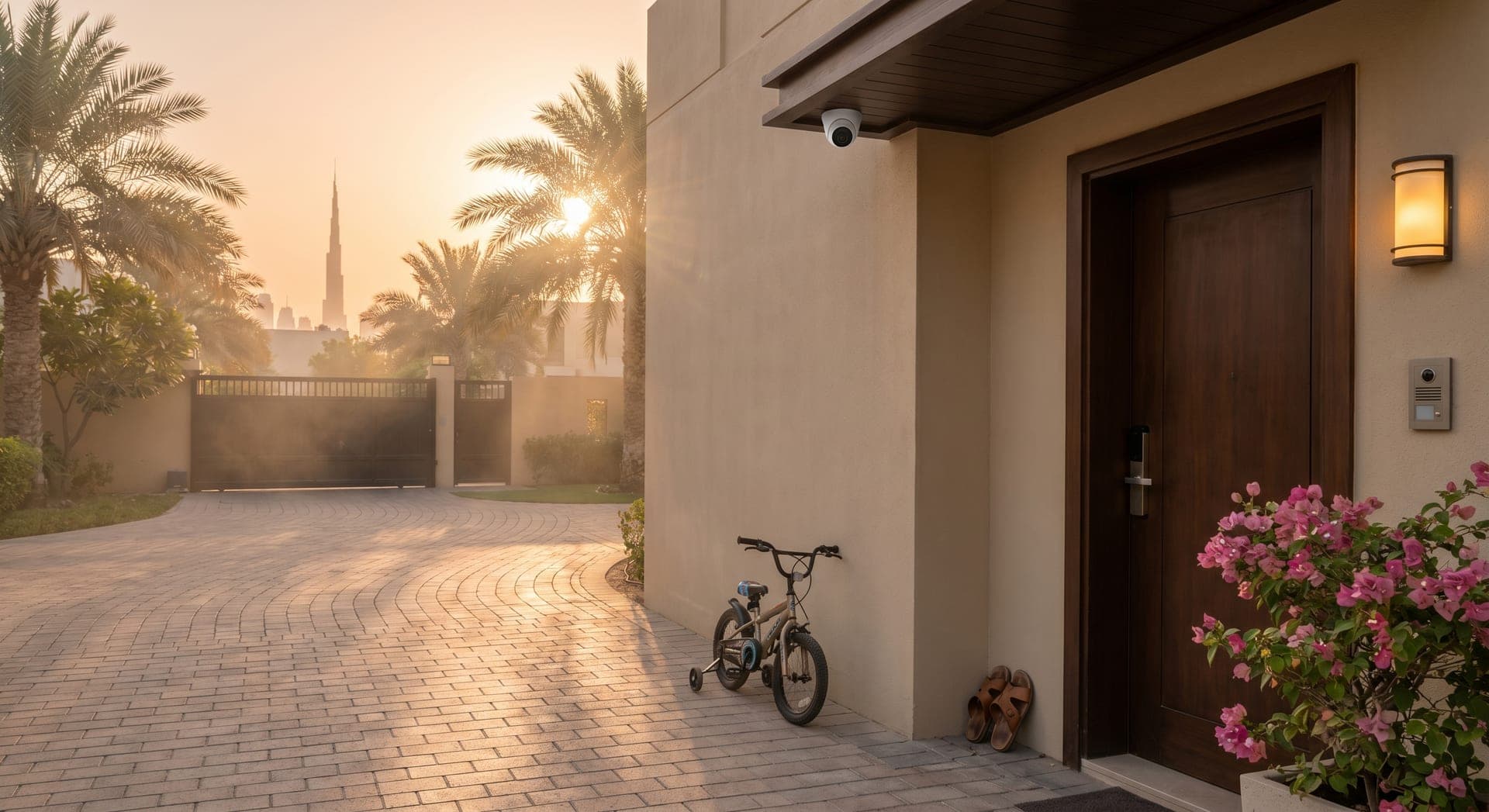
Your apartment has a building intercom, a hallway under building CCTV, a concierge, and a deadbolt on a door that opens to a corridor not a street. Your villa has a gate, a garden, a pool, a back wall any neighbour's contractor can walk along, and a driveway long enough that the man who delivers your Talabat order knows the layout better than your housekeeper does.
TL;DR: A solid outdoor camera setup for a Dubai villa costs AED 1,800 to AED 6,500 installed and covers the gate, the front door, the garden corners, and the back access. For most villas, 4 to 6 cameras is the right number. Solar-and-battery cameras work well for retrofits in compounds where you cannot run cables; hardwired PoE is the right call for new builds. Salt-air villas on Palm, JBR, and beachfront need 316-grade stainless mounts or the cameras die in 18 months. Dubai Police runs a free villa-watch service you can activate before you travel, and almost no one in Dubai knows about it.
Outdoor cameras for a villa are not the same conversation as indoor cameras for an apartment. The use case is different, the gear is different, the placement is different, the law is different, and the failure modes are very different. We have walked into villas in Arabian Ranches where the previous installer mounted bullet cameras with aluminium brackets four years ago and the brackets are now a powdery white crumble holding a useless lump of plastic to a stucco wall. We have walked into Palm villas where the cameras work fine but cover none of the actual entry points anyone would use.
This is what we wish more villa owners knew before they bought.
Why Villa Coverage Is a Geometry Problem, Not a Camera Problem
The mistake everyone makes is to start by asking which camera to buy. The right question is which corners of the property need to see what, and from where.
A Dubai villa has roughly the same threat surface as a small commercial building. There is a main gate, a pedestrian gate, a front door, a garden you can climb into from a neighbour's wall, a side return that runs to the back, a pool area, often a back maid's-room door, and sometimes a roof terrace. The reason most villa CCTV is bad is that it pretends to be a perimeter system but only covers two of those nine points.
In our experience surveying villas before quoting, the minimum useful coverage is four cameras: one wide-angle pointing at the main gate from inside the property, one covering the front door at face-height, one covering the back garden corner with line-of-sight along the side return, and one watching whichever pool, balcony, or roof access exists. That is the entry-level setup. A three-bedroom villa in Arabian Ranches or Dubai Hills usually lands at five to six cameras once you cover both side returns and a service area.
A 5,000-square-foot villa on Palm Jumeirah lands at eight to ten cameras because the property has more corners and a beach-facing rear elevation that needs its own coverage. Properties with separate staff accommodation, gym buildings, or majlis blocks add cameras per outbuilding, but those are project-specific.
The honest test: stand at the front gate and ask which directions someone could reach the house from. Every answer needs a camera. Anything beyond that is decoration.
What Outdoor Cameras Actually Need to Do in Dubai
The Dubai outdoor environment will destroy cameras that were specified for Frankfurt or Manchester. A camera installed on a west-facing villa wall will see direct sun above 45C from May through September. The Khaleej Times confirmed temperatures topping 46C across Eid Al Adha this week (The National, 2026). NCM has flagged a 61% probability of El Niño developing through July (Gulf News, 2026), which means hotter summers and weaker sea breezes going forward.
The non-obvious problem is not the camera body. Most modern outdoor cameras handle 40-50C operating temperatures. The problem is the mounting hardware. Standard aluminium brackets and screws corrode quickly in coastal salt air, and a corroded mount loses its watertight seal long before the camera itself fails. Salt particles travel on ocean breezes and coat every surface within three miles of the coast (Fanttik corrosion guide, 2024). Villas on Palm Jumeirah, JBR, Jumeirah 1, La Mer, and most of the beachfront belt sit inside that zone. Standard mounts last 18 to 30 months. 316-grade stainless steel mounts last the life of the camera.
The IP rating on the box tells you the camera survives water and dust. It does not tell you anything about chloride corrosion (Manomay weatherproof testing, 2025). For coastal Dubai villas, the spec we hold installers to is IP66 or higher, plus 316-grade stainless mounting hardware, plus a silicone seal at every cable entry. That single detail is the difference between a five-year install and a two-year install.
The other Dubai-specific consideration is dust. Today is one of those sandy mornings (Khaleej Times weather, 2026), and a camera with a recessed lens housing accumulates dust on the housing rather than the lens. A camera with the lens flush to a flat plastic face needs wiping every two weeks in summer. Small detail, recurring annoyance.
The Three Power Options for a Villa, Ranked by Honesty
Outdoor cameras for Dubai villas come in three power configurations, and the right one depends almost entirely on whether you can run cables.
Solar + Battery (Best for Retrofits in Existing Villas)
For a villa you already live in where you do not want to chase cables through painted walls, solar-and-battery wireless cameras are the right answer. The Reolink Argus Eco solar bundle runs around AED 355 (Yallapromos UAE listing, 2026), the Argus 4 Pro 4K with solar panel sits closer to AED 700-900, and the Eufy SoloCam S340 is available through Microless, Noon, and Carrefour (Microless UAE, 2026).
What works: install in 90 minutes per camera, no electrician needed, retrofit-friendly, no monthly fee with local SD card storage. What does not: in shaded corners under deep eaves the solar panel does not get enough sun, especially in narrow side returns where the next villa shadows the panel. You end up changing cameras every six months from low charge state. The fix is to mount the panel away from the camera with a 4-metre extension cable, but at that point you may as well run a low-voltage line.
PoE (Power over Ethernet) - Best for New Builds and Renovations
If you are renovating, building, or willing to chase cables once, a PoE setup is the long-term right call. One CAT6 cable per camera carries both power and data, runs to a small NVR (network video recorder) hidden in a utility cupboard, and gives you reliable 24/7 recording with no battery to ever charge or replace.
The Aqara Camera Hub G5 Pro PoE version is the unit we install most often in mid-size villas. Around AED 705 at Modo Store UAE (Modo Store, 2026), 4MP with true colour night vision, doubles as a Zigbee hub and Matter controller, integrates with Home Assistant, HomeKit Secure Video, Alexa, and Google. The 9to5Mac review keeps recommending it as one of the best outdoor HomeKit cameras through 2026 (9to5Mac, 2026).
Hardwired NVR-based systems from Reolink, Hikvision, and Dahua remain the standard in villa projects where the owner wants 30+ days of local recording and zero reliance on a phone app. Expect AED 4,500 to AED 12,000 installed for a four-to-eight camera system with NVR and 4TB storage, including labour.
Battery-Only (Use Sparingly)
Pure battery cameras with no solar are the wrong default for Dubai. The combination of summer heat (which degrades lithium batteries faster) and the actual amount of motion an outdoor camera in a villa sees means a battery-only unit needs charging every six to twelve weeks. We use them only for corner positions where solar is impossible and cable is harder than monthly maintenance.
The Coverage Layout We Use on a Typical Villa
For a three-to-four bedroom villa in Arabian Ranches, Dubai Hills, Springs, or Victory Heights, this is the layout we build off of.
Camera 1: Main gate, mounted inside the property. Wide-angle (110-130 degrees), positioned to see the gate, the driveway up to the front door, and the pavement approach. Mount under the eaves at 2.5-3 metres so a tall person cannot reach the lens. This camera does most of the work; it sees who arrives and how they arrived. It is also what lets you open or close the gate from your phone while seeing that the way is clear.
Camera 2: Front door at face-height (1.7-2 metres), or a video doorbell if there is mains power at the bell. Narrower angle (90-100 degrees), faces toward whoever rings or knocks. A face-height camera gets useful identification frames; a 3-metre eave-mount only gets the top of a baseball cap. We cover the video doorbell question separately in our video doorbell guide.
Camera 3: Back garden corner with line-of-sight along the side return. This is the camera that catches anyone who came over the back wall. Position it so the side return between your villa and the neighbour's is in frame. In our experience, this corner is where almost every incident in a residential compound starts.
Camera 4: Pool or rear access. Pool cameras serve double-duty (security and child supervision), but the framing matters. Frame the gate or door that leads to the pool, not the water itself. Children's safety around pools is a real concern but it is not a CCTV problem; it is an access problem solved by smart locks and pool fencing.
Cameras 5 and 6 (for larger villas): Second side return + service entrance. Any villa with a maid's-room door, a back service gate, or a separate gym building needs coverage on those points. A maid's-room door that opens to the back garden is the most-overlooked access point in Dubai villa stock.
The pattern: cover the points anyone would use to reach the house, at angles that produce usable identification frames, with mounting hardware that survives the climate. Five or six cameras placed correctly beats fourteen cameras placed everywhere.
What Dubai Police and SIRA Actually Require for Villas
The legal picture for residential villas is more relaxed than people assume. SIRA's 4K minimum resolution rules, 31-day retention requirements, and certified-installer mandates apply to commercial buildings and shared facilities (SIRA technical specifications). For a private villa where the cameras only cover your own property and you are not feeding the footage into a common-area system, you do not need SIRA approval (Al Tamimi & Company, 2024).
The hard rules that do apply: cameras must not face neighbouring properties, must not capture inside the next villa's windows, must not record audio without consent, and the footage cannot be posted on social media (Khaleej Times Dubai Police guidelines, 2024). A camera on the back garden corner is fine; a camera angled across the wall into the neighbour's pool is not.
The non-obvious legal benefit: Dubai Police runs a free Smart Home Security service specifically for villa residents (Dubai Police, 2026). When you register your villa with your Emirates ID, Makani number, and travel dates, police patrols include your villa in their neighbourhood watch routine while you are away (Gulf News, 2024). It does not replace cameras, it complements them. The service is apartment-blind and only available for villas.
With Eid Al Adha opening a 9-day window for public-sector residents and 6 days for private-sector (Khaleej Times, 2026), this week is when the service earns its place. A villa owner traveling Tuesday through the following weekend, with cameras live and Dubai Police aware of the absence, has the closest thing to insurance the system offers.
What This Costs, by Villa Size
For a three-bedroom villa in mid-tier compounds (Arabian Ranches, Springs, Mudon, Mira, Town Square), the realistic budget for a useful outdoor camera setup is AED 1,800 to AED 3,500 installed. That covers four to five solar-battery cameras (Reolink Argus or Eufy SoloCam class), wall-mounting in 316-grade stainless on coastal lots, app setup, integration into existing smart home if relevant, and a one-hour training session for the household.
For a four-to-five-bedroom villa in larger compounds (Victory Heights, Dubai Hills, Mira Oasis, larger Arabian Ranches villas), expect AED 3,500 to AED 6,500 installed for five to seven cameras with a mix of solar-battery on perimeter and a small NVR or hub at the front door for higher-frequency coverage.
For premium villas on Palm Jumeirah, beachfront properties, larger Dubai Hills villas (8,000+ sqft), Emirates Hills, and Al Barari, a hardwired PoE setup with NVR storage is the right answer. Budget AED 8,000 to AED 18,000 installed for eight to twelve cameras plus NVR, depending on cable runs and how much wall-chasing is required. This is where it overlaps with the broader whole-home automation conversation and where having one company own both the security stack and the smart home stack starts to matter.
These are honest installed prices, not equipment-only. The labour for a villa exterior install is half the cost on retrofits, because chasing a CAT6 cable along a stucco wall and through a soffit takes time.
What We Tell Villa Owners Not to Buy
Most villa owners walk into a security conversation having seen one of three things: a glossy 16-camera package on a delivery flyer, a TikTok ad for a no-subscription dual-lens 4K solar camera, or a SIRA-certified installer quote at AED 35,000. None of these is automatically right. These are the four things we talk most clients out of.
Skip 16-camera packages on a 4-bedroom villa.
If the quote shows sixteen cameras for a residential villa under 6,000 sqft, half of them are pointed at things that do not need coverage (the lawn, the pool water, the empty driveway in three angles). You are paying for camera count, not coverage. Six cameras in the right positions beat sixteen cameras with three overlapping angles on the rose bush.
Skip cameras facing the street, the pavement, or neighbouring property.
This is a hard line under both UAE PDPL (2021) and Dubai Police guidelines. Any camera that captures the public road, the pavement, or any part of the neighbour's property creates legal exposure and gets your service licence cancelled if it ever becomes a complaint. The angle the installer's app shows you in setup is the angle that matters; check every camera's field of view on the phone before signing off.
Skip AED 1,800-3,000 monthly cloud subscriptions for residential use.
The Ring Protect Pro subscription, Nest Aware Plus, Eufy Pro Cloud, and a dozen others bill annually for cloud video storage you almost never watch. Local SD card or NVR storage is enough for residential. We have never had a client request footage older than 14 days. If your camera does 30+ days of local recording, the cloud subscription is buying you nothing.
Skip wired hardwired NVR systems on a villa you are renting.
If the villa is leased and you are likely to move within three years, the cost of running cables and the difficulty of taking the system with you outweighs the marginal benefit over a solar-battery wireless setup. Wireless installs come down off the wall in 30 minutes per camera and follow you to the next villa. Hardwired systems are an investment in a property you own.
A Real Villa Setup We Did Recently
A four-bedroom villa in Mira Oasis, owner-occupied, no existing outdoor cameras. The owner had been quoted AED 22,000 by a SIRA-certified contractor for a 12-camera hardwired system with a 4TB NVR and a five-year monitoring contract. He called us for a second opinion before committing.
We surveyed the property. He had two real concerns: the main gate is a hundred metres from the front door and the driveway curves so you cannot see the gate from any window; and the back garden borders a small park that lets anyone walk along the back wall. Everything else was a wish list.
Five cameras solved both real problems and the wish list with margin. Reolink Argus 4 Pro at the main gate (4K, 180-degree dual-lens, no NVR needed because the camera does dual-stream local SD), Aqara G5 Pro at the front door (HomeKit Secure Video, Home Assistant integration with the rest of his smart home), Eufy SoloCam S340 on each of the two side-return corners (solar-powered, no cable runs along the stucco), and a fifth Aqara G5 Pro covering the back terrace with line-of-sight along the entire back wall.
Total: AED 4,260 in equipment, AED 1,800 in labour and 316-grade stainless mounting hardware (Mira Oasis is far enough inland that we used 304-grade for two of the units; the Aqara at the back terrace got 316 because it sits exposed). All cameras feed Home Assistant on his existing setup. Two-day install. Cost came in at AED 6,060 against the AED 22,000 quote. The owner registered for Dubai Police's villa-watch service before flying out for Eid this week.
The honest version: we walked him out of AED 16,000 of equipment he did not need. Five cameras in the right places solved his actual concerns. The other seven would have watched empty lawn.
How Outdoor Cameras Talk to the Rest of the Smart Home
The reason we keep coming back to Home Assistant and HomeKit Secure Video for villa cameras is that an outdoor camera that lives in isolation is half a system. An outdoor camera connected to the rest of the home becomes a sensor that triggers things.
The patterns we build most often:
- Front gate camera detects motion + person + 22:00-06:00: turn on the driveway lights at 80%, ping the homeowner's phone, do not record more than 30 seconds.
- Back garden camera detects motion + person + house is in away-mode: trigger the outdoor floodlight, send a high-priority alert, hold recording for 5 minutes.
- Front door camera detects a known face (Apple HomeKit Secure Video does this locally): turn on the entryway lights, unlock the door, disarm the security system. This is the convenience payoff for the household that lives there day to day.
- All cameras + house in away-mode + Dubai Police service active: record full continuous, alerts go to two phones plus an emergency contact, smart lights run a randomised occupancy schedule.
The cameras themselves are the cheap part. The integrations are what turn them into something you use day to day.
Frequently Asked Questions
Do I need SIRA approval for outdoor cameras on my own villa?
No, for a private villa where the cameras only cover your own property and are not connected to a common-area or building-wide system, SIRA approval is not required (Al Tamimi & Company, 2024). SIRA's 4K and 31-day retention rules apply to commercial buildings. You do still need to follow Dubai Police guidelines on field of view, neighbour privacy, and audio recording consent.
How long do outdoor cameras last in Dubai weather?
A camera rated IP66 or higher with 316-grade stainless mounting hardware should last five to seven years in inland villas (Arabian Ranches, Springs, Dubai Hills, Mudon). Coastal villas (Palm, JBR, beachfront) get three to five years from the camera itself but the mounting hardware fails first if you use anything less than 316-grade stainless. Standard aluminium mounts in coastal zones fail in 18 to 30 months.
Can I install outdoor cameras myself?
For solar-battery wireless cameras you can. The install is mounting bracket plus app setup. Two things go wrong DIY: cable seal at the back of the camera not being properly silicone-sealed (water enters, electronics fail), and angle being set without checking it on the app first (you mount the camera then discover it covers the neighbour's pool, which is a legal problem). Pay a professional for placement and sealing; do the app setup yourself if you want to.
What happens if my WiFi goes down while I am traveling?
Cameras with local SD card or NVR storage keep recording locally and sync the footage when WiFi comes back. Cameras that are cloud-only stop recording entirely. This is one of the strongest arguments for local storage. WiFi outages are common enough in Dubai that we never specify a camera setup that depends on cloud-only.
Does the Dubai Police villa-watch service cost anything?
No. The Smart Home Security service is free for any Dubai villa resident with an Emirates ID and Makani number. You register through the Dubai Police app or the Smart Home Security portal (homesecurity.dubaipolice.gov.ae, 2026) with your travel dates and emergency contact. Patrols include your villa in their neighbourhood watch route while you are away (Gulf News, 2024). The service is only for villas, not apartments.
Cameras handle the visible half of villa security. Smart locks handle the access half. Lighting and presence simulation handle the perceived-occupancy half. None of those alone does much; together they make a villa look lived-in and watched whether anyone is home or not.
If you want a survey before this Eid window closes, tell us about your villa and we will walk through the coverage geometry with you. Free, no obligation, and we will tell you honestly if four cameras solve the problem instead of twelve.
Ready to Get Started?
Get a free consultation and we'll recommend what makes sense for your situation.
Get Free Consultation