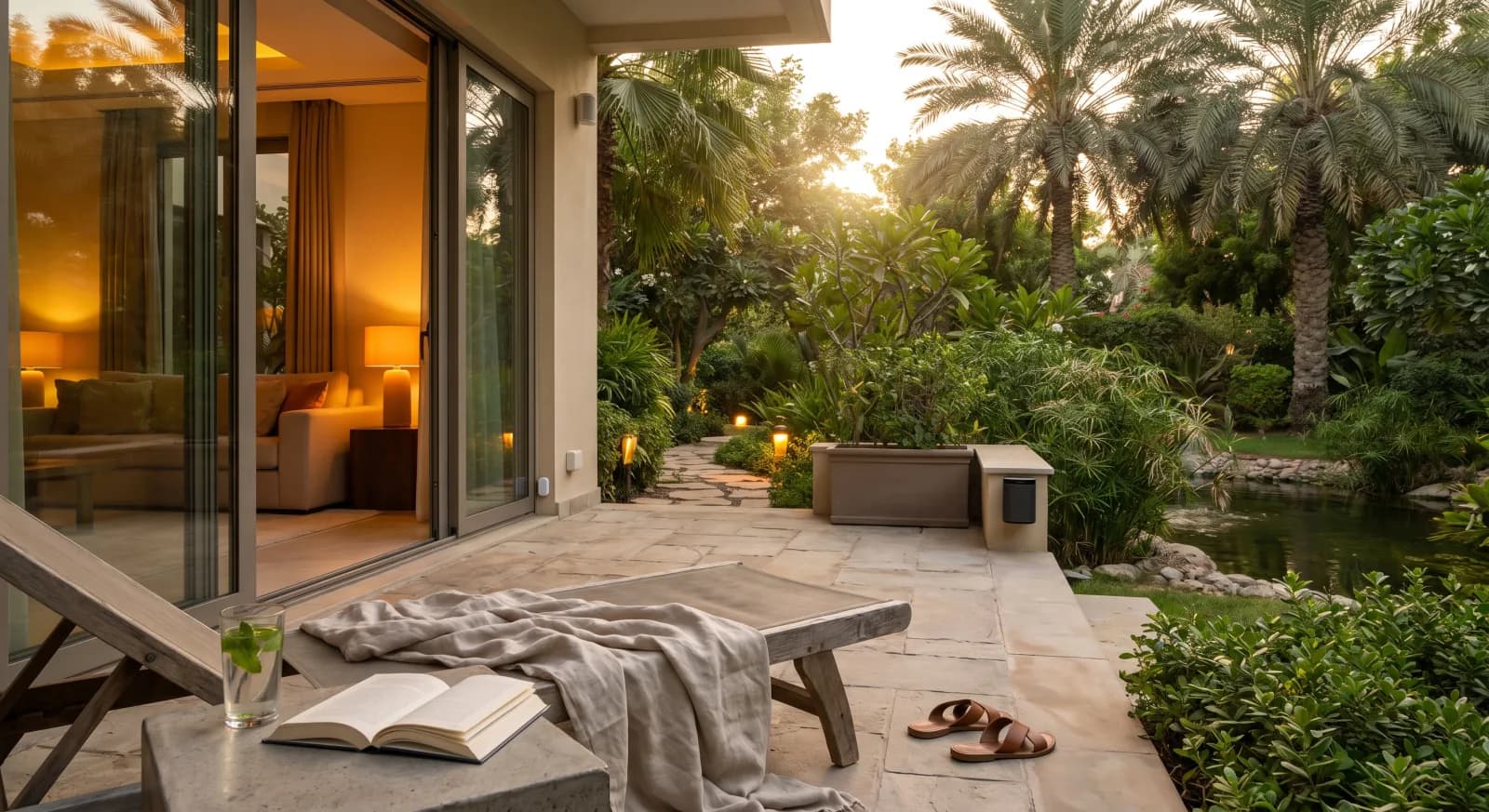
A Bromellia villa in Al Barari has a wall of glass between the living room and the garden. On a Thursday evening the doors are open, the terrace lights are on, and a Sonos speaker mounted behind a planter is playing something quiet. The remote for all of it sits on the counter next to a lamp that dims but has no schedule, in a house next to a pool pump that runs on a timer nobody has checked since it was installed.
That is the gap in most Al Barari smart home projects. The living room gets the full treatment - scenes, keypads, a proper AV rack. The garden, the water feature, the pool, and the six-figure square footage of green space around the villa get whatever the landscaping contractor left behind.
TL;DR: Al Barari dedicates 60 percent of its 15.3 million square feet to gardens, lakes, and green space, which means a villa here is not indoors and outdoors, it is one continuous space. A wellness-focused setup covers circadian lighting, soil-moisture irrigation, pool pump scheduling, and multi-zone outdoor audio alongside the usual climate and blinds. A 5-6 bed villa wellness build typically runs AED 95,000-180,000, and the garden and pool layer is usually a third of that.
Why Al Barari Changes the Automation Brief
Al Barari was built as an integrated wellness community, not a villa compound with landscaping bolted on (Al Barari, 2026). Sixty percent of the development's 15.3 million square feet is gardens, lakes, and freshwater streams (Al Barari community coverage, 2026). Biophilic design is the stated design principle for every villa here: erase the line between the house and the garden (LuxDubaiInteriors, 2026).
Automate one and ignore the other, and the house stops feeling like the thing it was built to be. A villa where the living room runs on scenes and schedules but the garden runs on a timer from the landscaping crew is not a wellness home. It is two different houses stitched together at the terrace door.
In our experience walking through Al Barari villas, this is the single biggest gap we find. Owners have already spent on interior finish and lighting design. Nobody has connected the garden lighting, the irrigation, and the pool to the same system, or to the same logic that governs when the sun comes up.
What the Garden Needs
A soil-moisture sensor changes the irrigation math completely. Instead of watering on a fixed schedule regardless of rain or heat, the system checks actual soil moisture and local weather before it runs, cutting outdoor water use by 30-50 percent compared to a timer-based system (WS Landscape, 2026). For a standard villa footprint, that can mean up to 45 percent less outdoor water consumption (AV Landscaping UAE, 2026).
The upgrade from a basic timer to a smart, sensor-driven system runs AED 3,000-8,000 more than the timer alone (Water Treatment UAE, 2026). In a garden the size of most Al Barari plots, that difference buys a system that waters what the garden needs instead of what the clock says, which matters more here than almost anywhere else in Dubai.
What we install is a soil-moisture sensor per zone (lawn, beds, potted areas each read differently), tied to a weather feed that skips the cycle when rain is forecast. The controller sits on the same platform as the rest of the house, so a garden watering cycle can be told to skip if the family is hosting on the terrace that evening.
The Pool Pump Nobody Is Watching
A pool adds AED 300-600 a month to a villa's utility bill in the UAE, on top of everything else (UAE Utility Bill Calculator, 2026). Most of that cost is the pump, and most pumps run on a fixed schedule set at installation and never revisited.
The Bromellia case below is the clearest version of this we have seen. Energy monitoring on a Shelly EM revealed the villa's pool pump was running for hours during the exact window the climate zones were also pulling peak load, stacking two of the highest-draw systems in the house on top of each other for no reason. Moving the pump to run outside that window, and shortening the cycle to what the pool needed, cut the villa's overall energy consumption by 22 percent.
Air conditioning is still the dominant cost in any Dubai villa, accounting for 60-70 percent of electricity use in peak summer months (UAE Utility Bill Calculator, 2026). The pool pump does not compete with that. What it does is stack on top of it at the wrong hour, which is a scheduling problem, not a hardware problem, and scheduling problems are the cheapest fix in the entire project. If you do want the pump on a smart switch as well, the motor needs the right parts between the app and the pump, which we explain in putting a pool pump on a smart switch.
Circadian Lighting Is Not a Finish Choice Here
Circadian-responsive lighting has become one of the two dominant themes in bedroom and wellness design because it is grounded in real sleep science, not a look (Mattress Miracle design research, 2026). Warm-white light in the 2200-2700K range suppresses melatonin at roughly 3.6 percent, against 12.3 percent for cool-white light at the same intensity (circadian lighting research summary, 2026). A pilot study on dynamic, day-night-matched lighting found participants fell asleep 22 minutes earlier on average, with more regular sleep timing overall (Nature Scientific Reports, 2025).
For an Al Barari villa built around a wellness pitch, this is not an optional layer. It is the layer that makes the wellness claim true instead of aspirational. A circadian lighting setup, usually built on Philips Hue or an equivalent tunable-white system, shifts color temperature through the day on its own: cooler and brighter in the morning, neutral through the day, warm and dim by evening, timed to actual sunset rather than a fixed clock. The same wake-up and wind-down logic that works in a Dubai apartment bedroom applies here, spread across a lot more rooms.
The same logic extends outdoors. Landscape lighting on a sunset-linked schedule (not a fixed 6pm timer) means the garden lights come on at the right moment year-round, as the sunset time shifts by close to an hour and three quarters between winter and summer. We cover the relays, ratings and schedules in our guide to smart garden lighting for Dubai villas.
Zoning a Villa That Is 5,000 to 7,000+ Square Feet
A single-zone AC setup in a villa this size means one thermostat trying to average a temperature across rooms that face completely different directions, get completely different sun, and get used at completely different times of day. The fix is climate zoning, typically 5-7 zones for a 5-6 bed villa, each with its own sensor and its own schedule.
Ventilation matters as much as temperature at this scale. Villas with sealed, heavily glazed rooms and multiple people at home can see indoor CO2 climb well past the point where air feels stale, even with the AC running cold. A CO2-based ventilation trigger brings in fresh air automatically when levels climb, rather than relying on someone noticing the room feels heavy and opening a window that lets the heat back in.
Motorized blinds tie into the same zoning logic. A west-facing living room in an Al Barari villa takes the same afternoon sun as anywhere else in Dubai. Blinds that close before the room heats up reduce the load the AC has to fight in the first place, instead of correcting for it after the fact.
What a Wellness Setup Costs
Three tiers for whole-home automation, based on real villa projects in the community:
Apartment whole-home (Ashjar): AED 32,000-55,000. Covers lighting scenes, climate control, and basic automation for an Al Barari apartment residence, no garden scope.
Villa wellness setup (5-6 bed): AED 95,000-180,000. Circadian lighting throughout, multi-zone climate with ventilation, motorized blinds, indoor and outdoor audio, soil-moisture irrigation, and energy monitoring. This is the tier most Al Barari villa owners land in.
Villa with full outdoor and cinema: AED 200,000-450,000. Everything above plus a dedicated cinema or media room and expanded outdoor scope, pool automation, and multiple garden zones.
The garden and pool layer, on its own, is usually a third of the mid-tier budget. It is also the part most owners skip first when a contractor quotes a whole-home project, because it reads as optional next to the rooms they live in every day. In a community built around outdoor living, that is the wrong thing to cut.
What We Tell Most Al Barari Owners to Skip
Full RGB landscape lighting on every path is the most common overspec we walk clients back from. Color-changing lights look good in a showroom and get used exactly once, at a housewarming, then sit on white forever. Warm, sunset-linked white light does the actual job better and costs less to run.
A second-tier wall touchscreen for a single garden zone is another one. If the villa already has a phone app and a handful of physical keypads at the doors people use every day, a AED 1,200-1,800 touchscreen dedicated to garden control duplicates something that already works.
Full villa rewiring for irrigation control is rarely worth it either. Most soil-moisture and irrigation controllers now run wirelessly, reporting back to the same hub as the rest of the house. Running new cable through an established garden to hardwire something that works fine over WiFi is money spent on a problem that does not exist.
And a standalone pool automation system, sold separately from the rest of the house, is the fourth. The pool pump should sit on the same energy-monitoring and scheduling logic as everything else, not on its own app that nobody in the family opens.
The Bromellia Villa: A Real Project
A 7,200 square foot, 6-bed villa in Bromellia, Al Barari, is the clearest example of what this looks like assembled. The scope: circadian Hue lighting throughout the house, a sunset routine built into the master bedroom, Sonos across 9 zones including the outdoor meditation pavilion, 7 climate zones with CO2-based ventilation, 12 motorized blinds, energy monitoring on a Shelly EM, and soil-moisture-driven irrigation for the garden.
Install took 18 days. Total project cost was AED 165,000.
The result the owner reported back: noticeably better sleep across the family since the circadian lighting and sunset routines went in. Energy monitoring caught the pool pump running at the wrong hour, and fixing that alone dropped overall consumption 22 percent. Music and lighting now extend into the garden the same way the architecture already did, so the meditation pavilion and the terrace stopped feeling like an afterthought bolted onto the house.
That last point is the one worth sitting with. The villa's design already erased the line between indoors and outdoors. The automation needed to catch up to what the architecture was already doing.
Where to Start
If the budget does not stretch to a full wellness build in one pass, start with energy monitoring. A Shelly EM on the pool pump and the main climate circuits costs a fraction of the full project and tells you, within a month, exactly where the waste is. Most Al Barari villas we survey have at least one system running longer than it needs to, and monitoring typically surfaces 15-25 percent of avoidable consumption in the first quarter from spotting the obvious.
From there, circadian lighting in the bedrooms and main living spaces is the next highest-impact single layer, both for the sleep benefit and because it is the piece that makes the wellness pitch of the house true day to day.
The garden and pool automation can follow once the indoor layer is proven out. It does not need to happen in the same phase, but in a community where 60 percent of the property is green space, it should not be treated as an afterthought either.
Frequently Asked Questions
Does smart home automation work with Al Barari's landscaping and water features?
Yes. Outdoor speakers, landscape lighting on sunset schedules, and soil-moisture-driven irrigation are standard scope in Al Barari, more so than most other Dubai communities, because the outdoor space here is treated as living space, not an afterthought.
Is energy monitoring worth it if I am not trying to cut costs?
Yes, even for owners who are not price-sensitive. Most Al Barari villas run a pool pump, irrigation system, and sometimes an EV charger longer than needed simply because nobody is watching. Visible monitoring typically surfaces 15-25 percent avoidable consumption in the first quarter, and the fix is usually a schedule change, not new equipment.
Will the automation match the wellness aesthetic of an Al Barari villa?
It should. We design installs for visual quietness in this community specifically: no flashing LEDs in living spaces, hidden outdoor speakers, recessed touch panels, and finish choices coordinated with the interior designer rather than dropped in afterward.
Does any of this integrate with rooftop solar?
Yes. Several Al Barari villas we have worked with run rooftop solar alongside the automation system, using energy production monitoring and smart load shifting, running the pool pump or irrigation while the panels are producing, plus battery storage management where installed.
How long does a full villa wellness install take?
The Bromellia project above, a 7,200 square foot 6-bed villa with the full scope described, took 18 days start to finish. Smaller scopes or phased projects can run faster; a full outdoor-and-cinema tier project typically takes longer given the added construction coordination.
Curious what this would look like for your Al Barari villa specifically? Get a free survey and we will walk the property with you and recommend where to start, garden included.
Ready to Get Started?
Get a free consultation and we'll recommend what makes sense for your situation.
Get Free Consultation