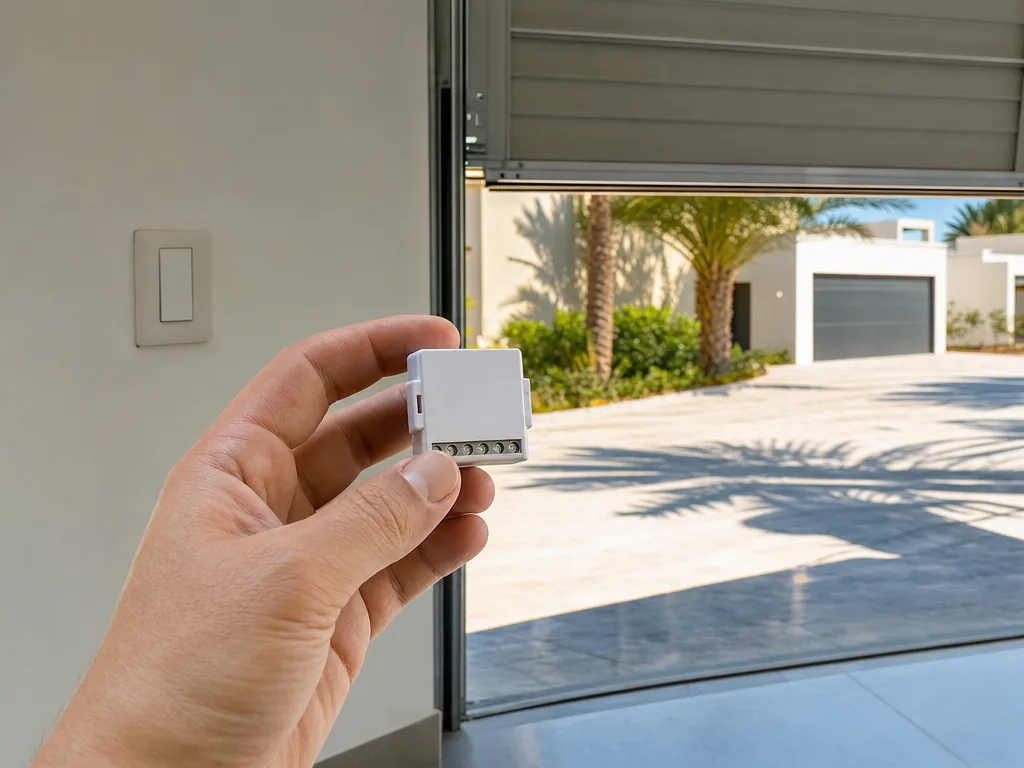
People shopping for smart switches in the UAE ask a version of the same question: Sonoff or Moes, Shelly or Aqara, which one holds up better in the heat? It is a fair thing to worry about in a country where the car dashboard is too hot to touch by eleven in the morning.
Open the spec sheets and the brand question mostly disappears. The three makers we checked print the same top temperature, and it is well below a Dubai summer afternoon. What decides whether a smart switch lasts here is the spot it is fitted in.
TL;DR: Sonoff, Shelly and Aqara rate the switch modules we checked to 40°C, and the UAE's average August maximum, a country-wide figure that takes in the hot inland interior, is 48°C. Inside an air-conditioned room every one of them has plenty of margin. In a garage, a gate pillar, a garden cabinet or a sealed outdoor box, none of them does. Ask where the module sits before asking which brand it is.
Smart Switch Temperature Ratings: Three Brands, One Ceiling
Sonoff lists its four-channel relay (the module that does the actual switching), the 4CHPROR3, at an "Operating Temperature -10ºC-40ºC" (Sonoff). Shelly gives the Shelly 1 Mini Gen4 an "Ambient working temperature: -20 °C to 40 °C" (Shelly). Aqara's Dual Relay Module T2 reads "Operating Temperature -10°C ~ 40°C" (Aqara).
Three brands, three different products, the same 40°C line at the top. We tried to get a Moes rating from their site too and could not, so we are not going to guess at it.
Now the weather. Historical data from the National Centre of Meteorology and Seismology put the UAE's average maximum at 47.9°C in July and 48°C in August across 2003 to 2016 (Gulf News, 2017). That is a country-wide figure, and it takes in the hottest inland places, like Al Qua'a, which the report names. For the two days after it was published, in late July, its forecast was an average of 37°C to 42°C for the country in general, so an afternoon outdoors can reach the 40°C line well away from the desert interior.
Put the two numbers side by side and the answer to "which brand survives the heat" is that, on paper, none of them is built for a Dubai afternoon outdoors, and all of them are comfortable indoors. A room held at 24°C leaves sixteen degrees between the air and the rated limit, before the wall box adds a little of its own. The choice between brands matters for features, reliability of the app and how well it fits your other devices, and much less for heat.
The Rating Is About the Air Around the Module
Shelly's wording is the useful one: ambient working temperature. The number describes the air the module sits in, and a module behind a wall switch does not sit in room air. It sits in a small plastic or metal box inside the wall, packed in with the wiring.
Two things warm that box beyond the room. The module draws a little power to keep its radio running, which Shelly puts at under 1.2 watts for the Mini Gen4, and every watt of it ends up as heat. And the current for whatever it switches, a row of downlights or a fan, runs through its relay contacts and terminals. A lightly loaded module in a roomy box adds very little. One switching a heavy load in a box crammed with cable adds more.
We do not have a measured figure for how much warmer a Dubai back box runs than the room around it, and we are not going to make one up. What we can say is that some modules will tell you. Shelly's Gen2-and-later devices can report their internal temperature in Celsius where the model supports it, and list "overtemp" among the error conditions they can raise (Shelly API documentation). Shelly also lists overheating protection as a safety function on the Mini Gen4. With one of those, you can check the module's temperature instead of guessing.
Heat Shortens a Module's Life Before It Stops It
A module that spends an afternoon a few degrees over its rating usually does not die that afternoon. Heat works more slowly, by ageing the parts inside.
The clearest published explanation we have found comes from the lighting side. Hatch, a power-supply maker, writes that "the lifetime of an LED driver is directly correlated to the average operating temperature of its electrolytic capacitors", and that "that lifetime roughly doubles for each 10°C reduction in temperature" (Hatch Lighting, 2023). We covered what that means for downlights in our post on LED drivers that flicker.
Hatch is writing about LED drivers, and we have not found a relay maker that publishes the same curve for its modules, so treat it as the direction rather than a number to plan with: a module that lives at 30°C and one that lives at 45°C can look identical for the first summer. The difference shows up later, as the hot one drops off the network or stops switching, and nobody connects it to where it was fitted.
The Places in a Dubai Home That Follow the Outdoor Temperature
Most of a Dubai home is air-conditioned most of the year, so most switch modules never come near their limit. The trouble spots are the handful of places that track the weather instead of the thermostat.
- The garage, unless it is cooled. A relay for the garage door or the garage lights sitting on a garage wall lives at whatever the garage reaches.
- The gate pillar, where a gate relay often ends up because the power is already there.
- Garden cabinets and pool equipment boxes, which sit in the sun and hold heat into the evening.
- The roof and any external plant area, for anything connected to water tanks, pumps or solar.
- Balconies and outdoor kitchens, for anything mounted outside the glass.
Inside the house there is one more to think about: any closed cupboard with equipment in it, even in a cooled villa. We wrote about this for network racks, where the router, switch and battery backup heat their own cupboard behind a solid door. The fix there was a vented door and a small temperature sensor inside the cabinet, and it carries over to any cupboard full of electronics.
Weatherproof Is Not Heatproof
The usual answer to an outdoor smart switch is a weatherproof box, and it solves a different problem. An IP rating describes how well a box keeps out dust and water. It says nothing about temperature, which is a separate line on the spec sheet, a point we made in our post on garden lighting.
A sealed box keeps the rain and the sprinklers off the module inside. It does not cool it. A module rated to 40°C is still rated to 40°C inside an IP66 enclosure on a sunny wall, and the box has no airflow to carry away the little heat the module makes itself.
Humidity Is the Second Line on the Sheet
Read one line below the temperature, the humidity rating (RH, relative humidity), and the brands do start to differ. Aqara rates the T2 for "0 ~ 95% RH, no condensation". Sonoff gives the 4CHPROR3 "5%-95%RH, Non-condensing". Shelly lists the Mini Gen4 for "30 % to 70 % RH".
That last range is narrower than the other two, and it matters for the spots where moisture collects: a laundry cupboard, a bathroom, or anywhere a cold AC duct runs close to a wall box. None of the three is rated for condensation, so a module fitted where water can form on surfaces is outside every one of these sheets. If you are planning a switch for one of those rooms, this is the line to read.
What We Do Instead
Our rule is simple: the module goes where the air is cooled, and only the wires go out into the heat.
For garage doors and gates, the relay can sit on the conditioned side of the garage wall, with only two command wires running out to the motor. For garden and pool lighting, each exterior circuit gets its own relay, grouped indoors rather than out in the garden. A relay does not need to sit next to the light it switches, so there is usually a cooler place for it.
Sometimes there is not. A gate at the end of a long drive may have no cooled space anywhere near it. On one Sharjah job we put the relay inside the gate's own enclosure, because that needed no separate cable run to either gate. It also put a part rated to 40°C inside an outdoor box, which is a trade-off to talk through before the install rather than after. When a module has to live in the heat, the plan is to choose one that reports its own temperature, make it easy to reach, and expect to replace it sooner than the ones indoors.
If you already have smart switches and want to know where they ended up, the person who installed them can tell you, or your app may list the model so you can look up its rating. Please do not open a wall box or a distribution board to look. Those carry mains voltage even when the light is off, and checking inside them is a job for a licensed electrician.
For anything bigger, our home automation work starts with that same question, and both Shelly and Aqara make modules that can live on the cool side of a wall.
Frequently Asked Questions
Do Sonoff switches work in UAE heat?
Indoors, yes. Sonoff rates its 4CHPROR3 relay to 40°C, which leaves a wide margin in an air-conditioned Dubai room. Outdoors, a summer afternoon can pass that rating, and an uncooled garage or a garden cabinet in the sun can too, and the same is true of Shelly and Aqara modules rated to the same 40°C.
Can a smart switch overheat inside the wall?
It can run warmer than the room, because it sits in a closed box and adds its own heat plus the heat of the load it switches. In a cooled room that rarely matters. Some modules, including models in Shelly's Gen2-and-later range, can report their internal temperature and raise an overtemp error, so you can check rather than guess.
Is an IP65 box enough for an outdoor smart relay in Dubai?
It is enough for water and dust, not for heat. An IP rating says nothing about temperature, and a module rated to 40°C keeps that rating inside a sealed box on a sunny wall. Where possible, have the relay mounted indoors with only the wires running out to the gate, light or pump. Fitting the relay means working on mains wiring, which is a job for a licensed electrician.
Do smart home devices need to be in an air-conditioned room?
Switch modules do best in cooled space. The three we checked are all rated to 40°C, and a UAE summer afternoon outdoors can pass that. What sits outside can be the thing being switched, a light or a motor, with its relay on the cool side of the wall.
Planning switches for a garage, a gate or a garden? Tell us about your home and we will show you where each module can live, and be straight with you about any spot where it cannot stay cool.
Ready to Get Started?
Get a free consultation and we'll recommend what makes sense for your situation.
Get Free Consultation