You slide the dimmer down. For the first third of the travel nothing happens at all. Then the room drops to about half in one step, the downlights start to shiver, something behind the wall plate begins to hum, and at roughly a fifth of the way down the whole circuit cuts out. Push it back up and everything returns, perfectly normal, as if you imagined it.
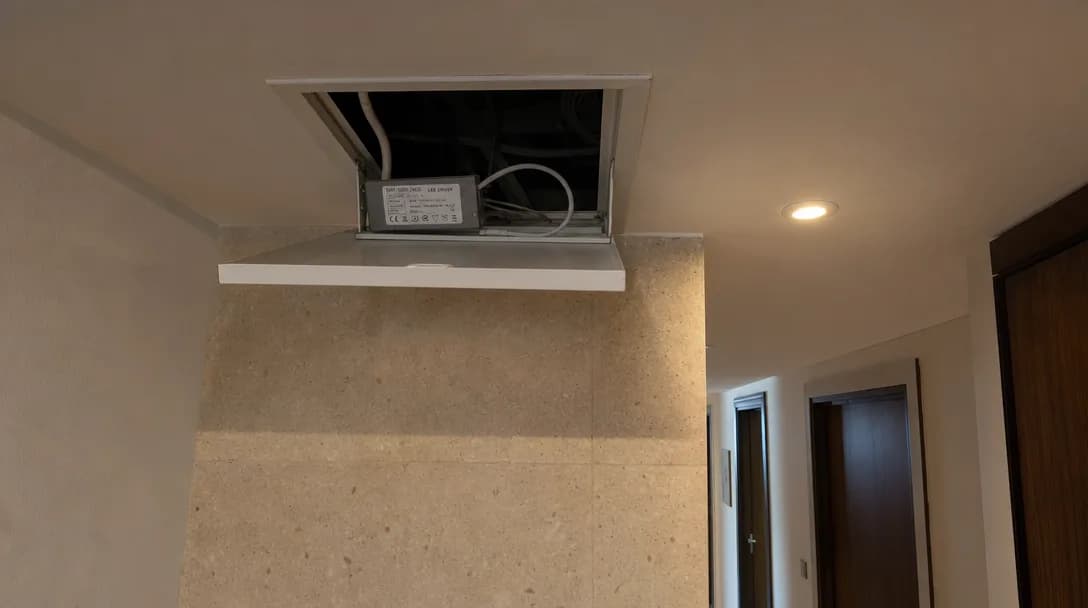
Nothing in that sequence is broken. Every one of those behaviours has a name, and they all point at the same component. It is a small box you have probably never looked at, and in a lot of Dubai apartments it is sitting above your gypsum ceiling right now.
TL;DR: Almost every LED light in your home needs a small converter called a driver to run off the mains. The driver, not the bulb and not the switch, decides whether the light can dim, how low it goes, whether it buzzes, and when the fitting eventually dies. Find its label, above the ceiling hatch or inside the pendant canopy, before you buy a dimmer, a smart switch, or a replacement fixture.
Almost Every LED in Your Home Has a Driver
An LED is a semiconductor. It runs on a low-voltage direct current held within a narrow band, and the mains in your flat is alternating current at 220 to 240 volts. Something has to sit between the two and do the conversion. That something is the driver, and the US Department of Energy's dimming material puts it plainly: "LEDs are non-linear loads which (typically) need a ‘driver’" (Poplawski and Miller, Pacific Northwest National Laboratory, Steps for Successful Phase-Cut Dimming of LEDs, 2014).
Where it lives depends on what kind of light you have.
In a screw-in or bayonet LED bulb, the driver is crammed into the plastic flare above the cap. You cannot see it, you cannot service it, and when it fails you throw the bulb away.
In a ceiling downlight, it is usually a separate box about the size of a phone, connected by a short lead and left lying in the void above the plasterboard. One per fitting, or one shared across a few. In a pendant with no bulb socket, it is tucked inside the canopy, the shallow cup where the flex meets the ceiling. In a cove, it is a chunkier metal box at the end of the strip.
Coves are common in Dubai apartments, and the driver at the end of a cove run is often the part nobody chose deliberately. We went into what a good cove is worth in the cove lighting guide.
Six Things Your Lights Do: Flicker, Buzz, Will Not Dim
Six behaviours cover almost everything people describe to us on the phone, and every one of them appears on the US Department of Energy's list of ways a dimmer and an LED can fail to get along. Find yours.
It shivers at low brightness
Fine at full, visibly unsteady once you take it down. An LED draws far less current than the filament lamp your dimmer was built for, and a dimmer that cannot hold a steady output on a small load is unsteady on it. The driver manufacturer Hatch documents one version of this, where the current an LED driver asks for falls below what the switching part inside an older dimmer needs to keep conducting (Hatch Lighting, Phase Dimming: A Technical Guide, 2024). Low load is the thread to pull, and it comes back further down.
Something hums
Usually at the wall plate, sometimes at the fitting, loudest in the middle of the dial and in a quiet room at night. Audible noise is on the Department of Energy's phase-cut list.
It will not go below about a fifth
You keep sliding and the room stops getting darker. The dimming range of the driver is narrower than the travel of the dimmer, so the last part of the slider controls nothing.
The first part of the dial does nothing, then the light jumps on
This is the one people mis-diagnose most, because it feels like a loose connection. The unresponsive stretch is called dead travel and the sudden arrival is called pop-on, and they travel together: the driver does nothing until the dimmer reaches the level it will start at, and then it starts at that level rather than at nothing. The slider and the light are not in step at the bottom of the range.
It cuts out before the bottom
The circuit goes dark somewhere above zero, and it only comes back if you push the slider up a good distance. That is drop-out.
It glows faintly when it is off
Too faint to light anything and still obvious in a dark bedroom. Ghosting. It is on the same Department of Energy list as the other five, and it is the one we cannot point you at a mechanism for.
One thing that does not belong in the list: a single downlight failing while its seven identical neighbours carry on. That has a different cause, and its own section below, on why the driver dies first.
Five of those six are the driver and the dimmer failing to agree about something, and you cannot tell which from the symptom alone. Ghosting we would want to see in person. What settles the other five is the label on the driver, above the ceiling hatch or inside the pendant canopy. Reading it is the only part of this you have to do yourself, and it is the next section.
Dimmable Is a Property of the Driver, Not the Bulb
Check the driver, not the box the bulb came in. The same Department of Energy guidance states it directly: "Not all LED sources/drivers are dimmable, or 'designed to dim'". Put a dimmer in front of a driver that was never built to be dimmed and you get some combination of the six behaviours above, and sometimes a driver that stops working for good.
Get the ceiling access hatch open, or take the canopy off the pendant, and photograph the label on the driver. It carries the output voltage or current, whether it is dimmable, and usually which dimming method it expects.
On the label, look for that method. Either the dimming is phase cut, where the dimmer works by chopping up the mains supply on its way to the light, or it uses a separate control wire, which will be named as 0-10V or DALI. If it is not printed on the driver, the original spec sheet will have it. If you cannot find either, that is fine, we check it on the site visit.
It is the first technical question we ask about lighting, because it changes the quote. We ask rather than assume because some Dubai LED retrofits stop working entirely under phase-cut dimming. On one job we scoped, the check is written in as an install-day test with the fallback spelled out, which is that a circuit which will not dim cleanly goes on a switch module instead, at no change in cost. On another it was a thirty-second test at the site visit. Promising dimming we have not tested is how a lighting job turns into an argument.
Leading Edge, Trailing Edge, and a Dimmer Built for a Different Lamp
If your lights buzz or will not dim smoothly, the dimmer on your wall is probably the wrong type for them. There is more than one type, and they are not interchangeable.
A wall dimmer works by chopping a slice out of each half-cycle of the mains waveform and sending the rest down the wire. Which slice it removes is the part that causes trouble. Older dimmers cut from the front, which is leading edge. That design came from filament lamps, which run on whatever shape of supply arrives; an LED driver has to build a steady output out of what is left of it. Cutting from the back is trailing edge, and Hatch's guide describes it as the design the market needed for a dimmer that would handle electronic loads smoothly, built around a switching part that stays controllable down to very small currents (Hatch Lighting, Phase Dimming: A Technical Guide, 2024).
Leading edge did not stay in the past. The same guide records that once LED became the default, "dimmer designs began to migrate back to leading edge dimmers" with microprocessor-controlled switching that manages the small-current problem at low dim levels. A leading-edge dimmer sold today is not the one on your wall from 2009, and if it is sold as LED-compatible it is a real option. Trailing edge has a cost of its own: it needs a neutral wire at the switch, which plenty of older flats do not have.
Which of them your driver tolerates is a property of that driver, not something you can read off the dimmer. Lutron, selling a trailing-edge dimmer into this region, prints the warning in its own specification: "LED dimming performance can vary from fixture to fixture and cannot be guaranteed." (Lutron, RA2 Select In-Line Load Controls product specification, 2024). That is a manufacturer telling you to test the pairing rather than trust the label on either part.
The way out of all of this is to stop using the power wire as the control wire. Send the dimming instruction down a separate pair and the waveform argument disappears, which is what 0-10V and DALI do. Both cost more to install and both want planning before the ceiling closes, the same timing problem we wrote about in the back box depth guide.
A Dimmer Has a Minimum Load, and Your New Bulbs May Be Under It
Most dimmers have a minimum load, and there is no universal figure for it: the Department of Energy is explicit that "Minimum load varies by dimmer and LED source". A dimmer built for filament lamps expects a certain amount of load before it behaves, and a handful of low-wattage LED downlights may not reach it, which is how a circuit ends up flickering purely because you replaced good bulbs with better ones. That is the low-load thread from the first symptom, and it is the reason a minimum brightness gets set per circuit at commissioning. Read the minimum off the dimmer you are buying, and note that some only impose one when there is no neutral wire at the switch. There is a maximum too, and past it the dimmer is what suffers: "Overloading can lead to premature failure".
The Driver Is the Part That Dies First
When a fitting fails, suspect the driver before the LED. One downlight out of eight going dark while the other seven are fine is almost never a dead LED.
The Department of Energy's lifetime guidance is careful about this and worth reading in full: driver electronics "can be an important reliability concern for LED luminaire systems, sometimes more important than the LED sources" (LED Luminaire Lifetime: Recommendations for Testing and Reporting, Third Edition, US Department of Energy, 2014). The same report lists driver failure as a likely eventual cause of abrupt failure, and in the same breath says that "long-lived drivers are available". Which of the two you end up with is decided when the driver is specified.
What mostly decides which one you bought is heat. Hatch puts the mechanism and the arithmetic together: "the lifetime of an LED driver is directly correlated to the average operating temperature of its electrolytic capacitors", and "that lifetime roughly doubles for each 10°C reduction in temperature" (Hatch Lighting, Driver's Operating Lifetime, 2023). In their worked example, a component rated for 5,000 hours at 105°C gets roughly 20,000 at 85°C.
So the driver's life is set by how hot the driver runs, and the driver runs wherever the installer left it, which is frequently an enclosed ceiling void whose temperature nobody has measured. We have no figure for how warm a Dubai ceiling void gets and we are not going to invent one. What we do know is which number to ask for: the driver's rated ambient temperature. A driver with headroom above the space it lives in will last. One specified right at the edge is the one you will meet again as a single dark downlight.
What to Do If You Want App and Scene Control
Three routes, and which one you are on depends on what is already in your ceiling: reachable drivers, sealed fittings, or a cove.
If your downlights have separate, reachable drivers, you are in the best position. Swap them for dimmable drivers that match the dimmer you intend to use, put a matching smart dimmer on the wall, and you keep your existing fittings and your existing ceiling. Nothing gets chased into a wall and nothing needs repainting.
If your fittings are integrated with a sealed driver and that driver is not dimmable, no wall device will fix it. The fitting is the unit of replacement. The alternative, when replacing twenty fittings is not what you came for, is a relay module instead of a dimmer: full brightness or off, under app and scene control, with no dimmer flicker and no dimmer hum. We recommend it often, and a good scene that switches four circuits in the right order beats a dimmer that buzzes.
If the thing you want to control is a cove, treat it as its own system. A constant-voltage dimmable driver plus a dedicated LED controller gives smooth, deep dimming, and if the strip itself is tunable-white or RGBW, colour temperature shift as well, because the controller speaks to the strip directly rather than chopping up the mains and hoping. We have covered the wider choice between controlling lamps and controlling circuits in smart bulbs versus smart switches, and the whole lighting picture sits on our smart lighting service page.
What to Check Before You Buy Anything
Five things, in the order that saves the most wasted money:
- Photograph the driver label. Ceiling hatch, or the canopy of a pendant. If the word dimmable is not on it, assume it is not.
- Note the dimming method if it is printed: phase cut, and if so whether the driver wants leading edge, trailing edge or either, or else 0-10V or DALI. These are not interchangeable.
- Add up the wattage on the circuit you want to dim, then check both the minimum and maximum load of any dimmer you are considering against it.
- Look for the driver's rated ambient temperature, and compare it against the enclosed space it sits in rather than the room below.
- If you are importing a fixture or a dimmer, confirm it is rated for 220 to 240 volts at 50 Hz. A device built for a 120 volt market is not a candidate, whatever the listing says about worldwide use.
Do the first one and you will already know more about your lighting than most people who have lived with it for years.
Frequently Asked Questions
Can I put a smart dimmer on my existing LED downlights?
Only if their drivers are dimmable and the dimmer suits the type. Check the driver label first. If the driver is not dimmable, or the fitting is sealed with a non-dimmable driver inside, a smart relay module gives you app and scene control at full brightness instead, with no dimmer flicker.
Why does only one of my LED downlights flicker or fail?
Because a downlight often has its own driver, so the LEDs in the others are unaffected when one driver goes bad. The US Department of Energy puts it carefully: driver electronics "can be an important reliability concern for LED luminaire systems, sometimes more important than the LED sources". A single odd fitting points at its driver.
What does dimmable mean on an LED bulb box?
It means the driver built into that bulb can respond to a dimmer, not that it will work with the dimmer on your wall. Compatibility depends on the pairing. Lutron's own specification notes that LED dimming performance can vary from fixture to fixture and cannot be guaranteed.
Why do my LED lights buzz when dimmed but halogen never did?
A phase-cut dimmer chops the mains waveform and an LED driver has to build a steady output from what is left, which a filament lamp never had to do. A dimmer matched to the driver, or a separate control wire such as 0-10V or DALI, removes the cause. Which type to match it with is printed on the driver.
Can I dim LED strip lights in a cove?
Yes, if you build it to dim. Use a dimmable constant-voltage driver with a dedicated LED controller rather than putting a wall dimmer in front of a strip. That combination dims deeply and smoothly, and if the strip is tunable-white or RGBW it can shift colour temperature too.
What We Can Help With
Most of this is diagnosis, and you can do it yourself with a phone camera and a ceiling hatch. We would rather you did, because the fastest way to an honest quote is a photograph of a driver label.
What we build is the layer above it: lighting control that behaves the same way every evening, scenes that run without anyone reaching for a slider, and the judgement call about which of your circuits should dim and which should simply switch. If any of that is useful, tell us what is in your ceiling and we will give you a straight view of what is worth doing. If the answer is that you need two dimmable drivers and nothing else, we will say so.
Ready to Get Started?
Get a free consultation and we'll recommend what makes sense for your situation.
Get Free Consultation