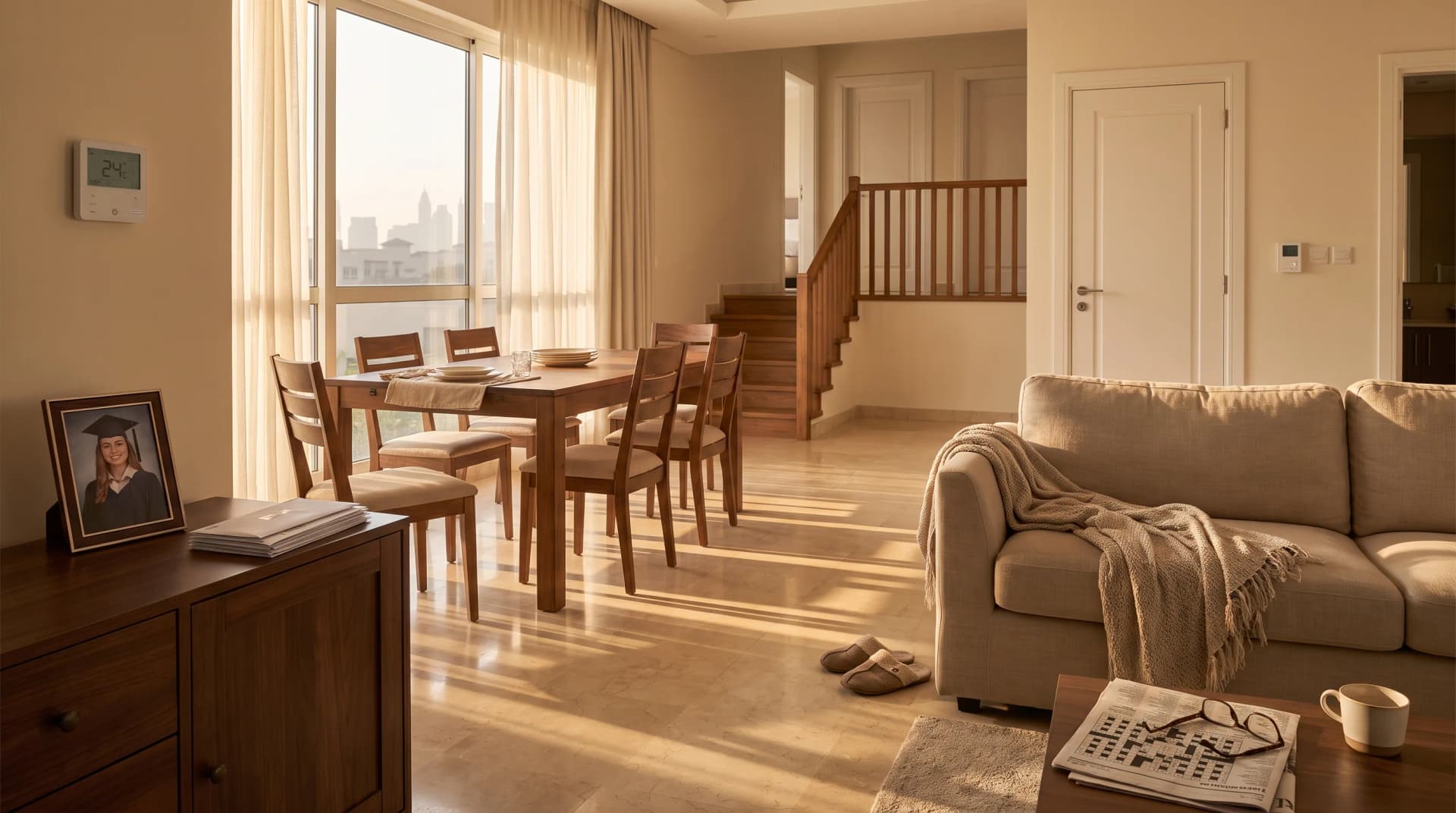
The dining table still seats six. You set two places at one end, and the other four chairs stay pushed in.
Upstairs, three bedroom doors have been shut since September. Behind them the air conditioning is still running the schedule it ran when there were people asleep in those rooms: down to 24 by ten at night, holding until seven in the morning, for nobody.
Your life reorganised itself the week they left. The house never got the message.
TL;DR: When your children leave Dubai, the home keeps running as though they never did. Unused rooms stay on the old cooling schedule, and switching their AC off completely invites mould in a Dubai summer. The fix is a home that knows which rooms are in use, not a smaller home.
The Dubai Empty Nest Comes With a Paperwork Date
In most places the nest empties gradually. In Dubai it has a deadline printed on a form. A resident can sponsor a son's residence visa until he turns 25, while an unmarried daughter can be sponsored with no age limit at all (Khaleej Times, 2025, citing Cabinet Resolution No. 65 of 2022).
The other difference is distance. Children here do not move to a flat twenty minutes away that you help them paint. They leave the country. Gulf News covered a Dubai support group of empty-nesters between 45 and 60, drawn together by children who had left or were about to leave, several of them for universities in Australia and London (Gulf News, 2023).
So the change is not gradual and it is not local. One August the house holds five people. By October it holds two, and every system in it is still configured for five.
The Rooms You Stopped Using Are Still on the Old Schedule
Cooling dominates electricity use in this city: DEWA puts air conditioning at up to 60 per cent of the electricity generated at peak hours, and says each degree you raise the setting is worth up to 9 per cent of your cooling cost (Gulf News, 2018). An under-occupied villa in Arabian Ranches or Dubai Hills spends a share of that on rooms with the door shut.
What we've found is that nobody ever sits down and rewrites the schedule. The thermostat settings in most homes were decided once, years ago, by whoever was most annoyed that week. They then survive every change in the household that follows.
Two people living in a four-bedroom villa are usually paying to condition four bedrooms. The bill does not fall when the children leave, because nothing in the house is aware that they did.
Switching the AC Off in an Empty Room Backfires Here
The obvious move is to shut the door and turn the unit off. In Dubai that trades a cooling bill for a repair bill.
Khaleej Times reported in August 2026 on homes left without cooling through the summer, finding damp patches, bad smells, insects and mould, with technicians describing moisture trapped in filters, ducts, coils and drain pans. The same piece notes DEWA has warned that switching the AC off can result in fungus, bad odours and equipment damage (Khaleej Times, 2026).
A closed, unconditioned room in a Dubai August is a humidity trap. The wardrobe your daughter left half full of winter coats is the thing that pays for it. A wardrobe does that even in a room the AC is still cooling, because the humidity behind it is not the humidity the sensor is reading.
What an Unused Room Should Actually Be Set To
The guidance in that same reporting is 26 to 28 degrees on fan or auto mode during extended absences, and keeping indoor humidity below 60 per cent. That is warm enough to stop paying for comfort nobody is using, and cool enough that the room does not turn into a problem.
The part people miss is that this should happen by itself. A setting you have to remember to change is a setting that drifts back within a fortnight.
Twice a Year, the House Refills
Every expat empty-nester in Dubai runs the same odd cycle: the house holds two people for ten months and six people for two. December and the summer break bring everyone home at once, usually with a friend.
This is where a fixed setup fails in both directions. Configure the home for two and the returning household is uncomfortable and arguing about the thermostat. Configure it for six and you spend ten months cooling empty rooms.
One thing clients ask early is whether they will be flipping things back and forth by hand. They will not. Rooms come back online when the doors open and the presence sensors see someone, then stand down a few days after the last flight out. Zone control is what lets a house be two sizes.
If the whole house empties while you travel, that is a different problem, and we wrote it up separately in what your AC should be doing while you are away.
The Room That Becomes Something Else
The bedroom that turns into an office, a gym or a proper guest room needs a different setup, because it is now used at different hours for different reasons.
A bedroom is cooled hard overnight and left alone all day. An office is the reverse: it needs to be comfortable from nine to six and can be given up entirely after dark. A home gym needs a hard pre-cool twenty minutes before you walk in and nothing at all for the other twenty-three hours.
The mistake we see is repurposing the room and leaving its old schedule underneath. The desk goes in, the bed goes out, and the AC carries on cooling it at 2am for a teenager who now lives in Manchester.
If the room becomes the guest room, it wants the quiet-season treatment most of the year and a one-tap wake-up before people arrive.
Most Dubai Empty-Nesters Are Not Downsizing
The assumption behind every empty-nest article is that you sell up and move somewhere smaller. Dubai's numbers say otherwise.
Property Finder data for April 2026 shows the villa share of demand rising from 25 to 29 per cent year on year while apartments eased from 75 to 71 per cent. Average villa rents climbed 9.1 per cent year on year to AED 229,000, and apartment rents softened to an average of AED 90,940 (Gulf Business, 2026).
People are choosing space, not shedding it. The garden, the community, the room that becomes an office, the two spare bedrooms that fill up every December: these turn out to be worth paying for.
So in most of these conversations, the honest recommendation is to keep the house and change how it behaves. Moving to save on cooling you could have stopped buying anyway is an expensive way to solve a scheduling problem.
Where We Would Start
Not with the whole villa. Start with the rooms that went quiet.
The first pass is climate on the rooms that went quiet: a controller per room, a floor set in the high twenties, humidity watched rather than assumed, and a rule that brings the room back properly when someone is in it. That sits inside our smart AC and climate service, and a Smart Home Starter begins at AED 3,000 installed.
The second pass, if you want it, is lighting that stops running a hallway scene built for teenagers coming in at midnight.
Beyond that, whole-home automation ties the full-house and quiet-house versions together. Plenty of people never need it. If your problem is three cold empty bedrooms, we will tell you it is three cold empty bedrooms.
If you are moving to an apartment after all, the portable half travels with you. We covered which devices survive a move in smart home devices you can take with you.
Frequently Asked Questions
Should I close the AC vents in empty bedrooms in Dubai?
Closing vents in a ducted system pushes more air through the remaining outlets rather than reducing the load, and a sealed room still collects humidity. Raising the set temperature for that room and keeping air moving on auto or fan is the safer approach, with humidity held under 60 per cent.
How much can I save by not cooling unused rooms?
DEWA puts each degree of higher AC setting at up to 9 per cent of cooling cost. Moving three unused bedrooms from 24 to 27 degrees is a meaningful change, though the exact figure depends on your villa, its insulation and how the rooms are used.
Will my children's rooms be uncomfortable when they visit?
No, if the system knows they are coming. Rooms can be brought back to normal comfort on a schedule you set before the flight lands, or triggered when someone is detected in them. The point of the setup is that the house has two modes, not one compromise.
Do I need to rewire the villa for this?
Usually not. Most Dubai split-AC systems can be controlled with a wireless controller per unit, with no wiring and no landlord approval, which matters if you rent. Ducted and district-cooled homes need a survey to confirm what the existing controls allow.
Is it worth doing if we plan to move in a year?
Often yes, because the controllers, sensors and plugs are portable and go with you. The fixed elements are the ones worth thinking twice about if a move is close, and we will say which is which before you spend anything.
The House Should Match the Household
Two people in a five-bedroom villa is not a problem to be fixed by moving. It is a home holding a shape it no longer needs to hold every hour of every day.
A house that knows which rooms are in use costs less to run, keeps the empty ones dry, and turns back into a full house the week everyone lands.
Tell us about your home and we will recommend where to start. Free consultation, no obligation.
Ready to Get Started?
Get a free consultation and we'll recommend what makes sense for your situation.
Get Free Consultation