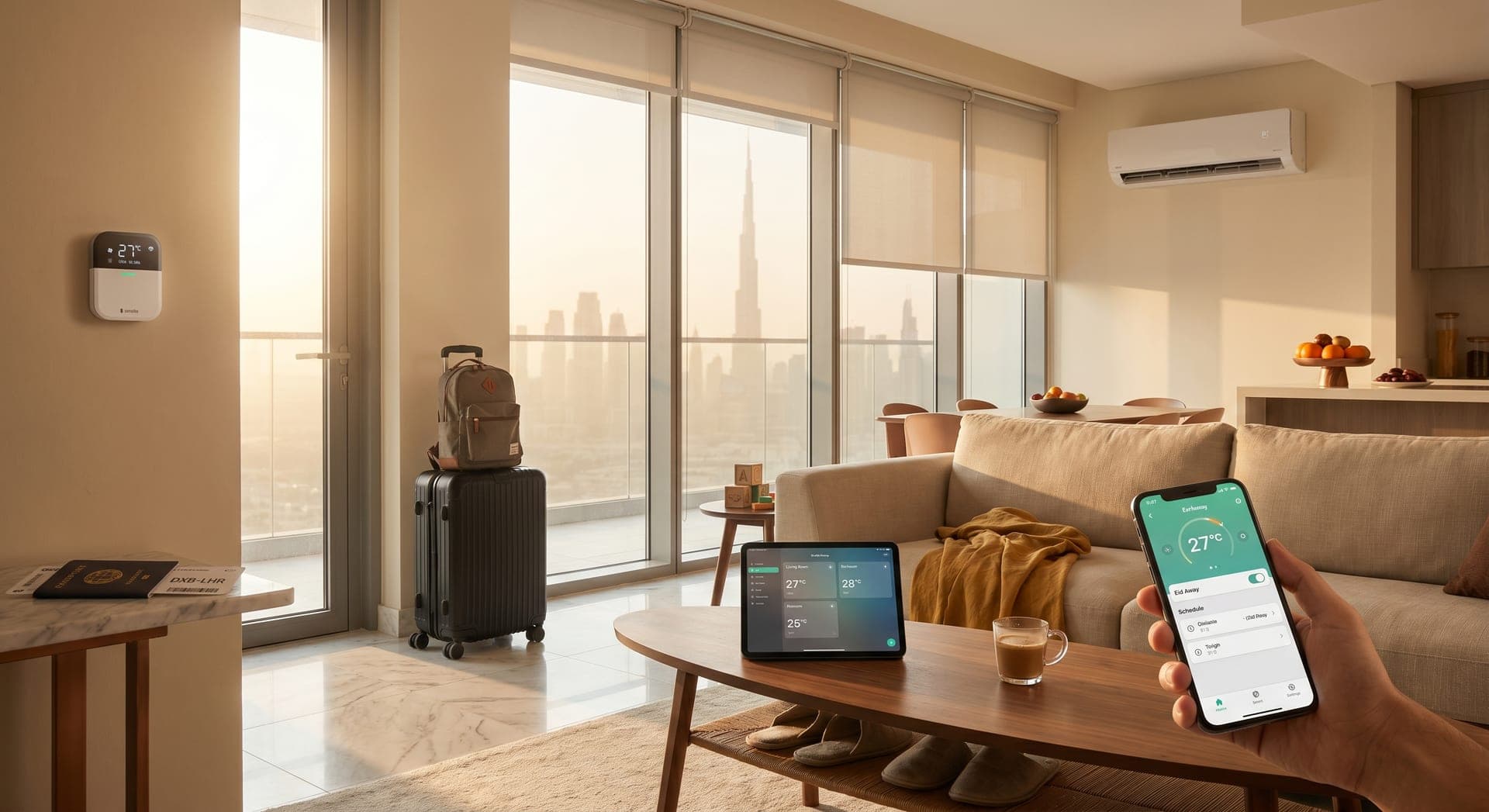
You are packed for Hatta, Hofuf, Jebel Jais, or a long weekend flight out of Terminal 3. The Careem to the airport is booked for tomorrow morning. The fridge is mostly empty, the dishwasher has run, the bins are out. The one thing nobody on your group chat is asking about is the AC.
Most people in your building will do one of two things on the way out the door tomorrow. They will leave the AC running at 22 degrees for the full six to nine days. Or they will switch it off completely on the way to the lift. Both are wrong. The first one wastes hundreds of dirhams while you are not even in the apartment. The second one comes back to mold on the ceiling, a smell that takes a week to clear, and a marble floor you can feel sweating when you walk in.
TL;DR: Leaving your AC running full-power for a 9-day Eid break in Dubai can add AED 300-500 to your DEWA bill for an empty 2-bedroom. Switching it off completely in 50-70% humidity invites mold, which originates from HVAC systems in 73% of Dubai cases. The right answer is a standby schedule: AC on at 27-28 degrees in fan-auto mode the whole time, paired with a 30-minute pre-cool the morning you fly back. A smart AC controller (Sensibo or Tado, AED 350-650 installed) lets you set it once from the airport, watch it from your phone, and override it the day before you land.
Tomorrow is Arafat Day. The UAE Cabinet has locked Eid Al Adha 2026 as Wednesday May 27 through Friday May 29, giving private sector a 4-day Tuesday-Friday holiday and the weekend, and giving public sector and schools a 6-day Saturday-Thursday stretch that becomes 9 days with one leave day on Monday (Gulf News, 2026; Khaleej Times, 2026). The National Center of Meteorology forecasts a 47C peak across Dubai and Abu Dhabi today, then 39-42C daytime highs through Friday (Khaleej Times, 2026). For the share of residents who are leaving the city, the apartment they are walking out of is about to face the hardest week of the year empty.
Why Leaving the AC On Full Power Is the AED 500 Mistake
In our experience surveying apartments after summer holidays, the most common pattern is a thermostat left at 22 degrees with a closed-door 2-bedroom flat running fully cooled for a 7 to 9-day stretch. The owner is in Tbilisi or Hatta. The AC is doing the same job it would do if a family of four were there, except no one is. The compressor is fighting 47C outside heat that has soaked the concrete walls and floors all day, with no internal load to balance against.
This is expensive. Air conditioning accounts for 60-70% of residential electricity consumption in Dubai (DEWA, 2025), and the slab tariff structure punishes high consumption. The first 2,000 kWh of your monthly bill is charged at AED 0.23 per unit. Above 2,000 kWh you cross into AED 0.28 per unit, and above 4,000 kWh into AED 0.32 (DEWA Slab Tariff, 2026). A 2-bedroom apartment in Business Bay or Dubai Marina running AC at 22 for 9 empty days in 47C heat typically pulls 200-300 kWh that would not otherwise show up on the bill, which lands in the AED 280-450 range after fuel surcharge and VAT.
Each degree above 24 drops consumption by about 5-8% (Daikin MEA, 2025). Moving from 22 to 27 is a five-degree swing. On a 9-day empty-apartment run, that compounds into 25-35% less cooling load. The room does not need to be comfortable for nobody. The room needs to stay dry.
Why Switching the AC Off Completely Is the Mold Mistake
The other extreme is worse. Dubai summer humidity sits between 50% and 70% during the day, with overnight readings often hitting 80% near the coast (The Healthy Home, 2025). An apartment with no air movement and no dehumidification for 9 days in those conditions builds condensation on cooler surfaces: behind wardrobes, under sofa cushions, on the back of leather sofas, on bathroom ceilings, inside the AC unit itself.
Laboratory analysis of more than 2,000 Dubai properties found that 73% of mold issues originate from HVAC systems and hidden condensation points rather than from visible water damage (The Healthy Home, 2025). Switching the AC off for a week in summer skips the prevention step and guarantees the conditions.
The damage goes beyond mold. Long stretches of trapped 38-42C indoor heat warp wooden floors, swell cupboard doors, crack gypsum ceilings as humidity expands and contracts the materials, and degrade electronics left on standby (Gulf News, 2025). The cost of a swollen wardrobe door in JBR is higher than the cost of running an AC at 27 for nine days.
The Standby Setpoint: 27-28 Degrees in Fan-Auto Mode
The middle ground is well-known to HVAC professionals in the UAE and barely known to residents. Air conditioning experts consistently recommend setting an unoccupied summer apartment to 26-28 degrees in fan-auto or auto mode (Time Out Dubai, 2025; The National, 2025). The compressor cycles on only when the indoor temperature exceeds the setpoint, which in a closed apartment with blinds drawn happens 3-5 times a day instead of every 15 minutes. The fan keeps air moving through the coil and the room, which is what prevents stagnant humidity from settling on every surface.
The job of this setting is preservation, not comfort. The apartment will sit at roughly 27-29 degrees the whole week, the air will keep circulating, the coil will keep pulling moisture, and the bill will land closer to your normal occupied-month baseline than to a panic-cooled empty-month spike.
In our experience, the 27-degree fan-auto schedule on a 2-bedroom Business Bay flat for a 9-day Eid window adds AED 90-160 to the month versus turning the AC off, and saves AED 200-340 versus leaving it at 22. Net of mold-prevention value, it is the setting that lands the right balance.
The same setpoint logic applies to a room that is empty permanently rather than for a week. If you have bedrooms standing unused all year because the children have moved out, the standby setting becomes a year-round schedule instead of a travel one, which we cover in smart home for Dubai empty-nesters.
What a Smart Controller Changes About the Whole Calculation
A traditional AC remote does not let you do any of this from the airport. You set 22 before you walk out, and 22 is what runs for nine days. You forget to switch to 27. You change your mind on the way home from the office. You realize at the gate that you set a schedule on weekday timing and tomorrow is a public holiday. The remote is on the kitchen counter, six hours away by flight.
A smart AC controller like Sensibo or Tado, which clips onto the wall opposite the AC unit and learns its remote-IR codes, fixes all of this from your phone. Sensibo offers 7-day schedules, geofencing that switches modes based on your phone's location, and remote control from any country (Sensibo, 2026). Tado uses explicit Home and Away modes with time-slot configuration that you can override mid-trip (Tado, 2025). Both work with any AC unit that came with a remote, which covers essentially every apartment AC in Dubai.
Here is what that looks like on a real Eid travel pattern. Tuesday morning you walk out the door, your phone leaves the geofence as your Careem hits Sheikh Zayed Road, the controller switches the AC from your 22-degree morning setpoint to the 27-degree fan-auto standby. The setting holds for 8 days. Thursday morning the day you fly back, you tap "Coming Home" from the lounge at Hofuf airport, and the controller pre-cools the apartment to 24 degrees over 90 minutes so it is ready when your taxi pulls up at the building.
We typically work with Sensibo Sky (AED 349 hardware, AED 350-450 installed in Dubai) and Tado Smart AC Control V3+ (AED 549-649 installed). Both are renter-friendly, take 20-30 minutes to install, and need nothing more than a power outlet near the AC unit and your home WiFi.
The 30-Minute Pre-Cool Is the Difference Between Coming Home and Camping
The other half of the empty-apartment problem is the homecoming. A 2-bedroom apartment that has held 28 degrees for a week, with concrete walls, marble floors, and furniture all sitting at the same temperature, takes 40-60 minutes to bring down to 24 if you turn the AC on at full blast when you walk in (Aquarius Home Services, 2025). That hour is the most miserable hour of your trip. The bedroom is hotter than the living room. The bathroom is humid. The first shower feels like the apartment is fighting you.
A smart controller eliminates this. You set a pre-cool schedule (or trigger it manually from your phone) 60-90 minutes before you land. The controller drops the setpoint from 27 to 24, the AC ramps up while the apartment is still empty, and by the time you put your suitcase down, every room is at 24 degrees with the humidity already pulled back to a comfortable 50-55%. The first 30 minutes home are normal, not survival.
This is the single best argument for installing a smart controller before Eid travel rather than after. The pre-cool is not optional for anyone returning to an apartment that has been at 28 degrees in 47C ambient for a week. Without it, the welcome home is an hour of standing in front of an AC vent.
The Three Other Settings That Multiply the Effect
A smart AC controller is the anchor, but it is not the whole picture. Three other smart-home settings compound the effect of the standby schedule on an empty-apartment run.
Motorized blinds, closed on west and southwest windows. Solar gain through floor-to-ceiling windows in JBR, Marina, and Downtown apartments can add 800-1200W per square meter of glass on a sunny afternoon (US Department of Energy, 2025), and a 2pm to 6pm west-facing exposure on a closed apartment is the single biggest driver of indoor heat soak. A motorized blind on a sun-tracking schedule, closed automatically at 1pm and reopened at 6pm, cuts the cooling load on those rooms by 30-40%. We covered the window-by-window math in Motorized Blinds for Dubai Living Rooms: The 4pm Glare Trap.
Water leak sensors under the AC drip tray, the dishwasher, and the kitchen sink. Nine days unattended is exactly the window when a slow leak becomes an insurance claim. A leak sensor (AED 60-150 per puck) sends a push notification the moment a drop touches it, so you can call the building manager from a hotel rather than walking into a flooded kitchen.
Smart locks paired with a Dubai Police Smart Home Security registration. The cleaner who comes on Wednesday gets a one-time code that expires Wednesday evening. The package courier rings a video doorbell, not a dead intercom. The building's police-portal-registered status means a patrol notes the property as protected, which the Dubai Police service confirms cuts targeted incidents in their reporting (Dubai Police, 2026). We unpacked the whole pre-trip security setup in Eid Al Adha 2026 in Dubai: The Smart Home Security Checklist Before You Travel.
These three are not strictly necessary for the AC question. They are the multipliers that make the AC standby schedule the smallest part of a properly-handled empty apartment.
What a Real Eid Travel Setup Costs
For a 2-bedroom apartment in Business Bay leaving for a 9-day Eid break, the AC-only setup is straightforward. One Sensibo Sky on the living room AC (the unit that drives the open-plan area) covers most of the apartment because the bedroom doors are closed and the bedrooms hold their temperature off the central setpoint. Installed cost: AED 350-450. Annualized over the four months of summer travel patterns, that is AED 87-112 per cooling-critical month, which is less than one wasted week of running at 22.
For a 3-bedroom apartment or a renter who wants per-room control, we install one controller per AC unit. A 3-bed Marina apartment with 3 split units lands at AED 1,050-1,350 installed, and the per-unit control means the master bedroom can hold a tighter standby (26 instead of 27) for an art collection or a sensitive wood floor, while the guest bedroom holds 28 to save power.
For a villa in Arabian Ranches or Dubai Hills, where the AC infrastructure is usually 4-7 split units across two stories, the math shifts. A full controller-per-unit setup runs AED 1,750-2,800 installed, but the standby savings over a 9-day Eid plus a 2-week August Europe trip plus a 3-week September Hatta-mountain getaway are typically AED 600-900 in DEWA per year against the AED 2,000 install cost. Payback inside the first summer, no recurring fees, no subscription.
What Bayora Will Tell You Not To Buy for an Empty-Apartment Setup
Honest recommendations are the cheapest way we build trust as a new company. Here is what we will tell you to skip for an Eid travel setup, even if a different installer will quote it.
Do not buy a chiller upgrade or a new AC unit before Eid. The standby schedule works on the AC you have. Replacing a 2018 split unit with a 2026 inverter is a financially sound decision over a 10-year horizon, but it is not a thing to do in the last 24 hours before flying. Smart control on the existing AC captures 80% of the available savings without the AED 4,000-7,000 swap.
Do not buy a wall-mounted touchscreen for the Sensibo or Tado. Your phone already does this from any country. The AED 1,200-1,800 wall touchscreen is a thing to specify on a whole-home automation build, not a thing to bolt on for one trip. If you want a physical fallback for guests, a AED 220-350 Lutron Pico keypad on the wall does the same job for one-eighth the cost.
Do not buy a "vacation mode" subscription from a single-brand AC vendor. A few AC manufacturer apps now offer monthly subscriptions for vacation scheduling. The fee is usually AED 25-40 per month for what an open-platform controller like Sensibo (one-time hardware cost, no subscription) or Tado (one-time hardware, optional but not required cloud features) does for free. If you are paying monthly for a vacation schedule that you only use 3-4 times a year, you are paying the wrong company.
Do not pay AED 3,000-5,000 for a whole-apartment "Eid travel package" from a security-first installer. The AC standby setup, leak sensors, and smart lock for a 2-bedroom apartment lands closer to AED 1,500-2,200 installed if you specify it directly. The "package" upsell usually bundles indoor cameras, motion sensors, and a glass-break detector that an empty apartment with the blinds drawn does not need.
What This Looks Like on a Real Apartment
A Business Bay 2-bedroom we set up before last year's Eid Al Adha is a useful benchmark. The owner had previously left the AC at 22 for the full 7-day break in 2024 and returned to a DEWA bill of AED 1,510 for May, against an occupied-month baseline of AED 980. The empty week added AED 530 to a month she barely lived in.
In 2025 we installed a single Sensibo Sky on the living room AC (AED 380 installed, 25-minute install). She set the standby to 27 degrees fan-auto for the 6-day window via the app from the lounge at DXB Terminal 3 the morning she flew. Tuesday morning at 10am she switched the schedule from her workday pattern to "Eid Away" with two taps. Sunday evening the schedule auto-triggered the pre-cool 90 minutes before her flight landed. She walked into a 24-degree apartment with a 50% humidity reading.
The DEWA bill for May 2025 came in at AED 1,090. AED 420 lower than 2024 for the same trip pattern, on a setup that cost AED 380 once. The standby week added AED 110 against her occupied baseline of AED 980 instead of AED 530. The Sensibo paid for itself in the first trip.
For Eid 2026, she is flying to Bangkok for 8 days starting Wednesday. The schedule is already loaded. We will see her DEWA bill in mid-June and have a data point for the third Eid in a row.
The 20-Minute Pre-Flight Setup Checklist
If you are flying tomorrow or Wednesday and want to do this without buying anything new, here is the version that works on a phone-controllable smart AC if you have one, and on a manual thermostat if you do not.
- Tonight, set every AC to 27 degrees in fan-auto mode. This is the standby. If your thermostat has only Cool mode, 27 is still the right number, the fan-auto is the part you cannot replicate without a smart controller but the higher setpoint captures most of the value.
- Close every blind and curtain on west and southwest windows. Solar gain is the single largest variable on a closed apartment. If you do not have motorized blinds, close them manually before you leave.
- Switch off the water heater at the breaker. A geyser at 24/7 standby for 9 days draws 60-90 kWh that contributes nothing to an empty apartment.
- Unplug the dishwasher, microwave, and any standby electronics on the kitchen counter. Standby loads add up. The fridge stays on.
- Put leak sensors (if you have them) under the AC drip trays and the kitchen sink trap. If you do not, put a couple of folded towels there.
- Set a calendar reminder for 90 minutes before your return flight lands. If you have a smart controller, trigger the pre-cool from the airport. If you do not, ask a neighbor or building maintenance to switch the AC to 24 degrees an hour before your taxi arrives.
A smart controller does steps 1, 2, 5, and 6 automatically and from your phone. Without one, you can still do 80% of the work manually, you lose the come-home-ready and the override flexibility.
Nine days is one thing. If the apartment sits empty for most of the year because you own it and live somewhere else, the standby setpoint is only the first decision, and we work through the rest in managing a Dubai apartment from abroad.
Frequently Asked Questions
Should I leave my AC on or off when I travel from Dubai in summer?
On, at 27-28 degrees in fan-auto mode. Switching it off completely in Dubai summer invites mold and humidity damage because 73% of Dubai mold cases originate in HVAC systems and dormant condensation points. Leaving it at 22 wastes AED 200-400 over a week. The middle setpoint with the fan running captures the protection without the bill spike.
How much does a smart AC controller cost in Dubai for one apartment?
Sensibo Sky lands at AED 349 hardware and AED 350-450 installed including a 20-minute setup and configuration. Tado Smart AC Control V3+ lands at AED 549-649 installed. Both work with any AC unit that has a remote, both are renter-friendly because they clip on without modifying the AC, and both run off WiFi without any subscription required for the core scheduling and remote control features.
Will the AC standby schedule work without WiFi?
Yes, partially. A smart AC controller can hold a schedule locally if your WiFi drops, and the schedule continues to run on the controller's internal clock. What you lose without WiFi is remote control from your phone, geofencing triggers, and push notifications. For a 9-day Eid trip, set the schedule before you leave and the controller will run it whether your home WiFi stays up or not.
Does this work with chilled-water or district-cooled apartments?
Yes, with a slightly different controller. Apartments on Empower or Tabreed district cooling use a fan-coil unit thermostat rather than a remote-controlled split AC. Smart thermostats like Sensibo Element or a Shelly relay tied to the FCU work for these setups. The principle is the same (27-28 standby, pre-cool before return), the hardware is different. We cover the wiring options in our smart AC service page.
What if I am away for 3 weeks or more, not just 9 days?
The 27-degree standby works for any duration, but for trips beyond 2-3 weeks we recommend adding a humidistat trigger that holds humidity below 60% rather than holding a fixed temperature. This means the AC cycles when the room gets damp rather than only when it gets hot, which matters more for art, electronics, and leather furniture over long stretches. A Sensibo Air Pro or a Home Assistant setup with a separate humidity sensor handles this. Budget AED 800-1,400 installed for the upgrade.
If you are flying tomorrow and want to do this without bringing forward a Bayora visit, the 6-step checklist above gets you 80% of the way there. If you are home through Eid and thinking about the next trip in August or September, send us a message with your building and your AC layout. We will tell you whether a single controller covers it or whether the per-unit setup makes more sense, and we will give you the install cost in the same reply.
For most Dubai apartments, the standby schedule plus a 90-minute pre-cool is the difference between coming home and camping. The AC is on. The apartment is dry. The bill is normal. You unpack instead of waiting for the AC to catch up.
Ready to Get Started?
Get a free consultation and we'll recommend what makes sense for your situation.
Get Free Consultation