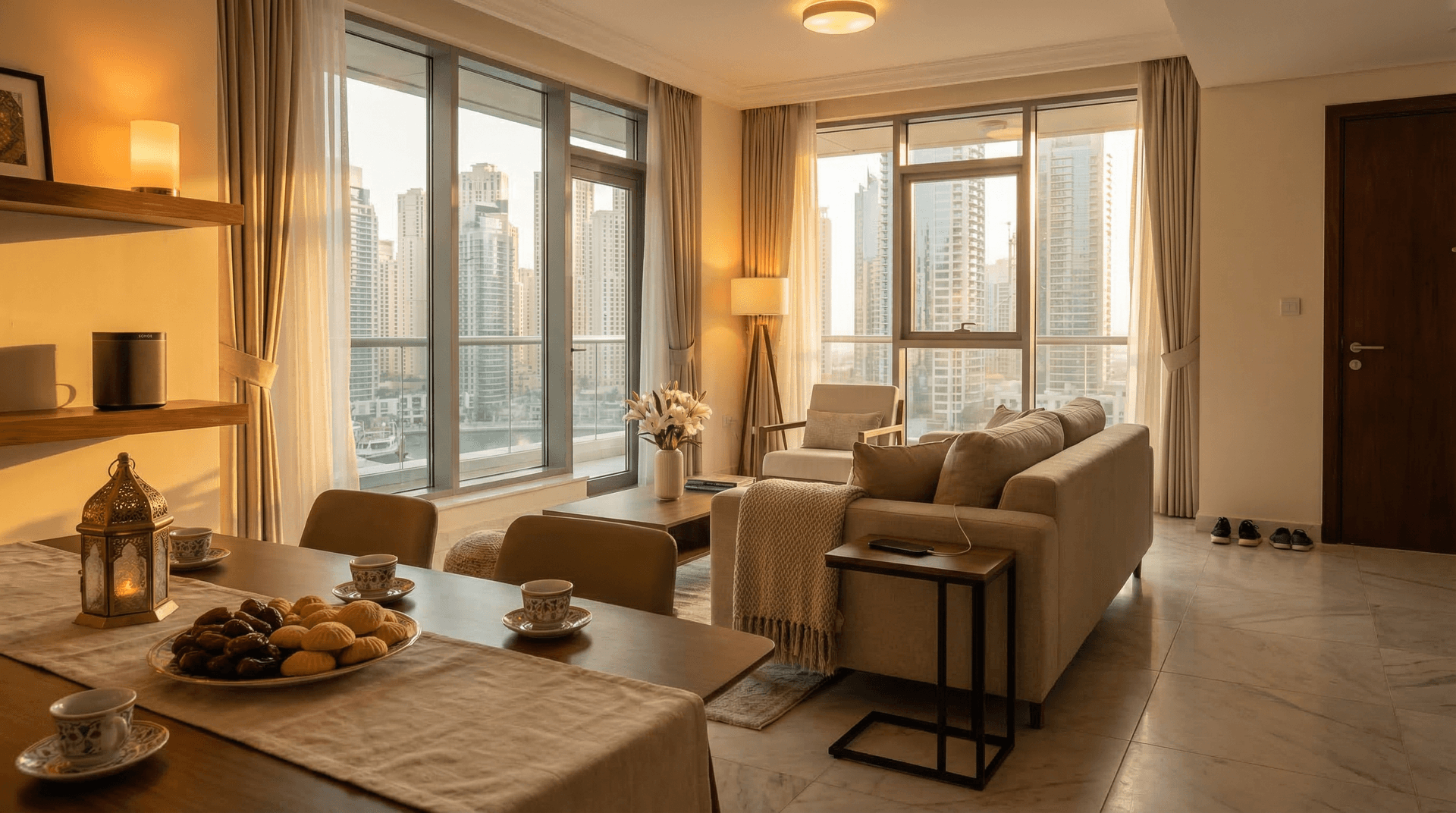
Ramadan trained your home. Eid is the final exam.
If you spent the last month dialing in iftar scenes and suhoor wake-ups, you already know what smart home automations can do for hosting. But Eid gatherings hit different. The crowds are bigger, the energy is louder, and people drop by with far less notice. Your home needs to go from quiet Ramadan mode to full celebration in the span of a morning.
67% of UAE residents plan to host house parties or in-home gatherings during Eid (Toluna, 2026). That means most apartments and villas in Dubai will function as event spaces for three or four days straight. A few automations set up this week save you hours of running around during the holiday itself.
TL;DR: Set up an Eid welcome scene (lighting, AC, audio in one tap), pre-cool before guests arrive, automate your reset between gatherings, and let motion sensors handle hallway and bathroom traffic. Everything here works in rental apartments with zero wiring changes. Total setup time: one evening.
What makes Eid hosting different from Ramadan?
Ramadan hosting follows a rhythm. Iftar is at sundown, every night, at roughly the same time. You build a routine. Eid is the opposite. Guests arrive at 9am for Eid brunch. Another group shows up at 2pm. Family comes for dinner. Someone drops by unannounced at 10pm with dessert.
The UAE holiday runs Thursday March 19 through Sunday March 22 this year (Gulf News, 2026). Four days of open-door hosting with no fixed schedule means your home needs to be ready on short notice, multiple times per day.
If you built Ramadan automations over the past month, you already have the foundation. Eid is about adapting those scenes for daytime crowds, faster transitions, and a more festive atmosphere.
How do you set up a one-tap Eid welcome scene?
The single most useful automation for Eid is a scene that prepares the entire apartment in one command. When we set these up for clients, the scene typically covers five or six things at once.
Here is what an Eid welcome scene looks like:
- Living room and dining lights shift to warm white at 70% (brighter than your Ramadan iftar scene since Eid gatherings are daytime-heavy)
- AC drops 2-3 degrees below your normal setting to pre-compensate for the crowd
- Smart blinds adjust to a half-open position, letting in natural light while blocking direct sun
- Background audio starts on your speaker system with a festive playlist or Eid nasheed
- Entrance hallway lights come on to greet guests at the door
- Kitchen lights go to full brightness for food prep
One voice command or phone tap replaces 10-15 minutes of walking room to room. If you already have a lighting scene setup, duplicating and modifying it for Eid takes about five minutes in most smart home apps.
Why does the AC struggle during large gatherings?
Every person in a room adds roughly 100 watts of body heat. Invite 10 guests and your living room gains the equivalent of a 1,000-watt space heater. Your AC was sized for two or three people.
Air conditioning accounts for up to 70% of residential electricity consumption in the UAE (Daikin, 2025). During Eid gatherings, that system works even harder. Each degree you lower the thermostat increases energy demand by 5-10% (SolarisKit, 2025). Cranking it to 18 degrees when guests arrive wastes electricity without cooling the room faster.
In our experience, the better approach is pre-cooling. A smart AC controller drops the temperature 30-45 minutes before guests are expected. The room starts cool, and the AC maintains rather than chases. After guests leave, the system returns to your normal setting automatically, so you are not cooling an empty room all night.
For villa owners in Arabian Ranches or Dubai Hills with central AC, zone control is the real advantage. Cool the majlis and dining room aggressively while bedrooms stay comfortable. No reason to freeze the whole house because the living room is packed.
What is the fastest way to reset between Eid gatherings?
Eid often means multiple gatherings in a single day. Morning brunch guests leave, and dinner guests arrive four hours later. Between those visits, you need the apartment back to baseline.
A "reset" automation handles the turnaround:
- All lights return to default brightness
- AC raises back to normal temperature
- Audio pauses
- Blinds return to their scheduled position
- Kitchen lights off (unless you are already cooking for round two)
When we installed this kind of reset for a Business Bay apartment last year, the client told us the gap between gatherings went from feeling rushed to feeling relaxed. Fifteen minutes of manual adjustments collapsed into a single tap.
The reset also saves energy. Running AC at full blast and lights at 70% in an empty apartment between visits is pure waste. Smart AC scheduling alone can cut cooling costs by 20-30% (DEWA, 2025). Over a four-day holiday with multiple gatherings per day, that adds up.
How do motion sensors reduce the hosting workload?
Hallways, bathrooms, and guest bedrooms see unpredictable traffic during Eid. Someone heads to the bathroom. Kids run through the hallway. A guest checks on a sleeping baby in the back room. Leaving lights on everywhere wastes energy. Leaving them off means people stumble in the dark.
Motion-activated lighting solves this without anyone thinking about it. The hallway lights come on when someone walks through and turn off 90 seconds later. The guest bathroom lights up when the door opens. The guest bedroom stays dark until someone enters.
This is one of the features guests notice first. One thing clients always ask is why their guests keep commenting on the automatic lights. It feels like the home is paying attention, and people remember that.
Smart bulbs from brands like Philips Hue support motion sensor pairing out of the box, and a full smart lighting setup can include motion sensors in every room. No wiring, no electrician. Stick the sensor to the wall and pair it in the app.
Can renters set up Eid automations without landlord approval?
Everything in this guide works in rental apartments. No holes in walls, no rewiring, no permission needed. When you move out, everything comes with you.
The renter-friendly Eid setup looks like this:
- Smart AC controller (plugs in, sticks to wall): from AED 800 installed
- Smart bulbs for living room, dining area, kitchen, hallway: AED 150-300 per room
- One smart speaker for voice control and audio: AED 200-500
- Optional: motion sensors for hallway and bathroom: AED 100-200 each
Total for a two-bedroom apartment: roughly AED 2,000-4,000 depending on how many rooms you cover. The Smart Home Starter package at AED 3,000 includes smart AC control with basic automation and gets you most of the way there.
The UAE smart home market is growing at 10.75% annually and is expected to reach $1.6 billion by 2033 (Renub Research, 2025). A big part of that growth comes from renters who want plug-and-play solutions that do not require permanent changes. Our renter's guide covers the full breakdown.
What about the Eid morning routine?
Eid morning has its own rhythm. You wake up earlier than usual, get dressed up, and the whole family heads out for Eid prayer. When you come back, guests might already be on the way.
An Eid morning automation handles the departure and return:
Before you leave:
- All lights off except the entrance
- AC shifts to energy-save mode (no point cooling an empty apartment)
- Blinds close against the morning sun
When you return:
- One tap activates the welcome scene
- AC has pre-cooled the apartment (scheduled 20 minutes before your expected return)
- Lights and audio set the festive mood instantly
- You walk into a celebration-ready home, not a warm, dark apartment that needs 15 minutes of prep
When we set this up for clients, we usually tie the return scene to a specific time or a geofence that triggers when your phone gets within a kilometer of home.
How do you handle background audio for Eid gatherings?
Music and atmosphere matter during celebrations. A multi-room audio setup lets you play background audio in the living room and dining area while keeping bedrooms quiet for kids napping or older family members resting.
77% of UAE residents plan to visit relatives and friends during Eid (Toluna, 2026). When your home is the gathering spot, ambient audio sets the tone without you managing it. A Sonos system or Apple HomePod group lets you change what is playing from your phone, even if you are in the kitchen plating dessert.
Pair the audio with your welcome scene so it starts automatically. Festive playlist for daytime gatherings, something calmer for evening visits. Two scenes, two moods, zero manual switching.
Frequently Asked Questions
How long does it take to set up Eid automations?
If you already have smart devices installed, creating new scenes and schedules takes 30-60 minutes in your app. Starting from scratch with smart bulbs and an AC controller takes an evening. Professional installation with configuration and scene setup can be done in a single visit.
Do Eid automations work with Alexa, Google Home, and Apple HomeKit?
Yes. All the setups described here work with any of the major voice platforms. Smart bulbs, AC controllers, and motion sensors from brands like Philips Hue, Aqara, and Sensibo support all three ecosystems. Pick whichever you already use.
Can I reuse my Ramadan automations for Eid?
Absolutely. Your iftar scene, reset automation, and suhoor schedule are already built. Duplicate them in your app, adjust the lighting levels and timing for daytime hosting, and rename them. Most of the work is already done from the past month.
What is the minimum setup for Eid hosting automation?
A smart AC controller and four smart bulbs (living room, dining, kitchen, hallway) cover the basics. Add a smart speaker for voice control and background audio. That gives you a welcome scene, a reset, and pre-cooling. Budget: around AED 2,000-3,000 for a two-bedroom apartment.
Will my Eid automations work after the holiday?
Every automation you build for Eid works year-round. The welcome scene becomes your general guest scene. The reset becomes your daily wind-down. The motion sensors stay useful forever. You are building a system for your home, not a one-time holiday setup.
Your home should feel ready before you are
Eid is about people, not logistics. The less time you spend adjusting thermostats, dimming lights, and turning on speakers, the more time you spend with the people who showed up.
If you built automations during Ramadan, you are 80% of the way there. A few scene adjustments this week, and your home handles Eid on autopilot.
Want to get the full setup done before Thursday? Book a free consultation and we will map out what makes sense for your space. No obligation, no surprises.
Ready to Get Started?
Get a free consultation and we'll recommend what makes sense for your situation.
Get Free Consultation