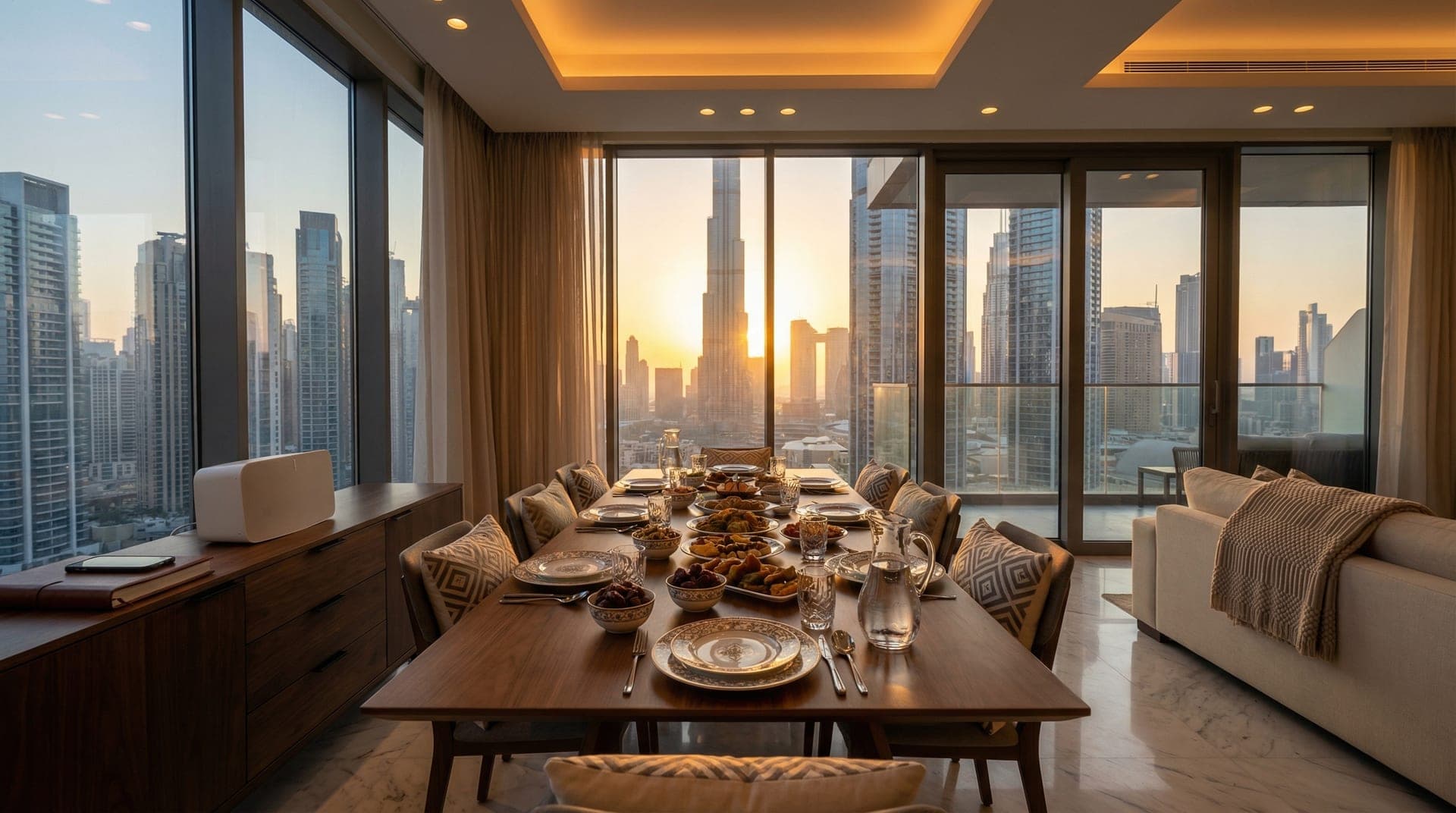
Your apartment is about to become a restaurant
For the next few weeks, your home runs on a different schedule. Iftar gatherings three or four nights a week. Family dropping by after Taraweeh. Weekend brunches replaced by late-night conversations that stretch past midnight.
Ramadan in Dubai turns every apartment into a gathering spot. And if you've hosted iftar for 8 or 10 people, you know the drill: the AC can't keep up with a full room, you're adjusting lights while someone's at the door, the kitchen is running at full capacity, and you forgot to close the blinds before the afternoon sun turned the living room into a sauna.
None of that needs to happen manually.
The AC problem nobody talks about
Here's a number worth remembering: every person in a room adds roughly 100 watts of heat. Invite 8 people for iftar, and your living room just gained the equivalent of a small space heater.
Your AC was sized for 2-3 people. When the guest count doubles or triples - which happens every night during Ramadan - the AC falls behind. The room gets stuffy. Someone opens a window (which makes it worse). Someone else cranks the thermostat down to 18 degrees (which doesn't cool faster, it just wastes electricity).
A smart AC controller solves this by letting you pre-cool the room 30-45 minutes before guests arrive. Drop the target temperature by 2-3 degrees before the crowd shows up, and the room stays comfortable even at full capacity. After everyone leaves, the AC returns to normal automatically.
If you're in a villa with central AC - say in Arabian Ranches or Dubai Hills - a smart thermostat does the same thing with zone control. Cool the majlis and dining room harder while the bedrooms stay at normal temps. No reason to freeze the entire house because the living room is packed.
One button that sets the entire room
The single most useful Ramadan automation is an "iftar scene" - one tap that configures everything at once.
Here's what ours looks like:
- Living room and dining area lights shift to warm white at 60%
- Kitchen lights go to full brightness (you need to see what you're doing in there)
- Hallway and entrance lights come on for guests arriving
- AC drops 2 degrees below normal
- If you have smart blinds, they close against the late afternoon sun
- Background audio starts on the living room speaker - Quran recitation, ambient music, whatever you prefer
That's six things you'd normally do by walking around the apartment for 10-15 minutes. One voice command or phone tap, and the space is ready.
You can tie this to a specific time (30 minutes before Maghrib prayer, which lands around 6:15-6:30pm this month) or trigger it manually when you start plating the food.
The "guests are gone" reset
This one saves you energy and money every single night.
After iftar, the apartment is warm, lights are on everywhere, and the AC has been working hard. If you don't reset things, the AC keeps fighting to cool an empty living room while you're in the bedroom. Lights stay on in rooms nobody's using. The DEWA meter keeps spinning.
A "reset" automation handles the wind-down:
- Living room lights dim to 20% or turn off
- AC raises back to normal temperature
- Kitchen lights off
- Only bedroom and bathroom lights stay active
- If you're heading to the mosque for Taraweeh, the apartment drops into energy-save mode automatically
Over 30 nights of Ramadan, this kind of nightly reset adds up. We've seen DEWA savings of 20-30% from smart AC scheduling alone. Add lights and blinds to the mix, and the savings grow.
Late-night mode for post-Taraweeh gatherings
Ramadan nights in Dubai run late. People come back from the mosque around 10 or 11pm, and the social gathering continues. But you don't want the apartment lit up like it's midday.
A "late night" scene keeps things comfortable without the brightness:
- Living room lights at 30% warm white
- Kitchen at 50% (for tea and snacks)
- Hallway and bathroom on motion sensors - they only come on when someone walks past
- AC at a comfortable sleep-adjacent temperature
When the last guest leaves, one tap puts the apartment into sleep mode. Lights off, AC adjusted, blinds ready for the morning.
The suhoor setup that doesn't wake the house
If you have family staying over - which happens a lot during Ramadan - the suhoor routine matters.
Nobody wants to stumble through a dark apartment at 4:30am, bang into furniture, and flood the kitchen with harsh fluorescent light. A suhoor automation handles the path from bedroom to kitchen with minimal disruption:
- Hallway lights come on at 10% warm white, 15 minutes before your alarm
- Kitchen lights fade up slowly to 40% over 10 minutes
- Bathroom light activates on motion at 20%
Guests sleeping in the living room or guest bedroom don't get blasted with light. Everyone who needs to eat can see where they're going. After Fajr prayer, one command puts the apartment back to sleep.
For a deeper look at how lighting scenes and schedules work, our 3-scene lighting guide covers the basics.
What about renters?
Everything described here works in rental apartments. No wiring changes, no landlord approval needed.
Smart bulbs plug into existing fixtures. Smart AC controllers stick to the wall or sit on a shelf. Smart plugs handle lamps and small appliances. A Google Home, Alexa, or Apple HomePod ties it all together.
The entry point is a smart AC controller at around AED 800 installed, or a smart thermostat at AED 2,000 for central AC. Add smart bulbs for the main rooms, and you have enough to run every automation in this post.
When you move apartments, everything comes with you. Our renter's guide covers this in detail.
The math on Ramadan hosting
Think about this: if you host iftar 4 times a week for 4 weeks, that's 16 evenings of adjusting the AC, setting up lights, and resetting the apartment afterward. Each evening takes 15-20 minutes of walking around toggling things.
That's 4-5 hours over the month spent on logistics that an automation handles in seconds.
And the DEWA savings from not running the AC at full blast for empty rooms after guests leave? That pays for a smart AC controller in one summer.
Getting set up before Ramadan ends
Ramadan 2026 runs through March 18. There's still time to get the basics in place - a smart AC controller and a few smart bulbs cover the most useful automations.
If you want the full setup - lighting scenes, AC scheduling, blinds, and audio - a whole-home consultation maps out what makes sense for your space. Every setup is different depending on your apartment layout, how often you host, and which rooms see the most traffic.
Tell us about your home and we'll recommend where to start. Free consultation, no obligation.
Ready to Get Started?
Get a free consultation and we'll recommend what makes sense for your situation.
Get Free Consultation