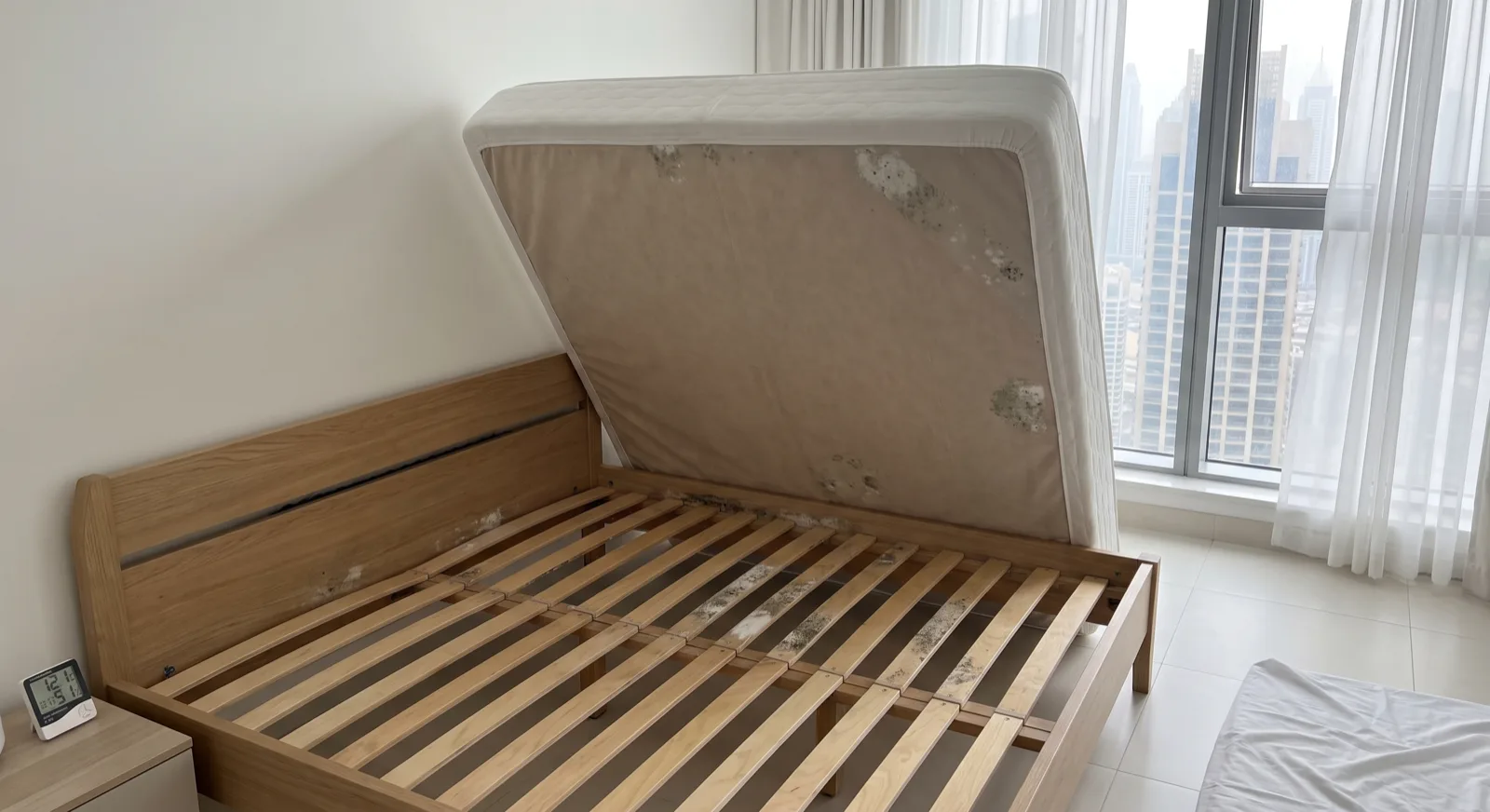
You moved into the flat, the furniture was delivered new, and the air conditioning has been running ever since. A few weeks later you lift the mattress to change the sheets and the slats underneath are spotted green and white, with more of it on the underside of the mattress itself and a line of it along the back rail of the frame.
Everything you have read about mould in Dubai says it happens when people switch the AC off. You did the opposite. The machine has not stopped since you got the keys, and the sensor on the bedside table has been reading somewhere in the fifties the whole time.
TL;DR: Mould responds to the humidity at a surface, not in the room. The WHO and the US Forest Products Laboratory put the surface limit at 75 to 80 percent. Your sensor and the Dubai Building Code read the room, to a 60 percent ceiling. The AC is doing its job on the room air. The mould is growing where that air does not reach.
If you want the things to do tonight before the explanation, they are below under what to do this week: protect yourself before you touch it, check whether the patch is small enough to be your job at all, get the furniture off the wall and the mattress up, and put a sensor where the growth is rather than where you are standing.
The Number on Your Sensor Is a Room Number
The 60 percent figure is everywhere, and it is a real threshold. The US Environmental Protection Agency's mould course states that "Indoor relative humidity (RH) should be kept below 60 percent -- ideally between 30 percent and 50 percent, if possible" (US EPA, Mold Course Chapter 2). Our own writing on Dubai apartment humidity when summer ends uses the same line.
Dubai's own building rules work to the same kind of number. The Dubai Building Code 2021 Edition sets indoor design conditions for Dubai at a temperature of 24 degrees and a relative humidity of "50% ±5%", and its thermal comfort table gives a relative humidity range of "30% (min)" to "60% (max)", with the requirement that "HVAC systems shall be capable of providing the range of internal conditions in Table H.3, for 95% of the year" (Dubai Municipality, Dubai Building Code 2021 Edition, Tables H.2 and H.3).
So a flat sitting at 58 percent is inside the band the code asks for, and inside the band the EPA calls acceptable. Both of those are averages of the air in the space. Neither is a statement about any particular surface in it.
Mould Responds to the Surface, and the Surface Number Sits Lower Than You Think
The variable that decides whether growth starts is the humidity at the material itself. The US Forest Products Laboratory's Wood Handbook puts it plainly: "Mold and mildew will grow on most surfaces if the relative humidity at the surface is above a critical value and the surface temperatures are conducive to growth." Its practical rule is to limit "surface relative humidity conditions >80% to short periods" (USDA Forest Service, Wood Handbook FPL-GTR-190, Chapter 17).
The World Health Organization's review of the literature lands close to it, and it is worth reading the whole range rather than the top of it. The WHO reports that "Even if the lowest relative humidity for germination of some species of fungi is 62–65%, experiments on common building and finishing materials indicate that susceptible surfaces can be kept free of fungal growth if the relative humidity is maintained below 75–80%", that one review "recommended that the relative humidity be maintained below 75% to limit fungal growth in buildings", and that "Mould fungi do not grow below a relative humidity of 80% (Adan, 1994) or below 75% within a temperature range of 5–40 °C (Viitanen, Ritschkoff, 1991)" (WHO, Guidelines for Indoor Air Quality: Dampness and Mould, 2009, page 38).
Two independent sources, one from wood science and one from public health, both putting the practical surface limit in the 75 to 80 percent band. Your sensor is reading the middle of the bedroom. The question is whether anything in that bedroom is sitting up in that band while the room sits at 58, and in a flat where the AC never stops that is a question worth answering with a reading rather than an assumption.
Why the Gap Under a Mattress Is Effectively a Different Room
Air in a room is mixed. Air in a sealed cavity is not. Once you put a mattress flat onto a slatted base and sleep on it, the few centimetres underneath stop exchanging with the rest of the room in any meaningful way. Anything that releases moisture into that gap, whether the mattress foam, the board, or the person sleeping above it, raises the humidity in there without moving the room reading at all.
Two things are going on and they are not the same. The one the sources name directly is temperature: the WHO notes that "Even under such conditions, however, relative humidity can be higher on colder internal surfaces" (page 37). The second is our own reading rather than anyone's published finding, and it is that a sealed space is slow to come back down, because nothing is carrying the moisture away.
The same EPA page that gives the 60 percent ceiling also lists "High humidity (60% relative humidity)" among its common moisture problems, which is worth reading twice, because 60 is the number most people treat as the safe side of the line rather than as a problem in its own right.
Temperature does not rescue you either. The EPA notes that "In most cases, temperature is not an issue; some molds grow in warm areas, while others prefer cool locations such as bread stored in a refrigerator" (US EPA, Mold Course Chapter 1). Cooling the room harder will not take the growth off the table. A colder surface is not a safer one, which is the WHO point quoted above.
What New Furniture May Be Bringing With It
This is why the problem shows up on a month-old bed rather than on one you have had for five years.
Wood holds moisture in balance with the air around it. The Wood Handbook's equilibrium table shows that at 26.7 degrees, wood sitting in air at 60 percent relative humidity settles at about 10.8 percent moisture content, and in air at 80 percent it settles at about 15.7 percent (Table 4-2, with the handbook's own note that those values "were derived primarily for Sitka spruce"). Moisture content measures how much of the board's own weight is water rather than how damp the air around it is, so a higher number means a wetter piece of wood, and the point is only that wood that lived in damp air arrives wetter than wood that did not. Engineered board and a foam mattress are not in that table at all.
A flat-packed bed frame usually sits in a warehouse, then a lorry, then a loading bay, then a lift lobby, and not all of that is air conditioned. Dubai International Airport's long-run climate record gives an October mean relative humidity of 60 percent and a mean daily maximum of 84 percent (NOAA NCEI, WMO station 41194, for the period the file itself states as 1974 to 1991). That is an outdoor reading at an airport, not a measurement inside any warehouse, and we have not measured one. The only thing it establishes is that outdoor air in October reaches a daily peak far above the 58 your bedroom sits at, even though its monthly mean of 60 is barely above it.
The furniture then gives that moisture back as it comes into balance with the drier indoor air, and the place it gives it back into is the enclosed space it is sitting in. How long that takes depends on the material and on how much air reaches it, and the handbook does not put a figure on it.
Why This Is Mould and Not Rot
What you will not usually see is the frame falling apart, and the handbook explains why. "Serious decay occurs only when the moisture content of the wood is above the fiber saturation point (average 30%)", but "By itself, the water vapor in humid air will not wet wood sufficiently to support significant decay, but it will permit development of some mold fungi" (Chapter 14). Fibre saturation point is the level above which the wood itself is wet through rather than just damp on the outside.
Humid air alone is enough for the green and white bloom but not enough to destroy the frame, which is why the answer to "do I have to throw this out" is usually no for the timber part.
What the AC Is Actually Doing, and What It Cannot Reach
An air conditioner removes water from air only while its compressor is running and the coil is cold. We have written about why the fan speed changes how much water comes out and about why a mild month makes a right-sized unit behave like an oversized one, and October is squarely in that second case. The cooling load drops, the unit satisfies the room faster, run time falls, and the drying falls with it.
But even a unit running perfectly has a boundary. It conditions the air it can circulate. The underside of a mattress, the back of a wardrobe flat against a wall, the inside of a closed drawer: those are volumes the supply air does not enter. Air it cannot reach is air it cannot dry.
The Dubai Building Code is alive to the general version of this problem. It requires that the building envelope not "promote surface condensation or mould growth, for the given occupancy conditions" (clause E.7.4). It even defines the word: "Mould: Type of fungus that grows on damp or decaying material surfaces." Note the last word. The code is written about surfaces, and the comfort number it hands your HVAC system is a room number. Those are two different things in the same document, and the gap between them is where your bed frame sits.
The Three Places to Look Before Anything Else
If you have found it in one place, you have not found all of it. Before you lift or pull anything, put gloves and a mask on, because disturbing growth is what puts it in the air. Then start here:
- Under the mattress and on the slats. Lift the mattress fully off the base and look at both faces. This is the most enclosed warm surface in the flat and it receives moisture every night.
- The back of anything pushed flat against a wall. Wardrobes, headboards, chests of drawers, and particularly against a wall shared with a bathroom, a riser, or the outside of the building. The EPA puts it generally: "Mold is frequently found on walls in cold corners behind furniture where condensation forms" (US EPA, Mold Course Chapter 2). Which walls in your flat are the cold ones is a question for a thermometer, not something guidance answers.
- Inside closed storage. The back panel of a wardrobe, the underside of drawers, the base board under hanging clothes. Shut doors keep the air still in exactly the way the gap under a mattress does.
What to Do This Week
You are about to disturb growth that the EPA says has to be removed rather than killed in place, and disturbing it is the moment it goes airborne, so the EPA asks you to limit your exposure before you touch anything (US EPA, A Brief Guide to Mold, Moisture and Your Home).
Cover your skin and your airways first. Put on what the EPA lists for this job: "Gloves, goggles, N-95 respirator". Use long gloves, because the guide recommends ones "that extend to the middle of the forearm", and do not handle any of it bare-handed: "Avoid touching mold or moldy items with your bare hands" (same guide). Work with the window open and the door to the rest of the flat shut, so you are not moving it room to room. If you can carry the mattress or the drawer out to a balcony, do it there instead of in the bedroom.
Know the point where this stops being a furniture job. The EPA's own dividing line is area: "If the moldy area is less than about 10 square feet (less than roughly a 3 ft. by 3 ft. patch), in most cases, you can handle the job yourself", and above that it sends you to its remediation guidance. Add the cases it does not size: if it is in the wall rather than on something you can carry, or it keeps coming back after you have opened the space up. On the health side the EPA says "If you have health concerns, consult a health professional before starting cleanup". The same guide notes that "Molds can also cause asthma attacks in people with asthma who are allergic to mold", so if anyone in the flat has a breathing condition or an allergy, make that call before you start rather than after.
Get it out and get it open. Move the affected pieces where you can see all of them. Dead mould is not neutral: the EPA is explicit that it "is allergenic and may cause allergic reactions and other health effects in some individuals, so it is not enough to simply kill the mold. It must also be removed" (US EPA, Mold Course Chapter 1). For the hard parts the brief guide says to "Scrub mold off hard surfaces with detergent and water, and dry completely". Wiping with bleach and pushing the wardrobe back against the wall solves nothing, because neither the growth nor the condition that produced it has gone. And if you do reach for bleach, the warning in the same brief guide is flat: "Never mix chlorine bleach solution with other cleaning solutions or detergents that contain ammonia because toxic fumes could be produced".
Break the seal. Pull furniture a few centimetres off the wall so air can pass behind it. Stand the mattress up for a few hours when you strip the bed, and if the growth is on the mattress itself rather than on the slats, read the mattress half of should I throw the furniture out before you put it back, because a soft porous item is its own decision. Leave wardrobe doors ajar. None of this costs anything and all of it attacks the actual variable, which is still air against a damp surface.
Then measure in the right place. Move a humidity sensor off the coffee table and put it where the growth is, under the bed or behind the wardrobe. A reading from the middle of the room has already told you everything it can, and it said 58.
Only then decide about equipment. If a surface reading sits high after you have opened the space up, you have a real dehumidification question to answer. If it drops once air can move, you had a placement problem, and a machine would have been treating a symptom in the wrong room.
What a Smart Home Does and Does Not Fix Here
The honest division is narrow.
What it does well is tell you the number you are actually missing. A small temperature and humidity sensor runs a long time on a battery and can go in the enclosed space rather than the open one. Put one behind the wardrobe and one in the middle of the room and you will see the gap between them directly, which is the whole argument of this article turned into two readings on a phone. From there, an automation that switches the AC into the setting that prioritises pulling water out of the air, usually labelled dry mode, when the enclosed sensor crosses a threshold is a reasonable thing to build.
What it cannot do is ventilate a sealed volume. No controller moves air into the gap under your mattress. If the fix is that the wardrobe needs to come four centimetres off the wall, that is a fix a person does with their hands, and no amount of sensing changes it.
We should be straight about the limit of our own standing here. There is no mould remediation job anywhere in our project records. We fit sensors, controllers and the automations that sit on top of them. The authority in this piece is the published documents cited above, not our experience of cleaning this up, and if the growth is widespread or behind a wall rather than on a piece of furniture you are looking for a remediation specialist, not a smart home company.
What Bayora Will Talk You Out Of
Buying anything from us before you have opened the space up. Sensors and the automations that sit on top of them are what we fit. Open the space up first and give it a few days before you order anything. If the reading drops once air can move, the fix was placement, and there is nothing here for us to sell you.
An air purifier as the first move. It filters particles out of moving air. It does not change the humidity at a surface inside a closed cupboard, which is the condition the growth is responding to.
Running the flat colder. It is tempting to read "the AC is not keeping up" into this and drop the setpoint. Lowering the room temperature does eventually cool the cavity too, and for the same amount of water in there, a colder surface means a higher relative humidity at it, which is the variable this whole piece has been about. The setpoint is not the lever. Air movement is.
Throwing out the frame on day one. The Wood Handbook's distinction matters here. Humid air alone supports mould growth but not serious decay. Surface growth on a frame that is otherwise sound is a cleaning and drying problem, and that is a different decision from a piece that has been genuinely wet. One carve-out, and it is an important one: this applies to the frame and the slats. A mattress is foam and fabric rather than wood, and the EPA says that "Absorbent or porous materials, such as ceiling tiles and carpet, may have to be thrown away if they become moldy", because "Mold can grow on or fill in the empty spaces and crevices of porous materials, so the mold may be difficult or impossible to remove completely" (US EPA, A Brief Guide to Mold, Moisture and Your Home). Treat the mattress as its own decision and do not read our answer about the frame across to it.
Escalating to the landlord before you have a reading. There is a conversation to have, and it is a better conversation with two numbers and a photograph than with a complaint.
Frequently Asked Questions
Is it safe to sleep in the room tonight?
What we would do tonight is get the mattress up off the base and out of that room while you sort it, because the enclosed gap underneath it is the condition driving the growth. Whether the room is safe to sleep in is not ours to answer. We fit sensors and controllers and have never done a remediation job, so that question belongs with a health professional, and that is where the EPA sends it too.
How do I actually clean it off a wooden frame?
Protect yourself first, then take the piece somewhere ventilated. The EPA says to scrub mould off hard surfaces with detergent and water and dry them completely, and that killing it is not enough on its own because it has to be removed as well. So the job is removal and then drying, not disinfecting in place. If what you are looking at is porous, soft or soaked rather than surface growth on sound wood, stop and get a remediation specialist, and read the mattress carve-out above.
What humidity reading should actually worry me?
Hold the room below 60 percent, which is the general guidance. But the reading that predicts growth is the one at the surface, and the two published limits for that sit up in the surface section, from the WHO and from the Wood Handbook. Treat anything sitting above 75 at a surface as worth acting on, and measure at the surface rather than in the middle of the room.
Will a dehumidifier fix it?
Possibly, but not as a first step, and not if it sits in the living room while the growth is under a bed in a closed bedroom. Open the space up and get air moving first, then take a surface reading. If it is still high after that, dehumidification is a reasonable answer to a question you have now actually measured.
Is this the landlord's responsibility?
It depends on your contract more than on a general rule. Dubai's tenancy law provides that "Unless otherwise agreed by the parties", the landlord is responsible during the lease term for the property's maintenance works "and for repairing any defect or damage that may affect the Tenant's intended use of the Real Property" (Dubai Legislation Portal, Law No. 26 of 2007, Article 16). That opening clause is doing real work: the article is a default that a tenancy contract can change, and many do. No Dubai tenancy instrument we found names mould specifically, so whether a particular outbreak is a defect affecting your use, and whose conduct caused it, is an argument on the facts rather than a settled rule. Read your contract, then take the question to the Rental Disputes Centre if it needs deciding.
Should I throw the furniture out?
Not on the strength of surface growth alone, and the answer splits by material. For the frame and the slats, the Wood Handbook's position is that water vapour in humid air permits mould growth but does not wet wood enough to support serious decay, which needs moisture content above about 30 percent, so surface growth on a sound frame is a cleaning and drying job. For the mattress and anything else soft, the EPA puts absorbent and porous materials in a different category, where the growth may be impossible to remove completely. A piece that has been soaked, or that has swollen and delaminated, is a different conversation again.
Where to Start
If you want the room-level fundamentals alongside this, our guide to managing humidity in a Dubai apartment covers the sensing and dry-mode layer in detail, and the fan speed piece explains why the setting most people reach for makes the room worse rather than better.
If the sensing layer is the part you want handled, tell us about your place and we will tell you where to put the sensors and what is worth automating. If it is past the EPA's 10 square feet, or behind a wall rather than on a piece of furniture, that is a remediation specialist's job and not ours.
Gloves and a mask on, then lift the mattress tonight and look. Then pull the wardrobe off the wall and look behind it. If you find nothing, you have spent ten minutes. If you find something, you now know the room reading was never going to tell you, and the next step is a sensor in the place that is actually wet rather than a machine in the place that is already fine.
Ready to Get Started?
Get a free consultation and we'll recommend what makes sense for your situation.
Get Free Consultation