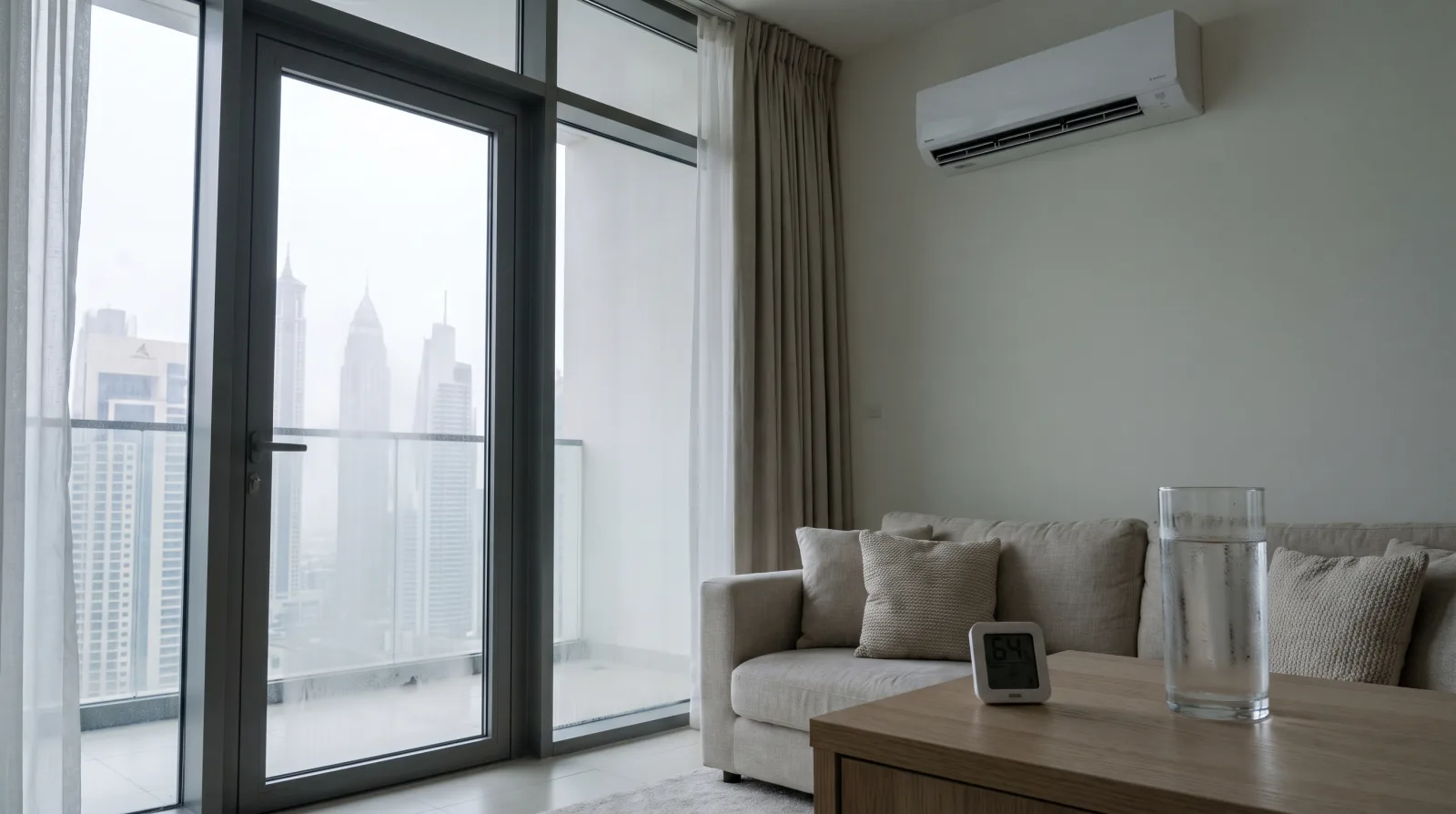
Every year, somewhere around the end of the hot season, a familiar thing happens in Dubai apartments. The weather outside turns pleasant. The AC stops fighting for its life. And the flat starts to smell faintly of a wardrobe that has been shut too long.
Most people blame the building, or the cleaning, or a towel that never dried. The cause is milder weather doing exactly what you wanted it to do.
TL;DR: Dubai's average relative humidity rises through autumn while temperatures fall. Your air conditioner removes moisture only while the compressor is running, so a milder month means shorter run times and less drying. The apartment gets cooler and stickier at the same time. The fix is to control humidity as its own target, instead of treating it as a side effect of chasing a temperature.
Dubai Gets More Humid as It Gets Cooler
Dubai's average relative humidity runs at 49% in July and 47% in August, then climbs to 52% in September, 54% in October and 56% in November (Climates to Travel). Over the same stretch, average daily highs fall from 41.9°C in August to 35.9°C in October and 30.7°C in November.
So the air in November carries a higher relative humidity than the air in an average August, at eleven degrees cooler. The two curves move in opposite directions, and that is the whole story.
The National Center of Meteorology describes the mechanism behind the autumn rise: relative humidity increases "especially during early morning as a result of the passage of moderate air masses over the Arabian Gulf towards the country, which enhance chances of formation of Fog/Mist especially over coastal areas" (Gulf News, 2024). The morning fog that shows up on Sheikh Zayed Road each autumn is the same moisture that ends up sitting in your living room.
Your AC Dries the Air Only While It Is Running
An air conditioner is a dehumidifier that happens to be sold as a cooler. Moisture condenses on the cold coil, collects, and drains away outside. That process needs time on the clock.
ENERGY STAR puts the requirement plainly: "In order for air conditioners to dehumidify or dry the air, they have to cycle long enough for moisture to condense on the coils and drain away" (ENERGY STAR, Right-Sized Air Conditioners).
The same document describes what happens when that time gets cut short. Short cycling reduces "the amount of condensation that drains off the coils" and "even allows some moisture to evaporate back into the air." Water that never reached the drain gets handed back to your living room.
A Mild Month Makes a Right-Sized AC Behave Like an Oversized One
Your AC was specified for a Dubai summer, and in a mild month it is carrying maybe half that load. It reaches your set temperature quickly, satisfies the thermostat, and shuts down before the coil has been wet long enough to drain much of anything.
A machine sized for 42°C is oversized for 31°C. It has not changed, but its job has, and it now behaves the way ENERGY STAR describes above: quick bursts, short cycles, very little water leaving the building. ENERGY STAR is writing about units that were oversized on the day they were installed, so applying it to a seasonal drop in load is our read rather than theirs.
The balance tips because your AC's two jobs do not shrink together. Cooling demand depends on how far the outside temperature sits above the inside one, and in a mild month that gap narrows sharply. The moisture arrives at the same rate regardless, from showers, cooking, laundry and the people in the flat, none of which care what the weather is doing.
What This Feels Like at Home
The temperature reading looks fine and the apartment does not.
Air feels heavy at a number that should be comfortable. Towels stay damp longer than they used to. There is a closed-cupboard smell in the wardrobe, and in the spare room nobody opens. Cold surfaces bead up: a water glass, a bathroom mirror, sometimes the inside of a window early in the morning.
Then people reach for the obvious lever and turn the temperature down, which makes things worse. A lower setting on a low-load day buys a slightly longer burst of cooling and a colder room, and the moisture still is not leaving. You end up in a flat that is cold and clammy at once, and paying for the privilege.
The natural assumption at this point is that the AC has broken. It rarely has. It is doing exactly what it was asked to do, which was to hit a temperature.
The Humidity Number to Aim For
The US Environmental Protection Agency's guidance is specific: "Indoor relative humidity (RH) should be kept below 60 percent -- ideally between 30 percent and 50 percent, if possible" (EPA). The EPA adds that holding that range may also discourage dust mites and pests. Above 60% is where damp stops being a comfort question and becomes a maintenance one.
A temperature and humidity sensor runs around AED 100 and turns an argument into a reading. Buy one that reports to your phone or hub rather than only showing a number on its own screen, because the display-only kind cannot trigger anything. Without one you are guessing about the single variable that explains how the room feels. We have written separately about what the number means and which AC setting moves it, and about how humidity behaves inside a Dubai apartment at the summer peak.
What to Change in a Smart Home When the Load Drops
In a mild month the reading worth holding is the humidity, and four changes get a smart home there.
-
Measure first. Put a humidity sensor in the room that feels worst, usually a bedroom or wherever the air moves least, and leave it a few days before changing anything.
-
Trigger on the humidity reading. A schedule built in July is aimed at heat, and it keeps aiming there long after the heat has gone. In a mild month the useful automation watches the sensor and calls for dry mode when the reading crosses your ceiling, whatever the temperature is doing. This is the change with the most effect, and the one a plain wall thermostat cannot make.
-
Favour long gentle runs over short blasts. A slightly warmer setting the unit holds for a long stretch removes more water than a cold setting it hits in six minutes and abandons. Inverter units are built for this and will settle into a long slow run rather than a stop-start cycle.
-
Leave the fan on auto. A fan that keeps blowing after the compressor stops passes air over a wet coil with nothing cold behind it. The US Department of Energy's Building America guidance sets the fan for humid climates so it goes "off at the end of the compressor cycle to allow the coil to drain" (Building America Solution Center). Running it on afterwards is the dry-climate setting, and it puts the water back.
A smart AC controller is what makes points two and three possible on an ordinary split unit, because it can act on a humidity reading. If you would rather have this set up properly, that is what our smart AC and climate work covers.
The Window Question
Some hours in the milder months genuinely offer drier air outside than in, and opening up is the least expensive dehumidification available.
Plenty of other hours do not, and early morning is reliably the worst of them. That is when the coastal moisture the NCM describes peaks and the fog forms. Open the windows then and you import the problem.
You cannot tell which is which by standing on the balcony, because skin is a poor hygrometer at a temperature that feels nice. The same sensor driving your dry-mode rule will tell you which hours are worth it, and in a well-sealed Dubai apartment the air only moves when you decide it does.
What Bayora Will Talk You Out Of
We will talk you out of buying a dehumidifier first. It is the intuitive purchase and usually the third-best one. A unit already on your wall, already plumbed to a drain, will do the work once it is asked correctly, and asking it correctly costs a sensor and a rule.
We will talk you out of a lower temperature setting as the answer. It treats a moisture problem with cooling and leaves you colder and no drier.
We will also talk you out of the opposite mistake. If a room sits above 60% for weeks whatever you do, that is not a settings problem. Look for a leak, a blocked condensate drain, or a bathroom extractor fan that has quietly stopped clearing the air, and fix the building before you automate around it.
Frequently Asked Questions
Why does my apartment feel humid when the weather is cooler?
Because relative humidity depends on temperature as much as on moisture. Cool the same air and its relative humidity climbs even if not a drop has been added. Meanwhile a smaller heat load means your AC reaches the set temperature and stops sooner, so it spends less time pulling water out. The room gets cooler and damper together.
What humidity level should a Dubai apartment sit at?
Below 60% is the level to hold, with 30% to 50% as the better target, per US EPA guidance. Above 60% you get the damp-cupboard smell, slow-drying laundry and eventually mould on cool surfaces. An inexpensive humidity sensor is the only way to know which side of that line a room is on.
Does turning the AC temperature down reduce humidity?
Not usefully. A colder setting buys slightly longer run times, but the limit is how long the compressor runs, and on a mild day that stays short. Dry mode, triggered by a humidity reading rather than a clock, does the job at a fraction of the running cost.
Should I use dry mode instead of cool mode in the milder months?
Dry mode is the right tool when a room already sits at a comfortable temperature but the air feels heavy. Run it from a humidity trigger and give it a stopping point, because left on permanently it will keep going and leave the room colder than you wanted.
Is a dehumidifier worth buying for a Dubai apartment?
For most apartments, not as the first purchase. Your split unit is already a dehumidifier with a drain plumbed outside. A portable dehumidifier adds a second machine, a tank to empty and more running cost, to solve a problem your existing hardware handles once it is controlled on the right variable.
If your rooms feel heavier than the thermostat suggests, tell us about your apartment and we will tell you where to put a sensor and what to automate first.
Ready to Get Started?
Get a free consultation and we'll recommend what makes sense for your situation.
Get Free Consultation