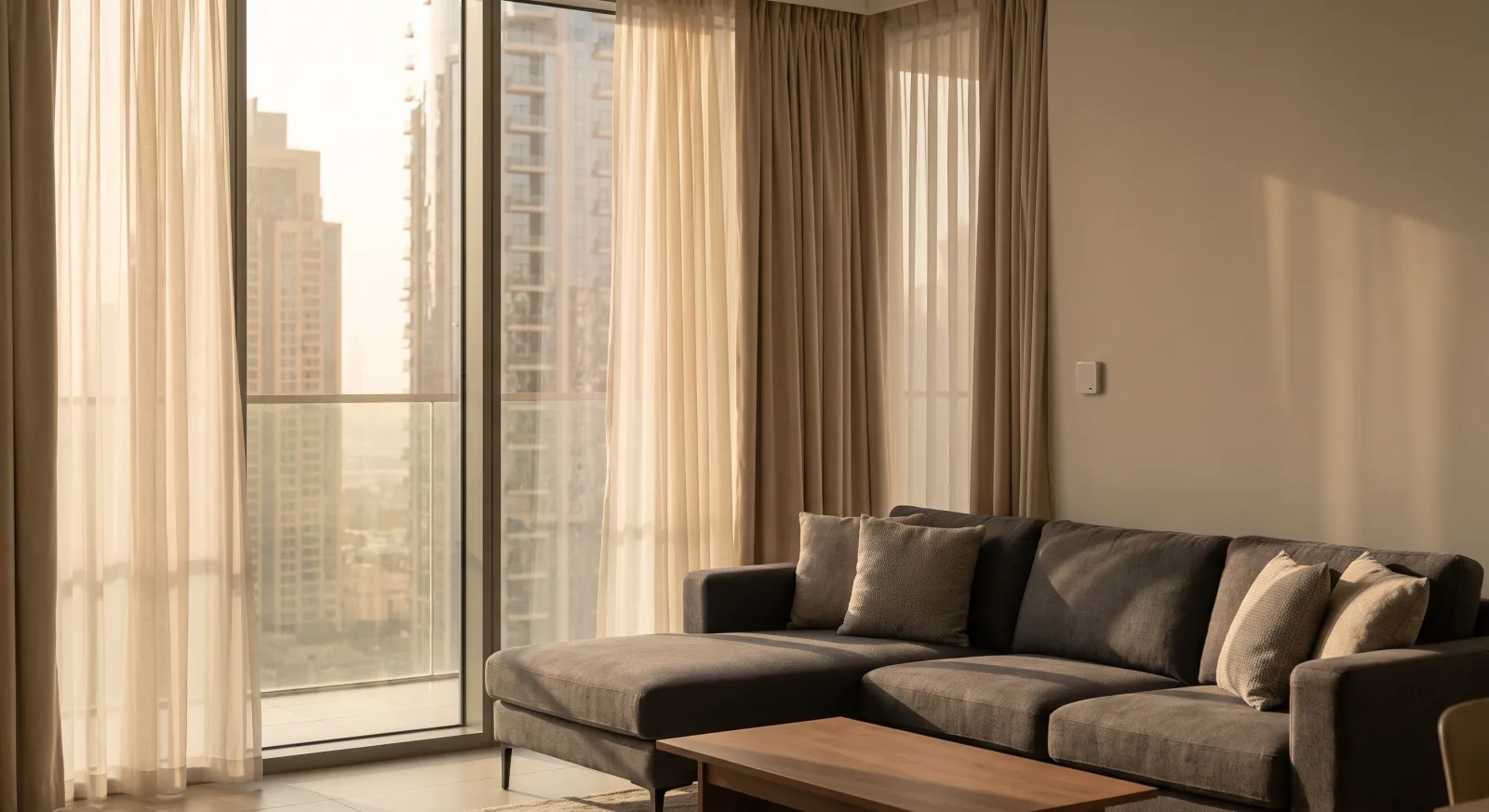
You own an apartment in Dubai. You are not in it. You will be there for two weeks in spring, maybe a fortnight later in the year, and between those visits the front door stays shut. Every guide to leaving a Dubai apartment is written for someone who lives in it and stepped out for a holiday. Your situation runs the other way around. Empty is the normal state of your apartment, and you are the visitor.
TL;DR: An apartment that sits empty most of the year needs three things a schedule cannot give you: a humidity reading you can see from anywhere, an alert that reaches you the moment water appears, and a way to know the connection carrying both is still up. Read your insurer's unoccupancy clause before you buy any of it.
Empty Is the Default State, and It Changes the Advice
The advice changes completely when the apartment is empty by default. A nine-day absence is a gap in a routine, and the routine resumes when you walk back in and notice what went wrong. There is no walking back in here. Whatever fails in February is still failing in July, and the first person to see it is you, on a visit, months later, or a neighbour whose ceiling has stained.
So the job stops being "set it up correctly before you leave" and becomes "know, from wherever you are, whether it is still true". Our vacation mode guide covers the pre-departure checklist and a cycled AC schedule. This post is about the months that follow.
The Unoccupancy Clause Most Owners Have Never Read
Most UAE home policies restrict cover for theft and water damage once a property has been empty past a continuous period, commonly 60 days. UAE brokers describe the clause as standard: most home insurance policies state that if the home is unoccupied for more than 60 consecutive days, certain covers, especially theft and water leakage, may not apply and claims can be rejected (InsuranceMarket.ae, 2026). A second UAE broker describes the same thing as an "unoccupancy clause", where cover "may be restricted or void" past a continuous period, and says you must tell your insurer about extended absences (Shory, 2026).
Both of those are broker summaries of a common clause, not a reading of your policy. Yours may say 30 days, 60, 90, or nothing at all. The point is that the two perils an empty apartment is least protected against are often the two the clause names. One phone call to your insurer settles it, and the answer may change what you bother installing. If water damage is the cover that thins out while you are away, the valve that shuts the mains by itself stops being optional.
Why the AC Can Hold Its Temperature and Still Leave the Air Wet
A setpoint controls temperature. It does not promise you a humidity number. An AC pulls moisture out of the air only while its compressor runs, so an empty apartment parked on a warm standby setpoint reaches that target in short bursts, drains less water out of the building, and lets some of what condensed on the coil evaporate back into the room after the compressor stops. The apartment can hold its temperature and still be wetter than you assumed. Leaving the AC on standby is the right instinct. It is where most owners stop.
The Number That Matters, and Where to Put It
The US Environmental Protection Agency's guidance is specific: indoor relative humidity "should be kept below 60 percent", and ideally between 30 and 50 percent (EPA). The same guidance notes that wet materials need to dry "within 24-48 hours" to avoid mould taking hold. Dubai's average outdoor relative humidity runs around 49 percent in July, climbing to 52 percent in September and 56 percent by November (Climates to Travel), and a closed apartment with the air conditioning idling can sit well above that indoors. We cover why the same machine behaves differently in shoulder season in our piece on Dubai apartment humidity when summer ends.
Start at 27 to 28 degrees in fan-auto, the standby setting we lay out for an empty apartment through a Dubai summer. A warm setting the unit holds for a long stretch removes more water than a cold one it hits in six minutes and abandons. Then stop guessing. You cannot resolve humidity from another country by reasoning about it, so put a humidity sensor in the room and read the number. For an apartment you visit twice a year, the sensor is what tells you the setpoint is working.
A Leak in an Empty Apartment Is a Different Event
A washing-machine hose or a corroded water heater behaves the same whether you are home or not. What changes is how long it runs. Nobody hears the drip, nobody sees the stain, and a leak that would have been a mop and a phone call becomes a floor, a neighbour's ceiling, and a conversation with building management.
This changes what you should buy. A leak sensor with a local siren is designed for a household that can hear it. In an empty apartment the siren is decoration, and the alert path is what you are paying for: the sensor has to reach your phone, wherever your phone is. The step beyond that is a valve controller, a motorised actuator that closes the mains valve automatically when a paired sensor gets wet, which we go through in detail in our guide to smart water leak detection in Dubai apartments. Auto-shutoff is the only part of that chain that acts without you.
Decide Who Attends Before You Go
An alert nobody can act on only tells you when the damage started. Pick one person who can be in the apartment within the hour, a property manager, a neighbour or a relative, give them a key or a door code and the location of the mains valve, and tell building management the name. It costs nothing to arrange, and it is what turns a notification into a repair.
The Internet Is the Whole Chain
Every sentence above depends on one link: the apartment's connection to the outside. The humidity reading, the leak alert and the camera view all travel the same path, and if the router stops, they all stop together.
The failure is quiet, which is why it gets missed. A dark app does not announce a flood or a dry, cool, perfectly fine apartment. It shows you the same nothing either way, and most people read nothing as fine. Routers in Dubai apartments drop for ordinary reasons, and we wrote about the usual causes in why your WiFi keeps dropping smart devices.
So ask for an alert on absence, not only on events. If a sensor has not reported in for a set period, that silence should itself produce a message, and the thing watching for the silence has to sit outside the apartment. A watchdog running on the hub in your living room goes quiet in exactly the outage you wanted it to catch. A system you have to remember to check is a system that will not be checked. It should be the one contacting you.
The Accounts Everything Runs On
Lose the DEWA account and the router, the AC and anything mains-powered stop together. Lose the internet line and the apartment keeps cooling while you stop hearing from it, which looks exactly like the silent failure above. If the building is on district cooling, there is a third invoice from the cooling provider, separate from DEWA, and it lapses just as quietly. Put them all on auto-debit before you go.
What a Power Cut Leaves Behind When Nobody Resets It
A short outage is a minor event in an occupied home. Somebody notices the clocks, opens an app, puts things back. In an empty apartment the outage is the beginning of a state that lasts until your next visit.
Devices come back in whatever way their power-on setting says, and most of those settings were never chosen by anyone. Lights can return at full brightness and stay there for months. An infrared AC controller is the sharper problem: it sends commands at the AC, it does not read the AC, so after an outage its app can show cooling at 24 while the unit sits idle. We go through each device's behaviour in what your smart home does after a power cut.
This is the second reason to put a sensor in the room. The app shows you what the controller last asked for, and only the sensor gives you the number the apartment is sitting at.
Access for the People Who Do Go In
A smart lock turns access into something you can issue and withdraw from anywhere. A code that works on Tuesdays, a code that expires at the end of the month, a code for one visit, and a log showing which one opened the door and when. You are away, but the apartment is not untouched: a cleaner comes through, a property manager does an inspection, a relative collects post, a technician services the AC. Every one of those is a handover, and couriering a physical key from another country is the part that does not work. We explain the mechanisms, and the limits, in how smart locks actually work in Dubai.
Two practical notes. Check with building management before changing anything on an apartment door, because some buildings have rules about it. And a lock with a physical key override is worth having, because a flat battery you cannot drive over and fix is otherwise a locksmith's problem.
What Bayora Will Talk You Out Of
A camera as the answer. A camera shows you a room. It does not measure humidity, it will not notice water behind the washing machine, and it needs somebody to look at it. For an empty apartment, a sensor that contacts you beats a lens you have to open.
Automations for an audience of nobody. Lighting scenes, wake-up routines and evening moods are worth every dirham in a home somebody lives in. In a flat that is empty for months, they are complexity with nothing to show for it. The one exception is a lamp or two on a varying evening schedule, whose only job is that the flat does not read as empty from the street. That is the one lighting task left in a home nobody is in. Put the rest of that budget into the things that report and act.
Anything that charges a subscription to send an alert. A notification is a notification. Paying monthly to be told your floor is wet is a bad trade, and it is the kind of ongoing cost that quietly outlives your interest in the system. Cloud video storage is a fair thing to pay monthly for, if you decide later that you want it. Before you buy anything, read the manufacturer's own app page for what its free tier covers, and check that leak, temperature and device-offline alerts are in it.
A big install ahead of your next visit. The sensible order is to fit the small reporting layer first, live with it for one cycle, and decide the rest when you are physically standing in the apartment.
Where to Start
Start with the reporting layer, because it is small, it is reversible, and it tells you whether anything else is needed.
- A temperature and humidity sensor in the main living space
- Leak sensors at the water heater, behind the washing machine, and in the AC drain pan, which is the one that matters most when a unit runs unattended for months
- Alerts that reach your phone, plus a no-report alert so you hear about silence as well as about water
Our leak detection guide prices that sensor layer in detail. Add to it only if the readings justify it: a valve controller if the plumbing is old or the apartment sits above other homes, a smart lock if you are handing access to more than one person, and an AC controller if the sensor shows that 27 to 28 in fan-auto is not holding the room under 60 percent, since a controller is what lets you lengthen the run from wherever you are. That last tier is where our Smart Home Starter package begins, from AED 3,000 installed.
Fitting It When You Are Not Here
You do not have to be in the apartment, but somebody does. The reporting layer is battery sensors and an app, and there are two practical routes. Book it into the first days of your next visit, so you watch the readings start while you are still in the room and can move a sensor that sits somewhere useless. Or arrange it around whoever already has access, a property manager, a cleaner or a relative, who opens the door for one appointment.
Either route needs a person in Dubai who can let us in, plus a photo of the water heater and the washing-machine recess beforehand so we know what we are walking into. We fit and configure the smart layer. The plumbing behind it stays a plumber's job, and no sensor changes that.
An owner who is not in the country is better served by three devices they trust than by a system they half understand. You can always add to a small setup. Debugging a large one from another time zone is the part that goes badly.
Frequently Asked Questions
Can I manage a Dubai apartment from abroad without a property manager?
For the physical building you still need somebody who can attend: a leaking tank needs hands, not an app. What smart devices change is that you find out early, you know what to tell whoever attends, and you can let them in without couriering a key.
Do I need to tell my insurer my Dubai apartment is empty?
Both UAE brokers quoted above say yes, in the same terms: inform the insurer if you plan long periods away. It is a phone call, it usually costs nothing, and doing it before a claim is the difference between an unoccupancy clause being a formality and being the reason a payout is refused.
What temperature should I leave the AC on in an empty Dubai apartment?
Start at 27 to 28 degrees in fan-auto. For a week or two you can cycle it a few hours every day or two instead. For months we prefer a held setpoint, because a long gentle run removes more water than a short cold blast, and because a cycle that quietly stops firing in February is not discovered until your next visit.
What happens to my smart home if the internet goes down while I am away?
Remote access stops, and anything running locally on a hub keeps running without you. The important part is that your alerts go quiet, so ask for a notification when a device stops reporting, not only when something goes wrong.
Do smart devices work in an apartment with no one living in it?
Yes, with two conditions. Mains-powered devices need a power-on setting chosen deliberately, so an outage does not leave them in an odd state for months. And coin-cell sensors want replacing on your visits rather than when they die, because a fading cell can drop a sensor offline quietly while the app still shows it as healthy.
The Apartment Should Be Able to Tell You
An apartment you visit twice a year has to report on itself, because nobody else will.
If you own property in Dubai and you are not here most of the year, get a free consultation, by call or WhatsApp, in whatever time zone you are in. We will tell you the two or three things worth fitting for your apartment, and which of the rest you can safely ignore.
Ready to Get Started?
Get a free consultation and we'll recommend what makes sense for your situation.
Get Free Consultation