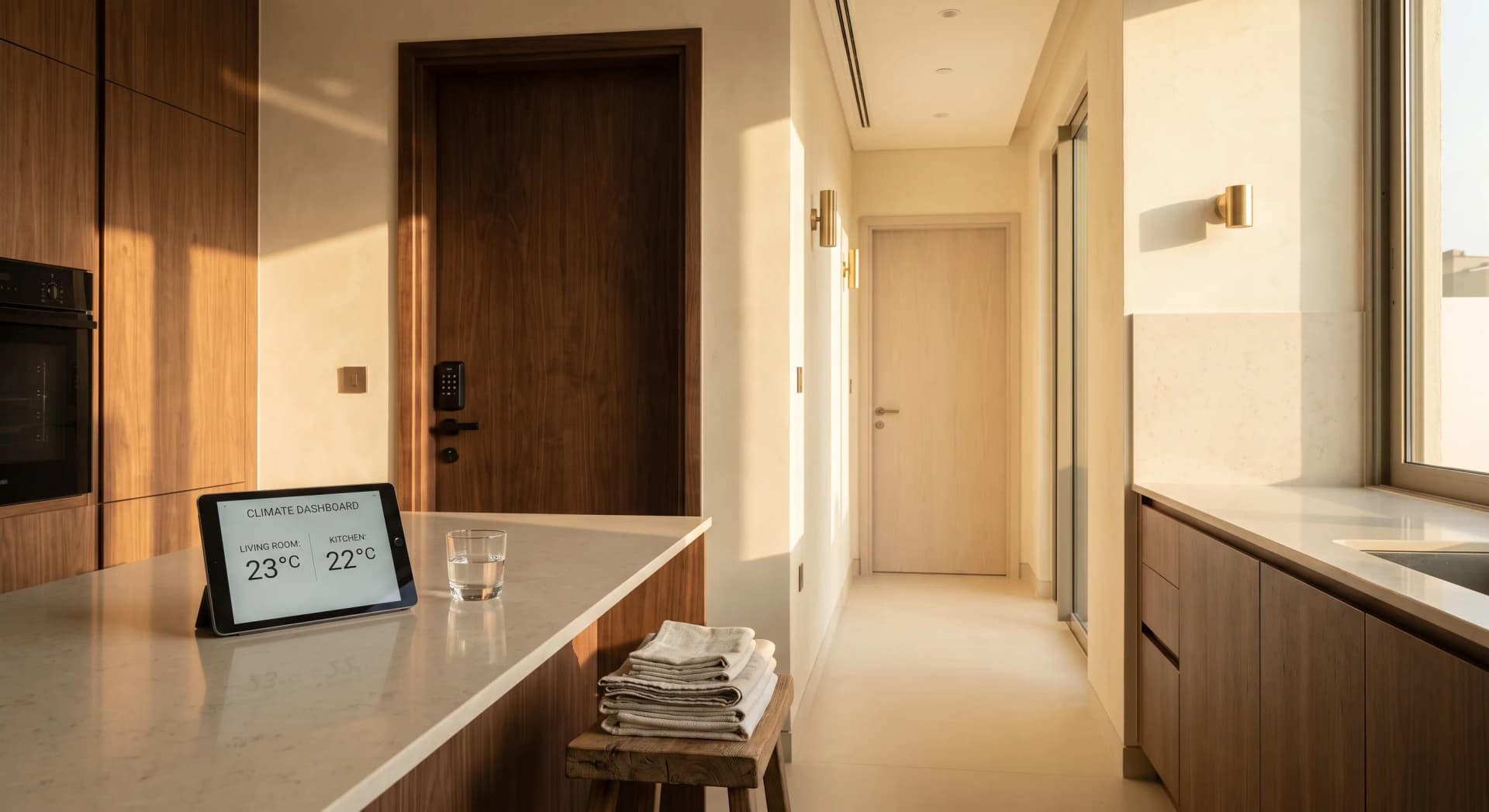
The house empties at eight. The school run finishes, the last car leaves, and the automations do what they were told: AC eased back, lights off, the whole home dropping into the mode it holds until somebody comes back at six.
Except somebody never left. She is in the kitchen, then the laundry, then the room at the end of the corridor past the utility door. For ten hours a day the house treats her as nobody, because when the system was set up, the only people anyone thought to configure were the family.
TL;DR: In a Dubai home with live-in help, the house is occupied during the hours your automations assume it is empty, and the maid's room is the one room nobody put on a schedule. Give it its own cooling schedule, give her a door code of her own, put a physical control in her room, and keep cameras out of it.
We install smart homes across Dubai, and in villa projects it is one of the first things we ask about. The floor plan already accounts for live-in help. Bayut and Property Finder both run "with maid's room" as a standing search filter on Dubai listings (Bayut, 2026; Property Finder, 2026). The smart home almost never does.
The Maid's Room Is the Room Nobody Puts on a Schedule
Walk a Dubai villa handover and you will usually find the same thing. Every bedroom has a thermostat someone has opinions about. The room past the kitchen has one nobody has touched since the developer set it.
In the homes we have worked in it is also the worst-placed room in the floor plan for cooling: an interior wall, a small window or none, and often an AC branch shared with the kitchen or the laundry, so it gets whatever is left after two heat-producing rooms have taken their share. It is usually also the room furthest from the thermostat that governs it, so the number on the wall and the temperature in the room rarely agree.
Then the family schedule sets the whole ground floor back to 26 at nine in the morning, and that room goes to 28 and stays there. Nobody notices, because nobody who sets the schedule is ever in it.
A House With Live-In Help Is Never in Away Mode
Away mode is the first automation we go back and unpick in these homes. The logic is sound in a normal house: last phone leaves, cut the cooling, drop the lights, arm the system. In a house where someone lives in, that same rule fires while a person is standing in the kitchen.
UAE law is precise about the hours and quiet about the room. A domestic worker is entitled to at least 12 hours of rest a day, of which eight must be consecutive, and to one full rest day a week (Cabinet Resolution No. 106 of 2022, Articles 7-8). Article 11 obliges the employer to "prepare an appropriate accommodation for the domestic worker" and to maintain her dignity and safety (MOHRE, 2022).
Appropriate is where the detail stops. Neither the Decree-Law nor its executive regulations set a floor area, a window requirement or anything else about the room, and the UAE's detailed labour-accommodation rules are cross-referenced for recruitment agency housing rather than a private home (MOHRE, 2022). So whether that room is liveable in August is decided by whoever writes the cooling schedule.
In practice that reduces to one number: whether the room holds 24 while the rest of the house is set back. Presence-based cooling handles this without anyone thinking about it: the room conditions when it is occupied and rests when it is not, on its own schedule rather than the family's. This is the same room-by-room zoning problem that makes one bedroom in a Dubai villa colder than the next, applied to the room nobody measured. It is the core of what smart AC control is for.
Give Her a Code of Her Own, Not the Family's
The usual setup is one shared PIN that everybody in the household uses, including whoever is currently working there. It fails in a specific way. When she leaves and a new person starts, you either change the code for all six people or you leave the old one live.
Mainstream smart locks solved this years ago and almost nobody uses the feature. Yale's Assure locks with Wi-Fi have three access types, Always, Temporary and Recurring, where a recurring schedule repeats on set days and hours (Yale, 2026). Aqara's locks do the same, with passwords that can be permanent, periodic or one-time, and the one-time codes generated locally so they still work when the lock is offline (Aqara, 2026). If you are still choosing hardware, our roundup of smart locks for Dubai homes covers which models handle scheduled codes well.
A live-in housekeeper should have a permanent code that is hers. A weekly cleaner should have a recurring one, the same mechanism we use for courier and delivery access. When somebody leaves, you revoke one code and nothing else in the house changes. You also get an accurate record of who opened the door and when, which matters more for settling honest confusion than for catching anyone.
The App Permission You Want Does Not Exist
This is the part most guides get wrong. What you want is to give her control of her own room's cooling and lighting and nothing else. No mainstream platform will do that.
Apple Home has two shared roles. Residents get "local and optional remote access to all accessories in the home at any time." Guests get "local-only access to specific doors, locks, and other security-related accessories on a set schedule" (Apple, 2026). A Guest can be handed a door on a schedule and cannot turn on a light or touch a thermostat. The choice is Resident, which grants the whole house, or nothing.
Google Home is no finer grained. A Member cannot add, remove or share devices, but the optional Settings permission an Admin can grant lets that person manage all device controls across the entire home (Google, 2026). It scopes what she can change, not which rooms she can reach. Alexa is the honest weak spot. Alexa profiles personalise what you hear back rather than restrict what you can control, and Amazon offers nothing equivalent to Apple's Guest or Google's Member role, so anyone who can speak to an Echo can operate most of what is connected to it. Doors are the exception worth knowing: Alexa will not unlock a lock by voice unless you switch that on and set a spoken PIN. If the house already runs on Alexa, do not rebuild it. Keep the voice layer for the family and give her a keypad and her own lock code instead.
There is a second reason to keep her off the family's home account rather than inside it. Whoever holds that account holds the whole house, and on Google an Admin can add and remove other people, including the person who set it up.
So stop looking for a permission setting. Put a physical control in the room instead: a wall keypad or scene switch in the maid's room that runs her cooling and her lights, plus her own code on the door she uses. She gets exactly what she needs, it works when her phone is dead or her data has run out, and nobody has to be added to the family's home at all.
Cameras Belong in Some Rooms and Not Others
Indoor cameras go wrong in both directions. Some put nothing anywhere, then have no record of anything that happens in the house. Some put a camera in the maid's room, which is somebody's bedroom.
The line we hold on every install is simple. Cameras go in shared and entry spaces: the main door, the hallway, the living room, the kitchen if you want it. They do not go in any room a person sleeps in, changes in or washes in. UAE law draws the same line. Article 44 of Federal Decree-Law No. 34 of 2021 makes it an offence to photograph or record someone in a public or private place without their consent, punishable by imprisonment of at least six months, a fine of AED 150,000 to AED 500,000, or both (BSA Law, 2021). A maid's room is a bedroom.
Clients ask whether to tell her. Yes, and show her where they are. A camera nobody mentioned is the one that causes a problem later. We cover the full placement question in our guide to indoor security cameras in Dubai apartments.
Train the Person Who Uses the House Most
She will use this system more hours a week than anyone else in the household, and she is usually the last person anyone thinks to show it to.
We train every person in the home on handover day, and that includes the housekeeper. We skip the app tour and cover the five things she actually needs:
- How to override the cooling in a room she is cleaning
- What to do when a bulb stops responding
- Which scene resets the house before the family gets back
- How to let a delivery in
- Who to message when something behaves oddly
Skip it and the system gets worked around instead of used. A door propped open, a light left on manually, a thermostat pushed to a setting that fights the schedule every day. That is what anybody does with a system nobody explained to them.
Frequently Asked Questions
Can a maid's room have its own AC schedule if the villa has central cooling?
Usually yes, though it depends on how the villa was piped. Where the room has its own thermostat, a smart controller gives it its own schedule directly. Where it shares a zone with the kitchen or utility area, a smart thermostat plus a room sensor lets you hold a target for that room specifically. Worth checking your own thermostat layout before assuming either.
Should a housekeeper have access to the security cameras?
No, as a default. Camera access is a household-owner function, and giving it out creates awkwardness in both directions. Give her the door access and the room controls she needs to do the job, and keep the camera feed with the people who own the home.
What happens to her door code when she leaves?
You delete that one code in the lock app and every other code in the house keeps working. This is the whole reason for issuing individual codes rather than one shared PIN, and it takes about thirty seconds.
Is it legal to put a camera in a maid's room in the UAE?
No. Recording someone without consent is an offence under Article 44 of Federal Decree-Law No. 34 of 2021, punishable by imprisonment, a fine of AED 150,000 to AED 500,000, or both (BSA Law, 2021). This is general information, not legal advice. Beyond the legal position, filming someone's bedroom is not something we will install. Cameras belong in shared and entry areas.
Does a live-in housekeeper mean smart AC saves us less?
It changes where the saving comes from. The house is never empty, so the empty-house saving is off the table. The saving comes from cooling by room instead of by floor: the three bedrooms nobody is in during the day set back while the two rooms in use hold their temperature.
Setting Up the Home Around Everyone in It
A smart home is a set of assumptions about who is where and when. We hit the same problem in multigenerational Dubai households, where the system was built around one generation's routine. In a household with live-in help, one of those assumptions has been wrong from the day it was installed, and the person it is wrong about is the one least likely to raise it.
Fixing it takes an afternoon. The maid's room gets its own schedule, the shared PIN gets retired, and she gets trained on handover day along with everyone else.
If your home has a room nobody ever configured, we can look at it with you. Book a free consultation and we will walk the floor plan room by room, including the ones the last installer skipped.
Ready to Get Started?
Get a free consultation and we'll recommend what makes sense for your situation.
Get Free Consultation