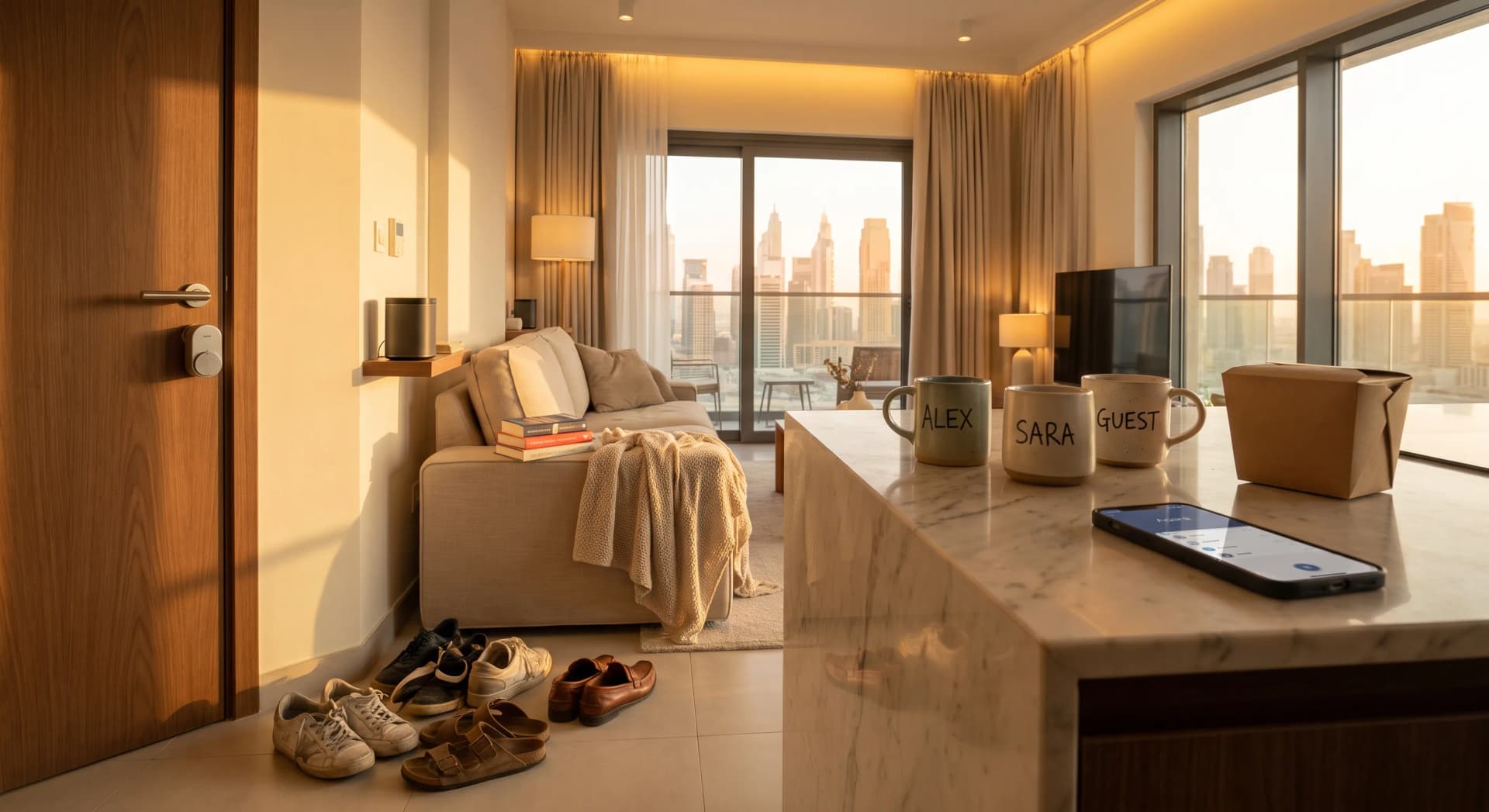
You and your two flatmates split the rent through an app that rounds to the fils. The Talabat order gets itemized in the group chat before the driver has even left the restaurant. Careem rides get split by whoever was in the car. Every cost in this apartment has a system.
Then you look at the apartment itself. There is one AC remote, and it lives wherever the last person who used it left it. There is one spare key under a mug on the kitchen counter, copied at least twice, and nobody remembers by whom. The WiFi password is still the one taped to the router since move-in day, which means the flatmate who moved out last year almost certainly still has it memorized.
TL;DR: Most smart-home advice assumes one household, not two or three unrelated adults splitting the rent. A shared flat needs personal access codes instead of one spare key, per-room AC control instead of one fought-over remote, and a smart plug so the DEWA bill splits by use. From AED 5,800 for a 2-bedroom, about AED 1,900 each split three ways.
Why the usual smart-home advice assumes one household
Almost every smart-home guide, including several of ours, is written for one household deciding together: a couple, a family, or a single renter in a studio. A shared flat is a different shape. Two or three people who are not related, keep different hours, split the same DEWA bill, and each have their own idea of what counts as a comfortable temperature.
Flatsharing has become the fastest-growing segment of the UAE rental market, with private rooms in Dubai running roughly AED 2,200 to 4,500 a month and master rooms AED 3,500 to 6,500 and up (roomiefinder.ae, 2026). A lot of that demand sits in the apartment towers: Dubai Marina, JBR, JLT, Business Bay. Those flats are new enough to take this kit and old enough that three unrelated tenants were never what the floor plan had in mind. People paying that rent have already automated everything else about splitting a life together. Everything except the flat itself.
The spare key problem
Most flatshares in Dubai run on one physical key, or one key per original tenant, with no record of who holds a copy. It works fine until someone moves out and everyone realizes nobody knows how many keys exist, or a flatmate's friend "just borrows" the spare for a week and it never quite comes back.
Swap the key for a code and the whole problem changes shape. In our experience the door decides what you can fit. If yours runs a compatible Euro mortise lock, the Aqara U200 retrofits straight onto it without changing the keys or modifying the door structure, and fitting it needs no tool beyond a screwdriver (Aqara, 2026).
From there it takes personalized codes on its keypad, plus one-time and periodic codes for anyone who needs access on a schedule rather than permanently. Each flatmate gets a code of their own, so the day-to-day way into the flat stops being a shared key with an unknown number of copies.
Splitting a DEWA bill nobody can prove
Shared flats usually split electricity by headcount, flat, regardless of who ran the AC at 18 degrees all night and who was barely home. Nobody can check who used what, so the same argument comes back every billing cycle.
An energy-monitoring smart plug settles the argument. It sits between an appliance and the wall outlet and measures what that appliance draws, hour by hour, in real time (evvr.io, 2026). Instead of a three-way guess, the group gets a record.
One limit worth naming. A hardwired split-AC unit does not pass through a wall outlet, so a plug cannot read its draw. Pair the plugs with a per-room temperature sensor and you still get a fair answer to who runs their room coldest, which is the question being argued about.
Giving each bedroom its own temperature
Outside the district-cooled towers, most Dubai apartments already run one wall-mounted split AC unit per bedroom. Flatmates rarely realize how much that works in their favor: each bedroom's unit can get its own smart controller, learning that bedroom's own remote, so each person sets their own room without touching anyone else's. Pair each controller with its own temperature sensor, because the AC unit's built-in sensor sits up inside the wall unit rather than at head height where the room feels warm or cold.
Bedrooms are the easy part. The living room is where it gets fought over, because nobody agrees on 22 versus 25 and the person sitting closest to the remote tends to win. Our smart AC and climate control page goes deeper on controllers. For a shared flat the short version is that bedrooms run independently from day one, and the living room runs on a setting the group agreed once, rather than on whoever picked up the remote last.
The common-area truce
Common areas have to work for everyone at once, which is exactly why nobody bothers to automate them. One shared scene fixes that: triggered from a wall button or the app, it sets an agreed default for lights, AC setpoint, maybe the Sonos, and removes the daily negotiation over the remote. Nobody has to ask who last touched the thermostat, because the button resets it to what the group agreed on.
It is a small thing that quietly ends a recurring argument. And it does not require everyone to download an app and log in: a physical wall button works for whoever is standing in the room, guests included.
What changes the day someone moves out
Dubai flatshares turn over constantly, and this is where the spare-key setup fails. A departing flatmate hands back one key, but there is no way to know whether that was the only copy. That leaves two options: trust it, or pay a locksmith to re-key the door.
With a smart lock you delete the departing flatmate's code, and their everyday way in is gone the same afternoon. Worth being straight about the limit. The U200 fits over the cylinder you already have, and the original keys still open the door for emergency access (Aqara, 2026). Deleting a code does not retire a key that was cut two tenants ago.
The codes are the easy half. If the departing flatmate is also the one whose phone the smart home was set up on, their account still runs the flat after they have gone, and removing them from the home app may not remove their access in each device's own manufacturer app.
What the lock changes is that access becomes a list you can read and edit, instead of a count of metal copies you were never keeping. If you have real reason to think a copy is circulating, re-keying the cylinder is still the answer, and it becomes a decision you make on evidence rather than a shrug.
Check with your landlord before you change who holds a key
Two rules matter here. First, a tenant needs the landlord's written consent before subletting or letting anyone else use the property, unless the tenancy contract already allows it (Gulf News, 2026). Second, Dubai Law No. (4) of 2026 takes effect on 26 August 2026, 180 days after it was published in the Official Gazette (Gulf News, 2026).
That second law decides who is allowed to rent out shared accommodation. Only owners, or companies authorised to manage or lease a unit on the owner's behalf, may do it, and tenants are barred from subletting any part of a shared housing unit. If your flatshare runs on one person holding the lease while the others pay them, read it properly rather than assuming it is aimed at somebody else.
None of it changes how a smart lock works. The practical takeaway is smaller than the legal language sounds. Talk to your landlord before you change who has access, the same courtesy as handing someone a key. Then read your own contract for what it says about occupancy and modifications.
What this costs split three ways
A shared 2-bedroom running the full basket starts around AED 5,800: a retrofit smart lock with its own codes, an AC controller for each bedroom, and a smart plug or two in the living room. Split two ways that is about AED 2,900 each, split three ways closer to AED 1,900. A 3-bedroom lands nearer AED 7,300, because the third bedroom adds another controller, which is about AED 2,400 a head across three flatmates.
Set that against what the same people already pay to live there. A master room in Dubai runs AED 3,500 to 6,500 a month, against AED 2,200 to 4,500 for a private one. Split three ways, each flatmate's share of the setup comes to less than a single month of the bigger room, paid once. If that is more than the group wants to spend at the start, the smart lock alone solves the access half of the problem and the AC controllers can come later, one room at a time.
What Bayora will talk you out of
We will not sell a shared flat a setup where one flatmate becomes the administrator of everyone else's access and settings. That moves the spare-key problem onto one person's phone instead of solving it. We also skip whole-apartment voice assistants in a flatshare unless everyone wants a shared speaker picking up their conversations. And we do not put cameras anywhere but the shared front door. Pointing one at a living room means recording your flatmates at home, which is not something a security feature should quietly ask them to accept.
Frequently Asked Questions
Do we need our landlord's permission to add a smart lock to a shared apartment?
Permission for the hardware is rarely the issue, since a retrofit lock leaves the door itself untouched and comes off when you go. What landlords care about is who is living there and who can get in, so raise it as an occupancy conversation rather than a hardware one, and check whether your contract names a maximum number of occupants.
Who pays for a smart home in a shared flat, and what happens if one flatmate refuses?
Usually the group splits whatever is shared, the lock and the common-area kit, and each person covers their own bedroom controller. That structure survives someone opting out: a flatmate who does not want to contribute keeps their room manual, and nothing else in the apartment stops working because of it.
Can each roommate control their own room without the others interfering?
Yes. Each bedroom's AC controller is paired to that room and to the person living in it, so your setpoint is yours alone. Nobody needs a shared password for their own room, and there is no reason for a flatmate to be in your bedroom settings. Common areas are the only thing the group sets together.
What happens when a flatmate moves out mid-lease and a new one moves in?
You delete the leaving person's code and issue the new arrival theirs, and the rest of the household keeps the codes they already use. That settles everyday access immediately. It does not retire an old physical key, because the original cylinder stays in the door, so if you suspect a copy is out there, re-key the cylinder as well.
Does this work if we're renting month to month or on a short lease?
Yes. Everything in this setup is retrofit and renter friendly: it clamps, sticks, or fits over what is already there rather than wiring in, and it comes off and travels with whoever bought it when the lease ends or the flatshare changes. That matters in a flatshare, where the group composition often changes faster than the tenancy does.
Start with the argument you actually have
You already split rent to the fils and itemize a Talabat order in the group chat. The apartment is the last thing in your shared life still running on one key under a mug and one remote nobody can find. Fixing that takes a lock and two AC controllers, not a whole-home project.
Tell us about your flat and we'll walk through your building, your AC setup, and how many of you are splitting the bill.
Ready to Get Started?
Get a free consultation and we'll recommend what makes sense for your situation.
Get Free Consultation