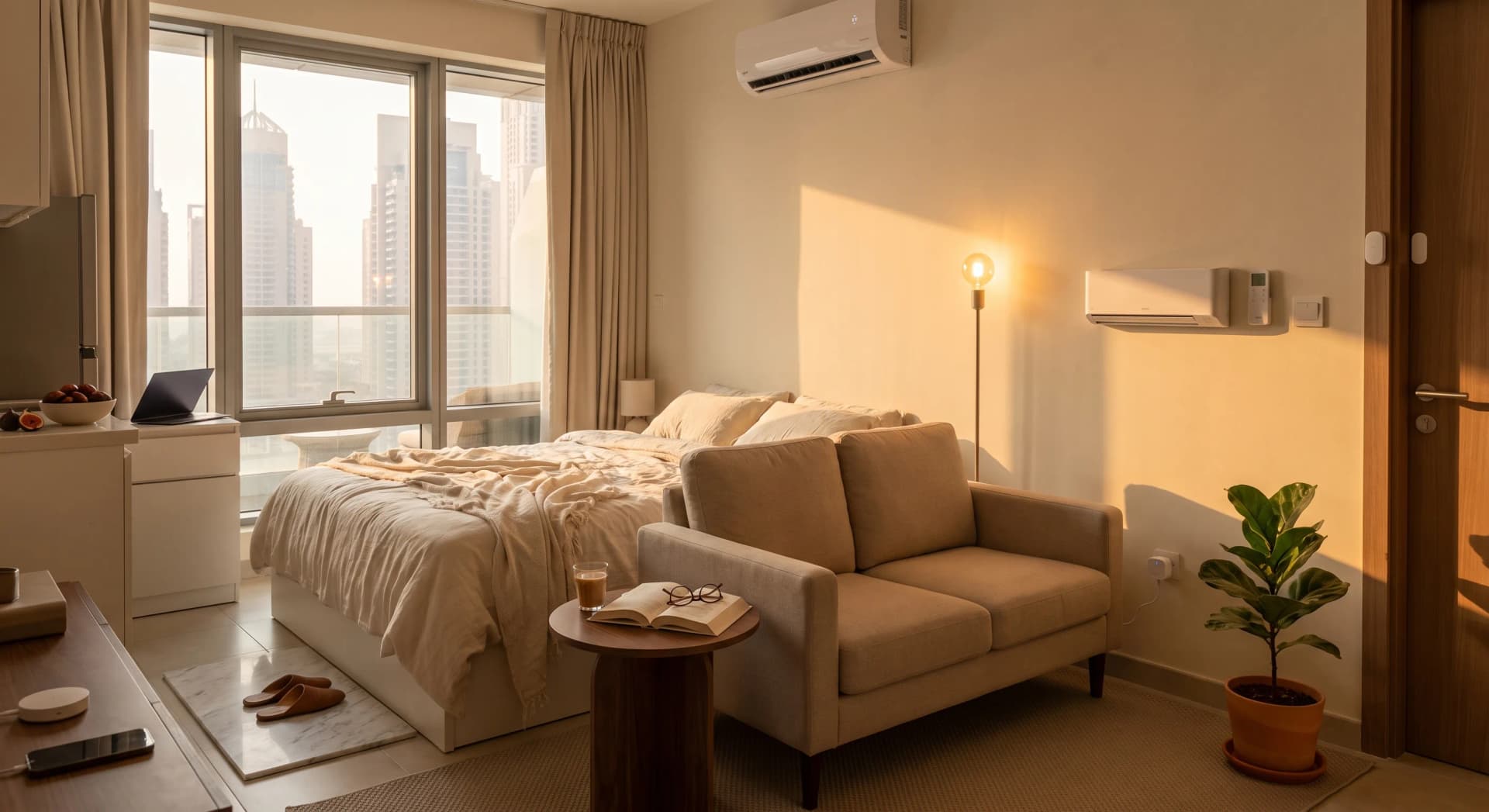
Most people in a Dubai studio assume smart home tech is for people with more rooms than them. It is for villas with zones, and for two-bedrooms where the kids' room and the master need different schedules. It is not, they figure, for one room, one window, and a kitchenette you can touch from the bed.
That belief has it backwards. A studio is the easiest place in Dubai to get a smart home right, and the cheapest place to get it completely right instead of half-right. You have one room, so one scene runs the whole home. You rent, so everything you add has to come off in an afternoon, which keeps you away from the expensive permanent stuff you would regret anyway. And you have one AC unit doing all the work in a 45-degree summer, so the single highest-impact upgrade is obvious.
TL;DR: A studio is the simplest smart home in Dubai because one scene controls the entire apartment. Start with smart AC control (your one unit is doing everything), add a couple of smart bulbs and a plug, and a battery door sensor. A full renter-friendly studio setup runs from AED 3,000 installed, everything is wireless, and it all comes off the wall when you move. No landlord approval, no drilling.
Why a Studio Is the Simplest Smart Home in Dubai
In a two-bedroom you build separate scenes per room. The master sleeps at 21, the kids' room needs a nightlight, the living room hosts. In a studio, "good night" and "I'm leaving" each touch the whole apartment at once, because the whole apartment is one room. That makes a studio the fastest smart home to plan and the fastest to feel finished.
It also makes the money go further. The AED 3,000 starter that gets a two-bedroom its first system is, in a studio, close to the whole job. You are not buying a first step. You are buying most of the destination. In our experience surveying studios across Marina, JVC, and Business Bay, the gap between "one gadget plugged in" and "the apartment runs itself" is a couple of thousand dirhams and one afternoon.
Everything Is Visible, So It Has to Look Right
In a villa the hub lives in a utility cupboard and the wiring hides in a riser. Nobody sees it. In a studio, the smart plug behind the lamp, the bulb, the sensor by the door, and the little hub on the console are all in your eyeline from the bed. Kit that looks bolted-on ruins a small room faster than it helps.
So the rule in a studio is tidier than anywhere else. Pick devices that disappear: a bulb that just looks like a bulb, a controller that sits flat and white next to the AC, a hub the size of a coaster. Skip the RGB light strips that turn a calm room into a gaming rig unless that is the look you actually want. One thing clients always ask is whether smart means visible clutter. In a studio, done right, it means the opposite. The room looks the same and behaves better.
The Three Things Worth Doing First
You do not need fifteen devices. You need the three that carry a studio, in this order.
Smart AC control
Your studio has one split AC or one district-cooling fan-coil, and it is doing everything. That makes climate the single highest-impact upgrade, more than in any villa where the load is spread across units. A wireless smart AC controller sits next to your existing unit, learns its remote, and lets you set a schedule from your phone: off while you are at work, cooling before you get home, holding a steady temperature overnight instead of you cranking it to 18 and freezing at 3am. Smart AC control typically reduces cooling energy by 15 to 30 percent on average (Sensibo, 2025), but the reason to do it in a studio is comfort. One unit, one room, one thing that finally runs on your schedule instead of your memory. Renters can add this without touching a wire or asking a landlord. Full detail on how that works is in our guide to smart AC for renters.
Lighting you can set once
A studio usually has one or two ceiling points and a lamp or two. That is all you need for scenes. Two or three smart bulbs plus a smart plug for the floor lamp gives you a "morning" that comes up warm and bright, an "evening" that drops to a low glow, and a "good night" that kills everything from your phone. You are not rewiring. Smart bulbs are the renter's answer because they screw into what is already there and go in the box when you move (PCWorld, 2025). In one room, three bulbs is a whole lighting system, not a starting point.
A door sensor and a leak sensor
The two cheapest devices in a studio earn their place immediately. A battery door sensor tells you the front door is open, or that it opened while you were out, and can trigger the AC to pause and the lights to come on. A leak sensor under the kitchenette sink matters more in a studio than anywhere, because your bed is three metres from your plumbing. Both are peel-and-stick, both run for a year or two on a battery, and both come off clean when you leave.
Everything Comes Off When You Move
This is the part that stops most studio renters before they start, and it should do the opposite. A studio renter moves often. One-year leases, a new building when the rent jumps, a bigger place when the salary does. So the whole setup has to be portable, and a renter-friendly studio build is portable by design.
The controller unclips from beside the AC. The bulbs unscrew. The plug pulls out. The sensors peel off and leave nothing but a clean wall. In our experience it takes about twenty minutes to pack a studio's entire smart home into a shoebox, and it all works again the same evening in the new place. Nothing here is glued to the building. That is the difference between renter kit and owner kit, and in a studio you want renter kit even if you could drill, because you will thank yourself at the next move.
The One-Router Advantage a Studio Has
Big apartments and villas fight their own walls. Thick concrete between rooms, a router stuck in the DEWA cupboard, dead spots in the far bedroom. A studio has none of that. One router, one room, and every device is a few metres from the signal. The coverage problem that forces villas onto mesh systems does not exist for you.
The one thing to know is the band. Most smart devices connect on 2.4GHz because it reaches further through walls and sips power, but 2.4GHz is the crowded band, and in a Dubai tower with hundreds of apartments, every router is competing on the same three channels (IoT For All, 2025). In a studio this is easy to manage: put your smart devices on the 2.4GHz network, keep your laptop and phone on 5GHz, and you are done. If devices still drop, our guide on why WiFi keeps dropping smart devices has the full fix, but a studio rarely needs it.
Split-AC Studios and District-Cooled Studios Are Not the Same
Where your studio is changes one thing: how it is cooled. Studios in JVC, Dubai Marina, and Dubai South mostly run on their own split AC unit, which is the straightforward case. A wireless controller learns the remote and you are set.
Studios in Business Bay and JLT usually run on district cooling from a provider like Empower, with a fan-coil unit and a wall thermostat instead of a split unit and a remote (Dubai Realty Trends, 2025). Smart control still works, it uses a different device: a thermostat that talks to the fan-coil rather than an IR controller that mimics a remote. If you are in one of those towers, the Business Bay apartment guide covers the district-cooling case in detail. The point for a studio buyer is to know which you have before you order, because the wrong device fits the wrong system.
What a Studio Setup Costs
A studio is the one place in Dubai where "smart home" and "under five thousand dirhams" describe the same project rather than the deposit on one. A studio in JVC rents for around AED 35,000 to 50,000 a year, and one in Business Bay for AED 55,000 to 82,000 (Bayut, 2026). Against a year's rent, a setup that changes how the room feels every single day is a small line.
A starter studio, smart AC control plus two or three bulbs and a plug, runs from AED 3,000 installed, including the controller, configuration, and getting the app set up on your phone. That alone changes how the room feels every day. A fuller studio, adding a door sensor, a leak sensor, a smart lock or video doorbell, and a small hub to tie it together, lands around AED 4,500 to 6,500 depending on the pieces. Past that, you are into things a studio does not need, which we will come to. Everything in both tiers is wireless and removable. There is no wiring line item because there is no wiring.
What Bayora Will Talk You Out Of
The honest recommendation is the cheapest thing we can give a studio renter, so here it is. A few things get pitched into small apartments that do not belong there.
Skip the AED 12,000 wall touchscreen. It is a permanent fixture you cannot take with you, in a room where your phone already does the job better. Skip motorizing a single window unless the afternoon sun genuinely cooks the room; a cheaper roller blind you pull down is fine for one window in one room. Skip a second AC unit; a studio has one for a reason. And skip the fifteen-device shopping list. In one room, more devices is not more smart home, it is more clutter and more things to reconnect at the next move. If AED 3,000 of controllers and bulbs solves how your studio feels, we will tell you that, and we will not sell you the villa package to fill a space that does not have the rooms for it.
A Real Studio, Start to Finish
A tenant in a Business Bay studio, district-cooled, one big window facing the canal, came to us because the fan-coil thermostat had two settings that mattered to her: freezing and off. She was paying Empower chiller fees on top of DEWA and still coming home to a room that was either an icebox or a sauna.
We fitted a smart thermostat to the fan-coil, three bulbs across the ceiling point and two lamps, a smart plug for the coffee machine, a leak sensor under the kitchenette sink, and a small hub, for AED 4,900 all in. Now the room holds 23 while she is at work, drops to a low warm light at 9pm on a "wind down" scene, and comes up bright at 6:30am. When she renewed into a bigger place in JVC nine months later, the whole setup came off the wall in an afternoon and moved with her. The only thing that changed was that the JVC flat had a split unit, so the thermostat swapped for an IR controller. Everything else went straight back up.
Where to Start
If you do one thing this week, make it the AC. It is the system your studio leans on hardest in July, it is the one that changes how the room feels the moment it is set, and it is entirely renter-safe. Add the bulbs and the sensors when you are ready. In a studio, that short list is not the beginning of a big project. It is close to the whole thing.
Frequently Asked Questions
Can I put a smart home in a rented studio without telling my landlord?
Yes. Everything a studio needs is wireless and removable: a clip-on AC controller, screw-in smart bulbs, plug-in smart plugs, and peel-and-stick sensors. None of it touches wiring or requires drilling, so there is nothing to disclose and nothing to restore when you move out. You take it all with you.
How much does a smart home cost for a studio in Dubai?
A starter studio setup, smart AC control plus a few smart bulbs and a plug, runs from AED 3,000 installed. Adding sensors, a smart lock or doorbell, and a hub brings it to roughly AED 4,500 to 6,500. In a studio that budget is close to a complete setup rather than a first step, because one room needs far less than a villa.
What is the single best smart device for a studio?
Smart AC control. Your studio runs on one AC unit doing all the cooling, so controlling it well affects the room more than any other upgrade. A wireless controller lets you schedule cooling before you get home and hold a steady temperature overnight, which is comfort first and a lower bill second.
Do smart devices work in Business Bay studios on district cooling?
Yes, but they use a different device. Split-AC studios in JVC or Marina use an IR controller that learns your remote. District-cooled studios in Business Bay or JLT use a smart thermostat that talks to the fan-coil unit instead. Both give you scheduling and phone control; you need to know which cooling type your building has before ordering.
Will one router handle a studio full of smart devices?
Almost always, yes. A studio's whole advantage is that one router covers every device from a few metres away, so you avoid the mesh systems bigger apartments need. Keep your smart devices on the 2.4GHz network and your phone and laptop on 5GHz, and a studio's handful of devices runs without trouble.
Ready to make one room run itself? Tell us about your studio and we will recommend the shortest setup that does the job, from AED 3,000, with no obligation and no surprises.
Ready to Get Started?
Get a free consultation and we'll recommend what makes sense for your situation.
Get Free Consultation