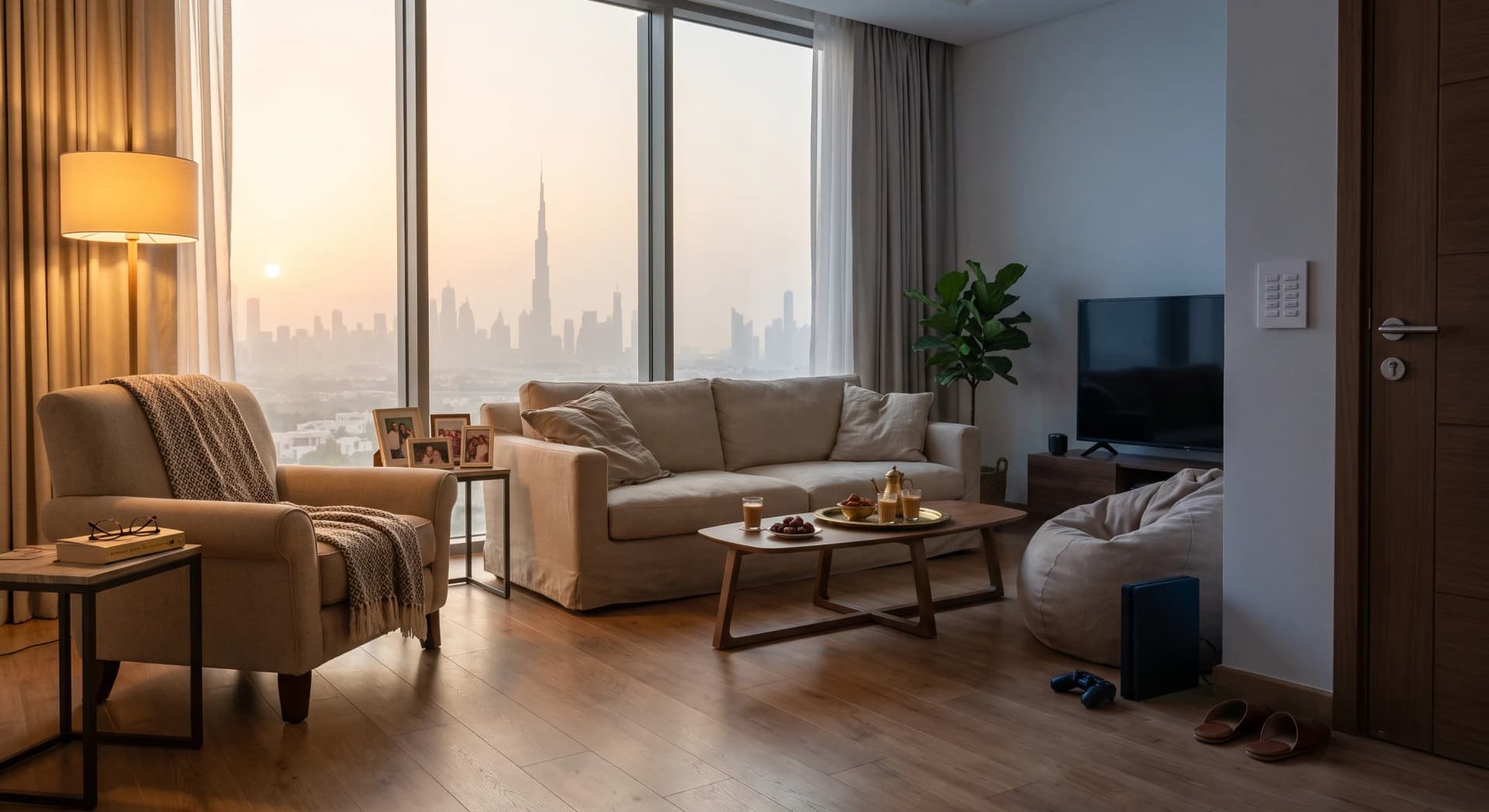
Your mother has the AC set to 26 and a lamp on even at noon. Down the hall, your teenage son has the blinds shut, the room three degrees colder, and no light on at all except his screen. Your own room sits in between, and by the time you get home from work you have already refereed one thermostat argument over WhatsApp.
Nobody in this apartment is being unreasonable. They are three different bodies with three different, physiologically real needs, sharing one AC unit, one light switch per room, and one household argument about who touched the remote.
TL;DR: A home with grandparents, parents, and kids under one roof has three overlapping sets of needs at the same hour: an older adult's room runs warmer and needs up to three times more light to see clearly, a child's room needs to go dim and cool early, and the shared rooms need a different mood for breakfast, homework, and family time. A single thermostat and light switch per room can only serve one of those needs at once. Per-room automation, scheduled by who uses the room and when, serves all three.
The Home Your Visa Already Requires
That WhatsApp argument is not a one-off. Dubai's own paperwork already assumes you are housing more than one generation. To sponsor a parent on a UAE residence visa, a resident needs a registered Ejari tenancy contract showing accommodation suitable for the family, typically a two-bedroom or larger, and a studio or one-bedroom Ejari that does not match the family size is a documented reason for rejection (Sarmat, 2026). The salary bar for the standard route dropped from AED 20,000 to AED 10,000 a month under a 2022 federal reform, though Dubai can still apply the higher AED 20,000 figure for some standard applications, so the exact number is worth confirming with GDRFA before you apply. Either way, it put parent sponsorship within reach of more households than it used to be.
So the immigration file already checks that you have the extra bedroom. Nobody checks whether that bedroom works for the person moving into it, or whether the rest of the apartment can run three different schedules without everyone getting in each other's way. That gap, between having the room and the room working, is the whole subject of this post.
In the villas we've surveyed across Arabian Ranches and other family communities, room count usually isn't the problem. The apartment or villa was designed for one household with one set of preferences, and three generations bring three sets of preferences into the same walls.
One Thermostat, Three Different Bodies
An older adult in the same room, at the same setpoint, as a younger adult feels a different temperature. A study on thermal comfort by age in hot, humid climates found older adults were most comfortable around 27C, about half a degree warmer than younger adults in the same room (thermal comfort study, hot-humid climate, 2026). The gap comes down to physiology, not preference. Older adults sweat less and start sweating later, so their body signals "too hot" after they are already overheating. A grandparent asking for the room warmer is often working with a body that signals overheating later and less clearly than a younger one does.
Meanwhile a Dubai apartment's smart AC control usually has one setpoint, or if you're lucky, a per-room controller that still needs someone to manually change it four times a day. Zone control fixes the mechanics of uneven cooling between rooms; we've written about the physical version of this problem in Dubai apartment temperature differences. What a multi-generational home adds on top is a human-need version of the same fix: the same room needs to be a different temperature depending on who is in it and when.
What a Grandparent's Room Actually Needs
A grandparent's room needs roughly three times the light a twenty-year-old's room needs to look equally bright. One senior-living lighting guide puts the comparison at seniors over 70 needing nearly three times the light young adults do to see clearly, moving from a soft, dim-lamp level of brightness in your twenties to something closer to a well-lit office desk past 70 (mdseniorliving.com, 2026). That single lamp that feels bright enough to you when you check in on your mother's room is, to her eyes, closer to dim.
The other half of the problem is the opposite of brightness: the walk to the bathroom at 3am. Aging eyes are also more sensitive to glare, so a single overhead light flicked on in the dark is uncomfortable in the exact moment it needs to be helpful. A low, warm path light triggered by a presence sensor, the same motion and presence sensor layer we install in every home we survey, solves both problems at once: enough light to see the step, not enough to hurt to look at.
What a Kid's Room Needs at the Same Hour
At the exact hour a grandparent's room should be brightening for an evening of reading, a child's room needs to be doing the opposite. Morning light exposure helps set a consistent wake rhythm at every age, but for younger children the more useful lever is on the other end of the day: dimming and warming the light in the hour before bed is what moves the needle on when a child falls asleep, more than the morning light does (Hatch, on children's circadian light exposure, 2026). We've gone deeper on the mechanics of a kid's bedtime lighting scene in smart lighting for kids' rooms.
Put those two rooms next to each other and you get the actual shape of the problem. At 8pm, a grandparent's room wants to be bright enough to read a newspaper in. A child's room, ten feet down the same hallway, wants to be dim enough to fall asleep in. A single hallway light switch, set to whatever level is "normal," gets both of them wrong at once. Two rooms, two scenes, running on their own schedules, gets both of them right without anyone touching a switch.
The Common Rooms Where Everyone Collides
The kitchen and the living room need automation most, more than any bedroom, because those are the two rooms every generation uses, at different hours, for different reasons. A living room at 7am is a grandparent's quiet coffee spot. At 4pm it's a kid's homework table. At 9pm it's where everyone ends up for a while before bed. Trying to pick one lighting level and one AC setting that serves all three moments is why the room ends up either too bright for the morning or too dim for homework.
The fix is scenes tied to time and use, not to who's in the room, and definitely not more devices per person. A morning scene, a midday scene, an evening scene, each one dialed for what the room is being used for at that hour, running the same way every day whether it's a grandparent, a teenager, or a toddler using the space. Nobody has to remember to change anything, and nobody has to ask anyone else to turn something down.
Three Ways to Start
You don't need to automate the whole home at once, and we'd talk you out of trying to. Three tiers, depending on what stage of setup you're in.
Starter, from AED 3,000. One grandparent's room done properly: a warmer AC schedule, a bright reading lamp on a smart plug, and a battery-powered presence sensor running a low night path light. This is the highest-impact single room in the house and the one we'd install first if that's all you can do for now.
Two-room build, AED 6,000 to 10,000. Grandparent's room plus a kid's room, each on its own AC schedule and lighting scene, running independently. This is where the "two rooms, two clocks" problem gets solved properly.
Full-home, AED 15,000 and up. Every bedroom on its own schedule, common areas running time-of-day scenes, and a single keypad by the main door or in the kitchen that switches the whole house between morning, midday, evening, and night without anyone opening an app. This is the setup for a villa in Dubai Hills or Arabian Ranches housing three generations under one lease.
What Bayora Will Talk You Out Of
The honest recommendation here cuts against the instinct to buy one big system and call it done.
Don't put a single voice assistant in the living room and expect it to serve everyone. A grandparent who doesn't speak the accent it's tuned for and a teenager who wants a different music service both end up ignoring it, and you've spent money on a speaker that answers to nobody.
Don't put a camera in any shared living space. A grandparent's dignity and a teenager's privacy are both worth more than the convenience of watching a room nobody asked to be watched in. Presence sensors solve the "is someone in this room" problem without recording anyone doing anything.
Don't zone every room in the house on principle. If two people share the same room on the same schedule, an extra controller for that room is money spent on control nobody will use. Zone the rooms with genuinely different needs and leave the rest alone.
What This Looks Like in Practice
Take a villa built for a couple and two kids, where a mother-in-law has just moved in from abroad. Here's how we'd typically approach it. Her room gets a warmer AC schedule holding steady around 25 to 26 degrees through the day, a bright reading lamp (roughly office-desk brightness, not living-room-ambient) on a schedule that ramps up in the evening, and a presence-triggered path light to the bathroom, dim enough to be gentle on the eyes, bright enough to see the step. The younger son's room, two doors down, gets its own cooler, dimmer evening ramp on an entirely separate schedule. The living room gets three time-of-day scenes instead of one static setting.
A build like that, three bedrooms plus the shared living space, sits in the two-room-to-full-home range above, usually on a Home Assistant hub so nothing depends on one company staying in business. The point of running it this way is fewer arguments over a thermostat, and nobody having to ask anyone else to change the temperature.
Where This Fits the Rest of Your Home
None of this needs new categories of hardware. It uses the same sensor layer and zone-controlled AC already behind most Bayora installs, scheduled per room and per generation. If you're planning this from scratch in a Dubai Hills villa, get it into the build before the paint goes on, while the wiring and switch choices are still simple to change.
Frequently Asked Questions
Can a smart home really run different temperatures in different rooms?
Yes, with a zone-controlled AC setup or per-room controllers rather than one central thermostat. Each room runs its own schedule, so a grandparent's room can hold 26 degrees while a kid's room next door holds 23, on the same central AC system, without anyone adjusting anything by hand.
Is this only for villas, or can an apartment do it too?
Apartments can do the lighting and per-room scheduling in full. Zone-controlled AC is easier to add in a villa with a ducted or multi-split system, but a Dubai apartment with individual split units in each room can already run separate schedules per unit, which covers most of what a multigenerational household needs.
What's the first room to automate if I can only afford one?
The grandparent's room, almost always. It has the clearest, most physiologically grounded need (warmer air, more light, gentle night lighting), and it's the room most likely to be uncomfortable if left on whatever setting suits everyone else.
Do I need a hub, or can this run on battery devices alone?
A single room can run on battery devices with no hub. Once you're coordinating two or more rooms plus shared spaces on different schedules, a hub like Home Assistant makes the automations easier to manage and keeps everything on one app instead of three different brand apps.
Will an older family member be able to use this without a smartphone?
Yes, if it's set up correctly. The automations should run on their own schedule without anyone opening an app, and a physical wall keypad handles any manual override, so a grandparent never needs to touch a phone to get the room they need.
That's the fix for three generations under one roof: give each room its own schedule, keyed to whoever lives in it and what hour it is, and let the house sort out who needs what.
Tell us about your household and we'll walk through which rooms to start with first, and what it costs before you commit to anything.
Ready to Get Started?
Get a free consultation and we'll recommend what makes sense for your situation.
Get Free Consultation