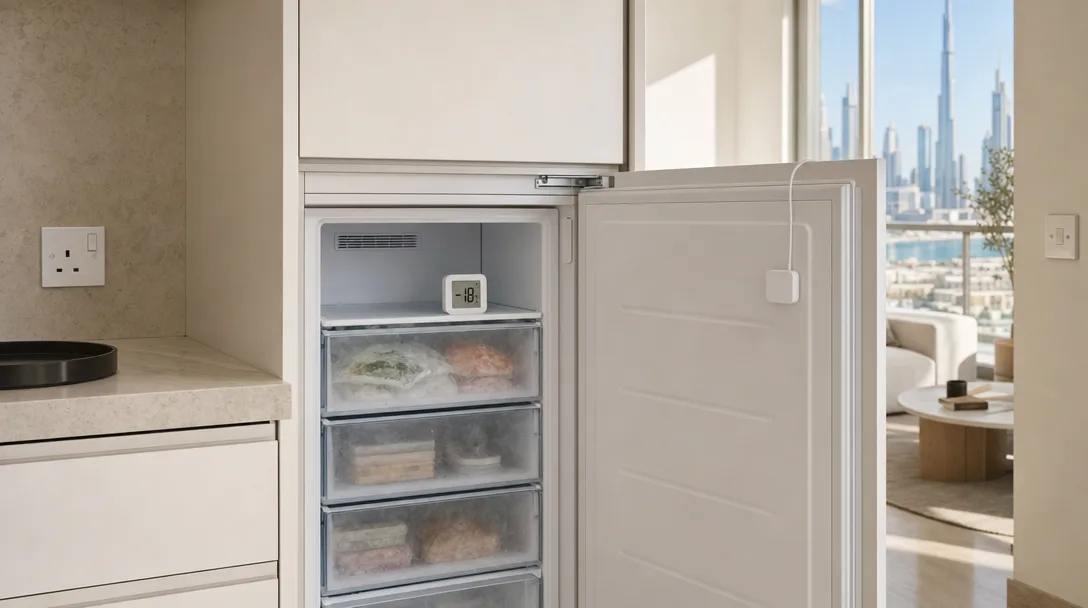
A freezer temperature sensor is worth having if it can tell you the freezer is warming before the food thaws. A sensor bought for the living room will sit in a freezer and show a number. Whether that number reaches your phone, and whether it's still there after the power has been off, depends on the sensor's rated range, the batteries inside it, the metal around it and what happens when the router goes down too.
The Two Numbers to Watch
The USDA's food safety service recommends an appliance thermometer in both the fridge and the freezer, with the fridge at 40°F or below and the freezer at 0°F or below (USDA FSIS). In Celsius that's about 4°C and -18°C.
A smart sensor is that thermometer with a radio and a log. It keeps a graph of the readings and can send an alert when the reading crosses a line you set. For the fridge, an alert a degree or two above where it normally sits is enough. For the freezer, set it a few degrees above its normal reading. If your app lets you add a delay before it alerts, use it, so a door left open while you unpack the shopping doesn't set it off.
Check the Rated Range, Then the Batteries
Look at the measuring range on the spec sheet before you buy. SwitchBot's Meter lists -20°C to 80°C, with typical accuracy of ±0.4°C between -20°C and 0°C (SwitchBot Meter manual). That covers a freezer at -18°C with two degrees to spare, so check what your freezer actually reads first. If it runs colder than -20°C, the Meter is outside its rated range. Inkbird's IBS-TH2 lists -40°C to 60°C (Inkbird manual), which leaves room for a freezer that runs cold. A sensor rated only from 0°C, or from -10°C, will show you something in a freezer, but it isn't rated to be right.
Then the batteries. Both of those sensors take two AAA cells. Energizer rates its standard E92 alkaline AAA for -18°C to 55°C (Energizer E92 datasheet), so a freezer holding -18°C sits at the very bottom of what that battery is rated for. Its L92 lithium AAA is rated from -40°C to 60°C (Energizer L92 datasheet). If the sensor lives in the freezer, put lithium cells in it.
Even inside their range, batteries last less in the cold. MOCREO, which makes sensors for fridges and freezers, says the effect is small in a fridge, but in very cold freezers you may need to change the battery every 6 to 12 months instead of every two years or more (MOCREO). Our guide to smart sensor batteries covers how to get a warning before one goes flat.
Getting the Signal Out of a Metal Box
A fridge or freezer is a box with a lot of metal in it, and metal blocks radio. MOCREO says metal objects are a very effective absorber of Zigbee signals (Zigbee is the radio many home sensors use to talk to their hub), and for a fridge or freezer it recommends its sensors with a temperature probe (MOCREO). Omega, writing about commercial freezers and cold rooms with steel walls, describes the same problem, and one of its two fixes is the same idea: mount the transmitter outside and run the probe wires in (Omega white paper).
A home freezer isn't a cold room, and you won't know how much yours blocks until you try it. Put the sensor in, close the door, and check the next morning that the graph kept updating overnight with no gaps. If it has gaps, move the hub closer to the fridge, or switch to a probe model, where the sensor body sits on the outside of the door and only the probe goes in. Check the door still closes flat on the probe's lead.
A sensor that talks to your phone over Bluetooth alone has a shorter reach still. If the Meter's alert doesn't work, SwitchBot's manual says to place it within your phone's Bluetooth range. On Android the alert needs a SwitchBot Hub even at home, and on any phone, alerts when you're out need one (SwitchBot Meter manual).
Alerts and Logs During a Power Cut
If the freezer warmed up because the power went off, the hub and the router usually went off with it, so an alert that travels over Wi-Fi or the internet has no way out of the flat until the power comes back. Our piece on what happens after a power cut covers the order things come back in, and a small backup battery (a UPS) on the router, the hub and the box your fibre line comes in on keeps the network alive through a short cut.
For the food, the USDA's guidance gives you time. A fridge keeps food safe for up to 4 hours with the door shut. A full freezer holds its temperature for about 48 hours, or 24 hours if it's half full (USDA FSIS).
After a cut, a sensor that kept logging while the hub was down shows roughly how warm the air around it got and for how long. That's a reading of the freezer, not of the food. The USDA's test is the food itself: thawed food that still has ice crystals, or that stayed at 40°F (about 4°C) or below, may be safely refrozen, though the quality may suffer. For the fridge, it says to discard perishables such as meat, fish, eggs and leftovers after more than 4 hours without power. It also says never to taste food to check it, and when in doubt, throw it out.
Not every sensor keeps logging when it can't reach its hub, so test yours before you need it. Unplug the hub for an hour, plug it back in, and look at the graph. If the hour fills in, the sensor stores readings on the device. If it's a gap, you'll only ever see what happened while the network was up.
Garage and Store-Room Freezers in Summer
Every fridge and freezer has a climate class on its rating plate, and it sets the room temperatures it's designed for. Beko's definitions: N (temperate) is designed for 16°C to 32°C, ST (subtropical) for 16°C to 38°C and T (tropical) for 16°C to 43°C (Beko).
At Dubai International Airport, the average daily high in the 1974 to 1991 record is 40.6°C in July and 40.4°C in August (NOAA NCEI, station 41194). A chest freezer in a villa garage or an outside store room without AC can spend summer afternoons well above 32°C, past what an N-class unit is designed for. Check the plate, and if it's a second freezer out of sight, that's the one to put a sensor in first.
Putting It on One App
A freezer temperature sensor is most useful when it alerts the same way as everything else in the house. If you have Home Assistant or another hub, a Zigbee or Bluetooth sensor can sit alongside the door sensors and leak sensors you already have, and send its alert to the same phones. If you'd like one added when we set up or extend your smart home, get in touch.
Ready to Get Started?
Get a free consultation and we'll recommend what makes sense for your situation.
Get Free Consultation