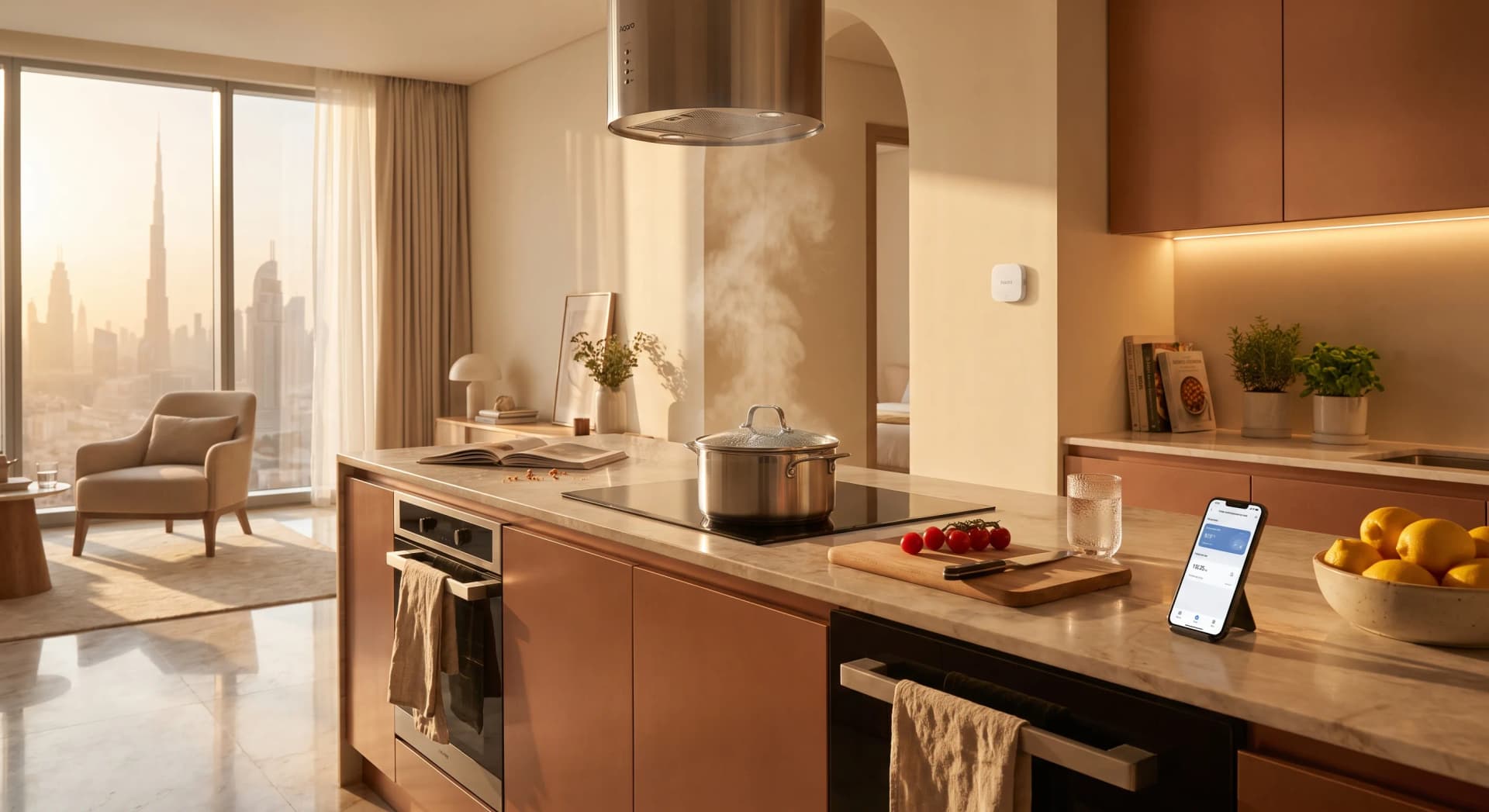
You set the whole apartment to 22. The bedroom reads 22. The living room reads 22. Then you stand at the hob at seven in the evening, and the kitchen is 28, sweat on the back of your neck while everyone in the next room is comfortable. Same AC. Same setting. One room that never gets the memo.
This is the most common comfort complaint we hear in Dubai apartments, and almost nobody has the right explanation for it. The kitchen is not hot because your AC is weak. It is hot because it is the one room in the flat that runs a heat source, and it usually sits in the spot with the least cooling.
TL;DR: Your Dubai kitchen is the hottest room because you run an oven or hob, which is a heater, in the part of the apartment that gets the weakest airflow, and most apartment cooker hoods recirculate the air instead of venting the heat outside. No thermostat setting cools a room faster than a hob heats it. The smart-home fixes are ventilation, timing, and sensing, not colder air: pre-cool before you cook, sense the heat and boost the zone, cut the sun at the window, and stop overcooling the rest of the flat to compensate.
The Kitchen Sits Where the Cooling Is Weakest
The kitchen runs hotter because it holds the apartment's biggest heat source in the spot with the least airflow. In most Dubai two-bedroom apartments, the kitchen is open-plan, tucked at the far end of the living space, and shares one AC vent with the whole lounge. That vent is aimed at the sofa, not the hob. By the time the cooled air drifts across the room to where you are cooking, it has already picked up heat.
Older Marina and Business Bay towers often do it worse, with a closed galley kitchen and no dedicated cooling at all, only whatever leaks in through the doorway. So before you even switch on a ring, the kitchen is starting the evening a degree or two warmer than the rooms your thermostat is measuring. The gap you feel at dinner builds from there.
Your Oven and Hob Are Heaters the AC Has to Undo
An oven or hob is a heater, and in an apartment kitchen most of that heat ends up in the room instead of in the food. Cooling-load engineering treats an unhooded cooking appliance in a conditioned space as putting roughly half of its energy straight into the room as heat (ASHRAE Fundamentals Handbook, 2021). Your AC then has to remove that heat before the room can drop back to setpoint.
Gas makes this harder than electric. The US Department of Energy notes that induction cooktops are up to three times more efficient than gas (US Department of Energy, 2024), which is another way of saying a gas flame dumps far more waste heat into the room. Induction releases less of that heat into the kitchen, which keeps kitchen temperatures lower and gives your cooling less to remove (ENERGY STAR, 2025). If you are renovating a Dubai apartment and comfort matters to you, that is one honest reason to choose induction over gas.
Most Apartment Cooker Hoods Recirculate, So the Heat Stays In
The extractor hood over your hob is probably not removing any heat at all. Most Dubai apartments come fitted with a recirculating hood, which pulls air through a grease filter and a charcoal filter and then blows it straight back into the kitchen. A recirculating hood does not remove heat or moisture from the room, it only traps some grease and odour before returning the air (KitchenAid, 2025).
A ducted hood, the kind that vents through a pipe to the outside, does carry the heat and steam out of the building. Villas and some newer apartments have them. Most towers do not, because running a duct through a high-rise is expensive and often not allowed. This is the single detail that every generic kitchen-cooling guide skips, and it is the reason your hood roars away for an hour while the room keeps getting warmer. It was never built to cool anything.
Cooking Adds Water to the Air, Which Makes the Heat Feel Worse
Cooking makes the kitchen feel worse than the thermometer says because it adds moisture as well as heat. A boiling pot, a simmering curry, a steaming rice cooker all release water vapour into the room, and the EPA lists cooking among the everyday activities that raise indoor humidity (US EPA, 2024). In a Dubai summer, where the outdoor air is already heavy, that extra vapour has nowhere easy to go if your hood only recirculates it.
Higher humidity is why 28 degrees in the kitchen feels stickier than 28 degrees in the bedroom. Your skin cannot shed heat as easily when the air around it is damp. We cover the mechanics of this in detail in our guide to Dubai summer humidity, but the short version for the kitchen is that the steam you are making is part of why the room feels like a sauna even when the number on the wall looks reasonable.
Pre-Cool the Kitchen Before You Cook, Not During
The first smart-home fix is timing: cool the kitchen zone before you start cooking, not while you are fighting the heat. Once the hob is on, you are trying to remove heat faster than you are making it, and you lose. Drop the temperature ten or fifteen minutes ahead of dinner instead, and you start cooking from a cooler baseline with the room already on your side.
In an apartment with smart AC control, this is a schedule, not a chore. If you tend to cook around 7pm, the kitchen zone steps down at 6:45 on weekdays and holds there. One thing clients always ask is whether this only means a colder, more expensive evening. It does not. You are cooling for fifteen focused minutes when it counts, instead of leaving the whole flat blasting cold all evening to make up for a room that spikes for an hour.
Let a Sensor Catch the Heat and Boost the Zone
The next step up is to let the room tell the system when it is heating up. A small temperature and humidity sensor mounted near the kitchen, away from the direct heat of the hob, gives your smart home an actual reading of what is happening where you stand, not what the hallway thermostat thinks. When we put a sensor in the kitchen zone of a Downtown two-bedroom last summer, it showed the corner by the hob running five to six degrees above the living-room thermostat every evening.
With that reading, the system can act. When the kitchen climbs past a threshold, it can boost the cooling to that zone, and it can switch on a smart-plugged fan to move the stale hot air off the cooking area. A ceiling fan on a smart switch does the same job for the open-plan space, letting a slightly higher setpoint still feel cool. The sensor is what turns guesswork into a room that responds to what you are doing.
Cut the Heat Before It Reaches the Kitchen
The easiest degree of cooling is the one you never let in. West-facing glass near an open-plan kitchen pours afternoon sun onto the same surfaces you are about to cook on, and Dubai summer highs sit in the mid-40s, so that solar load is real. Motorized blinds that drop before the sun swings around mean the AC and the hob are not also fighting a wall of heat coming through the window.
Set the blind on the kitchen or dining window to close on a sun-position trigger in the afternoon, and the room is already cooler by the time you start prepping dinner. It is the same principle as pre-cooling: deal with the heat before it arrives, when it is easy, rather than after, when your AC is already losing. This one change often does more for a hot open-plan kitchen than turning the thermostat down another degree ever will.
What a Smart Home Cannot Do in Your Kitchen
Being honest about the limits matters, because a smart home cannot out-cool a running oven, and anyone who promises it can is overselling you. While the hob is on, the room will run warmer than the rest of the flat. The goal is to narrow that gap and clear it fast once you finish, not to hold the kitchen at 22 mid-roast. Physics wins that fight.
It also cannot turn a recirculating hood into a ducted one. No automation removes heat that the hood was never built to remove. If the kitchen heat genuinely ruins your evenings, the real fixes are a proper ducted extractor if your building allows it, or switching a gas hob to induction, both renovation decisions, not app settings. In our experience walking Business Bay and JLT apartments, we would rather tell you that plainly than sell you a sensor that cannot fix a ventilation problem.
Where to Start, and What to Skip
For most renters, start with the simplest layer: one temperature and humidity sensor in the kitchen zone and a pre-cool schedule on your existing AC control, which is a software change on hardware you may already have. Add a smart-plugged fan next. That combination handles the everyday spike for a few hundred dirhams and moves with you when you leave.
Owners who cook seriously can go further, with proper zone control so the kitchen gets its own cooling profile, motorized blinds on the hot windows, and the ventilation conversation if the building supports a duct. Skip the expensive wall panel that only shows a temperature, skip any device sold as making a recirculating hood remove heat, and skip freezing the whole apartment to compensate for one room. If you want us to look at your kitchen and tell you plainly what is worth doing, tell us about your apartment and we will give you an honest recommendation, no obligation.
Frequently Asked Questions
Why is my kitchen hotter than the rest of my Dubai apartment?
Because it holds a heat source, your oven or hob, in the part of the flat that usually gets the least airflow. In open-plan apartments the kitchen shares one AC vent aimed at the living room, and most cooker hoods recirculate rather than vent heat outside, so the warmth from cooking stays in the room.
Does turning the AC colder cool the kitchen faster while I cook?
Not really. While the hob is on, you are adding heat faster than the AC can remove it, so a lower setpoint mostly overcools the rest of the flat. Pre-cooling the kitchen ten to fifteen minutes before you cook works far better than dropping the temperature once the room is already hot.
Do recirculating cooker hoods remove heat in Dubai apartments?
No. A recirculating hood filters some grease and odour and blows the air back into the kitchen, so heat and moisture stay in the room. Only a ducted hood that vents outside removes heat. Most Dubai towers have recirculating hoods because running a duct through a high-rise is difficult.
Will a fan help in an open-plan kitchen, or just move hot air around?
It helps. Moving air lets your skin shed heat more easily, so a slightly warmer room still feels cool, and a fan clears the pocket of hot, steamy air that sits over the hob. A smart-plugged fan or a ceiling fan on a smart switch can turn on automatically when the kitchen sensor detects a spike.
Can I cool the kitchen without freezing the rest of the flat?
Yes, with zone control and a kitchen sensor. Instead of dropping the whole apartment's setpoint, the system boosts cooling only to the kitchen zone when it heats up, then eases off once you finish cooking. That keeps the bedrooms comfortable and stops the evening turning into an expensive, over-chilled flat.
Ready to Get Started?
Get a free consultation and we'll recommend what makes sense for your situation.
Get Free Consultation