It is 9pm in a Dubai tower and the bedroom smells of fish. Nobody in your flat has cooked fish. Nobody in your flat has cooked anything. The windows have been shut since May, the AC has been running all evening, and the smell is strongest near the bathroom and in the corner of the bedroom under the ceiling vent. Your neighbour's cooking has found a way in.
TL;DR: The usual path is a shared extract duct that several flats on your line connect into, and the way it gets in is the one-way valve on your branch failing to close. Your AC cannot clear it, because a fan coil unit recirculates the air already in your room. The test that tells you whether your branch is working is free and takes ten seconds with a sheet of tissue paper.
This comes up in UAE forums regularly and the answers tend to be the same handful: buy a purifier, clean your ducts, or accept that this is how towers are built. The first two address a different problem. The third is wrong. There is a specific part involved and it has a name. Put the name in the request and building management has something to schedule.
One thing to say before any of it. This is not our trade. Bayora builds smart homes, and we have never been paid to fix a ventilation fault. We are writing it because the honest answer to the question is that a smart home does not fix it, and nobody has written down what does.
The Smell Is Travelling Through a Duct You Share
Your bathroom ceiling grille and your kitchen hood are not always vented straight out through the side of the building. In many towers they connect into a vertical duct, a riser, that runs the height of the building and carries extract air from the flats stacked above and below you up to a fan on the roof.
Builders choose that arrangement deliberately. The US Department of Energy's Building America Solution Center notes that while each fan ideally gets its own duct to the outside, builders sometimes connect them to a common duct "for reasons of layout or a wish to minimize penetrations through the roof" (Building America Solution Center, Back-Draft Dampers at Shared Common Exhaust Duct, 2022). One duct and one roof opening instead of forty is cheaper to build and easier to waterproof.
We have not found a published breakdown of how Dubai towers are ducted, so treat this as the arrangement to check for rather than a description of your building.
The design only works in one direction. Air is supposed to leave each flat, join the riser, and go up. Nothing in that arrangement stops air coming back down a branch except one component. The same path carries cigarette smoke, which is why smoke from a flat you have never been near can turn up in your own bathroom. Canada Mortgage and Housing Corporation, the national housing agency, puts the two together at the top of the list: "Tobacco smoke and cooking odours top the list of complaints" (CMHC, Solving Odour Transfer Problems in Your Apartment).
The Part That Fails Is a One-Way Valve Called a Backdraft Damper
A backdraft damper is a flap in your flat's extract branch, at or just above the fan. It opens when your fan pushes air out and falls shut when your fan stops, so the shared duct cannot feed back into your room.
The same DOE guidance is explicit about what it is for: "A common exhaust duct can be used if each fan has a back-draft damper to prevent cross-contamination when the fan is not running" (Building America Solution Center, 2022). Cross-contamination is the technical term for your neighbour's dinner.
When that flap is missing, painted over, jammed with grease, or installed backwards, your branch becomes an opening into a duct shared with every flat on your line. Whichever flat is running its kitchen fan is pushing air into that riser, and your dead branch is a place for it to go.
We are describing a known and code-recognised failure mode, not a diagnosis of your building. We have not found any published figure for how often it fails in Dubai towers specifically.
There is a second path worth knowing about. CMHC also lists where air leaks between neighbouring flats, and the list includes "Wiring penetrations" and "Plumbing penetrations" alongside ducts and the joints between walls and floors (CMHC, Solving Odour Transfer Problems in Your Apartment). Unsealed holes behind a kitchen cabinet or under a sink let air in without it going near a grille at all. On the building side, Building America's multifamily guidance says that with central systems "it is necessary to air seal vertical service shafts at each floor level" (Building America Solution Center, Ventilation and Exhaust Strategies for Multifamily Housing, 2024).
Running the AC Cannot Clear It
It cannot work, because in an apartment served by central chilled water the box above your ceiling is a fan coil unit, and a fan coil takes air from your room, cools it, and gives it back.
CIBSE, the UK institution for building services engineers, puts it plainly in its professional training material: "many FCUs do not supply any outdoor air, but simply recirculate" the room air (CIBSE Journal, Module 101: The evolution of fan coils, 2016). Fresh air, where a building provides it, comes from a separate central unit.
So a fan coil neither pulls the smell out nor brings clean air in. Run it harder and you move the same smelly air around the flat faster, which is why people report the smell spreading from the bathroom to the bedroom after they turn everything on.
CIBSE names an exception. Fan coils that do draw in outdoor air exist, usually mounted on an outside wall with their own dampers. If your unit is a ceiling cassette in an interior corridor, it is not one of those.
Your kitchen hood is the other thing people expect to help. Many apartment hoods recirculate, pulling air through a grease filter and a charcoal pad and returning it to the room. Building America's position on that is blunt: "Recirculating kitchen range hood fans do not provide effective contaminant removal and odor control" (Building America Solution Center, 2024). If yours vents into a duct rather than back into the kitchen, this part does not apply to you. We wrote about what a recirculating hood does to kitchen heat in why your Dubai kitchen is the hottest room in summer.
The Tissue Test Takes Ten Seconds and Costs Nothing
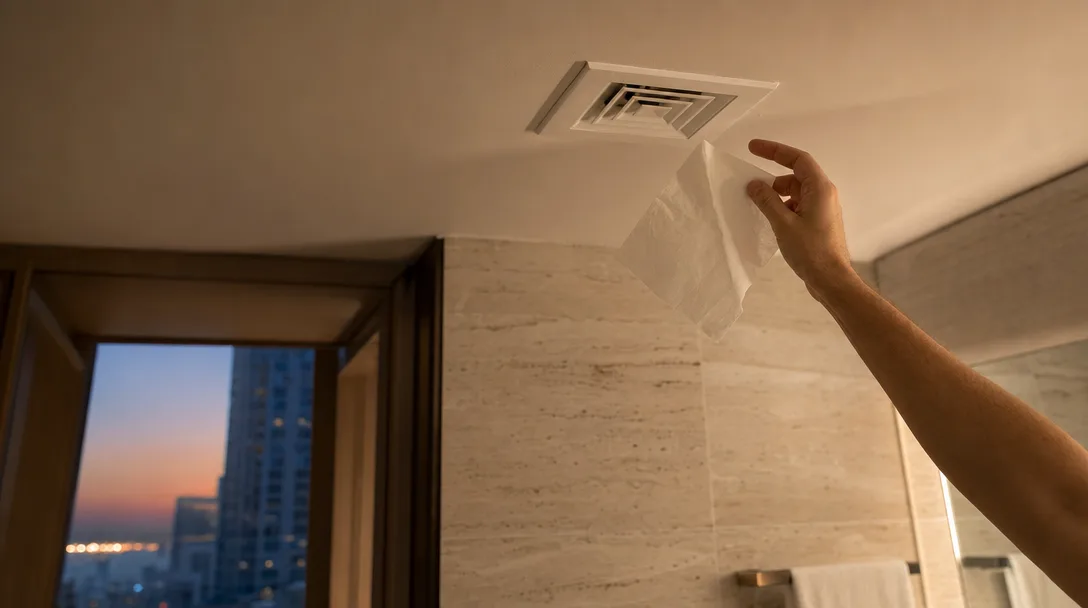
Hold a sheet of tissue paper flat against your bathroom extract grille with the fan running, and give it a few seconds. If the grille holds it there, that branch is pulling. If it drops, that branch is doing nothing.
The check comes from CMHC, which gives residents this exact test for this exact complaint. Working fans "should be able to hold a piece of tissue paper to their grilles when operating. If they are unable to do this, or little airflow is detectable, the exhaust fan, duct system or outside hood may require cleaning" (CMHC).
Worth knowing before you ask for anything: CMHC's own first suspects for a grille that fails the test are cleaning and, if that does not do it, replacing the fan. The damper is a separate question.
Then two things:
- Repeat it at every extract point, both bathrooms, the kitchen and the laundry.
- Write down which ones held and which dropped, with the date, because that list is what you are going to hand over.
The ceiling grille in the bedroom belongs to the fan coil unit rather than to the extract system. Depending on the layout it either blows air in or draws room air back to the coil, so it can push the tissue away or hold it there, and neither result tells you anything about your extract branch. A dead grille in a flat that smells of someone else's cooking is the single most useful thing you can hand to building management, because it points at one branch rather than at the building.
While you are there, find out whether your bathroom fan runs on a switch, on the light, or continuously. A fan that only runs with the light is off for most of the day, and the whole time it is off the damper is the only thing holding that duct shut.
Why the Purifier You Bought Did Not Help
An air purifier catches particles. A cooking smell is a gas, and those are different jobs for different filters.
The US Environmental Protection Agency is clear that the standard rating does not cover odour at all: "there are no widely used performance rating systems for portable air cleaners or filters designed to remove gases. The CADR rating system is for particles only" (EPA, Guide to Air Cleaners in the Home). The HEPA number on the box is a particle number.
Carbon can work on odours, with a condition attached. EPA again: "Activated carbon filters can be effective, provided that there is a large amount of material used in the filter" (EPA). The thin carbon mat wrapped around a HEPA cylinder is not a large amount of material.
Even a good carbon filter is treating the air after it arrives. It does nothing about the opening the air is arriving through, which is why people describe buying a second purifier and getting the same result.
Running Your Own Extract Fan Can Make It Worse
Pulling air out of your flat has to pull air in from somewhere, and it will come from whichever gap is easiest. CMHC warns residents directly that "operation of exhaust fans in your unit may draw more air from neighbouring apartments or the common corridor into your unit, making the problem worse, not better" (CMHC).
If your branch is the dead one, the fan is barely moving air at all, so it is neither clearing the smell nor doing much else. Try it, note what happens, and stop if the smell gets stronger.
CMHC is describing North American towers, where most buildings put up since the mid-1960s feed outdoor air into the common corridors rather than into each flat, and that corridor air then tends to push into the apartments. We have not found a document establishing that Dubai towers are built to that same arrangement, so we are citing the principle rather than claiming your building's design. The shared extract riser is the part that is common to both.
What to Ask the Building For, in One Sentence
Ask for this: inspect the backdraft damper on our flat's bathroom and kitchen extract branches and confirm the riser is extracting on our floor. That sentence is a work order. "There is a smell" is not.
You are also on firmer ground than most residents realise. Dubai Municipality's Green Building Regulations and Specifications carry a clause written to apply to all new and existing buildings: "Exhausted air must be discharged in a manner to avoid it being drawn back into the building or the building ventilation system and to ensure that it does not become a nuisance to the building occupants or other buildings occupants or pedestrians" (Dubai Municipality, Green Building Regulations and Specifications, clause 401.03).
Dubai Municipality's publications page records that the regulations became mandatory and were adopted for all new building in Dubai as of March 2014 (Dubai Municipality, Publications Related to Building Regulation). How hard that bites on a tower finished before then is a question for the Municipality rather than something we can answer for you. Either way the clause gives you language building management recognises.
Extract air arriving in a neighbour's bedroom is the thing that clause is written against. You are not inventing a standard.
Bring three things to the conversation: which grilles failed the tissue test, the dates and rough times the smell appears, and the request above. If the building does not act, Dubai Municipality's contact centre is on 800900 and info@dm.gov.ae (Dubai Municipality, Contact Us).
Where a Smart Home Helps, and Where It Does Not
A smart home does not fix this. The fault is a mechanical part in a shared duct, and the repair belongs to a mechanical contractor and your building, not to us and not to any device we sell.
What a sensor does is settle the argument. The hardest part of this complaint is that it happens at 9pm on some evenings and not others, and by the time anyone comes to look, the flat smells of nothing. An air quality sensor that logs continuously gives you a timestamped record showing the spikes, how long they last, and that they repeat. We wrote about that sensing layer and what it is good for in the dust day guide.
If the log shows eleven evening spikes in a month, that is something building management can act on. That is the whole contribution.
If the smell is seasonal rather than evening by evening, the shoulder months have their own explanation, and we covered that in why your apartment gets damper as the weather gets better.
Frequently Asked Questions
Why does my Dubai apartment smell like my neighbour's cooking?
In many towers, flats stacked on one line share a vertical extract duct for bathrooms and kitchens. A one-way flap called a backdraft damper is supposed to stop air coming back down your branch. If it is missing, jammed or painted over, air from the shared duct can enter your flat through the grille.
Why can I smell cigarette smoke when nobody in my flat smokes?
Smoke travels the same way cooking smells do. It moves through the shared extract duct when a damper is not sealing, and through unsealed wiring and plumbing penetrations between flats. It is the reason the smell can arrive from a flat you have never been near, rather than from the balcony next door.
Will cleaning my AC ducts stop the smell?
Usually not. Duct cleaning addresses dust and grime in your own system. If the smell originates in another flat and arrives through a shared extract riser, cleaning your AC does not touch the path it travels, and a fan coil unit recirculates room air rather than extracting it.
Should my bathroom extract fan run all the time?
Not necessarily, and running it longer is not a fix for this. Find out how yours is wired instead. If it comes on with the light rather than running continuously or on its own switch, it is off for most of the day, and the whole time it is off the backdraft damper is the only thing holding that duct shut.
Can an air purifier remove a neighbour's cooking smell?
Only partly, and only the right kind. HEPA filters catch particles, not gases, and EPA notes there is no widely used rating system for gas removal. A large activated carbon filter can help with odour, but it treats air that has already arrived rather than closing the path it came through.
What We Can Help With
We cannot repair a damper, and we will say that on the phone rather than after a site visit. What we do build is the climate control and the sensing that goes with it: an air quality sensor we can choose and connect to the rest of your home if you want the record, and cooling that works around the building you live in.
If that is useful, tell us about your apartment and we will give you an honest view of what is worth doing, with no obligation. If your problem is the damper, we will tell you that too, and you will have lost nothing but the message.
Ready to Get Started?
Get a free consultation and we'll recommend what makes sense for your situation.
Get Free Consultation