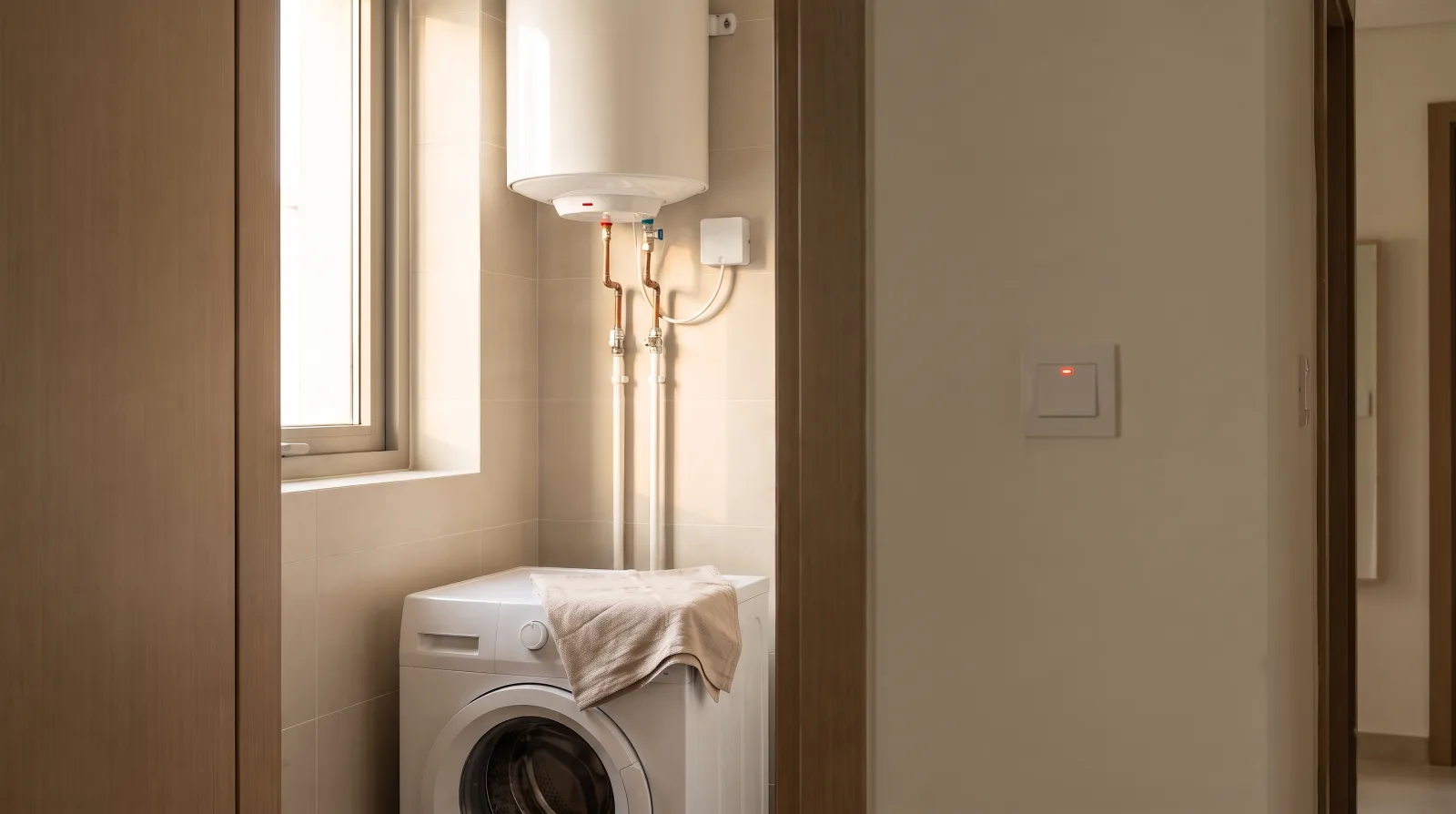
Outside the bathroom or the laundry cupboard in most Dubai homes there is a switch with a small red light. It runs the water heater, and it is probably on right now, keeping a tank of water hot for a shower nobody will take until tomorrow morning. Every energy tip online says the same thing: put the heater on a smart plug and schedule it. So you go to look for the plug, and there isn't one. The cable runs straight into the wall.
That is normal here, and it is why the smart plug advice falls apart in a Dubai home. The heater can still run on a schedule. It needs a different part, and a timer that knows how long a tank takes to heat.
TL;DR: Most Dubai water heaters are wired to their own switch, with no plug to swap. Renters can fit a button-pusher on that switch. Owners can put a rated relay behind it, or a contactor above about 2 kW or on a 20-amp circuit. Switch on well over an hour before showers, and let the tank reach 60°C, not just "warm".
Why Most Dubai Water Heaters Can't Take a Smart Plug
Usually there is nothing to plug in. Every water heater we have been asked to automate so far was wired to its own switch or its own 20-amp point, and one full villa drawing set we have worked from marks each heater point as a 20-amp socket. A smart plug needs a standard 13-amp socket, and the heater does not use one.
Even when a heater does sit on a plug, the numbers are tight. Storage heaters sold in the UAE run at "1,500W – 3,000W" (Utility Bill UAE, 2026). On the UAE's 230-volt supply (World Standards, 2025) that is about 6.5 amps for the smallest and 13 amps for the largest, and the UK-style socket and plug used here is rated 13 amps. A 3,000-watt heater on a smart plug is running a small relay at its ceiling for an hour at a time, every day.
We said this plainly in our guide to how smart plugs work: a water heater belongs on a proper wall control, and that is a safety line rather than a preference. Some of our older energy articles still suggest a plug for the heater. We are correcting them, and this post is the longer answer.
Three Ways to Put a Water Heater on a Schedule
Which one fits depends on whether you rent, the wattage on the heater's label, and the amp rating printed on its breaker. A renter who cannot touch the wiring has one option. An owner, or a renter with the landlord's OK, has two better ones.
A Button-Pusher on the Existing Switch
If you rent and cannot open the switch, a small robot can press it for you. The SwitchBot Bot sticks on next to a switch and is "compatible with most rocker switches and one-way buttons", and its app has "built-in timers" to schedule on and off (SwitchBot, 2026). We have seen one fitted to exactly this kind of switch, a wired switch labelled for the water heater.
It is the no-wiring answer, and it comes with limits. On its own it works "within Bluetooth range", and control from outside the flat means adding a SwitchBot hub, which SwitchBot says enables "remote control". The Bot runs on a small battery and needs a firm press on a stiff, heavy-duty switch. It also cannot tell you whether the heater is actually heating. For a renter who only wants the tank off during the day, that is often enough.
A Relay Behind the Switch or in the Junction Box
For an owner, the cleaner answer is a small smart relay wired in behind the existing switch or inside the heater's connection box. On one apartment job the heater was a storage tank of about 1.5 kW, and we fitted an Aqara relay module inside its junction box. Aqara rates that module at "Max 2200W of resistive load (With Neutral)" (Aqara, 2025), so a 1.5 kW heater sits well inside it. A 3 kW heater does not.
Where you want to see the power draw, we use the Shelly 1PM Gen3, which Shelly rates for a "Max. switching current: 16A (240 V~)" and lists "heating appliances" among its supported loads (Shelly, 2026). It shows in the app when the element is drawing current and when it has clicked off. When we specified Shelly relays for a villa's heaters, we planned a contactor for any heater above about 2 kW, even though the Shelly's 16-amp rating would cover it on paper.
Check one thing before ordering: the breaker. Shelly says the breaker in front of that relay should be rated no more than 16 amps, and on the villa drawing set we mentioned earlier, the water heater points are marked 20 amps. If yours is on a 20-amp breaker, the relay alone is the wrong answer, and that brings in the third option.
A Contactor for Bigger Heaters and 20-Amp Circuits
A contactor is a heavier switch built to carry the load, and the smart relay only tells the contactor when to switch. It is the same arrangement we described for pool pumps on a smart switch. A heater is an easier load than a pump, because it has no motor. Contactors are rated by duty, and the one to ask for here is AC-1, which covers "resistive loads such as heaters and electrical furnace" (Electrical4u, 2020).
This is the setup for any heater on a 20-amp circuit, and the one we recommend above about 2 kW. The contactor sits in a small enclosure or at the board, the smart relay drives it, and the heater wiring stays untouched.
How Long Before a Shower the Heater Needs to Switch On
Longer than most tips say. The common advice is to switch the heater on an hour before your shower, and for a full tank from cold that is often too short.
The arithmetic is simple. Heating 80 litres from 25°C to 60°C takes about 3.3 kWh of energy. A 2,000-watt element delivers 2 kWh an hour, so that tank needs about an hour and forty minutes, before counting any heat lost through the tank wall. A 50-litre tank on a 1.5 kW element, starting from 30°C, needs about 70 minutes.
So set the first schedule generously, around two hours before the morning showers, and then use the relay's power reading to tune it. When the power reading drops to zero, the tank has reached its thermostat setting. Note the time it took, add a margin, and move the schedule. After a week you will have a heating window that fits your tank rather than someone else's. On a button-pusher there is no power reading, so keep the generous two-hour window.
The Summer Switch-Off, and the Water Left in the Tank
Many UAE households switch the heater off through the hottest months. One UAE utility guide says: "During UAE summer (May-September), tap water naturally reaches 35-40°C, hot enough for comfortable showers" (Utility Bill UAE, 2026). You can test your own home in a minute: run the cold tap in the evening, and if it comes out warm enough to shower under, the heater is doing very little.
There is one catch, and it is why a smart schedule should never keep the tank lukewarm. The World Health Organization says Legionella bacteria "live and grow in water systems at temperatures of 20 to 50 degrees Celsius (optimal 35 degrees Celsius)", and that keeping hot water above 50 °C "requires water leaving the heating unit to be at or above 60 °C" (WHO, 2022). The UK's Health and Safety Executive puts it the same way: "Hot water should be stored at 60°C at least to kill legionella bacteria" (HSE, 2024).
For the water stored in the tank, that means three things. Keep the heater's own thermostat at 60°C, even though some saving guides suggest turning it down. Make each heating window long enough to reach full temperature, rather than only take the chill off. And when the heater comes back on after weeks switched off, let it run to full heat before anyone showers. The schedule saves energy by deciding when the tank heats. The thermostat still decides how hot.
Where the Smart Part Sits, and What Happens If It Fails
Put the relay somewhere reachable that stays inside its temperature rating. The Shelly 1PM Gen3 is rated for an "Ambient working temperature: -20 °C to 40 °C" (Shelly, 2026). While the heater cupboard is open, it is also a good place for a leak sensor, since an ageing tank is one of the usual sources of a flood.
The more common worry is simpler: what happens if the smart part stops working? Done properly, the wall switch keeps working. The Shelly has a switch input for the existing wall switch, and it "can work standalone in a local Wi-Fi network", which means the internet going down does not strand the heater. The relay should sit after the existing isolator, so the red-light switch still cuts the power for anyone servicing the heater.
Whoever fits it should show everyone in the home which switch does what, and name the heater tile in the app something nobody can confuse with a light. Small detail, but the day the shower runs cold, the person standing at the switch should know which one to press.
Frequently Asked Questions
Can I put my water heater on a smart plug?
Usually not. Most Dubai water heaters are wired straight to their own switch, so there is no plug to use. Where there is one, a 3,000-watt heater draws about 13 amps, the full rating of a UK-style plug, for long stretches. Use a rated relay, a contactor, or a button-pusher on the existing switch instead.
Can renters make a water heater smart without rewiring?
Yes, with a button-pusher. A device such as the SwitchBot Bot sticks next to the existing water heater switch and presses it on a schedule, with no wiring and nothing left behind when you move. It cannot measure whether the heater is heating, and a stiff switch needs a firm press, so test it first.
How long does a water heater take to heat up?
It depends on the tank and the element. An 80-litre tank on a 2,000-watt element needs about an hour and forty minutes to go from 25°C to 60°C, and a 50-litre tank on 1.5 kW from 30°C needs about 70 minutes. A relay with power metering shows the real figure for your heater.
Should I turn my water heater off in the Dubai summer?
Many households do, because the cold supply runs warm in the hottest months. If you do, let the tank reach 60°C when you switch it back on, before anyone showers. Keep the thermostat at 60°C too, which is the temperature health guidance sets for stored hot water.
Where to Start
Two checks tell you which option is yours. Look at the rating label on the heater for the wattage, and look at the breaker marked for the water heater in your distribution board (the breaker panel) for its amp rating. On a 16-amp breaker with a heater up to about 2,000 watts, a 16-amp relay such as the Shelly 1PM Gen3 does the job. For anything bigger, or anything on a 20-amp breaker, we would recommend a contactor. If you rent and cannot touch either, start with the button-pusher.
If you want it done properly, the heater fits into the same whole-home setup as your AC and lights, with one app and one schedule. Tell us about your heater and we will tell you which of the three it needs.
Ready to Get Started?
Get a free consultation and we'll recommend what makes sense for your situation.
Get Free Consultation