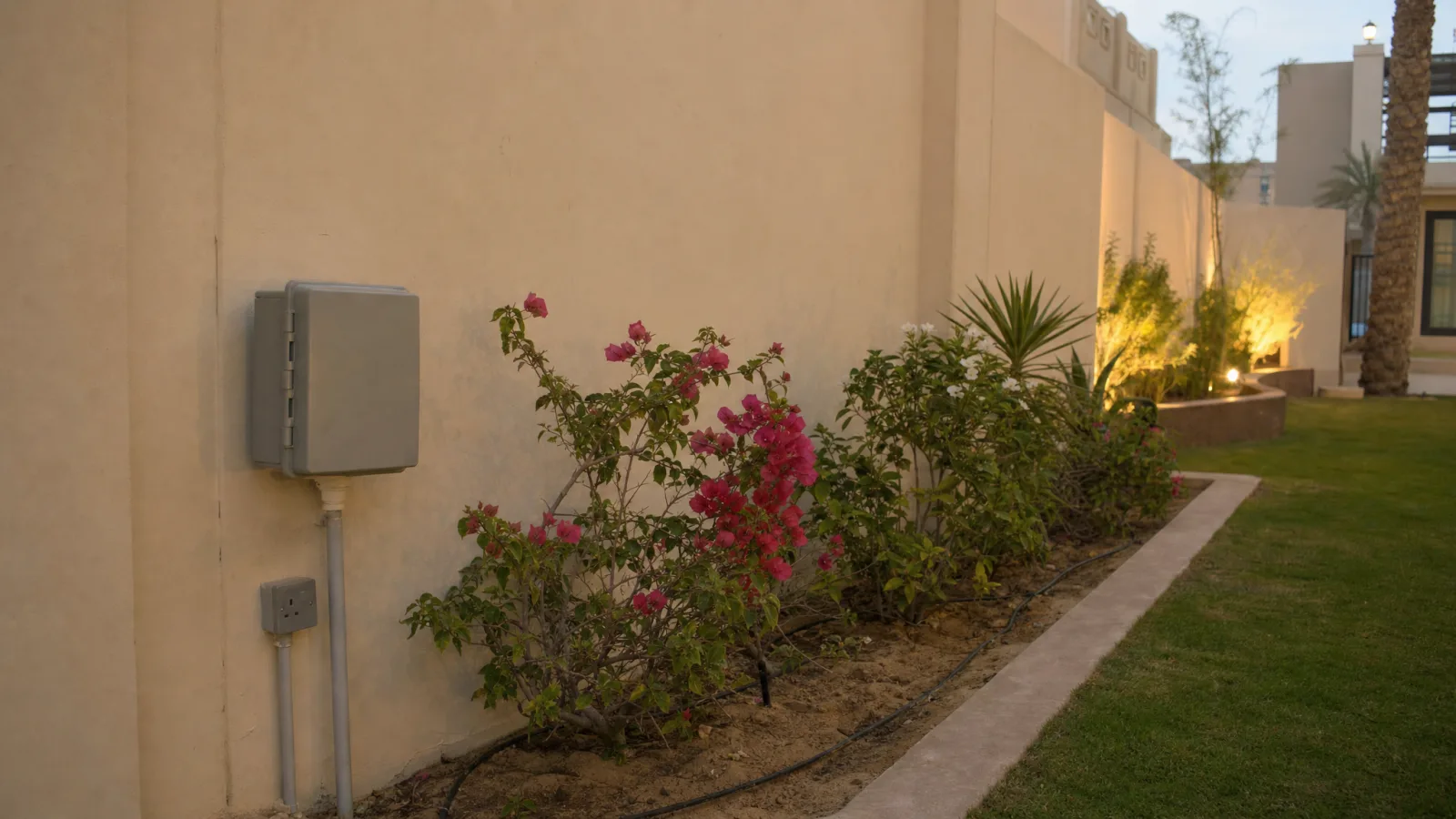
If your villa garden runs on a smart irrigation controller, check its seasonal setting before the cool months. On some controllers the default is to water the same amount all year, so a drip line left on its summer run time is giving the plants more than they need by December. Set once, the controller gives the garden less in winter and more in summer without anyone touching the timer.
Rain skip won't do that job in Dubai. Records from Dubai International Airport average 94 mm of rain a year, with measurable rain on about 14 days, and June to October average close to nothing (WMO climate normals, 1974 to 1991).
Dubai's Weather Across the Year
The same airport records put the average temperature at 34.4°C in July and August and 18.7°C in January, with average humidity between 53% and 65% in every month.
DEWA advised residents with home gardens, in summer 2021, to use smart irrigation systems, soil moisture sensors and automatic sprinkler adjustment, and to run light sprinklers between 6pm and 8pm to avoid evaporation (Gulf News, 2021). The start time takes a minute to set. The amount needs the controller's weather setting.
The Seasonal Setting on a Smart Irrigation Controller
On OpenSprinkler, an open-source controller, the weather setting scales each program's run time by a percentage, so a zone programmed for 60 minutes on a 50% day runs for 30. It's under Edit Options, then Weather Adjustment (OpenSprinkler documentation), and there are five methods. Auto Rain Delay only sets a rain delay and leaves the percentage alone. The other four set it:
- Manual, the default. You set one percentage and it stays there until you change it.
- Monthly. You set a fixed percentage for each month of the year.
- Zimmerman. It works out the percentage each day from the previous day's temperature, humidity and rain.
- ETo. It works from evapotranspiration, the water the ground and plants lose to the air, using your location, elevation and solar radiation as well.
Each program also has its own Use Weather Adjustment box, which is off by default. A program with the box unticked ignores all of this and runs its fixed time.
Rachio handles it with Seasonal Shift, which changes the run times on a Fixed schedule at the start of each month using ten years of almanac weather data for your area. Its Flex schedules adjust on their own (Rachio). If you turn Seasonal Shift on in a Dubai garden, check the zone run times in the app straight away, and again at the start of the next month.
What Zimmerman Does With Dubai Weather
Zimmerman starts from a reference day of 21°C, 30% humidity and no rain, which counts as 100%. Hotter days push the number up, more humid days pull it down, and rain pulls it down sharply. You can change those reference values and how much each one counts.
We put the airport's monthly averages through the formula with the default settings to see where a typical dry day lands:
| Month | Average temperature | Average humidity | Watering (% of programmed time) |
|---|---|---|---|
| July | 34.4°C | 56% | 170% |
| October | 28.7°C | 60% | 125% |
| November | 24.3°C | 61% | 92% |
| January | 18.7°C | 65% | 48% |
With the defaults, a program set for 20 minutes runs for about 34 in July and about 10 in January. Real days move around these figures, and the weather data comes from a provider's model for your location, not from the airport.
Our monthly average humidity sits above the 30% reference all year, so on those averages the humidity part of the formula trims the run time every month. Check in summer that the plants are getting enough. If they aren't, raise the program times or the temperature weighting.
Setting Up ETo
ETo needs a baseline, the average evapotranspiration for your area, which the controller can detect, and your elevation, which you type in. When you switch to ETo, OpenSprinkler's advice is to set program times for the yearly average instead of the summer, so the percentage goes above 100% in the hot months and below it in the cool ones. Program times written in July are the wrong starting point here.
When the Controller Loses the Internet
The weather methods depend on the controller reaching its weather service. OpenSprinkler keeps using the last good reading for up to 24 hours. After that, or after a restart with no fresh reading, Zimmerman and ETo go back to 100% and programs run at their full programmed time. Manual and Monthly keep their percentages because they don't need the internet.
That matters when the controller sits at the edge of the villa's Wi-Fi. With summer-sized program times, a controller that drops off the network in January gives the garden summer watering until it reconnects. Either give it a solid connection or use Monthly, which needs nothing from outside. Our internet-down guide covers what else in the house keeps working.
Rachio's self-healing covers a different failure: if the weather station you picked stops reporting for three days or more, it switches to the nearest one that's still reporting.
Rain Skip in Dubai
Most of Dubai's rain falls between December and March, and the wettest 24 hours in the airport records brought 150 mm, in February. Leave rain skip on for those days. Rachio's default threshold is an eighth of an inch over 48 hours, about 3 mm, and it can be set anywhere from a sixteenth to three quarters of an inch (about 1.5 to 19 mm). On current firmware, OpenSprinkler can skip when forecast rain over a set number of days passes an amount you choose.
Before the Cool Months
- Open the weather setting and see whether it's still on Manual.
- Pick a method. Monthly works with no internet. Zimmerman and ETo need a steady Wi-Fi link, and with ETo, set program times for the yearly average.
- Tick Use Weather Adjustment on every program that should follow it.
- The next day, check the run time the controller actually used. On Rachio, check straight away and again next month.
- Ask your landscaper how long each zone needs, since that depends on the plants and the soil. If the controller is replacing an old timer box, ask them too whether the valves are a type it supports.
- Keep the controller somewhere dry and shaded, or in an outdoor-rated enclosure, with power nearby. A new socket or anything else on the mains side is a job for a licensed electrician.
If you'd like the controller set up and, where it's supported, tied in with the rest of the villa through Home Assistant, tell us which controller you have and how many zones it runs.
Ready to Get Started?
Get a free consultation and we'll recommend what makes sense for your situation.
Get Free Consultation