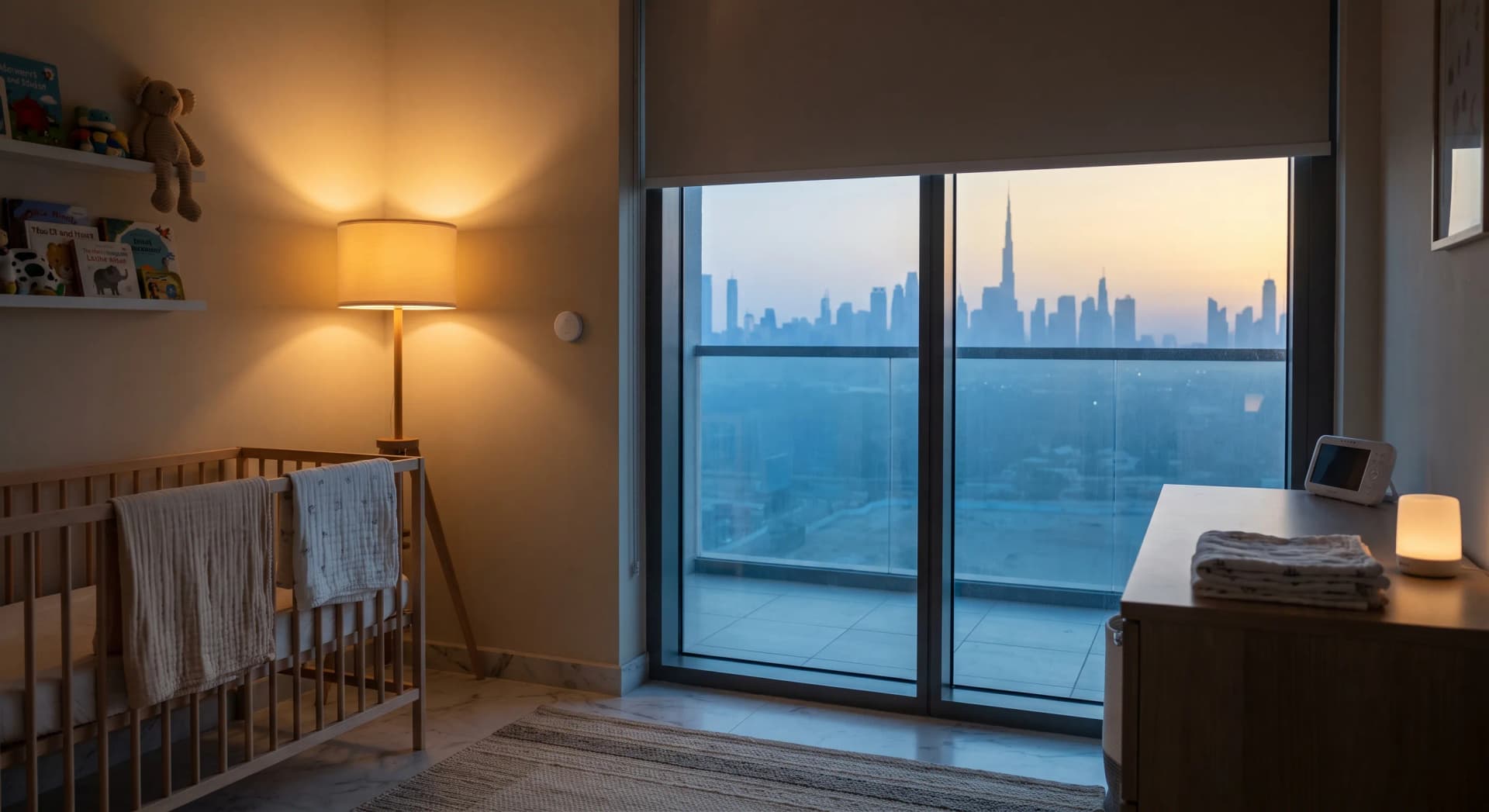
You brought a newborn home to a Dubai apartment in August. Your whole world shrank to a three-hour loop of feed, change, settle, and the fifteen minutes of sleep you can steal in between. And the apartment, the one place that is supposed to make this easier, is fighting you the entire time. The light switch by the nursery door is either off or blinding, nothing in between. The AC you set to 23 has drifted to 26 while you were feeding. At four in the afternoon the west sun lands straight on the cot and the nap you spent an hour building falls apart in ten minutes.
None of this is a parenting failure. It is a house that runs on manual controls at the exact moment you have no spare hands and no spare attention. This is where a smart home earns its place. It does not parent for you. It holds the conditions steady so you can spend your energy on the baby instead of the building.
TL;DR: A newborn cannot manage heat the way you can, so the job in a Dubai summer is a steady room, not a cold one. A smart home holds the nursery at a set temperature through the mid-40s heat of a Dubai summer, gives you a dim path to the cot at 3am without a blinding switch, closes the blind before the 4pm sun hits, and keeps white noise and humidity consistent. It will not make your baby sleep, and you should skip the fear-marketed gadgets. A sensor, AC control, and one dim light scene is the honest place to start, from around AED 3,000.
A newborn cannot manage heat the way you can
A newborn's body works much harder to hold a steady temperature than yours does. A baby's body surface is about three times greater than an adult's relative to its weight, and babies can lose heat as much as four times more quickly than adults (Children's Hospital of Philadelphia). That cuts both ways in Dubai. A cold draft from a vent chills them fast, and a warm, stuffy room tips them the other way, because they cannot balance heat as easily as an older child can.
Guidance from the UK's Lullaby Trust puts a baby's room at 16 to 20 degrees, cooler than most adults keep their own bedroom. In a Dubai apartment in August that exact number is often impractical, and chasing it will freeze the rest of the household. What matters more is that the room stays steady and you dress the baby for it. Steadiness is a control problem, and control is exactly what a manual AC and a wall switch are bad at.
The real job is keeping the room steady, not freezing it
A basic AC does not hold a temperature. It cools hard until the wall sensor near the ceiling is satisfied, shuts the compressor off, and lets the room drift up several degrees before it kicks in again. You feel that swing as a baby who settles, then stirs forty minutes later for no reason you can see. The room moved.
Smart AC control closes that gap two ways. It holds a tighter band around your setpoint instead of letting the room roam, and it reads the temperature from a small sensor placed where the baby sleeps, not from the return-air grille up near the ceiling that runs a few degrees off. When we set up a nursery in a Business Bay or Dubai Marina apartment, that single change, measuring the cot's air instead of the ceiling's, is what stops the mystery wake-ups. If your nursery also sits a couple of degrees off the rest of the flat, the same fix that solves uneven room temperatures applies here.
The 3am feed without flipping a blinding switch
Every parent of a newborn learns to dread the light switch. You need to see enough to feed and change safely, and the overhead light is a floodlight that wakes the baby fully and resets your own body clock at the worst possible hour.
The fix is a low, warm light you never have to reach for. A dim lighting scene set to something like ten percent in a warm amber tone gives you a path to the cot and enough to latch a feed, without the blue-white blast that tells everyone's brain it is morning. You trigger it with a single tap by the bed, a voice line under your breath, or a motion sensor that brings the light up soft when you walk in and fades it after you leave. This is the same logic behind a good Good Night scene, tuned down for a room where someone tiny is trying to stay asleep. One thing new parents always ask us is whether the light can come up gently rather than snap on. It can, and on a motion trigger you never touch a switch at all.
Blinds that close before the sun wrecks the nap
A west-facing or south-facing nursery has a predictable enemy. Around four in the afternoon the sun clears the neighbouring tower and lands on the cot, and the room heats several degrees in half an hour right through the middle of the afternoon nap. A blackout curtain helps with the light but does nothing about the timing, because someone still has to remember to close it, and that someone has not slept.
Motorized blinds on a schedule close themselves before the sun arrives, every day, without a note on the fridge. The quiet part matters more than it sounds. Reviewers describe the better motors as a low whirr that is quiet enough it will not wake a sleeping baby (Tom's Guide). That is the whole point. A blind that clatters is worse than no automation at all in a nursery. Pair the scheduled close with the AC holding its band, and the 4pm heat spike that used to end the nap stops happening. We cover the room-by-room version of this in the kids' room lighting guide.
White noise that stays consistent and never too loud
White noise is one of the few sleep tools with real evidence behind it. In a 1990 study in Archives of Disease in Childhood, 16 of 20 newborns, 80 percent, fell asleep within five minutes to white noise, against only 25 percent in the quiet control group (Spencer et al.). In a Dubai apartment it does a second job too, masking the lift lobby, the neighbour's door, and the building sounds that carry through shared walls at night.
The one caution is volume. Many machines run louder than they should, and infant ears are more sensitive than ours, so the rule is low and across the room, never right beside the cot. If you already have multi-room audio, it can hold a soft, steady sound in the nursery as part of the same system that plays music everywhere else. If you do not, a simple dedicated machine on a shelf across the room does the job well. This is not a reason to buy speakers. It is a reason to keep whatever you use consistent, because the consistency is what settles the baby, not the price of the box.
Humidity: the Dubai AC side-effect nobody warns new parents about
Run the AC hard all summer and it does something quiet in the background. It pulls moisture out of the air, and a heavily air-conditioned Dubai bedroom can sit drier than is comfortable for a small set of airways. Dry air irritates a baby's nasal passages and makes a stuffy nose harder to clear, which turns into a broken night for everyone.
The comfortable band for an indoor room is roughly 30 to 50 percent relative humidity (US EPA). The trouble is you cannot feel the difference between 35 and 22 percent, you only feel the congested baby three hours later. A small temperature and humidity sensor in the nursery turns that invisible number into something you can see on your phone, and if it reads low on a hard-AC night, that is your cue to run a humidifier for a while rather than guessing. Sensing first, then acting, is the whole approach, and it beats buying a humidifier you leave running blind.
What a smart home will not do, and what to skip
The baby market is full of fear dressed up as technology. A smart home will not make your newborn sleep. It holds the room steady, softens the light at night, closes the blind on time, and takes the small repeated jobs off your hands, and that is genuinely a lot at 3am. It is not a substitute for a plan, and no device parents for you.
A few things are worth skipping. The AED 1,500 "smart" bassinet, if money is tight, because a steady room and a settled routine do more of the work than the marketing admits. The medical-grade monitors sold on worst-case worry, unless your pediatrician specifically asked for one. A simple monitor you already trust, plus a sensor that shows you the room's real temperature and humidity, covers what most families need. In our experience, the parents who spend the least on gadgets and the most on getting the room's temperature and light right are the ones who tell us the room finally holds.
Where to start: one room, three jobs
You do not need to automate the apartment to make the nursery work. Start with the room the baby is in, and the three jobs that break a nap: temperature that drifts, light you cannot control at night, and sun that arrives on a schedule. A sensor in the cot's air, smart AC control to hold the band, and one dim warm light scene is a real starting point, and it lands in the range of the Smart Home Starter from around AED 3,000 installed. Add the scheduled blind next, once you have seen the difference the first three make. The bill runs a little lower as a side effect, because a room that holds its setpoint stops the AC from overcooling and catching up all night, but the reason you do it is the sleep, not the DEWA line.
Frequently Asked Questions
What temperature should a baby's room be in a Dubai apartment?
Guidance for a baby's room suggests 16 to 20 degrees, cooler than most adults keep their own room. In a Dubai summer that exact figure is often impractical, so aim for a steady, comfortable room in the low twenties and dress the baby to suit it. Steadiness matters more than hitting a precise number.
Can I control the nursery AC without waking the baby to adjust it?
Yes. Smart AC control lets you set and hold the nursery temperature from your phone, so you never open the door to change a setting. It also reads the temperature from a sensor placed near the cot rather than the ceiling grille, which is what stops the room drifting and the baby stirring.
Do smart blinds make enough noise to wake a newborn?
A good motorized blind is a low whirr that reviewers describe as quiet enough not to wake a sleeping baby. Lesser motors can rattle, which is worse than no automation in a nursery, so this is one area where the quality of the motor is worth paying for.
Is white noise safe for a newborn?
Evidence shows white noise helps many newborns settle, with one study finding 80 percent fell asleep within five minutes. The caution is volume. Keep the machine low and across the room, never right beside the cot, because infant ears are more sensitive than adult ears.
Do I need a whole smart home, or can I start with only the nursery?
Only the nursery is the right way to start. A sensor, AC control, and one dim light scene solve the three things that break a newborn's nap. You can add the rest of the apartment later, once you have seen what a steady, quiet, well-lit room does for everyone's sleep.
Bringing a newborn home is the least sleep you will ever run on. The house should not add to the list of things you have to remember. Tell us about your nursery and we will recommend the smallest setup that makes the room hold steady, quiet, and dark on its own. No obligation, and no gadget we would not put in our own child's room.
Ready to Get Started?
Get a free consultation and we'll recommend what makes sense for your situation.
Get Free Consultation