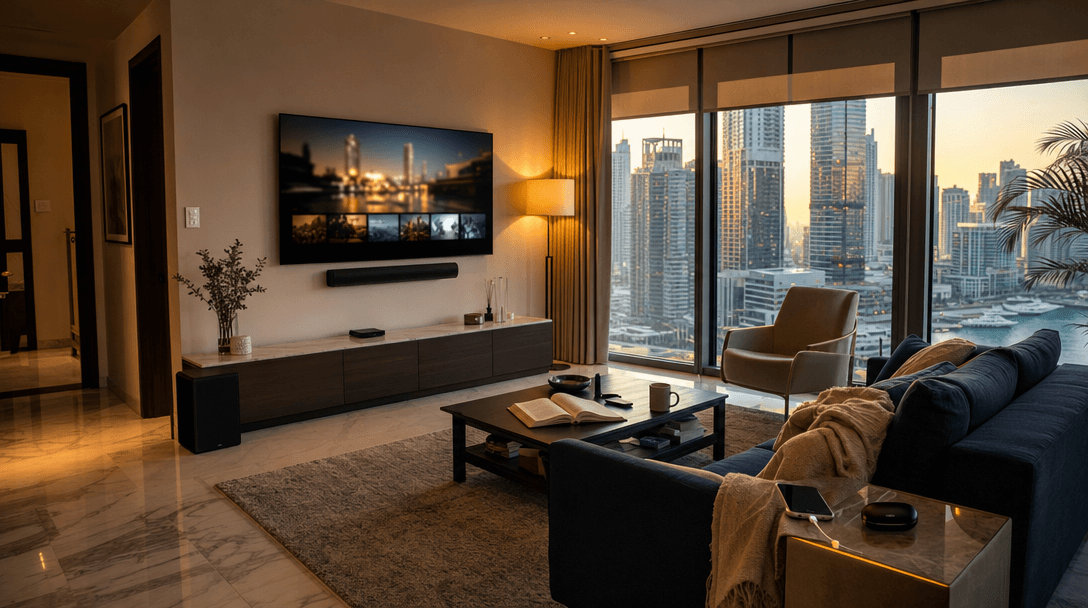
You manage a team of 20 from your phone. You approve invoices from the back of an Uber. You order groceries in 30 seconds. But to watch one episode of something on a Tuesday night, you reach for the TV remote, the soundbar remote, the Apple TV remote, the AC remote, and the wall switch you never quite know which way is "off." Five remotes. Three apps. Two arguments about whose turn it is to figure out why Shahid is logged out again.
Dubai apartments love a big TV. About 81% of Dubai residents watch TV on a regular basis (The National), the UAE smart TV market hit roughly USD 1.84 billion in 2025 (Research and Markets), and Samsung, LG, and Sony together hold more than 65% of GCC smart-TV market value (GlobalGrowthInsights, 2026). The hardware is already in your living room. What is missing is the part that makes it feel smart.
TL;DR: A proper smart TV setup for a Dubai apartment combines an Apple TV or Fire TV (AED 250-630), a soundbar or AV receiver, an IR or smart-home hub like a BroadLink RM4 Pro (AED 189) or SwitchBot Hub Mini (AED 105-180), and a single remote scene that controls TV, sound, lights, blinds, and AC together. Renters can do all of this without drilling. Total: AED 1,500-6,000 depending on what you already own.
This is a guide for the way most people in Dubai really live. Big screens, multiple streaming services, an AC that runs half the day, and a host of small frictions that smart home automation handles in one tap. Renting or owning, hardwired or wireless, AED 50K apartment or AED 5M penthouse, the same playbook works.
What a Smart TV Setup Means in 2026
A smart TV setup in 2026 is a coordinated system, not a single device. One streaming box with all your apps, one audio chain that plays the right way, one remote scene that pulls down the blinds and dims the lights when you press play, and one shared logic across the rest of your home. The TV stops being its own island.
Most Dubai apartments stack their entertainment piece by piece. A TV from Sharaf DG. A soundbar a year later. An Apple TV when somebody noticed how much better it is than the built-in OS. A streaming stick for the bedroom. A gaming console for the kids. Each device works fine on its own. Together, they create the five-remote evening.
The fix is not more devices. The fix is one layer that talks to all of them. That layer is either a streaming hub like Apple TV, a smart-home hub like an Aqara M3 or Home Assistant box, or both working together. In our experience, the apartments where TV night feels effortless are the ones where the streaming hub and the smart-home hub know about each other. The AC, blinds, and lights respond when the TV turns on. Nobody touches a remote after the first tap.
Pick the Right Streaming Device for the UAE
The streaming device matters more than the TV's built-in operating system, because the built-in OS is almost always slower, less updated, and missing apps people in the UAE use every week. Picking one good streamer fixes 80% of the problem on its own. Three options dominate Dubai apartments: Apple TV 4K, Amazon Fire TV, and Google Chromecast with Google TV.
Apple TV 4K (AED 499-629)
Apple TV 4K is the cleanest choice for most Dubai households, especially anyone already inside the Apple ecosystem. The 64GB Wi-Fi model is AED 499 and the 128GB Wi-Fi + Ethernet model is AED 629 in the UAE (Sharaf DG, 2026). Du also runs an instalment plan starting at AED 30/month with zero upfront cost and a free year of Apple TV+ (du). It runs every major UAE app: OSN+, Shahid, Starzplay, Netflix, Disney+, Prime Video, Apple TV+, plus AirPlay from any iPhone for casting from someone's lap.
Apple TV is also the best at smart-home integration through HomeKit. When we set this up in Dubai Marina apartments where the family already uses iPhones, the Siri remote becomes a useful shortcut for the rest of the home, not only the TV.
Amazon Fire TV Stick 4K Max or Cube (AED 250-450)
Fire TV is the better choice if you watch a lot of Prime Video, want IPTV apps that the Apple App Store does not allow, or need an upgrade for AED 300 instead of AED 600. Fire TV Stick 4K and 4K Max work with all major UAE streaming apps and need a minimum of 25 Mbps for HD and 50+ Mbps for 4K (Olyviax, 2026), which is easy on any decent etisalat or du fibre line.
The Cube version has a built-in microphone for hands-free Alexa and is the more capable option for anyone who wants voice control without picking up a remote. AirPlay even works on Fire TV smart TVs now (Amazon), so iPhone households are no longer locked out.
Chromecast with Google TV (AED 200-300)
Chromecast is fine. If you already use a Pixel phone and live inside Google's ecosystem, it works well, and at AED 200-300 it is the most accessible serious option. For most Dubai apartments, though, Apple TV or Fire TV is the better fit.
What we tell clients: pick one streamer for the whole apartment. Same brand, same logins, same app layout in the bedroom and the living room. The cost of standardising is small. The friction it removes is huge.
Audio: Soundbar, AV Receiver, or In-Ceiling
The TV's built-in speakers are the weakest part of any modern setup. A 65-inch OLED with stock speakers sounds like a 22-inch laptop. Three audio paths work in Dubai apartments, and the right one depends on whether you rent, what walls you have, and how much your neighbour cares about Tuesday-night dialogue.
A soundbar plus subwoofer (AED 1,500-5,000) is the fastest fix and the right answer for most renters. A Sonos Arc or a mid-range Samsung HW-Q-series soundbar plus a wireless sub gives you proper dialogue, real bass, and a single power cable. No drilling, no AV receiver in a cupboard, no afternoon of wiring. A full breakdown of when each path makes sense lives in our soundbar vs AV receiver vs in-ceiling speakers guide, and an honest comparison of multi-room audio options covers what happens once you want music to follow you between rooms.
Concrete walls and marble floors in Dubai apartments push bass around the room more than carpeted Western homes do. Dubai noise rules also matter: residential noise is capped at roughly 40-50 dB during the day and 30-40 dB at night under Local Order 61/1991. In our experience, a soundbar with a "night mode" or compressed dialogue setting solves more late-night arguments than a fancier speaker setup ever will.
For owners doing a renovation, in-ceiling speakers with a hidden AV receiver give you the cleanest look and the best surround sound. We pair this with Sonos zones in adjacent rooms so the same apartment can run movie audio in the living room and a different playlist in the kitchen.
One Remote: How an IR Hub Replaces the Pile
Every TV, soundbar, AC, and old DVD player in your apartment runs on infrared. So does most of the older entertainment gear in Business Bay, JBR, and Downtown furnished rentals. You do not need to throw any of it away. You need one device that learns every IR code and replays it on command.
The two devices we install most often:
BroadLink RM4 Pro (AED 189). A small black puck that learns IR signals from any remote, blasts them across the room, and adds RF (315 MHz and 433 MHz) for older curtain motors and shades. It supports more than 50,000 IR-controlled devices out of the box (Broadlink UAE, 2026), works with Alexa, Google Home, and IFTTT, and integrates cleanly with Home Assistant. A more compact RM4 Mini at AED 79 covers IR-only setups in smaller rooms.
SwitchBot Hub Mini (AED 105-180). Slightly more polished app, deeper smart-home ecosystem if you already use SwitchBot curtain rods or smart locks. Works with Alexa, Google Assistant, and Siri, and supports more than 4,000 device manufacturers (SwitchBot UAE, 2026). Slightly less powerful for RF devices than the BroadLink, slightly nicer for app-driven setups.
The setup is short: point the old remote at the hub, press the button you want to copy, the hub stores the code, and now your phone or Siri or Alexa can replay it. Once you have all the codes captured, you can build scenes. "Movie night" presses TV on, source HDMI 2, soundbar on, volume 22, AC to 23 degrees, lights to 20%, blinds down. One tap. No remotes.
When we installed this for a JBR renter last summer, the family kept saying the same thing: "We did not realise how often we were standing up to fix something until we stopped having to." That is the part nobody markets. The win is not the new hardware. The win is everything you do not do anymore.
Streaming Services That Matter in Dubai
The UAE streaming market in 2026 is not the US one. The same Apple TV running Netflix in California works fine here, but the apps that matter for Dubai households are different, and the device you pick should run them all without surprises.
The current shortlist that covers most viewing in a Dubai apartment:
- OSN+. The HBO/Max library, Warner Bros. pipeline, English-language premium (tbreak, 2026).
- Shahid VIP. The leading Arabic-language service. Since January 2026, Shahid VIP+ subscribers also get a rotating Netflix catalogue without a separate Netflix bill (Middle East Insider).
- Starzplay. Hollywood films, Western TV, Arabic programming. Bundled into many etisalat eLife plans for free (Etisalat eLife).
- Netflix, Prime Video, Disney+, Apple TV+. The four global services everyone already has.
A typical UAE household runs OSN+ Premium plus Shahid VIP at a combined AED 93.73/month (tbreak, 2026), plus whatever comes free with the etisalat or du plan. Apple TV and Fire TV both run all of these. The built-in OS on a 2022 Samsung often does not.
The honest take: do not let your TV's app store decide your streaming line-up. Run a dedicated streamer. Update it every couple of years. Your TV will last 8+ years and look fine; your streaming device should be replaced every 3-4 years to keep up with apps and codecs.
Smart Home Integration: The TV as Part of the System
The real upgrade in a smart TV setup is not the TV. It is what happens when the TV turns on. The lights respond, the blinds drop, the AC adjusts, and the music either pauses or follows you, all from one trigger.
This is where a smart-home platform earns its place. Most Dubai apartments we work in run Home Assistant for the flexibility, Lutron for the lighting, and either Apple HomeKit or Google Home for the voice layer. The TV plugs into all of it. When you select "movie night" on the Apple TV or press a Lutron Pico keypad on the wall, three things happen at once:
- The TV powers on, the soundbar matches volume, the streaming app you use most opens.
- The smart lighting drops to 15-25% on warm whites; floor lamps off, accent lights on.
- The motorized blinds close, the smart AC shifts from 24 to 22 degrees, and the kitchen lights stay on at full bright if anybody is still cooking.
What we have found is that this is the moment people stop calling it a "smart home" and start calling it "the apartment." The system disappears. They notice it again only when they travel and stay somewhere that does not have it. That gap, between expectation and what a normal hotel room or AirBnB delivers, is the new baseline a smart home builds for you.
A full setup for a 2-bedroom Dubai apartment ties into whole-home automation. Renters can hit 80% of the same outcome with a streaming device, a soundbar, an IR hub, smart bulbs, and a battery-powered curtain motor.
Standby Power: The Quiet DEWA Cost
Entertainment centres are quietly the worst offenders for standby power in Dubai apartments. A modern TV draws 1-5 watts on standby on its own, but a TV plus set-top box, soundbar, streaming device, and gaming console can pull 40-60 watts combined when "off" (US Department of Energy). Across a year, that is meaningful in DEWA's slab tariff system.
DEWA confirms that combined standby loads from devices like TVs, soundbars, coffee machines, and gaming consoles can account for roughly 5-10% of a typical household's electricity bill (Gulf News, 2026). On a Dubai 2-bedroom apartment running 1,800-2,200 kWh per month, that is AED 30-90 a month silently going to devices nobody is using.
The fix is one smart power strip behind the TV. AED 80-150 for a strip with master/slave outlets, or about AED 240 for four Aqara or Shelly smart plugs that cut power on a "movie off" scene. The standby savings alone cover the hardware cost inside a year, and it is the most boring smart-home upgrade we ever sell. Boring works. The full picture of appliances running 24/7 in your apartment covers the other quiet drains worth fixing the same way.
What This Costs in a Dubai Apartment
Three realistic budgets, based on what we install most often. None of these include a TV, on the assumption you already have one.
Renter starter (AED 1,500-2,500). Apple TV 4K or Fire TV Stick 4K Max (AED 250-499), a Sonos Beam or Samsung HW-B650 soundbar (AED 1,000-1,500), a BroadLink RM4 Mini (AED 79), and a smart power strip (AED 100-150). Streaming, sound, and standby savings, all without drilling.
Apartment owner (AED 4,000-7,000). Apple TV 4K 128GB (AED 629), a Sonos Arc + Sub Mini (AED 4,500), a SwitchBot Hub Mini or BroadLink RM4 Pro (AED 105-189), a few smart bulbs and a Lutron Caséta dimmer (AED 600-900), a smart AC controller (AED 600-700). Movie scenes, lighting scenes, and a single remote that runs the room.
Whole-home or villa (AED 12,000-25,000). AV receiver with 5.1 in-ceiling speakers, hidden equipment cupboard, Lutron HomeWorks keypads on the wall, motorized blinds, Sonos zones in adjacent rooms, and the whole thing tied together by a Home Assistant box or Crestron Home processor. This is the version where guests visit and ask who installed it. Pricing for this scope tracks the home automation Dubai guide.
We do not pitch the AED 25K version to a 2-bedroom renter whose problem is solved by AED 2,000 of equipment. If your only frustration is "we have too many remotes," we will tell you to spend AED 1,500 and call it done.
Frequently Asked Questions
Do I need to replace my smart TV to get a smart home setup?
No. Almost any TV from the last six years works. The streaming device, audio chain, and IR hub do most of the work. Even a 2019 Samsung or LG without modern apps becomes a clean modern TV the moment you plug an Apple TV or Fire TV into HDMI 1 and stop using the built-in apps.
Will all the streaming services I use in Dubai work on Apple TV and Fire TV?
Yes. Both run OSN+, Shahid, Starzplay, Netflix, Prime Video, Disney+, Apple TV+, and YouTube in the UAE. Some IPTV apps that the Apple App Store does not allow run on Fire TV but not Apple TV, which is the only meaningful gap. For mainstream streaming, both are fine.
Can renters do this without modifying the apartment?
Yes. The whole renter playbook above is wireless, plug-in, and fully removable. Streaming devices sit on the TV stand. Soundbars connect by HDMI ARC. IR hubs sit on a shelf. Smart plugs and bulbs come with you when you move. The full renter angle is covered in our smart home devices renters can take when they move guide.
Does a universal IR remote really replace four separate remotes?
For 95% of households, yes. A BroadLink RM4 Pro or SwitchBot Hub Mini learns the codes from each remote and lets your phone, Siri, Alexa, or a wall keypad replay them. The TV remote that came in the box still works as a backup. You stop reaching for it.
How much can a smart power strip on the entertainment centre save on DEWA?
Combined standby loads from a TV, soundbar, streaming box, and gaming console can run 40-60 watts continuously, or AED 10-30 per month at typical Dubai slab tariffs. A smart power strip cutting that load when the TV is off recovers its hardware cost in 6-12 months, and the savings continue every month after that.
The Setup Worth Building
The smart TV setup that works in a Dubai apartment is not the most expensive one. It is the one where you sit down at 9pm, press one button, and the room becomes a cinema. The lights know. The blinds know. The AC knows. The remotes are in a drawer somewhere because nobody has needed them in three months.
Get the streaming device right. Get the audio right for your apartment, not a showroom. Add an IR hub so your phone can replace the pile of remotes. Tie it into the rest of the home so the TV is part of the system, not an island. That is the whole game.
Curious what this would look like in your apartment? Get a free consultation and we will tell you exactly what to keep, what to upgrade, and where the AED 1,500 fix would do more for you than the AED 25K one. No obligation, no surprises.
Ready to Get Started?
Get a free consultation and we'll recommend what makes sense for your situation.
Get Free Consultation