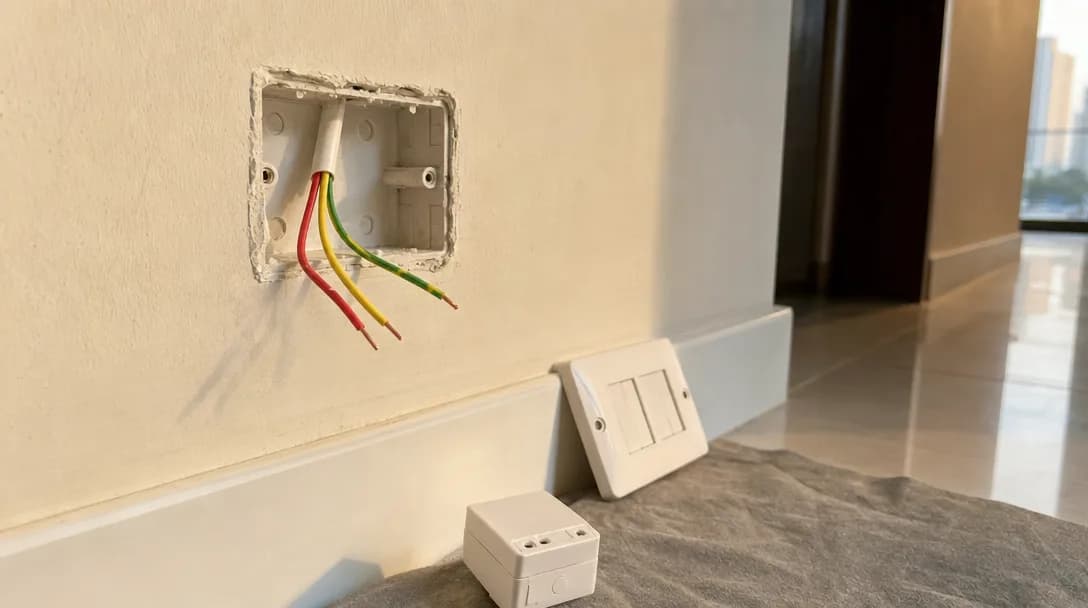
The electrician has the faceplate off and the box open. Inside there are two wires where the smart switch wants three: a live coming in, a switched line going up to the light, and no neutral. He looks at the green and yellow earth sitting there doing nothing, says he can take the neutral from that, and offers to have it working in ten minutes.
He is right that it will work. Put the module's neutral terminal on the earth wire and the switch powers up, joins the Wi-Fi, and turns the light on and off from your phone. Nothing sparks and nothing trips, and there is no hot smell an hour later. The job looks finished.
TL;DR: Smart switches need a constant trickle of power, which means they need a neutral, and a lot of Dubai switch boxes only carry a live and a switched line. Borrowing the earth wire instead works immediately and is prohibited. DEWA's regulations say neutral and earth conductors must be kept separate and not connected together "at any other point in the customers' installation". Nothing trips when it is done, because earth-leakage protection only acts above a rated threshold and one module's standby current sits under it. A quiet breaker is not a verdict on the wiring. The three legitimate routes are a no-neutral module, a relay at the light fitting, or having a real neutral pulled.
Why a Smart Switch Wants a Third Wire
A smart switch is a small computer that has to stay awake while the light is off. It needs a continuous low-voltage supply for its radio and its processor, and any continuous supply needs a return path. That return path is the neutral.
An ordinary wall switch needs nothing of the kind. It is a mechanical gap in the live conductor, and when it is open, no current flows and nothing in the box needs power. So in a lot of Dubai apartments the builder ran what the ordinary switch needed and no more: a live down to the switch and a switched line back up to the ceiling. The neutral stayed at the light fitting, where the lamp joins it. There is a green and yellow earth in the box as well, and on a good day a spare drawstring, and that is the lot.
When you open that box with a smart module in your hand, you are two wires into a three-wire problem. We cover the measuring side of this, including whether anything will physically fit in the box, in our guide to Dubai back box depth and smart switch modules.
What the Earth-Wire Shortcut Actually Does
Joining the module's neutral terminal to the earth wire sends the switch's standby current back through the earth conductor instead of the neutral. It is a small continuous current, and it now flows along a wire whose entire design assumption is that it carries nothing at all until something goes wrong.
Every other safety feature in the flat is built on that assumption. Your earth conductor exists to give fault current a fast, low-resistance path home so that a breaker opens before anyone gets hurt, and it is also the thing bolted to the metal body of every earthed appliance you own. DEWA's regulations describe it that way directly: the exposed conductive parts of all the electrical equipment in an installation are connected by circuit earth conductors to one main earthing terminal (DEWA Regulations for Electrical Installations, 2017 Edition, clause 5.1.9).
One conductor, running to the body of the oven, the washing machine, the water heater, the AV rack and the AC chassis. Put a working current on that conductor and every one of those bodies is now referenced to a wire that is no longer sitting quietly at zero.
If the box is already open: the line is "Leave the earth as the earth. I would rather use a switch that does not need a neutral."
The Rule in Dubai Is One Sentence Long
"In all cases the Neutral and Earth Conductors shall be kept separate and not connected together at the main earth terminal or at any other point in the customers’ installation."
That is clause 5.1.10 of the DEWA Regulations for Electrical Installations, 2017 Edition. "In all cases" and "any other point" are doing the work. There is no depth of installation at which it becomes acceptable, and a switch box is a point in your installation.
The same document says the neutral is earthed once, at DEWA's substation, and "shall not be earthed elsewhere in the consumers’ electrical installations" (clause 1.2). Joining the two in your hallway is a second earthing point for the neutral, in a flat, behind a faceplate, with no record that it was ever done.
None of this is limited to new buildings. Clause 1.1 puts "any additions, alterations to the existing buildings and installations therein" inside the regulations' scope, which covers the retrofit you are standing in the middle of.
Three Ways Round a Missing Neutral That Are Not This
None of these touches the earth conductor, and all three are ordinary work in Dubai.
Before anyone opens a wall, ask the person quoting two things: is there a neutral in the switch boxes, and if there is not, which product are you planning to use. An answer naming a no-neutral module or a relay at the fitting tells you the problem has been thought about. "We will manage on site" tells you it has not been settled yet, and that is worth knowing while you are still choosing.
Use a module built to run without a neutral
These draw their standby current through the light fitting instead of through a return wire, which is the entire reason they exist. They come with real constraints, mostly a minimum load for each button on the plate, and fussiness with cheap LED drivers. Those constraints are the price of not doing the other thing. The back box guide covers which of these fit a UAE box.
Move the intelligence to the light instead of the switch
Up at the ceiling fitting where the lamp hangs, the live, the neutral and the load are all present, because that is where the lamp connects. A relay module up there has everything it needs, and the wall switch underneath becomes a trigger or stays as a manual override. Smart bulbs with a wireless wall button do the same job from the other direction, which we compare in our piece on smart bulbs against smart switches.
Have a real neutral pulled
This is the proper answer and it is cheap at exactly one moment, which is while the wall is already open for something else. In Dubai this is work for a licensed, DEWA-approved electrical contractor, not for you and not for us.
Why Nothing Trips, and Why Nobody Will Catch It
Nothing trips because the leakage is below the threshold of the device watching for it. That is all a quiet breaker tells you.
Dubai requires earth-leakage protection on every circuit: clause 9.3.1 says that "in addition to the over current and short circuit protection, every circuits shall be protected for earth leakage". The sensitivity is not the same everywhere. Clause 9.3.2 puts final sub circuits feeding 13A socket outlets and portable equipment at 30 mA, and says that "100mA ELCB/RCCB shall be provided for protection of other lighting circuits, fixed equipment, etc. unless otherwise specified". Water heater circuits get 30 mA under clause 4.6.5.
That last caveat matters, and it is easy to read past. DEWA's inspection checklist separately calls for 30 mA additional protection on cables concealed in a wall at less than 50 mm deep, and on cables in walls or partitions containing metal parts at any depth. A switch drop chased into an apartment wall can easily be one of those, and in a gypsum partition on steel studs it qualifies whatever its depth. So you cannot assume which figure is guarding the lighting circuit in your flat.
Either way, earth-leakage protection does not react below its rated operating current, and the continuous current one wall module draws is a small fraction of any of those ratings. The electrician's multimeter says the installation is fine, the breaker agrees, and the only honest conclusion either of them supports is that this specific fault is below the threshold of this specific detector today.
Then the second module goes in, and the third, and each one adds its own small return to the same total.
There is a test that would find it, as long as the module is still connected when it is run. DEWA's Inspection and Testing Certificate requires an insulation resistance measurement at 500 volts DC taken between several pairs of conductors, and one of the listed pairs is "Between protective conductors and with phases and neutral together" (Appendix 3). A properly wired flat shows no connection between them. A flat with the earth bonded to a neutral shows one.
That test belongs to the handover of the installation. A smart switch going in two years later, on a Tuesday afternoon, by arrangement between you and whoever answered the phone, produces no certificate and gets no test. Clause 1.13 does require periodic inspection and testing of every installation, and clause 9.3.3 puts a standing duty on the consumer to check the earthing and the ELCBs regularly, so this is not somebody else's problem. But the only hard interval written down, at least every two years by an independent consultant or contractor, is for industrial and commercial installations. There is no equivalent interval for your apartment, and nobody is scheduled to come and look.
That is why the decision sits with you, in the ten seconds after the offer is made, and not with an inspector later.
What Goes Wrong Later Rather Than Today
The failures here are patient, which is what makes the shortcut feel safe.
The first is that the earth conductor stops being a quiet reference and starts being a wire with a voltage drop along it. Everything bonded to it sits slightly above true earth. How large that offset is depends on how much current the devices wired this way are drawing and how long the run back to the board is. With one module it is small. It is not a fixed quantity, though: every further device wired the same way adds to the current on that conductor, and the offset grows with it.
The second is the broken connection. If that earth-to-neutral link at the switch comes loose, which is what years of heating and cooling behind a faceplate can do to a terminal nobody has looked at since the plasterer closed the wall, the module's neutral terminal is no longer connected to anything. It floats up towards line potential. The next person to open that box to change a faceplate finds a live terminal sitting in the same joint as the earth conductor, which is the one their training tells them is safe to touch.
The third is cumulative. Earth-leakage protection works by comparing what goes out against what comes back, and it has one threshold for the whole circuit. Deliberate leakage from a handful of modules eats into the margin that was supposed to be reserved for a genuine fault, and the day a real one happens, part of the budget has already been spent on your lighting.
All three show up later, as a live terminal in a box or a breaker without the margin it was supposed to have, at a moment nobody will connect back to a light switch.
The One Time This Came Up on a Job
On a single apartment project this year, the site electrician proposed exactly this: bond earth to neutral at the switch boxes so that neutral-requiring smart switches would work. The client asked what the specific downsides were before agreeing to anything, which was the right question and the reason there is anything to write about.
We declined it in writing, and the flat was specified with no-neutral wall modules instead. That is one recorded instance in our book, so take it as a thing that happens rather than as a measurement of how often. The client paused long enough to ask, on the one afternoon when asking was free. That is the part worth copying.
Bayora does not hold an electrical contracting licence and does not do fixed wiring. We choose where the intelligence goes, and that choice sits upstream of this whole problem, because picking a device that needs a neutral when there is no neutral is what creates the pressure to invent one.
Frequently Asked Questions
Can I use the earth wire as a neutral for a smart switch in the UAE?
No. DEWA's Regulations for Electrical Installations, 2017 edition, state that neutral and earth conductors must be kept separate and not connected together at the main earth terminal or at any other point in the installation. It will function if you do it, which is the problem, because nothing in the flat will tell you it is wrong.
Why does my light switch have no neutral wire?
Because an ordinary switch does not need one. A switch loop carries only the live and the switched line by design. Where a flat was wired that way, the neutral stayed up at the light fitting, which is where the lamp joins it, and the switch box got a live, a switched line and an earth.
Will the breaker trip if the earth and neutral are joined at a switch?
Usually not. DEWA clause 9.3.2 rates lighting circuits and fixed equipment at 100 mA and 13A socket outlet circuits at 30 mA, and clause 4.6.5 puts water heater circuits at 30 mA. DEWA's inspection checklist separately calls for 30 mA where cables are concealed in a wall at less than 50 mm, or in a partition containing metal parts at any depth. Either way, one module's standby draw is small enough that the device is unlikely to react. A quiet breaker tells you the leakage is under the threshold, not that the wiring is correct.
I think this was already done in my flat. What now?
Nothing in the flat will announce it, so start by asking rather than looking. Ask whoever fitted the switch which wire the module's neutral terminal went to. That question is the one that settles it.
If the answer is the green and yellow one, or if nobody can tell you, then the next time a licensed DEWA-approved contractor is in the flat for any reason, ask for one extra test. You do not need to follow the words, only read them out: "an insulation resistance test between the protective conductor and the phases and neutral together", which is Appendix 3 of the 2017 regulations. Ask for the result in writing, and ask one more thing: was the smart switch still connected while they tested. A contractor will normally disconnect anything that could skew a reading, and disconnecting that module takes the borrowed join out with it, so a clean result proves very little.
Until you have an answer, tell anyone who opens that box what may be behind the faceplate. Do not open it yourself to check.
Is a no-neutral smart switch safe to use instead?
Yes, it is a normal product doing a normal thing. It draws its small standby current through the light fitting rather than through a return wire. Watch the minimum load each button on the plate needs, and pair it with decent LED lamps, because very low-wattage fittings are where these modules misbehave.
Who is allowed to change fixed wiring in a Dubai apartment?
A licensed, DEWA-approved electrical contractor. Pulling a new neutral, altering a circuit or touching the distribution board is their work. Fitting a module behind an existing faceplate puts your hands in a box fed by a live circuit, so that is their work too. Bayora specifies the devices and does not do fixed wiring.
Before You Say Yes in the Hallway
You do not need to argue the regulation. One line does it: "Leave the earth as the earth. I would rather have the no-neutral module, or put the relay up at the light." If he pushes, the follow-up is "I would rather it be slower than be the thing nobody can see."
It will be harder to say than it looks on the page, because the person making the offer is competent, the alternative takes longer, and the result works. If it has already been done, the move is the same question asked later: get it written down by someone licensed, and warn the next person who opens the box.
If you are planning smart lighting across a flat and want the device choice settled before anyone opens a box, tell us what you have and we will work from the wiring you actually have rather than the wiring the product assumed.
Ready to Get Started?
Get a free consultation and we'll recommend what makes sense for your situation.
Get Free Consultation