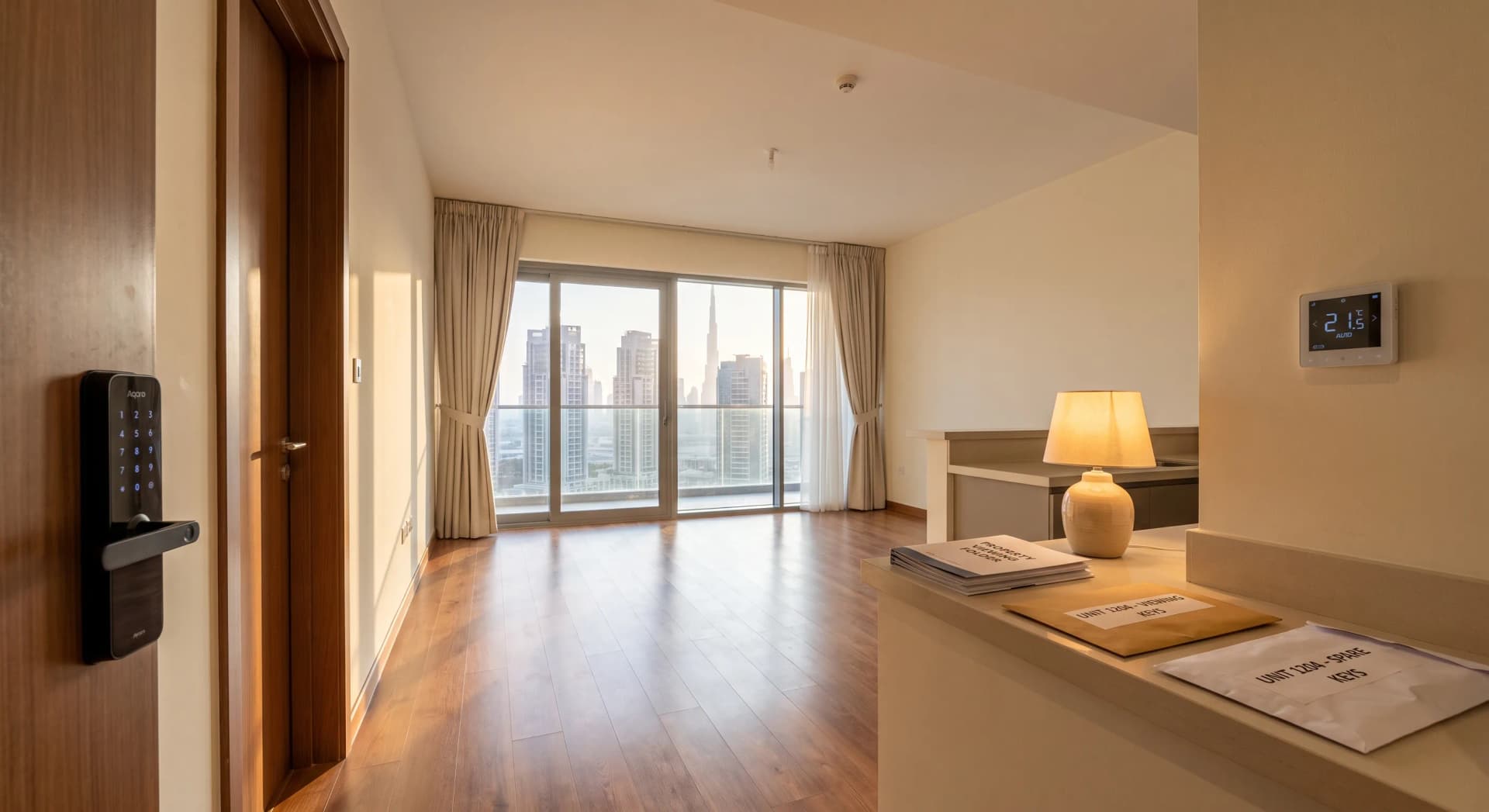
The agent calls at 11am with a viewing for 2pm. Your unit sits empty between tenants, key with the building security desk, and by the time you get someone over to unlock it, adjust the AC so the flat is not a furnace, and lock back up, you have spent an hour on a viewing that lasts eight minutes. The tenant who saw it liked it. They also saw four other units that same afternoon, because betterhomes counted around seven enquiries for every available rental listing in Dubai this year, from 1,232 tenant enquiries against 172 new listings in a single ten-day window (betterhomes, 2026). Your competition is not one other landlord. It is whoever else is free that afternoon.
TL;DR: For a Dubai rental, the upgrades that actually change how fast a unit leases are narrow: a smart lock so agents and prospective tenants can view without you or a locksmith on site, and a smart AC controller so a unit is comfortable for back-to-back same-day showings instead of stuffy and locked. A starter setup runs from AED 3,000. Skip cameras inside the unit and skip whole-home automation. Nobody rents an apartment for someone else's automation system.
We install smart home systems across Dubai for owner-occupants most of the time, but a growing share of our calls now come from landlords getting a unit ready between tenants. The brief is almost always the same. Make the viewing easy, make the handover clean, and do not spend money that a future tenant will not notice or care about.
What Actually Slows Down a Dubai Rental Turnover
It is rarely the apartment itself. It is the logistics around it. Every viewing needs someone with a key, which for most landlords means either driving over personally or paying an agent's admin fee for building-desk coordination. Every new tenant needs the locks changed or the previous cylinder swapped, which means a locksmith visit that has to be scheduled around move-out and move-in dates that never quite line up. And every unit that sits locked and switched off between tenants shows worse than one a viewer walks into at a normal temperature with a light already on.
None of that is a smart home problem in the way most people think of one. It is an access problem and a first-impression problem, and those are the two things worth solving before anything else.
The Smart Lock Is Where Landlords Start
A keypad or app-based smart lock replaces the physical key exchange that eats most of the coordination time in a turnover. You give your agent a time-limited code for the viewing window instead of a key they have to return. Once a tenant signs, you generate a fresh code for their move-in date and delete every code that came before it, no locksmith, no cylinder swap, no waiting for a physical key to be cut and couriered. Igloohome, Yale, and Aqara all make keypad or app-controlled locks that fit standard Dubai apartment door hardware, typically installed for AED 800-2,500 depending on the brand and whether it is a full cylinder replacement or a retrofit over the existing lock (our smart locks guide covers the renter-friendly retrofit options, which work the same way for a unit you own).
The part landlords tend to miss on the first pass is that this is also the cleanest way to run multiple viewings in one day without being physically present for any of them. One code for the agent that expires at 6pm, logged automatically, no spare key floating around with a third party after the unit is let.
What Makes a Unit Feel Considered During a Viewing
A locked, powered-off apartment reads as neglected the second someone opens the door, even if the finishes are good. Dubai heat makes this worse than almost anywhere else. A unit that has been closed up for a week is warm, stale, and needs ten minutes to cool before anyone can comfortably look around it, and most viewers do not wait ten minutes.
A smart AC controller lets you set the unit to hold a modest baseline, around 26-27 degrees, and then bump to a comfortable temperature an hour before a scheduled viewing from your phone, no site visit required. For a chiller-free apartment on standard DEWA power, this is a straightforward retrofit controller at AED 380-1,200 depending on the brand. For a district-cooled building, Business Bay, Downtown, JLT, and similar towers where Empower alone serves over 1,684 buildings (Dubai Media Office, 2024), it is a smart thermostat on the existing fan-coil unit, usually AED 800-1,800 per zone (smart AC control covers both setups). One honest limit worth knowing before you spend anything: in a district-cooled building, the fixed capacity charge on your Empower or Emicool bill runs around AED 750 per refrigeration ton per year (Bayut, 2025), billed whether the unit is occupied or empty (Gulf News, 2024), and no thermostat changes that line. What it changes is the metered consumption charge, which is the part that actually moves when you stop running the unit cold around the clock for no one. We cover the full split between the two charges in our district cooling guide if your building bills that way.
One warm lamp on a timer and a scent-free, dust-free unit do more for a first impression than any device does. The smart home layer removes the friction of arranging both on short notice, it does not replace either. In our experience, the landlords who lease fastest rarely spent the most on the unit. What they got right was smaller: a viewer never stood at a locked door wondering if anyone was coming.
What Bayora Will Talk You Out Of for a Rental Unit
A rental is not your home, and that changes the honest recommendation. We will not sell a landlord a full whole-home automation setup for a unit they do not live in, because a future tenant is renting an apartment, not inheriting someone else's scene presets and app logins.
Skip cameras inside the unit entirely. Once a tenant signs a lease, the interior is their private space, and an indoor camera left running or even just installed raises a reasonable privacy objection before you have had a single conversation with them. A doorbell camera at the front door is a different case, useful for viewing security and parcel drop-offs, and runs AED 600-1,200. But nothing that looks into a living room or bedroom belongs in a unit someone else is about to call home.
Skip multi-room audio, elaborate lighting scenes, and anything the next tenant has to learn how to use. A system that needs a walkthrough at handover is a system that generates support calls after you have moved on to the next viewing. Betterhomes has projected that over 40% of new Dubai villas would ship with some smart home layer built in (betterhomes, 2026), which tells you where baseline tenant expectations are heading, but expectation is not the same as demand for complexity. A lock that works and a unit that is not an oven when the door opens beats a system nobody asked for.
If you are protecting the unit itself between tenants, not just showing it, that is a separate setup entirely, humidity control, leak sensors, occupancy simulation, and we cover that full build in our vacation-mode guide. Do not confuse the two. Protecting an empty apartment and renting one out faster solve different problems, and conflating them is how landlords end up overspending on the wrong half.
What This Costs for a Rental Unit
A smart lock and a smart AC controller for a standard 1-2 bedroom unit, installed and configured, starts from AED 3,000, in line with our Smart Home Starter entry point. Add a doorbell camera and the top of that range moves toward AED 5,000. That is the full list for a unit you are letting to someone else. Anything past that is spending on features the next tenant did not ask for and likely will not notice.
Frequently Asked Questions
Do smart locks work for a standard Dubai landlord tenancy contract?
Yes. Most keypad and app-based locks retrofit onto existing Dubai apartment door hardware without needing to alter the frame, so they move between tenancies the same way a normal lock would. You reset the codes at each turnover, no reinstallation required.
Does a smart AC controller reduce the cooling bill during a vacancy?
Only the metered consumption charge, and only in a chiller-free, DEWA-billed apartment. In a district-cooled building the fixed capacity charge continues regardless of occupancy or automation, so the saving is real but partial.
Should I install cameras inside a rental unit before a new tenant moves in?
No. Once a tenant signs, the interior is their private space. A doorbell camera at the entrance is fine. An indoor camera is not, and most tenancy expectations in Dubai treat it as a reasonable objection.
Is this worth it for a single apartment, or only for landlords with multiple units?
The logistics problem, coordinating access for viewings and turnovers, exists whether you own one unit or ten. The spend scales down accordingly. A single unit only needs the lock and the AC controller, not a portfolio-wide system.
How is this different from setting up vacation mode on my own apartment?
Vacation mode protects a home you plan to return to, with humidity control, leak sensors, and occupancy simulation built for weeks of nobody being there. This setup solves the leasing and turnover process for a unit someone else is about to live in, a narrower and cheaper problem.
Have a unit between tenants right now? Get a free consultation and we will tell you exactly what a fast turnover setup costs for your building type, chiller-free or district-cooled.
Ready to Get Started?
Get a free consultation and we'll recommend what makes sense for your situation.
Get Free Consultation