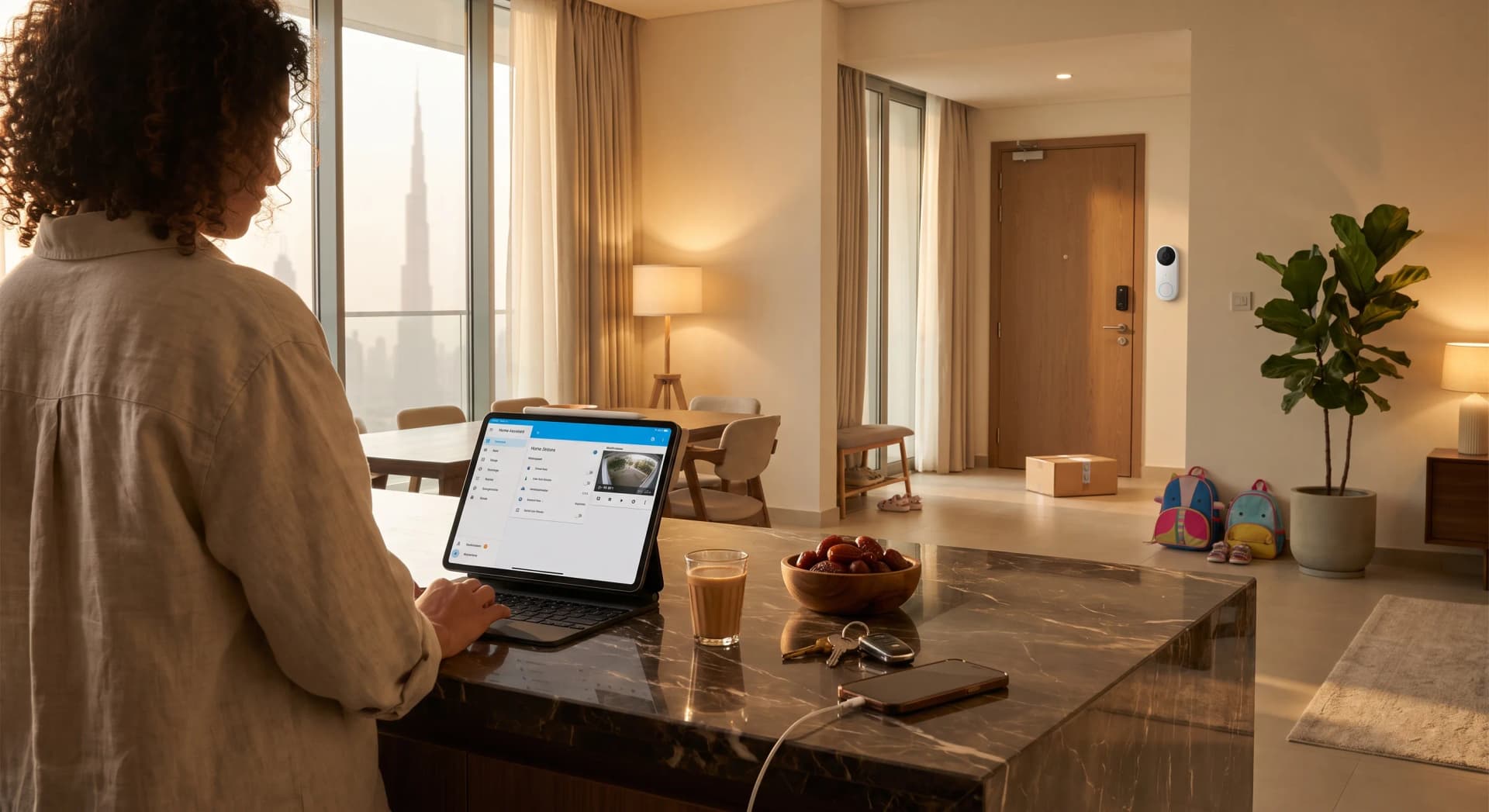
Almost every smart security setup is sold to you for the day you leave. Watch your empty apartment from a beach in another country. Get an alert while your home sits dark. That is a real use, and it matters two or three weeks a year.
For the other forty-nine weeks, and especially across a Dubai summer, the house is full. School is out from the sixth of July until the end of August (Gulf News, 2026), so the kids are home for eight weeks. The afternoon officially belongs indoors, with the midday outdoor work ban running to mid-September. The courier arrives at noon. The cleaner has her own day. You are standing at the kitchen island when someone rings the door and you have no idea who it is. Road journeys across Dubai fell in the first quarter of 2026, because people are home more, not less.
TL;DR: Dubai is one of the safest cities on earth, so in a busy summer the useful security question is not "who is breaking into my empty home." It is "what does the home do about the door, the courier, the cleaner, and the kids while we are all here." A smart security layer answers the door from your phone in another room, lets the delivery in without you getting up, and keeps everything recorded on a card in your own home with no monthly fee. A renter version starts from AED 3,000 installed, no drilling and no landlord approval.
This post is about the second setup, the one for a home that is occupied. It is the more useful build, and almost nobody sells it.
Dubai Is Safe, So This Is About Convenience, Not Fear
Start with the honest frame. Dubai scored 83.9 on the Numbeo 2026 Safety Index and ranked sixth in the world, with Abu Dhabi first for the tenth year running (Khaleej Times, 2026). More than 90 percent of residents say they feel safe walking alone at night (Gulf News, 2026). We are not going to tell you your home is unsafe. It is not.
So a security layer here earns its place on convenience, not on fear. It saves you the walk to the door forty times a week. It answers the intercom when your hands are wet. It tells you the delivery arrived so the box is not sitting in the corridor for three hours. It shows you the kids came in from the pool while you were on a call. In our experience fitting these across Business Bay and Marina apartments, the alerts people keep are almost never about intruders. They are about the ordinary traffic of a busy home, made visible from wherever you happen to be standing.
What a Full House Needs Watched
Walk through a normal Dubai summer day and the security layer has a short, specific job list. Someone rings the door around ten in the morning, and it is usually a delivery or building maintenance. The cleaner arrives on her day, and you want to let her in whether or not you are home. A parcel lands at the door at noon and you would rather not leave it in the shared corridor. In the afternoon the children come back in from the pool or a friend's flat, and you want to know they are in. If a parent is staying for the summer, you also want to know they are up and moving on a hot day, which is a gentler, camera-free version of the same job that we cover in the setup for an aging parent's room.
None of that is a crime scene. It is coordination. The right build covers four touchpoints: the front door (who is there, let them in), the entrance and corridor camera view (the parcel, the visitor), one or two indoor cameras in shared living space (the kids came in, the dog is fine), and the lock itself (a code for the cleaner, not a spare key under the mat). Get those four right and the home stops interrupting you for things it can show you instead.
The Video Doorbell Does the Most Work in Summer
A video doorbell is the single highest-value piece for an occupied home, because the door is where a full house gets interrupted most. Someone rings, your phone shows you who it is, you talk to them without moving, and if it is the delivery you were expecting you can tell them where to leave it. When we install these, it is the device the whole family ends up using, because everyone answers the door from wherever they are.
The Aqara Video Doorbell G4 runs about Dhs 690 in the UAE and stores video on a MicroSD card of up to 512GB in the indoor chime, with no monthly subscription (Modo Store UAE, 2026). It works on battery for a few months or wired to your existing chime, so a renter can fit it without touching the wiring. That is the point worth holding onto: the doorbell that saves you forty trips to the door a week costs less than one month of a whole-home project, and it keeps its footage in your home, not on someone's cloud that bills you every month.
Letting the Cleaner and the Courier In Without Being There
The second job is access. Your cleaner has a day, the courier comes when the courier comes, and you do not want to be the bottleneck for either. A smart lock solves both by giving out a code instead of a key. The cleaner gets a code that works on her hours. The delivery, if you use one of the newer courier-access setups, gets a single-use code or a remote unlock while you watch on the camera.
The rule we hold with clients is that a code is safer than a spare key, because you can see when it was used and switch it off in a second. A key under the mat cannot be revoked. We go deeper on the delivery side in our guide to letting a courier in when you are not home, and on the cleaner side in the smart intercom guide. For a full house, the lock plus a code list is the quiet workhorse that means you never coordinate a handover from a meeting again. If you are choosing hardware, our renter-friendly smart lock picks cover what fits a Dubai apartment door.
One or Two Indoor Cameras, Placed With Care
Indoor cameras are where families ask the most careful questions, and rightly so. Placed well, one camera in the living room or hallway tells you the children came in from the pool, the older one is doing homework and not on the console, the dog has not eaten the sofa. For pet owners the camera is only half of it, because the bigger summer worry is the temperature of the room the pet sits in while you are at work, which we cover in keeping a dog or cat comfortable while you are at work. The Eufy Indoor Cam E30 is a common pick at around AED 199, with 4K, pan and tilt, and local SD storage with no subscription (tbreak, 2026). Paired with a local hub like the Eufy HomeBase, which holds recordings on storage expandable to 16TB in your own home, nothing leaves the apartment and nobody bills you monthly.
Placement is the whole game. An indoor camera belongs in shared living space, pointed at the front door or the main room, never in a bedroom or a bathroom, and never where it can watch your housekeeper's private space. That is more than courtesy. It is the law, which brings us to the part most installers skip.
The UAE Camera Rules You Should Follow
Home cameras in the UAE sit under Federal Decree-Law No. 34 of 2021 on cybercrime, which makes recording someone in a place where they expect privacy, without their knowledge, an offence, and Federal Decree-Law No. 45 of 2021 on personal data protection, which covers identifiable video (bennellin.ae, 2026). A purely private residence does not need SIRA certification, since SIRA regulates commercial security. But the rules on where a camera may point are firm.
Three lines to hold. A camera must not capture a neighbour's balcony, garden, or a shared corridor, because that generates a formal complaint and can carry legal consequences. Filming a housekeeper or nanny in a bedroom or bathroom is illegal, even in your own home. Recording audio without consent is not allowed. Keep footage for two to four weeks and no longer as a practical home baseline. A good installer designs the camera angles around these limits before drilling anything, and we treat them as the starting constraint, not an afterthought.
Kids Home for Eight Weeks: What the House Can Quietly Tell You
The summer break puts children home for two months, and Dubai Police reminded parents this month that child safety stays a parent's responsibility at home and abroad, urging families to keep children under close supervision and in constant communication (Khaleej Times, 2026). A smart home does not replace supervision. What it does is close small gaps. You are at the office for a WFH day and the door sensor tells you the front door opened at 3:40, which is your older one back from a friend's flat. The living-room camera shows they are in. A contact sensor on the pool gate or balcony door tells you it was opened. None of this watches your children. It tells you the ordinary facts a present parent would notice anyway, on the days you are one room over instead of right there.
We build this as a light touch: a door sensor, one shared-space camera, and a rule that pings you when the front door opens on a weekday afternoon. It is the same quiet coordination a smart home does for a work-from-home summer day, pointed at the people instead of the AC.
What Bayora Will Talk You Out Of
Here is where the honest recommendation costs us equipment, and we make it anyway. We will talk most families out of the following.
- A camera in every room. Two or three cameras in shared space cover a normal apartment. A camera in every bedroom is a privacy problem you are creating for yourself, and half of them get unplugged within a month.
- A monthly cloud subscription. The gear we fit records to a card or a local hub in your home. If a company can only sell you security with a recurring fee, that is their business model, not your safety. Peace of mind should not come with a monthly bill.
- A full wired CCTV system for a rented apartment. Wireless cameras and a video doorbell do the job for a renter and come off the wall in twenty minutes when you move. Save the hardwired system for a villa you own.
- The AED 12,000 touch panel on the wall for security. Your phone is the panel. A wall screen looks impressive in a showroom and gathers dust in a hallway.
If your whole concern is the door and the deliveries, we will fit a doorbell and a lock and leave it there. We do not pitch the villa system to the apartment that needs a doorbell.
What It Costs in a Dubai Apartment
For a renter, a sensible occupied-home layer is a video doorbell, a smart lock, and one or two indoor cameras with local storage, which lands inside the AED 3,000 to 4,500 range installed and configured, with no subscription and nothing that needs the landlord's permission. That is the same Smart Home Starter band we quote for a first project, and security is a natural place to start because it earns trust inside your home on day one.
An owner who wants it done properly across a 2 to 3 bedroom apartment, with the doorbell, the lock, three cameras, contact sensors on the doors that matter, and everything running on an open platform, is usually in the AED 6,000 to 12,000 range. Above that you are into whole-home territory, where security folds into lighting, climate, and access as one system. We keep all of it on open platforms, so nothing is locked to a single vendor and the system still works if you ever switch providers.
A Business Bay Family, One Summer
A family we worked with in a Business Bay two-bedroom had the common summer setup: two children home for the break, a cleaner twice a week, and both parents doing a mix of office and WFH days. The problem was not safety. It was the constant low-level interruption. Deliveries left in the corridor, the cleaner texting to be let in, one parent getting up from a call every time the door rang.
We fitted an Aqara doorbell, a smart lock with a code for the cleaner, and two indoor cameras in the living and dining space, all recording to a local hub, for just under AED 4,200. The cleaner now lets herself in on her code. The doorbell answers from a phone anywhere in the flat, so deliveries get directed to the door and not the corridor. On WFH days, the front-door sensor pings a parent when it opens in the afternoon, which is almost always the older child back from a friend's place. The mother told us the win was not feeling safer, because she already felt safe. The win was that the apartment stopped interrupting her day for things it can show her instead.
Where to Start
Start with the door. Fit a video doorbell and, if the door allows it, a smart lock with a code you can give the cleaner. That one step removes most of the summer interruptions and costs less than a month of a bigger project. Add an indoor camera in the living room only if you want the "they came in from the pool" signal on WFH days. Everything else can wait until you know what you reach for.
Curious what an occupied-home security layer would look like for your place? Tell us about your home and we will recommend where to start, no obligation and no monthly fees. If you want to go further into whole-home, our home security service and home automation pages cover the full picture, and the Aqara sensor-layer guide is a good next read for the contact sensors that make the quiet coordination work.
Frequently Asked Questions
Do I need SIRA approval to put a camera in my Dubai apartment?
No. A purely private residence does not need SIRA certification, because SIRA regulates commercial security systems. Your home cameras still fall under UAE data-protection and cybercrime law, so they must not point at neighbours or shared corridors, must not record private staff areas, and should not record audio without consent.
Can I record my cleaner or nanny at home?
You can have cameras in shared living space, but filming a housekeeper or nanny in a bedroom or bathroom is illegal in the UAE, even in your own home. Keep indoor cameras in common areas like the living room or entrance, never in private rooms, and tell anyone working in the home where the cameras are.
Do smart security cameras need a monthly subscription in the UAE?
Not the ones worth buying. Cameras like the Eufy indoor range and the Aqara doorbell store footage on a local SD card or a home hub with no monthly fee. A subscription is optional cloud backup, not a requirement. If a system only works with a recurring fee, that is a business model choice, not a safety need.
Is a smart lock code safer than giving out a key?
For most Dubai apartments, yes. A code can be set to specific hours, tracked so you see when it was used, and switched off in seconds if the cleaner changes or you lose trust in it. A spare key cannot be revoked once it is copied. You still keep a physical key as a backup for power or WiFi outages.
What is the cheapest useful first step for a family home?
A video doorbell. It handles the door, which is where a full house gets interrupted most, and a good one like the Aqara G4 runs around Dhs 690 with local storage and no subscription. Add a smart lock next for the cleaner and couriers, then an indoor camera only if you want the "kids are home" signal. Start there and expand once you know what you reach for.
Ready to Get Started?
Get a free consultation and we'll recommend what makes sense for your situation.
Get Free Consultation