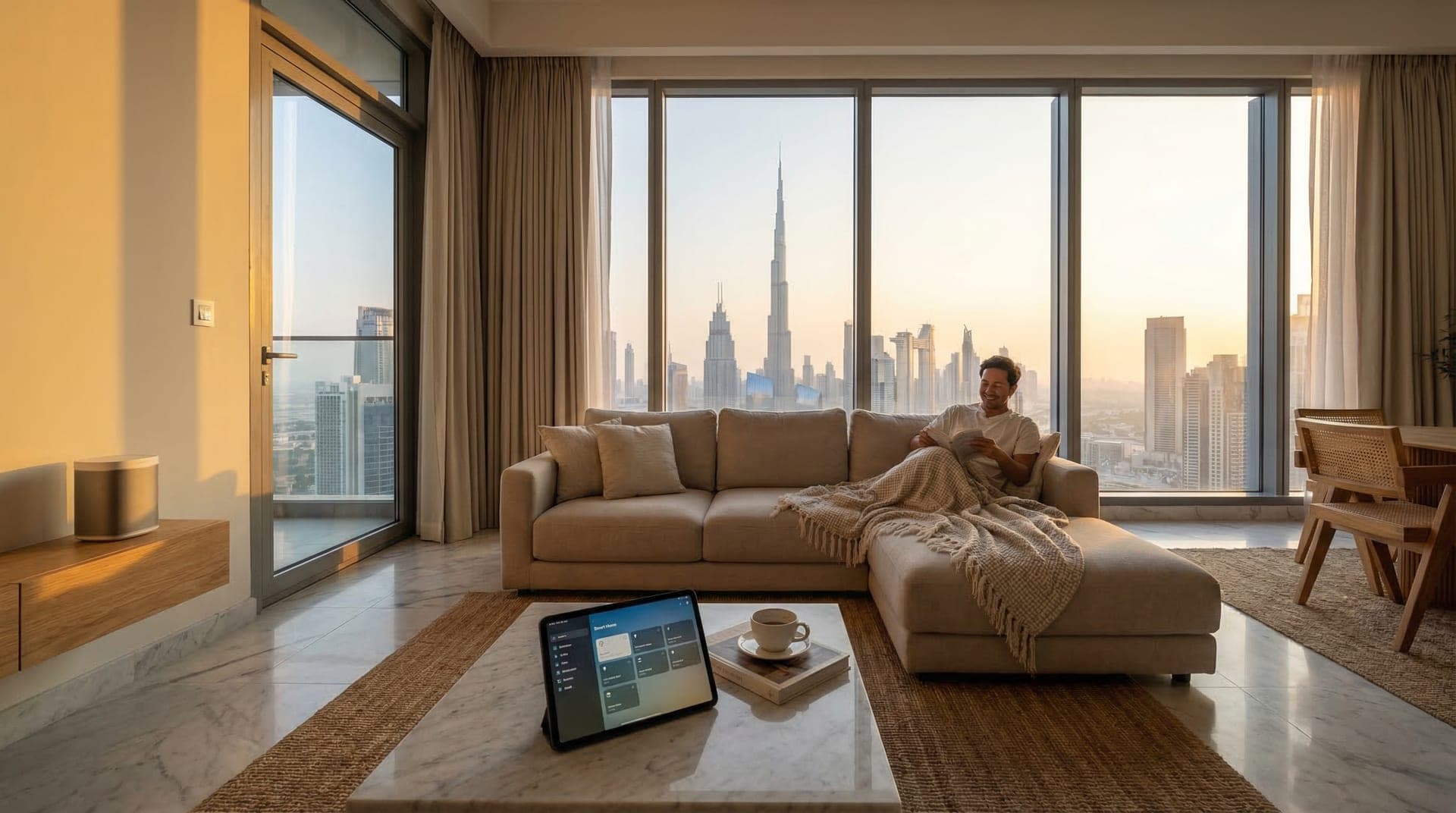
You've thought about making your home smarter. You've probably even browsed a few products on Amazon or asked a friend who has smart lights. But something stopped you. Maybe it was the price tag you imagined. Maybe someone told you hackers could watch you through your cameras. Or maybe it sounded like a weekend project that would turn into a month-long headache.
We hear these concerns from Dubai residents every week. And almost every time, the worry is based on something that was true five years ago but isn't anymore.
TL;DR: Most smart home fears are outdated. Starter setups begin at AED 3,000 installed, renter-friendly options need zero wiring, modern encryption makes hacking extremely unlikely, and you don't need to be technical. The UAE smart home market is growing at 10.75% per year because the tech actually works now.
Here are the seven myths we hear most often, and what's true in 2026.
Myth 1: Isn't Smart Home Technology Really Expensive?
A full smart home setup costs AED 3,000 to get started, not the AED 50,000+ number most people have in their heads. That entry price gets you smart AC control, professional installation, configuration, and app setup.
This myth sticks around because early smart home systems were genuinely expensive. A decade ago, you needed proprietary hardware, custom programming, and a dedicated installer for days. That's changed. Smart plugs cost AED 40-90 each. A smart light bulb runs AED 50-80. A complete starter kit with a voice assistant, smart plugs, and bulbs sits around AED 550-900 (Tom's Guide, 2025).
The global smart home market hit $80 billion in 2022 and is projected to reach $338 billion by 2030 (Statista, 2025). That growth brought competition, and competition brought prices down.
In our experience, most Dubai apartments need AED 3,000-8,000 for the systems that make a real difference: smart AC control, automated lighting, or keyless entry. You start with one system and expand when you're ready.
Myth 2: Do I Need to Be Tech-Savvy to Use It?
No. If you can use Careem and Deliveroo, you can use a smart home. Modern smart home apps are designed for the same audience that uses food delivery and ride-hailing apps. Voice commands through Alexa, Google Home, or Siri handle most daily interactions without opening an app at all.
The "tech-savvy" myth comes from early DIY setups that required programming skills, soldering, and hours of configuration. Those options still exist for enthusiasts, but they're not what most people use anymore.
When we set up a home, we handle the configuration, test everything, and train every person in the household. We've even walked housekeepers through the system so they can adjust lights and AC while cleaning. The handover isn't done until everyone is comfortable.
Clients ask whether they'll need to "maintain" the system. Most of it updates itself: phone apps and hubs generally handle their own updates. Some devices wait for you to press a button in the app, and an update can also move a control or withdraw a feature you used, which is why the morning after a big app update is worth two minutes. It's closer to using a smartphone than building a computer.
Myth 3: Can Renters Even Install Smart Home Tech?
Yes, and your landlord doesn't need to know about it. Most smart home devices in 2026 are wireless, battery-powered, or plug-and-play. They leave zero marks on walls and take five minutes to remove when you move out.
This matters in Dubai, where roughly 80% of residents rent. If smart home tech required drilling holes and rewiring, most of the city would be locked out. Manufacturers figured this out years ago.
Smart AC controllers attach with adhesive and communicate with your AC via infrared - the same technology as your existing remote. Smart locks for apartments fit over your existing deadbolt without replacing it. Smart bulbs screw into standard sockets. Smart plugs go between the wall outlet and your appliance.
According to the National Apartment Association, 84% of residents without smart home tech are willing to pay an additional $35 in rent per month for smart features (NAA, 2024). Landlords are catching on. Some Dubai buildings now advertise smart home features as selling points.
We've set up dozens of renter-friendly systems across Dubai Marina, Business Bay, and JBR. Every device we install in a rental can be uninstalled and moved to your next apartment.
Myth 4: Won't Hackers Break Into My Smart Home?
Your smart home is about as hackable as your online banking - which is to say, it's protected by the same type of encryption. Modern smart home devices use AES-128 or AES-256 encryption, the same standard used by banks and government agencies.
The scary headlines about hacked baby monitors and compromised cameras almost always involve cheap, unbranded devices bought from random sellers, with default passwords that were never changed. Devices from established brands like Google, Apple, Ring, and Yale use encrypted connections and require two-factor authentication.
Yes, IoT attacks are increasing - an average of 29 daily attack attempts per connected home in 2025 (Netgear, 2025). But these attempts target poorly secured networks and outdated firmware, not properly configured homes with strong passwords and updated devices.
What we've found is that three steps eliminate almost all risk: use a separate WiFi network for smart devices, enable two-factor authentication, and keep firmware updated. We configure all three during installation. Your home WiFi setup matters more than any individual device.
Myth 5: Does Everything Stop Working When the Internet Goes Down?
Most smart home devices continue working locally during an internet outage. This is one of the most persistent myths, and it was partially true in the early cloud-dependent days. The industry has moved hard toward local processing.
Schedules and automations you've already set keep running. Your smart light switch still works as a physical switch. Your smart lock still accepts your code or fingerprint. Your AC controller maintains its last setting.
What you lose during an outage is remote control from outside your home and voice commands through cloud-based assistants like Alexa. But the devices themselves don't stop functioning.
The Matter standard, now at version 1.4 with over 750 compatible products (CSA-IoT, 2025), was specifically designed for local-first operation. Devices communicate directly with each other over your local network. When we install systems, we build automations that run locally whenever possible, so an internet hiccup doesn't turn your home back into a "dumb" one.
Myth 6: Isn't It a Hassle to Set Up and Maintain?
Professional installation takes one to two days for most apartments. Setup includes all configuration, automation programming, voice assistant integration, and a hands-on training session for everyone in the household.
The "hassle" myth comes from DIY horror stories - people who spent weekends wrestling with incompatible devices, firmware updates, and community forums. That experience is real if you go the fully self-installed route with mixed brands and no plan.
Professional smart home setup is closer to hiring an interior designer than assembling IKEA furniture. You tell us what bothers you about your home. We come back with a plan, specific products, and a complete price. Then we install, configure, and test everything. The delivery process includes a handover session where we walk through every feature.
After setup, maintenance is minimal. When we installed systems in a Downtown Dubai apartment last year, the client called us once in six months - to add more devices to the system, not to fix anything. Modern smart home platforms handle updates automatically and alert you if a device needs attention.
Myth 7: Do Smart Homes Actually Save Money, or Is That Marketing?
Smart AC control alone can cut cooling costs by 20-30%, which translates to AED 200-400 per month during Dubai's summer (PropertyFinder, 2025). Over a year, that's AED 1,500-3,000 back in your pocket.
The savings come from eliminating waste, not from sacrificing comfort. Your AC runs at 24 degrees all day even when nobody is home. Your lights stay on in rooms you left an hour ago. Your water heater runs at full power at 3am for no reason.
Smart thermostats learn your schedule and pre-cool your apartment before you arrive, then dial back when you leave. Motion-triggered lighting turns off automatically. Smart plugs cut phantom power to devices on standby. These aren't theoretical savings. DEWA's own guidelines recommend programmable thermostats as a top energy reduction strategy (DEWA, 2025).
The UAE smart home market reached $654 million in 2024 and is projected to hit $1.64 billion by 2033, growing at 10.75% annually (Research and Markets, 2025). That growth is driven by people seeing real returns on their investment, not by marketing.
In our experience, most clients recover the cost of a smart AC system within 12-18 months through DEWA bill reductions alone. Everything after that is pure savings.
Frequently Asked Questions
What is the cheapest way to start with smart home in Dubai?
A smart AC controller is the highest-impact starting point for Dubai residents, beginning at AED 3,000 professionally installed. It solves the most universal pain point (coming home to a hot apartment) and pays for itself through DEWA bill savings within 12-18 months. You can expand to lighting and security later.
Can I take my smart home devices when I move apartments?
Yes. Wireless smart home devices are designed to be portable. Smart AC controllers, smart plugs, smart bulbs, and wireless cameras can all be removed in minutes and reinstalled at your new place. We help clients relocate their systems when they move within Dubai.
Do smart home devices work with all AC brands in Dubai?
Smart AC controllers work with any split AC unit that has an infrared remote, regardless of brand. This covers the vast majority of residential AC systems in Dubai apartments and villas, including brands like Daikin, Gree, Midea, LG, and Samsung.
Is my smart home data private and secure?
Reputable smart home brands encrypt all data in transit and at rest using bank-grade encryption. Your data stays between your devices and your account. We recommend enabling two-factor authentication and using a dedicated WiFi network for smart devices as standard security practice.
How long does smart home installation take in Dubai?
A single-system installation like smart AC control takes one to two days. Multi-room setups with lighting, security, and climate control take three to seven days. Whole-home automation for villas ranges from one to three weeks depending on scope.
Ready to separate fact from fiction for your specific home? Get a free consultation and we'll tell you exactly what's possible for your apartment or villa, what it costs, and how long it takes. No surprises.
Ready to Get Started?
Get a free consultation and we'll recommend what makes sense for your situation.
Get Free Consultation